Japanese built AI tool predicts the structure of the Universe

The origin of how the Universe created its voids and filaments can now be studied within seconds after researchers developed an artificial intelligence tool called Dark Emulator.

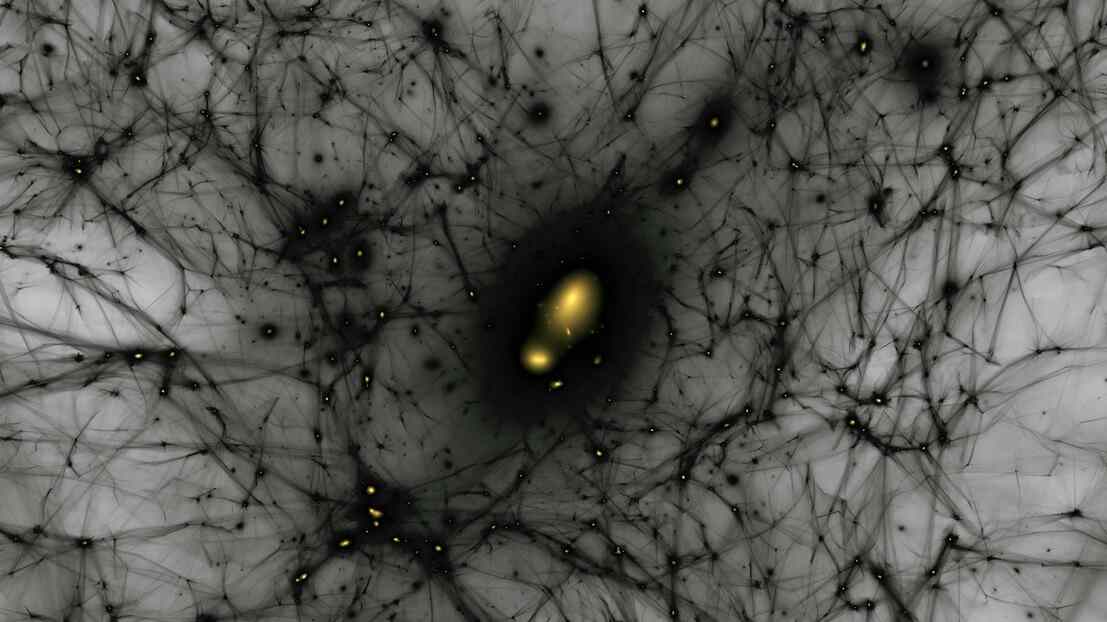
Advancements in telescopes have enabled researchers to study the Universe with greater detail and to establish a standard cosmological model that explains various observational facts simultaneously. But there are many things researchers still do not understand. Remarkably, the majority of the Universe is made up of dark matter and dark energy, of which no one has been able to identify its nature. A promising avenue to solve these mysteries is the structure of the Universe. Today’s Universe is made up of filaments where galaxies cluster together and look like threads from far away, and voids where there appears to be nothing (image 1). The discovery of the cosmic microwave background has given researchers a snapshot of what the Universe looked like close to its beginning, and understanding how its structure evolved to what it is today would reveal valuable characteristics about what dark matter and dark energy is. Image 1: The way in which galaxies cluster together in the Universe is made clear in this image of the Universe as observed by the Sloan Digital Sky Survey (SDSS). The yellow dots represent the position of individual galaxies, while the orange loop shows the area of the Universe spanning 1 billion light-years. At the center is Earth, and around it is a three-dimensional map of where different galaxies are. The image reveals how galaxies are not uniformly spread out throughout the Universe, and how they cluster together to create areas called filaments, or are completely absent in areas called voids. (Credit: Tsunehiko Kato, ARC and SDSS, NAOJ Four-Dimensional Digital Universe Project)

A team of researchers, including Kyoto University Yukawa Institute for Theoretical Physics Project Associate Professor Takahiro Nishimichi, and Kavli Institute for the Physics and Mathematics of the Universe (Kavli IPMU) Principal Investigator Masahiro Takada, used the world’s fastest astrophysical simulation supercomputers ATERUI and ATERUI II to develop the Dark Emulator. Using the emulator on data recorded by several of the world’s largest observational surveys allows researchers to study possibilities concerning the origin of cosmic structures, and how dark matter distribution could have changed over time.

“We built an extraordinarily large database using a supercomputer, which took us three years to finish, but now we can recreate it on a laptop in a matter of seconds. I feel like there is great potential in data science. Using this result, I hope we can work our way towards uncovering the greatest mystery of modern physics, which is to uncover what dark energy is. I also think this method we’ve developed will be useful in other fields such as natural sciences or social sciences,” says lead author Nishimichi. Image 2: The conceptual design of Dark Emulator. Left: an example of the virtual Universe created by “ATERUI II” supercomputer. It shows the distribution of about 10 billion particles in a volume encompassing about 4.9 billion light years evolved until today. It takes about 2 days using 800 CPU cores in “ATERUI II”. Center: The architecture of Dark Emulator. It learns the correspondence between the fundamental cosmological parameters employed at the beginning of a simulation and its outcome based on a machine-learning architecture with hybrid implementation of multiple statistical methods. After training, the machine now immediately predicts accurately the expected observational signals for a new set of cosmological parameters without running a new simulation. This allows us to drastically reduce the computational cost needed for the extraction of cosmological parameters from observational data. (Credit: YITP, NAOJ){module INSIDE STORY}

This tool uses an aspect of artificial intelligence called machine learning. By changing several important characteristics of the Universe, such as those of dark matter and dark energy, ATERUI and ATERUI II have created hundreds of virtual Universes. Dark Emulator learns from the data, and guesses outcomes for new sets of characteristics without having to create entirely new simulations every time. When testing the resulting tool with real-life surveys, it was able to successfully predict weak gravitational lensing effects in the Hyper Suprime-Cam survey, along with the three-dimensional galaxy distribution patterns recorded in the Sloan Digital Sky Survey to within 2 to 3 percent accuracy, in a matter of seconds. In comparison, running simulations individually through a supercomputer without the AI would take several days.

The researchers hope to apply their tool using data from upcoming surveys in the 2020s, enabling deeper studies of the origin of the Universe.

Details of their study were published in the Astrophysical Journal on 8 October 2019.

Japanese researchers use supercomputing to show that liquid water takes two distinct structures

Researchers at The University of Tokyo have used computational methods and analysis of recent experimental data to demonstrate that water molecules take two distinct structures in the liquid state. The team investigated the scattering of X-ray photons through water samples and showed a bimodal distribution hidden under the first diffraction peak that resulted from tetrahedral and non-tetrahedral arrangements of water molecules. This work may have important implications throughout science, but especially with regard to living systems, like proteins and cell structures, which are strongly affected by their surrounding water molecules.

Given the ubiquity of water on our planet and the central role it plays in all known life, it may be hard to believe that there is anything left to learn about this most familiar fluid. A simple molecule made up of just two hydrogen atoms and one oxygen; water still hides fundamental mysteries that remain to be unraveled. For example, water has unusually high melting and boiling points, and even expands when it freezes (unlike most liquids, which contract). These and other unusual properties make it very different from almost all other liquids but also allow life as we know it to exist. Water, water everywhere{module INSIDE STORY}

The weirdness of water can be best understood by thinking about the very unique interactions between H2O molecules--the hydrogen bond. Water tends to form four hydrogen bonds with its four neighbors, which leads to tetrahedral arrangements of the neighbors. Such arrangements can be largely distorted under thermal fluctuations. However, whether the distortion leads to the coexistence of distinct tetrahedral and non-tetrahedral arrangements has remained controversial.

Now, scientists at The University of Tokyo have combined supercomputer simulations and the analysis of scattering experimental data to find the "structure factor" of water - the mathematical function that represents the paths of dispersed X-rays when they scatter off the hydrogen and oxygen atoms. The analysis showed two overlapping peaks hiding in the first diffraction peak of the structure factor. One of these peaks corresponded to the distance between oxygen atoms as in ordinary liquids, while the other indicated a longer distance, as in a tetrahedral arrangement. "The combination of new computational methods and analysis of recent X-ray scattering data allowed us to see what was not visible in previous work," first author of the study Rui Shi explains.

This discovery may have huge implications across many scientific fields. Knowing the exact structural ordering of water is critical for a complete understanding of molecular biology, chemistry, and even many industrial applications. "It is very satisfying to be able to unravel the liquid structure of such a fundamental substance," senior author Hajime Tanaka says.

McMaster, Harvard researchers create 'intelligent' interaction between light, material; establishing a promising new platform for supercomputing

A collaboration between McMaster and Harvard researchers has generated a new platform in which light beams communicate with one another through solid matter, establishing the foundation to explore a new form of supercomputing.

Kalaichelvi Saravanamuttu, an associate professor of Chemistry and Chemical Biology at McMaster, explains that the technology brings together a form of hyrdrogel developed by the Harvard team with light manipulation and measurement techniques performed in her lab, which specializes in the chemistry of materials that respond to light.

The translucent material, which resembles raspberry Jell-O in appearance, incorporates light-responsive molecules whose structure changes in the presence of light, giving the gel special properties both to contain light beams and to transmit information between them. A collaboration between McMaster and Harvard researchers has generated a new platform in which light beams communicate with one another through solid matter, establishing the foundation to explore a new form of supercomputing.{module INSIDE STORY}

Typically, beams of light broaden as they travel, but the gel is able to contain filaments of laser light along their pathway through the material, as though the light were being channeled through a pipe.

When multiple laser beams, each about half the diameter of a human hair, are shone through the same material, the researchers have established that they affect one another's intensity, even without their optical fields overlapping at all - a fact that proves the gel is "intelligent."

The interaction between those filaments of light can be stopped, started, managed and read, producing a predictable, high-speed output: a form of information that could be developed into a circuit-free form of computing, Saravanamuttu explains.

"Though they are separated, the beams still see each other and change as a result," she says. "We can imagine, in the long term, designing computing operations using this intelligent responsiveness."

While the broader concept of computing with light is a separate and developing field unto itself, this new technology introduces a promising platform, says Derek Morim, a graduate student in Saravanamuttu's lab who is co-first author on the paper. Their work is described in a paper published today in the Proceedings of the National Academy of Sciences.

"Not only can we design photoresponsive materials that reversibly switch their optical, chemical and physical properties in the presence of light, but we can use those changes to create channels of light, or self-trapped beams, that can guide and manipulate light," he says. "Further study may allow us to design even more complex materials to manipulate both light and material in specific ways."

Amos Meeks, a graduate student at Harvard's John A. Paulson School of Engineering and Applied Sciences, said the technology helps to advance the idea of all-optical supercomputing, or computations done solely with beams of light.

"Most computation right now uses hard materials such as metal wires, semiconductors, and photodiodes, to couple electronics to light," said Meeks, who is also co-first author of the research. "The idea behind all-optical computing is to remove those rigid components and control light with light. Imagine, for example, an entirely soft, circuitry-free robot driven by light from the sun."