

Hotspot mapping accelerates early-phase drug design

Cambridge Crystallographic Data Centre (CCDC), Exscientia, and Oxford University collaborate on an automated, quantitative method for informing the design of compound selectivity across protein families

The amount of structural data on protein drug targets continues to grow. However, successfully mining this data to form testable hypotheses that drive drug discovery can prove challenging. Selectivity for the target protein is a crucial property in the development of new therapeutics. In a recent paper in the Journal of Chemical Information and Modeling, authors from the CCDC, Exscientia, and Oxford University show how an automated process leveraging “ensemble hotspot maps” can identify key structural differences that contribute to the selectivity of a compound for one protein over another. Hotspot maps use empirical data to assess protein binding sites to understand the druggability of the pocket, prioritize drug design, and spot differences in similar proteins that might drive compound selectivity.
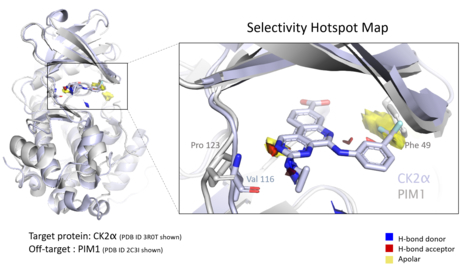
The power of hotspot mapping to advance drug design

Hotspot mapping quantifies the propensity for compounds to exploit interactions in a preferred binding site—providing a 3D grid of data to help score and prioritize compounds. The power of this method lies in how it finds key interactions during early-phase drug discovery and then distills the information into easily interpretable results. Chris Radoux is Head of Structural Bioinformatics at Exscientia and a co-author on the paper.

“Adding hotspot maps early in a drug discovery project can provide a molecular blueprint using the protein structure alone,” says Radoux. “This can be used to help determine how druggable a given pocket of a target protein is and to prioritize fragment starting points for compound design. The highest scoring interactions can then be used to guide computational methods and algorithms.”

Hotspot maps drive cohesive drug design

This approach automates analysis across a protein family, as proteins in the same family often have similar binding sites. According to Mihaela D Smilova, co-author and postgraduate researcher at the Centre for Medicines Discovery at Oxford University, selectivity profiles in both the complete proteome—and within the target protein family—must be understood to develop safe and effective drugs. Interactions with unrelated target proteins can lead to unwanted side effects and toxicity, she says. However, effective drugs often exploit the benefits of “polypharmacology.”

“Introducing polypharmacology, or the ability to modulate multiple targets, may help to prevent the development of resistant disease phenotypes,” says Smilova. “Consequently, a successful drug candidate has a finely tuned selectivity profile within its target family—interacting with targets that positively impact the disease phenotype and avoiding interactions that lead to unwanted side effects.”

Using hotspot maps as inputs for computational workflows means researchers can rapidly explore the chemical space.

“This saves time by summarizing the information and presenting it in a way that is both interpretable by medicinal chemists and can be used in further computational analyses,” says Smilova.

Leveraging real-world, empirical data for reliability

The script used to generate the hotspot maps is a Python package called, “Hotspots API,” which leverages the data in the Cambridge Structural Database (CSD) via CCDC’s IsoStar library of interactions. The CSD is the world’s repository for small-molecule organic and metal-organic crystal structures—containing over 1.1 million structures from x-ray and neutron diffraction analyses. IsoStar is a web application that uses the CSD to generate thousands of interactive 3D scatterplots that show the probability of occurrence and spatial characteristics of interactions between pairs of chemical functional groups. Dr. Jason Cole is a Senior Research Fellow at CCDC.

“Using CSD data for this type of analysis provides different insights from energy-calculation-based methods, as the interactions observed in the CSD are influenced by more than their strength,” says Cole.

Impacts of the study

Exscientia is a global leader in pharma tech, which sits at the interface of advanced AI applications and complex drug discovery. They have implemented the hotspot mapping in-house within multiple drug discovery programs and use it to guide target validation and drug design. In addition, a research team at the University of Cambridge recently published in Nature how they used fragment hotspot mapping to identify structures that may assist in designing DNA-dependent protein kinase catalytic subunit inhibitors, which show potential as cancer therapeutics.

Satellite captured eruption of Hunga Tonga-Hunga Ha’apai volcano (VIDEO)

FY-4B Satellite captured the eruption of Hunga Tonga-Hunga Ha’apai volcano and monitored the diffusion of volcanic ash clouds.CREDIT National Satellite Meteorological Center of China
...

Read more

Irish-based researchers win €10 million in ‘precision medicine’ program that focuses on Motor Neuron Disease

An ambitious academic, clinical, and industry research program that will provide new insights into our understanding of Motor Neuron Disease (MND), also known as Amyotrophic Lateral Sclerosis (ALS), was launched today by Tánaiste and Irish Minister for Enterprise, Trade, and Employment, Leo Varadkar T.D. The research is supported by the Irish Government through a Science Foundation Ireland investment of €5 million which will be leveraged with an additional €5 million from industry partners.

Precision ALS, which is led by two SFI Research Centres - ADAPT and FutureNeuro - involves world-class Irish-based researchers in clinical science, data science, and artificial intelligence (AI). The researchers will work in partnership with TRICALS, an independent consortium of leading ALS experts, patients, and patient advocacy groups across Europe.

Speaking at the launch, Tánaiste and Minister for Enterprise, Trade, and Employment, Leo Varadkar T.D. said: “This project straddles clinical research and industry and will combine the best of our technologies, the best of our ideas, and the best of our medical expertise with to potential to change lives for the better. It will develop tools that facilitate clinical trials based on precision-medicine, and has the potential to produce benefits for other rare conditions and diseases, supporting job creation and reducing drug costs.”

The program, which will advance data-driven prediction models for the progression of the disease in patients and next-generation data analysis that facilitates clinical insights and treatment, will include the participation of national and international industry partners, charities, and patient organizations.

Simon Harris T.D. Minister for Further and Higher Education, Research, Innovation, and Science welcomed the announcement, saying: “The Covid-19 pandemic has taught us the value of research and the difference it can make to people’s lives. This is a perfect example of the impact research and innovation can have. By supporting and harnessing these types of advanced research projects we will ultimately see the benefits across society.”

Speaking at the launch, Professor Philip Nolan, Director General of SFI said: “The SFI Research Centres were developed to create a critical mass of excellent research in areas of national importance and to ensure this research has tangible benefits for our health, our society, and our economy through collaboration between academia, government and industry across the island of Ireland and internationally. I am delighted to welcome the launch of Precision ALS, which will deliver outstanding science in the area of personalized and precision medicine, focused on neurodegenerative disease. This collaboration will directly benefit healthcare and patient communities, and yield new knowledge, approaches, and treatments with the potential to improve the lives of many.”

Precision ALS will provide an innovative and interactive platform for all clinical research in ALS across Europe, that will then harness AI to analyze large amounts of data. As the largest international multimodal dataset aimed at precision medicine for this condition, Precision ALS will address the issues with gathering new data at scale in a timely and cost-effective manner across multiple international sites to present that data in real-time to clinical scientists.

Director of the Precision ALS research program and Professor of Neurology at Trinity College Dublin, Professor Orla Hardiman said: “Despite significant advances in pre-clinical models that help us understand the biology of disease in animals, the success of clinical trials has been disappointing. ALS is a disease that only affects humans, and there is increasing recognition of the need for a Precision Medicine approach towards drug development. We know now that ALS is heterogeneous, meaning that it has different causes and different patterns of progression. Large numbers are required to understand these differences. Using “big data” analyses, Precision ALS will provide an in-depth understanding of the factors that drive heterogeneity, and in doing so will for the first time allow us to target new and innovative treatments to specific patient subgroups.

Precision ALS is a unique program that brings together Clinicians, Computer Scientists, Information Engineers, Technologists, and Data Scientists. The researchers will work together with leading pharmaceutical, data science, clinical research, medical device organizations, and the HSE to generate a sustainable precision medicine-based approach towards new drug development that will have many benefits including better clinical outcomes for patients and reducing the economic cost of these diseases.

On completion, Precision ALS will be a first-in-kind modular transferable pan-European ICT framework for ALS that can be easily adapted to other diseases that face similar precision medicine-related challenges.