Mayo Clinic radiologists build AI to help diagnose pancreatic cancer at earlier, more treatable stage

study published in Gastroenterology finds that radiomics-based machine learning models may detect pancreatic cancer on prediagnostic CT scans substantially earlier than current methods for clinical diagnosis.

"Pancreatic cancer is a deadly disease and a leading cause of cancer-related death," says Ajit Goenka, M.D., a Mayo Clinic diagnostic radiologist, and the study's senior author.

Dr. Goenka says that while early detection enhances the chances for successful treatment, standard imaging cannot detect early pancreatic cancer.

"Up to 40% of small pancreas cancers may not show up on standard imaging. As a result, the majority of patients present with an advanced and noncurable disease," says Dr. Goenka.

For this reason, Dr. Goenka and his colleagues looked to incorporate artificial intelligence (AI) into radiological screening to detect pancreatic cancer at an earlier, more curable state. "We found that AI models can detect cancer from a normal-appearing pancreas on CTs several months prior to cancer symptoms, even when the disease was beyond the scope of perception of radiologists."

For the study, researchers computationally extracted the imaging signature of early cancer from CTs. Prediagnostic CTs are CTs that were done for unrelated indications between three months and three years prior to cancer occurrence.

Next, they used an age-matched group of control subjects who did not develop pancreatic cancer during three years of follow-up. Expert radiologists then segmented the pancreas on CTs from both groups and computationally extracted and quantified the metrics of pancreas tissue heterogeneity.

Next, researchers built advanced machine learning models that could predict the future risk of pancreatic cancer at a median time of 386 days, a range of 97 to 1,092 days, prior to clinical diagnosis with accuracies that ranged from 94% to 98%.

"In comparison, radiologists were unable to reliably differentiate between patients who went on to develop cancer versus those who had normal pancreas," says Sovan Mukherjee, Ph.D., a senior data science analyst in Dr. Goenka's team and the study’s first author. "We also tested our AI models against variations in image noise, scanner models, image acquisition protocols, and postprocessing parameters, and found them to be unaffected by these variations."

Dr. Goenka says this level of testing is necessary for the potential deployment of this technology in clinical practice. Finally, researchers validated the high specificity — 96.2% — of the AI model on an open-source CT data set to further increase the reliability of the AI methodology.

"Our study demonstrates that artificial intelligence can identify those asymptomatic people who may harbor occult cancer at a stage when surgical cure may be possible," says Dr. Goenka. "These findings may help overcome one of the key barriers to improving survival for patients with pancreatic cancer."

Dr. Goenka says a large prospective clinical trial — the Early Detection Initiative (NCT04662879) sponsored by the Pancreatic Cancer Action Network — is underway to evaluate the impact of a pancreatic cancer screening strategy using CTs in 12,500 participants. The trial is being led by Suresh Chari, M.D., an emeritus Mayo Clinic gastroenterologist. Dr. Goenka’s team is exploring the option of prospective validation of their AI models on the CTs to be done as part of the EDI trial.
Cincinnati builds model that predicts how racial makeup of neighborhoods will change

The machine learning algorithm proves 86% accurate in one test

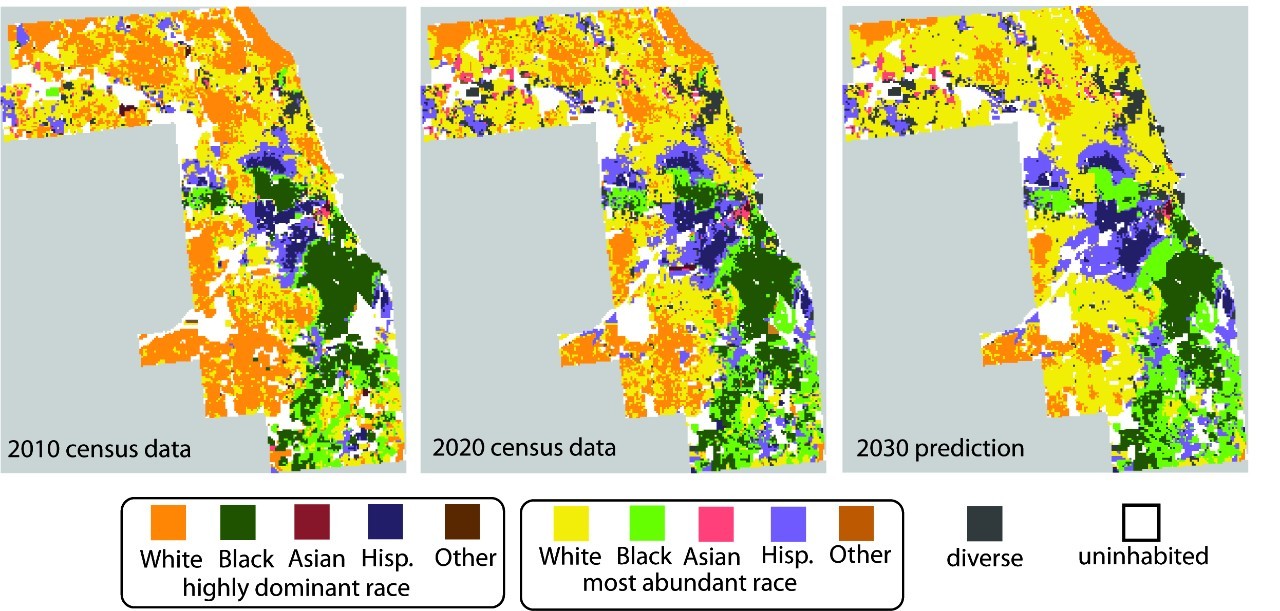
A map created by researchers at the University of Cincinnati can predict with surprising accuracy how the racial makeup of neighborhoods will change. A predictive map of Cook County in 2030, far right, shows how the racial composition of neighborhoods will change compared to maps using U.S. Census data from 2010 and 2020.  CREDIT Tomasz Stepinski/UC

UC College of Arts and Sciences geography professor Tomasz Stepinski created a machine-learning algorithm to predict in fine detail how neighborhoods will become more or less segregated in the next 10 years.

Stepinski, who works in UC’s Space Research Institute for Discovery and Exploration, analyzed data collected by the U.S. Census Bureau every decade. They mapped the data by racial composition in the high resolution of 300-meter squares called cells.

The algorithm had to be “trained” to interpret the data from two census years spaced 10 years apart. The algorithm also examined individual cells in relation to those around them.

“The name ‘machine learning’ suggests there’s something magical about it, but it’s just more powerful statistics,” Stepinski said.

Stepinski validated his algorithm by comparing its predictions to actual data from the 2010 and 2020 censuses and found it was up to 86% accurate.

“Our hypothesis that you can predict the class of a cell in 10 years based on the previous two classes and surrounding classes was correct,” he said. “It’s not perfect, but you can see it’s pretty good.”

The study was published in the journal Machine Learning with Applications.

Stepinski and co-author Anna Dmowska, an assistant professor in the Department of Geoinformation at Adam Mickiewicz University in Poland, applied their algorithm to Chicago’s Cook County, Illinois, considered one of the most racially segregated places in America.

UC’s map showed that many neighborhoods dominated by white and Black populations will become less segregated by 2030 with less noticeable changes in neighborhoods dominated by Hispanic and Asian American populations.

Stepinski said researchers in Chicago have conducted pioneering sociological research on race, ethnicity, and gentrification using Cook County as their model. The sprawling, heavily populated county also provides a good model to study the algorithm because it still has many segregated neighborhoods despite trending toward greater racial and ethnic diversity over the last 50 years, he said.

Stepinski also applied the algorithm to Houston, Texas, and Los Angeles and San Francisco in California with similar success.

“The ability to predict demographic changes is essential from a scientific point of view and for policymakers, city development, etc.,” co-author Dmowska said.

“As shown in the paper, the predictive maps are pretty accurate and show how the area might look in the next 10 years,” she said.

Stepinski said the predictive maps could be used to help schools or governments plan for more services such as Spanish-speaking classrooms or interpreters. It also could help sociologists understand the driving forces behind the changing demographics of neighborhoods.

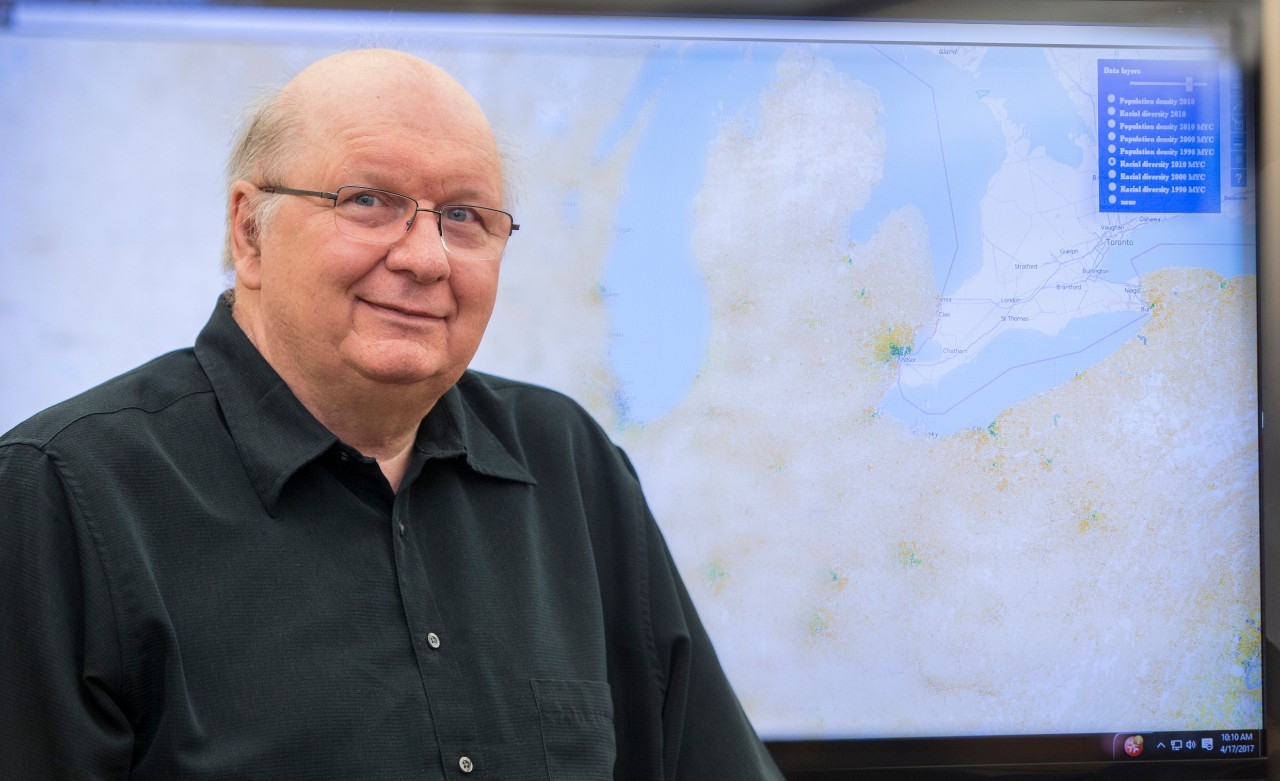
“My interest is not sociological. My specialty is computation,” Stepinski said. “I leave the why to someone else. But I can imagine what’s happening.” University of Cincinnati geography professor Tomasz Stepinski developed an algorithm that can predict with 86% accuracy how the racial composition of neighborhoods will change over the next 10 years.  CREDIT Joseph Fuqua II/UC

Stepinski said younger generations are often likely to remain in nearby neighborhoods if they remain in an area at all. And if one particular racial population declines in an area, others typically fill the void.

“It’s diffusion,” Stepinski said. “So in Cook County, you have a Hispanic population that is growing faster than the white population. They’re going to move close by. They’re not going to move far from home.”

A boost in performances in fibre-integrated quantum memories

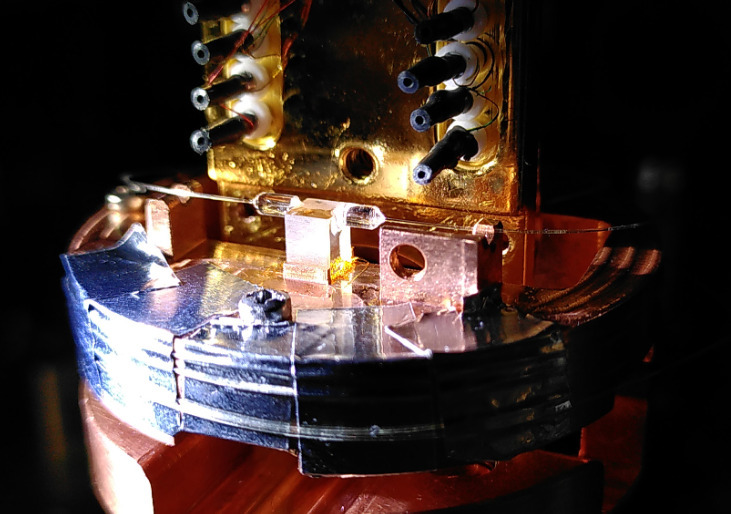
Researchers from ICFO, IFN-CNR, and Heriot-Watt University report in Science Advances the demonstration of entanglement between a fiber-integrated quantum memory and a telecommunications-wavelength photon Picture of the quantum memory attached to the optical fiber. Image credit: ICFO/ S. Grandi

Quantum memories are one of the building blocks of the future quantum internet. Without them, it would be rather impossible to transmit quantum information over long distances and expand into a real quantum network. These memories have the mission of receiving the quantum information encoded in a photon in the form of qubits, storing it, and then retrieving it. Quantum memories can be realized in different material systems, for example, ensembles of cold atoms or doped crystals. 

To be useful memories, they need to fulfill several requirements, such as the efficiency, duration, and multiplexing of their storage capability, to ensure the quality of the quantum communication that they will support. One other requirement that has become a matter of considerable research is designing quantum memories that can be directly integrated into the fiber-optic network.

In recent years and with the boom of quantum technologies, there has been a lot of work-oriented to improve the scalability of existing quantum memories (make them smaller and/or simpler devices) to facilitate their integration and deployment in a real-work network. Such a fully integrated approach comes with several physical and engineering hurdles, including finding a solution that preserves good coherence properties, providing an efficient and stable system to transfer photons from optical fibers to the quantum memory, as well as the miniaturization of the control system of the quantum memory and its interface with incoming light. All of this should be performed while reaching the same level of performance obtained in “standard” bulk versions of the device. This has so far proved to challenge, and current realizations of fiber-integrated quantum memories are far from what can be reached in bulk memories.

With these objectives clear, in a recent work published in Science Advances, ICFO researchers Jelena Rakonjac, Dario Lago-Rivera, Alessandro Seri, and Samuele Grandi, led by ICREA Prof. at ICFO Hugues de Riedmatten, in collaboration with Giacomo Corrielli and Roberto Osellame from IFN-CNR and Margherita Mazzera from Heriot-Watt University, have been able to demonstrate entanglement between a fiber-integrated quantum memory and a telecommunications-wavelength photon.

A special Quantum Memory

In their experiment, the team used a crystal doped with praseodymium as their quantum memory. A waveguide was then laser-written inside the memory. This is a micrometer-scale canal within the crystal that confines and guides the photon in a tight space. Two identical optical fibers were then attached to both sides of the crystal to provide a direct interface between photons carrying quantum information and the memory. This experimental setup enabled an all-fiber connection between the quantum memory and a source of photons.

To prove that this integrated quantum memory can store entanglement, the team used a source of entangled photon pairs where one photon is compatible with the memory, while the other one is at a telecom wavelength. With this novel setup, they were able to store photons from 2 µs up to 28 µs and preserve the entanglement of the photon pairs after storage. The result obtained is of major improvement since the entanglement storage time shown by the team is 1000 longer (three orders of magnitude) than any other previous fiber-integrated device used until now, and approaches the performances observed in bulk quantum memories. This was possible thanks to the fully integrated nature of the device, which allowed for the use of a more sophisticated control system than previous realizations. Finally, since the entanglement was shared between a visible photon stored in the quantum memory, and one at telecom wavelengths, the team also proved that the system is entirely compatible with telecommunications infrastructure and suitable for long-distance quantum communication.

The demonstration of this type of integrated quantum memory opens up many new possibilities, particularly regarding multiplexing, scalability, and further integration. As Jelena Rakonjac emphasizes, “this experiment has given us great hopes in the sense that we envision that many waveguides can be fabricated in one crystal, which would allow for many photons to be stored simultaneously in a small region and maximize the capability features of the quantum memory. Since the device is already fiber-coupled, it can also be more readily interfaced with other fiber-based components”.

Hugues de Riedmatten concludes by stating that “we are thrilled with this result which opens many possibilities for fiber integrated memories. What is clear is that this particular material and way of creating waveguides allows us to achieve performances close to bulk memories. In the future, extending the storage to spin states will allow on-demand retrieval of the stored photons and lead to the long storage times that we have been aiming for. This fiber-integrated quantum memory definitely shows great promise for future use in quantum networks”.