Climate whiplash approaches: A warning from supercomputer simulations

Recent research conducted by the Institute for Basic Science (IBS), a Korean government-funded research institute, and its collaborators has raised significant concerns regarding the behavior of the global climate system in the forthcoming decades. The study indicates that the fluctuations within the recurring cycles of the El Niño–Southern Oscillation (ENSO) may intensify in amplitude and become more regular and interconnected with other significant climate patterns. The implications of these high-resolution supercomputer simulation outcomes are noteworthy, suggesting a transition from irregular, loosely linked climate oscillations to a more synchronized and amplified system. This shift represents not merely an increase in extreme weather events but a fundamental alteration of the climate patterns to which humanity has become accustomed.

What the simulations show

The research team employed a state-of-the-art climate model (AWI‑CM3) with a horizontal resolution of approximately 31 km in the atmosphere and 4-25 km in the ocean. Under a high-greenhouse-gas scenario, the model projected that by around mid-century (2060s), the ENSO cycle will undergo an abrupt transition: The amplitude of sea-surface temperature fluctuations in the tropical eastern Pacific will increase markedly.
 
The cycles will become more regular instead of erratic, in effect, the “irregular rhythm” of El Niño/La Niña will give way to a more predictable but much stronger oscillation. Other major climate modes, such as the Indian Ocean Dipole (IOD), the North Atlantic Oscillation (NAO), and the tropical North Atlantic mode (TNA), are projected to synchronize their behavior with ENSO, a kind of "resonance" between climate subsystems.
 
In simple terms, the study suggests a potential shift towards a climate regime in which the tropical Pacific, Indian Ocean, and Atlantic oscillations all begin to ‘swing in step,’ amplifying rainfall and temperature extremes in connected regions around the world.

Why we should worry:

The shift projected by the simulations is not merely academic. The researchers highlight that this amplified and synchronized behavior could create “hydroclimate whiplash,” rapid transitions between flood and drought, intense storms followed by extended dry spells in vulnerable regions such as Southern California and the Iberian Peninsula. Such whiplash events challenge existing adaptation/confidence strategies, infrastructure planning, agriculture, and water resource management.
 
The study’s authors emphasize that while a more regular oscillation might, in principle, facilitate forecasting, the magnitude of the impacts will demand far more robust preparedness.

Key takeaway: a scientific red flag

The distinguishing characteristic of this research lies in the clarity and specificity of its supercomputer simulation outcomes. These findings represent a departure from general end-of-century projections, as the model indicates an impending shift occurring within the next few decades. The authors characterize this change as an "abrupt transition." Consequently, rather than a gradual deterioration, we may be confronted with a tipping-point scenario: transitioning from a period of moderate, irregular ENSO fluctuations to one characterized by robust, regular, synchronized oscillations and heightened impacts.
 
Immediate action is required from policymakers and infrastructure planners, given the prospect of increasingly extreme and predictable climate fluctuations. Adaptation strategies must evolve from addressing isolated extreme events to proactively anticipating a fundamentally altered climatic pattern. International collaboration is paramount, as the synchronization of these climate modes will result in global repercussions, extending beyond regional impacts. Furthermore, sustained high-resolution modeling is essential to enhance predictive accuracy, particularly concerning regional effects. The study itself acknowledges ongoing advancements in high-resolution simulations at IBS's supercomputing facility.
 
In conclusion, the simulations presented by IBS and its collaborators introduce a concerning possibility: a transformation of the Earth's climate system into a new "swing mode," characterized by accelerated, more frequent, and synchronized extreme variations across ocean basins. The window for preparedness is diminishing. Should the model's projections materialize, the world will confront not merely intensified weather events, but a fundamentally altered tempo of climate variability, representing a challenge of potentially unprecedented magnitude.
Physics frontier: Supercomputing sheds light on ultracold molecular matter

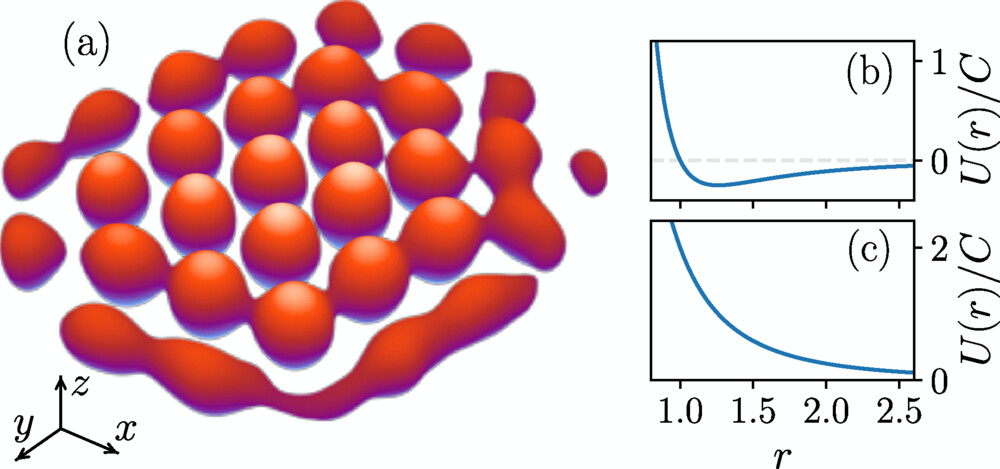
A team of theorists from TU Wien (Vienna) has shed light on one of the most intriguing phenomena in contemporary atomic physics: the spontaneous formation of self-bound superfluid membranes and monolayer crystals composed of ultracold polar molecules. Their findings, recently published in Physical Review Letters ("Self-Bound Superfluid Membranes and Monolayer Crystals of Ultracold Polar Molecules") by Matteo Ciardi, Kasper Rønning Pedersen, Tim Langen, and Thomas Pohl, present exciting prospects for quantum matter research and the advancement of computational simulations.

🧊 From 3D Quantum Gas to 2D Superfluid Membrane

Within this seminal investigation, the research team employed path-integral quantum Monte Carlo simulations, a high-fidelity computational approach adept at capturing quantum fluctuations and correlations, to delineate the complete phase diagram of ultracold dipolar molecules, encompassing a spectrum from weak to strong interactions and ranging from small to mesoscopic particle numbers. The findings are remarkable: under specific conditions, a three-dimensional cloud of interacting dipolar molecules can coalesce into a self-bound droplet, capable of maintaining its structure without external constraints. As the strength of these interactions increases, this droplet transforms into a two-dimensional sheet, forming a superfluid membrane of a single molecular layer. Further intensification of these interactions causes the system to "freeze," resulting in a self-bound crystalline monolayer, a crystalline sheet of molecules suspended in free space.

🚀 Supercomputing + Path Integral Monte Carlo: The Machine of Discovery

To obtain these findings, the research team made extensive use of supercomputing resources and the path-integral Monte Carlo (PIMC) method. PIMC is particularly well-suited for systems where quantum effects are dominant, such as superfluidity, strong correlations, and quantum phase transitions. By representing quantum particles as "paths" in imaginary time and sampling configurations of these paths, PIMC provides access to quantum many-body behavior that goes beyond simpler approximations. The complexity of modeling numerous interacting polar molecules, with anisotropic dipole-dipole interactions and quantum fluctuations, is substantial. The supercomputers employed in this research enabled the team to vary particle number, interaction strength, and geometry, allowing for an in-depth exploration of the emergence of self-bound states and transitions. The outcome is a comprehensive phase diagram that predicts novel forms of matter, which could potentially be experimentally verified in the near future.

🌌 Why It Matters: Quantum Matter, Quantum Engineering

This research represents more than just a computational achievement; it serves as a source of inspiration for future advancements in quantum science. Specifically, the capability to predict the existence of self-bound superfluid membranes and monolayer crystals composed of ultracold polar molecules opens avenues for: New platforms for investigating superfluidity within low-dimensional, strongly correlated systems; Opportunities for the development of engineered quantum materials, including molecular sheets, quantum simulations of crystals, and potentially novel devices; and Experimental targets, as the authors highlight that the predicted transitions occur at interaction strengths that do not lead to two-body bound states, thus allowing for observation in ongoing experiments without limitations from three-body recombination.
 
In summary, we are witnessing the emergence of novel quantum phases, facilitated by simulation and enabled by advanced computational resources.

🎯 The Takeaway

The research conducted by Ciardi, Pedersen, Langen, and Pohl represents a significant advancement in theoretical quantum physics. Employing path-integral Monte Carlo simulations and large-scale computational resources, they have explored previously uncharted areas, ranging from gaseous dipolar ensembles to self-bound droplets, ultrathin superfluid membranes, and crystalline monolayers. Their findings offer valuable guidance for experimental investigations and suggest that the realm of quantum materials may be more complex and accessible than previously understood. As computational capabilities and quantum technologies continue to evolve, it is evident that the convergence of simulation, theory, and experimentation propels the advancement of scientific understanding. This study serves as compelling evidence that the future of quantum matter is being shaped through computational modeling, advanced hardware, and experimental exploration.

Harnessing the fury of plasma turbulence: Supercomputer simulations illuminate fusion’s next frontier

In a significant advance for fusion energy research, Japanese scientists are using supercomputer simulations to investigate turbulence in high-temperature plasma, a complex phenomenon. A new study reveals how turbulence at different scales interacts, transforms, and bifurcates in magnetized plasmas, mirroring conditions within next-generation fusion devices.

Unveiling the Invisible Dance

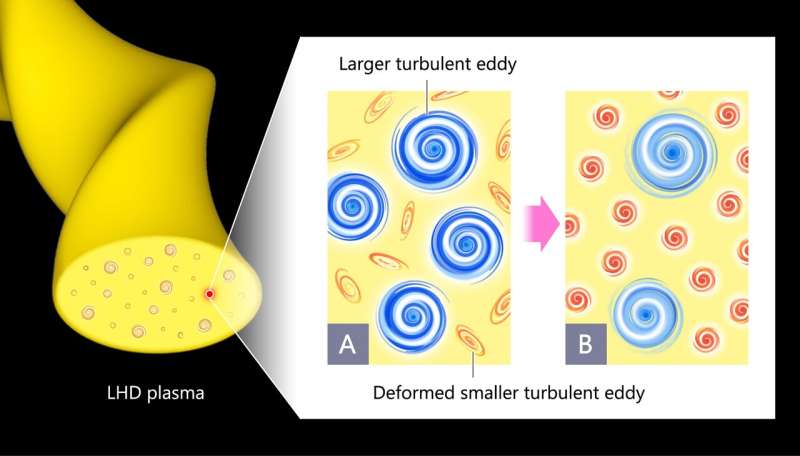
Plasma is the fourth state of matter, permeates the universe, from the heart of stars to the confined cores of fusion experiments. Within magnetically-confined plasma, turbulence reigns: swirls of charged particles and eddies of electric and magnetic fields operate on scales ranging from centimeters (ion gyroradius) down to millimeters or less (electron gyroradius). This new research shows that these disparate scales are not isolated but locked in a dynamic interplay. The team experimentally observed, and simulations backed this up, a bifurcation in the turbulence regime: as the ion-scale (“micro-scale”) turbulence was suppressed, the “hyper-fine” (HF) scale turbulence at the scale of the electron gyroradius abruptly rose. Simultaneously, the patterns of turbulence shifted from being highly anisotropic (stretched in particular directions) to much more isotropic.
 
This is not just a curiosity; understanding and controlling turbulence is vital to improving plasma confinement, which in turn is key to realizing fusion as a viable energy source.
 

Simulations at the Heart: Supercomputers Make the Invisible Visible

 
While experiments provide direct insight, the real revelation comes from the power of supercomputer simulations to model multi-scale turbulence. Previous work (e.g., Maeyama et al., 2022) used the Japanese flagship supercomputer “Fugaku” to span ion- and electron-scale turbulence in fusion-relevant conditions. These simulations solved the gyrokinetic equations across vastly different length and time scales, a monumental computational challenge. By resolving both the large swirling eddies (ion scale) and the fine ripples (electron scale), they uncovered how small-scale turbulence can suppress large-scale fluctuations, and vice versa, shaping the overall transport of heat and particles in the plasma. In the current work, though primarily experimental, the authors situate their results within the context of these simulation-based predictions: that cross-scale interactions matter and may trigger abrupt transitions (bifurcations) in turbulence behavior. The inspiring takeaway: by harnessing supercomputers, researchers are no longer passively observing turbulence, they are actively modeling, predicting, and beginning to control it.

Why It Matters: Towards Better Plasma Confinement

Turbulence in fusion plasmas acts like an “energy leak” mixing hot and cold zones, allowing heat to escape, and undermining confinement. Taming or steering this turbulence results in a hotter, denser plasma, which enables fusion reactions.
 
The discovery of a bifurcation between scales suggests new strategies: Suppressing one scale while triggering another to dominate, or vice versa, could steer the turbulence towards a more favorable regime. This path leads to improved confinement, reduced energy losses, and more efficient fusion performance.
 
Supercomputer simulations provide a blueprint, demonstrating how small-scale electron gyroradius turbulence influences larger ion gyroradius turbulence, thereby altering energy transport. Armed with this blueprint, experimentalists can test and refine control strategies.
 

Looking Ahead: The Future of Turbulence Modeling

 
This promising work sets the stage for the next generation of research:
  • Expanding simulations: Develop more high-fidelity simulations to capture wider scale separations and complex magnetic geometries.
  • Coupling simulation and experiment: Use simulation predictions to guide experiments in real time and refine simulation models with experimental data.
  • Active turbulence control: With a better understanding of the mechanisms, future devices could incorporate active control of turbulence scales, using magnetic fields, heating profiles, or other methods to steer the plasma into optimal regimes.
In short: Supercomputer-powered simulations are transforming turbulence from an unruly foe into a potential ally.
 

A New Chapter in Fusion Science

 
This research marks a turning point. Turbulence, once chaotic and inscrutable, is now understood as multi-scale, coupled, and bifurcating. The supercomputer is our microscope and our compass. As one author states, studying cross-scale nonlinear interactions “is essential … to understand the physics of high-temperature nuclear fusion plasmas.”
 
Imagine the roar of swirling plasma inside a confinement device, the invisible eddies twisting and untwisting. Now, imagine scientists using petaflops machines to model, predict, and tame that roar. That is fusion’s future, turbulence, no longer a barrier, but a path forward.
 
In summary: By combining cutting-edge experiments and supercomputer simulations, plasma physicists are making strides in mastering turbulence within fusion devices. The new study by Tokuzawa et al. underscores how multi-scale interactions and abrupt transitions shape turbulence behavior, offering potential to harness this knowledge for a cleaner, limitless energy future.