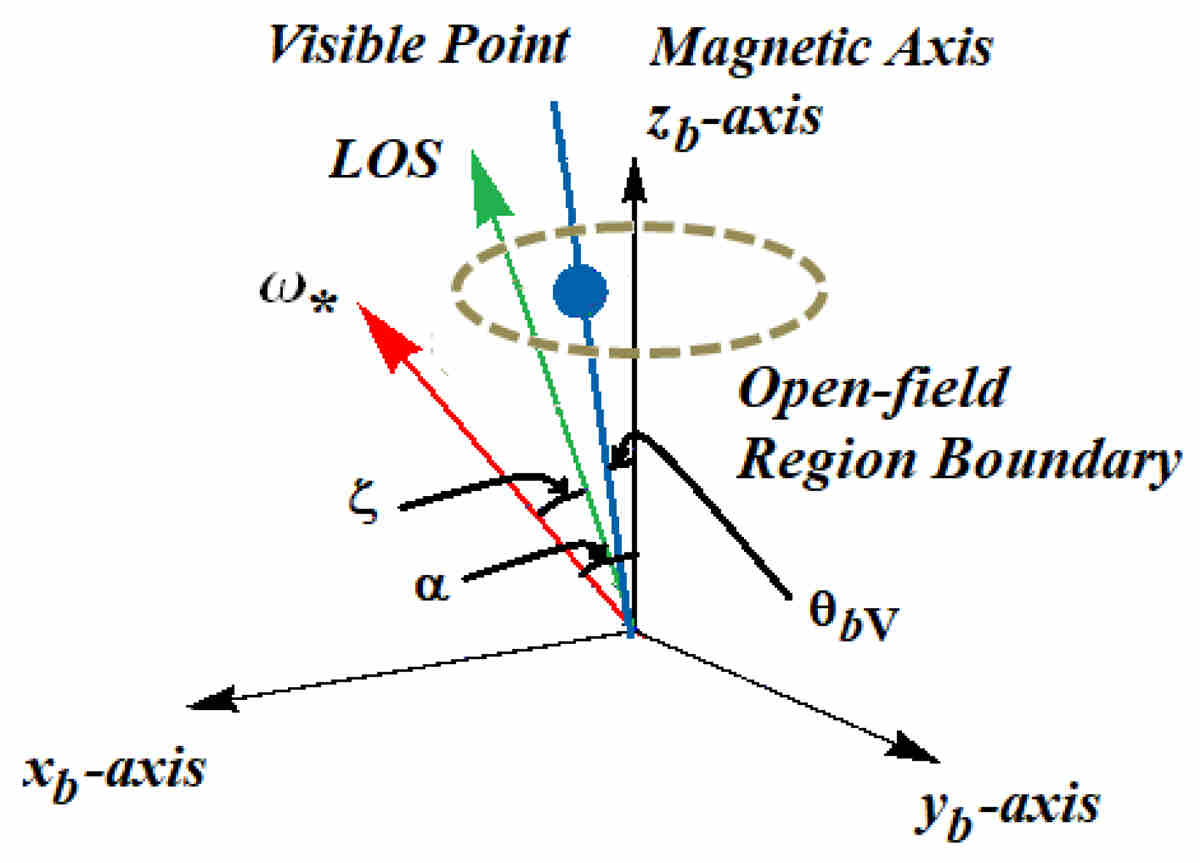
Illustration of the pulsar viewing geometry in Cartesian coordinates using the angles of ζ = 25° and α = 35° in the magnetic frame. The magnetic axis is aligned with the zb-axis, and the line-of-sight (LOS) and the rotation axis are indicated by the green and red arrows, respectively. Also drawn is the boundary of an open-field region (dotted gray), centered at the magnetic pole. The orientation is chosen so that the magnetic axis, the rotation axis and the line-of-sight all lie in the xb − zb plane at ψ = 0°. At this phase, the visible point is located at {θbV,  ϕbV}={6.7° , 0° }, as indicated by the blue dot.

Chinese researchers build high-stakes simulations or high-risk overreach?

Chinese Academy of Sciences (CAS) researchers stirred headlines and skepticism with a press release touting cutting-edge supercomputer simulations modeling cosmic gas dynamics around massive star clusters. A peer‑reviewed study in Astronomy & Astrophysics (May 2025) uses a computational approach to dissect the turbulence and fragmentation in stellar nurseries. But do these simulations chart a path toward understanding star formation, or inflate what we can compute into what we meaningfully know?

Inside the CAS announcement

  • The claim: Using an unnamed Chinese supercomputer and magnetohydrodynamic (MHD) models, the team simulated turbulence-driven cloud collapse and feedback processes, such as stellar winds and radiation pressure, to reproduce observed gas structures in star-forming regions.
  • The red flags: The press release is heavy on evocative imagery (“continuously braided gas filaments,” “shocks carving cavities”), and light on hard data. It mentions “detailed” simulation but offers no benchmarks comparing the output to real telescope measurements or alternative models. Hardware specifics? GPU count? Node types? Missing.

The A&A article delivers a quantitative deep dive. The researchers ran high-resolution, 3D turbulent-cloud MHD simulations across parameterized density regimes, assessing fragmentation scales and mass distribution. They compare their simulated filament widths and fragmentation spacing to actual observations, showing modest agreement within a factor of two.

Yet even this rigorous approach confronts limitations: simplified chemistry (no full CO cooling network), neglect of cosmic rays, and spatial resolution that skirts the threshold of critical fragmentation scales. The paper cautions that adding self-consistent radiative transfer or small-scale turbulence triggers could significantly alter results, in which case, their conclusions remain provisional.

The CAS press release blurs supercomputational muscle with scientific breakthroughs. But raw FLOPS aren’t scientific rigor. Without transparent code, parameters, or error bars, the claims read more like marketing copy than methodical discovery.

Could it be simply that flashy visualizations substitute for astrophysical insight? A Nature-oriented source notes that even U.S. exascale efforts (e.g., HACC on Frontier rely on simplified “kitchen-sink” physics and still require careful calibration and often fall short of real-world fidelity space. If even DOE-backed teams struggle to link simulation to observation, one wonders what exactly the CAS group has accomplished.

Conclusion

Simulations undeniably help astrophysics, no one denies that. But claims should be rooted in transparency, data benchmarks, and reproducibility. Without reporting key details, initial conditions, convergence tests, and code availability, the CAS release looks premature, perhaps even overhyped. Until the group publishes its methodology and results in a peer-reviewed venue, their “breakthrough” remains just another dazzling computer graphic, hard to verify, easy to question.

Simulations are vital tools, but they’re not truth machines. Without rigorous publication and comparative analysis, exascale hype remains hollow.
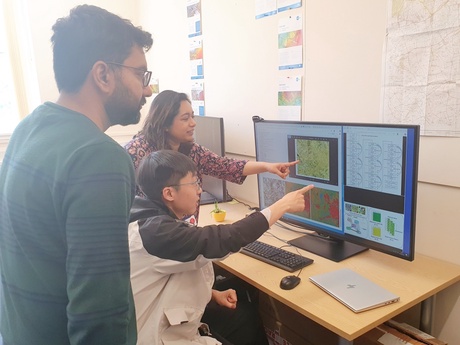
Dr Anshuman Bhardwaj (left), Baoling Gui (centre) and Dr Lydia Sam

AI breakthrough at the University of Aberdeen to enhance global environmental monitoring

A pioneering team at the University of Aberdeen in Scotland has introduced an AI model named SAGRNet, which can potentially transform environmental and agricultural monitoring worldwide.

Developed by Dr. Lydia Sam, Dr. Anshuman Bhardwaj, and their colleagues, SAGRNet—short for Sampling and Attention-based Graph Convolutional Residual Network—utilizes deep learning to map land cover from satellite imagery with greater accuracy and efficiency. Instead of analyzing individual pixels, the model examines entire landscape features, such as forests, fields, and waterways, providing deeper insights into vegetation types and their contexts.

Initially trained on the diverse terrains of northeast Scotland, encompassing habitats ranging from farmland to urban areas, SAGRNet has demonstrated impressive adaptability. It has performed well in various regions worldwide, including Guangzhou (China), Durban (South Africa), Sydney (Australia), New York City (USA), and Porto Alegre (Brazil). The team has made the model open-source so that decision-makers, researchers, and conservationists can implement it in their local contexts.

“Our system of deep learning algorithms can instantly and accurately recognize different types of land cover, vegetation, or crops in an area,” said Dr. Sam.

Significantly, the model provides detailed information while minimizing computational demands—an essential advantage for timely monitoring of climate impacts, such as wildfires, floods, and droughts.

Dr. Bhardwaj emphasized its versatility: “It can also monitor crop growth, facilitating more accurate harvest predictions and helping make better-informed decisions about land-use sustainability.”

PhD researcher Baoling Gui pointed out how seamlessly SAGRNet integrates into operational pipelines, benefiting various applications from ecological studies to national land-use surveys.

This research, published in the prestigious ISPRS Journal of Photogrammetry and Remote Sensing, was supported by the UK’s BBSRC International Institutional Award, with contributions from international collaborators in Spain, and Germany.

Woolpert wins a $250M NOAA contract supporting shoreline mapping

The firm will offer various geospatial services to support nautical charts, maritime navigation, coastal resource management, and the definition of territorial boundaries.

Woolpert has been chosen by the National Oceanic and Atmospheric Administration (NOAA) to provide shoreline mapping services under a $250 million, multiple-award, indefinite-delivery, indefinite-quantity contract in support of the National Geodetic Survey and its Coastal Mapping Program.

The Coastal Mapping Program aims to survey approximately 95,000 miles of U.S. coastline, producing a seamless digital database of accurate and consistent national shoreline data for use in nautical charting, maritime navigation, coastal resource management, and defining territorial boundaries.

Under this contract, Woolpert will deliver a range of geospatial services, including:

- Topographic and bathymetric lidar acquisition
- Aerial imagery collection
- Ground control surveys
- Tide and water level monitoring
- Geographic cell shoreline cleanup
- Data editing, attribution, and compilation

“The work being done under this contract is essential for ensuring the accuracy of U.S. shoreline data, which supports everything from safe navigation to disaster response,” said Jeff Lovin, Woolpert’s Government Solutions Market Director. “We’re proud to continue our long-standing partnership with NOAA and the National Geodetic Survey and to contribute to this vital work that safeguards coastal communities and enhances national resilience.”

The contract is currently underway.