Multi-layer simulations reveal the hidden supply chain of solar prominences

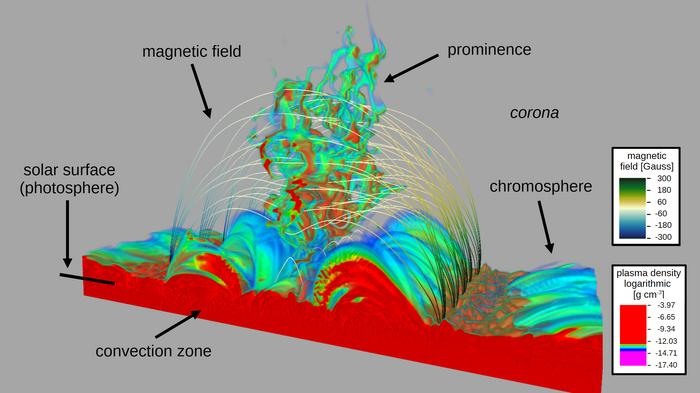
A recent study in Nature Astronomy (DOI: 10.1038/s41550-026-02840-7) represents a major leap forward in computational astrophysics, showcasing how state-of-the-art supercomputing is transforming our understanding of solar prominences, one of the Sun’s most mysterious features. By utilizing large-scale, high-resolution simulations, scientists at the Max Planck Institute for Solar System Research have, for the first time, recreated the Sun’s complex multi-layer dynamics from the convection zone up to the corona, uncovering a self-sustaining mechanism that supports these plasma formations.

A multiscale computational challenge

Solar prominences are massive, relatively cool plasma formations (~10,000 K) suspended within the Sun’s much hotter corona (~1 million K). Despite their apparent fragility, they can persist for weeks or months and may ultimately erupt, triggering space weather events that can disrupt Earth’s infrastructure.
 
Modeling such structures presents a formidable computational challenge. The physics spans multiple regimes: magnetohydrodynamics (MHD), radiative transfer, thermal instability, and turbulent plasma flows across spatial scales ranging from sub-surface convection to coronal loops extending tens of thousands of kilometers.
 
The research team addressed this complexity using advanced numerical simulations that integrate:
  • Full-sphere stratified solar models, extending from the convection zone below the photosphere to the corona.
  • Dynamic magnetic field evolution, driven by turbulent plasma flows.
  • Thermal coupling across layers, capturing steep temperature gradients between the chromosphere and corona.
  • Plasma injection and condensation processes, resolved in time-dependent MHD frameworks.
These simulations required high-performance computing (HPC) resources capable of resolving nonlinear interactions across scales while maintaining numerical stability over long simulation times.

Magnetic topology and plasma supply mechanisms

At the core of the study lies a specific magnetic configuration: a double-arched field structure forming a dip in the corona. Within this dip, prominence material accumulates and remains magnetically confined.
 
The simulations reveal a dual supply mechanism:
  1. Chromospheric Injection
    Turbulent magnetic activity in the chromosphere ejects bursts of cool plasma upward. These injections are driven by small-scale magnetic reconnection and wave dynamics.
  2. Coronal Condensation
    Hot coronal plasma flows along magnetic field lines into the dip, where it cools radiatively and condenses into denser material.
Simultaneously, gravitational drainage causes some plasma to fall back toward lower layers. The prominence persists because these losses are continuously offset by the two supply channels, establishing a dynamic equilibrium.
 
This “supply–loss balance” represents a key breakthrough: earlier models typically captured only coronal condensation and neglected the deeper layers of the Sun. By coupling subsurface dynamics with atmospheric processes, the new simulations close a longstanding gap in solar physics.

Supercomputing as the enabling infrastructure

The study’s significance lies not only in its astrophysical findings but in its computational methodology. Achieving a self-consistent, multi-layer solar model required:
  • Massively parallel MHD solvers to handle nonlinear plasma dynamics.
  • Adaptive mesh refinement (AMR) or equivalent resolution strategies to capture fine-scale injection events.
  • Long-duration time integration to observe prominence formation and stability cycles.
  • High-throughput data handling, given the volumetric and temporal scale of simulation outputs.
Such requirements place the work squarely in the domain of modern supercomputing. Without HPC systems capable of petaflops (and increasingly exaflops) performance, resolving the coupled dynamics of magnetic fields and plasma across solar layers would be computationally prohibitive.

Implications for space weather forecasting

Understanding prominence formation is not merely an academic pursuit. Prominence eruptions are closely linked to coronal mass ejections (CMEs), which can trigger geomagnetic storms affecting satellites, power grids, and communications systems.
 
By identifying the underlying supply mechanisms and stability conditions of prominences, the study provides a pathway toward:
  • Improved predictive models of solar eruptions.
  • Better integration of subsurface solar dynamics into space weather simulations.
  • Enhanced coupling between observational data and physics-based HPC models.
As noted by the researchers, a deeper understanding of prominences is “a crucial piece of the puzzle” in forecasting hazardous space weather events.

Toward exaflops solar physics

This study highlights a growing shift in astrophysics: moving away from inference based solely on observations toward data-intensive, physics-driven modeling. High-fidelity simulations of entire stellar subsystems are quickly becoming a hallmark of modern research in the field.
 
Future directions will likely include:
  • Integration with real-time solar observation pipelines.
  • Data assimilation frameworks combining HPC simulations with satellite measurements.
  • Deployment on exaflops architectures to increase spatial resolution and physical realism.
In this context, solar prominences are no longer just spectacular features of our nearest star; they are a proving ground for the next generation of supercomputing-enabled science.
Supercomputers peer into alien worlds, find matter unlike anything on Earth

 
Deep beneath the serene blue atmospheres of Uranus and Neptune, something extraordinary may be unfolding, something no spacecraft has ever seen, and no laboratory has fully reproduced. Instead, it has been revealed through the relentless, precise calculations of modern supercomputers.
 
In a new study, alongside complementary research from the Carnegie Institution for Science, scientists have used large-scale quantum simulations to predict a previously unknown state of matter, one that challenges our understanding of physics, chemistry, and planetary science.

Simulating the unreachable

The interiors of ice giants are among the most extreme environments in the solar system, with pressures reaching hundreds to thousands of gigapascals and temperatures of several thousand degrees Kelvin. These are conditions far beyond routine experimentation.
 
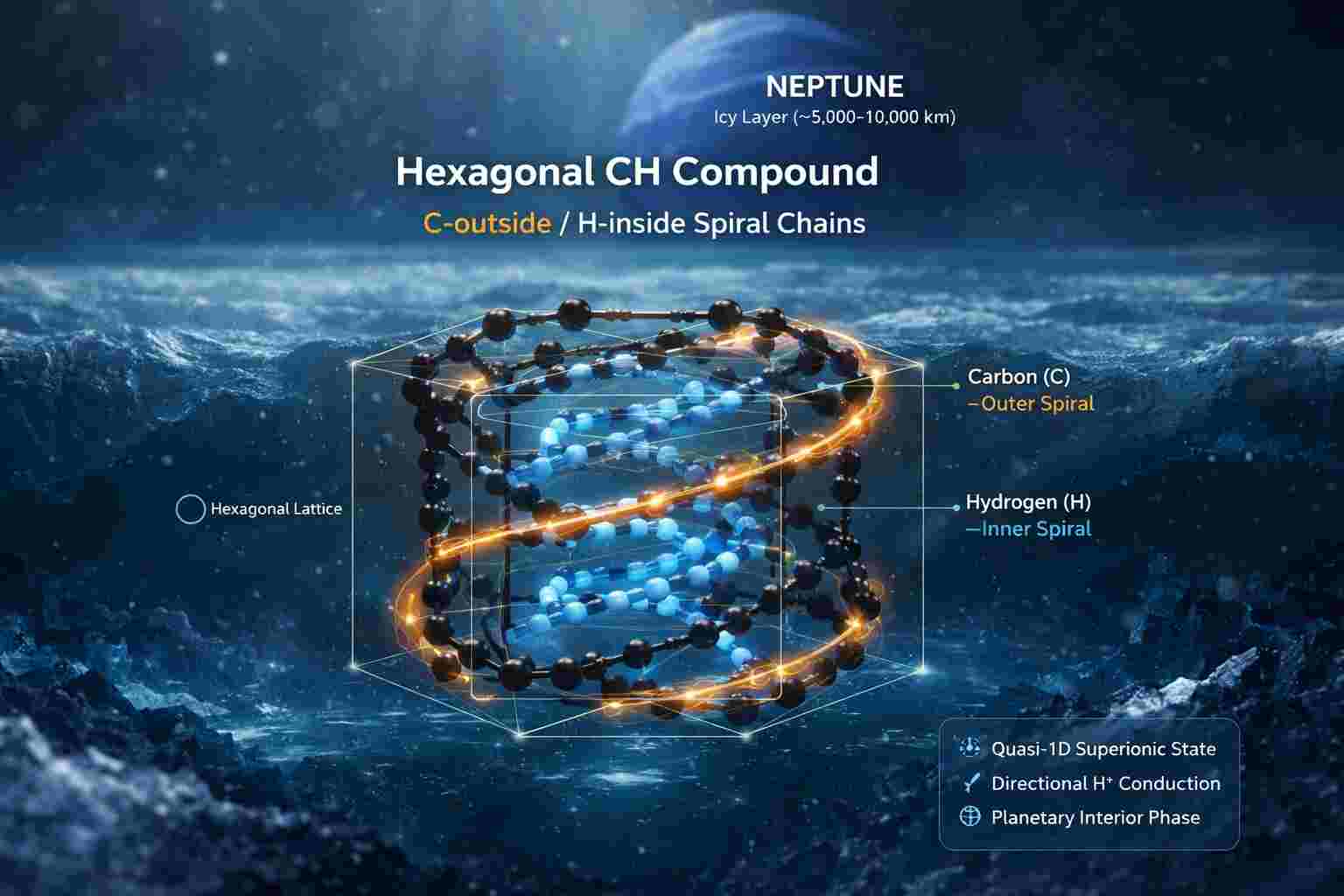
To explore this hidden realm, researchers turned to first-principles simulations powered by high-performance computing (HPC). By combining quantum mechanics with machine-learning-enhanced models, they recreated how simple elements, carbon and hydrogen, behave under such crushing extremes. The result: a prediction of a quasi-one-dimensional superionic state, an exotic phase where matter is neither fully solid nor liquid.

A spiral state of matter

In this simulated world, carbon atoms form a rigid, hexagonal framework, while hydrogen atoms move through it, not randomly, but along spiral, helical pathways.
 
This directional motion is what makes the phase so unusual. Unlike conventional superionic materials, where mobile ions diffuse in all directions, this structure channels movement along specific paths, effectively creating atomic-scale “highways” through the material.
 
Such behavior could fundamentally reshape how scientists think about:
  • Heat transport
  • Electrical conductivity
  • Magnetic field generation
inside giant planets.

The power of simulation

At its core, this work demonstrates the true power of supercomputing, the ability to uncover phenomena otherwise out of reach.
 
The simulations required modeling matter at the quantum level across a vast range of pressures and temperatures, conditions spanning millions of times Earth’s atmospheric pressure.
 
By leveraging HPC systems, researchers were able to:
  • Predict entirely new crystal structures.
  • Track atomic motion in extreme environments.
  • Identify phase transitions invisible to current experiments.
In effect, supercomputers are acting as virtual laboratories for the universe, enabling experiments that cannot yet be performed in the physical world.

Rethinking planetary interiors

The implications ripple far beyond Uranus and Neptune.
 
Scientists have long struggled to explain why these planets have unusual, asymmetric magnetic fields, unlike Earth’s relatively stable dipole. The newly predicted superionic phase could offer a missing piece of that puzzle.
 
Because hydrogen motion is directional, the material may conduct heat and electricity unevenly, potentially shaping the chaotic magnetic behavior observed in both planets.
 
More broadly, the findings suggest that planetary interiors are not simple layered structures, but dynamic systems with complex, evolving phases of matter.

A new frontier for HPC

Perhaps most inspiring is what this work represents for computational science itself.
 
Supercomputers, now engines of discovery, predict unknown forms of matter before they are observed.
 
As researchers continue to push the limits of HPC, they are:
  • Expanding the boundaries of quantum simulation
  • Bridging physics, chemistry, and planetary science
  • Providing blueprints for future experiments and space missions
With more than 6,000 exoplanets now known, many of which are similar in size to Neptune, these simulations may help decode not just our solar system but countless others.

The Universe, recreated in code

No probe has yet descended into the depths of Uranus or Neptune. No instrument has directly sampled their inner layers.
 
And yet, through supercomputing, scientists are beginning to see them, atom by atom, phase by phase.
 
In the hum of HPC systems, entire planets are being reconstructed, revealing that even the simplest elements can organize into astonishing complexity under pressure.
 
It is a powerful reminder: sometimes, the most profound discoveries are not observed; they are computed.
 

Riding invisible waves: How open-source code transforms space weather science

Far above Earth, a hidden storm perpetually swirls.
 
Charged particles spiral along magnetic field lines while electromagnetic waves ripple through the vastness of space. Energetic electrons accelerate, scatter, and occasionally dive into Earth’s atmosphere, disrupting satellites, communications, and navigation systems.
 
We call it space weather. But understanding it has never been simple.
 
Now, a new generation of open-source tools is beginning to change that, turning one of the most complex environments in physics into something scientists can explore, test, and even predict.

A problem hidden in equations

At the center of this transformation is a deceptively difficult challenge: modeling how waves and particles interact in space.
 
The research published in Earth and Space Science introduces a Python-based software package designed to calculate diffusion coefficients, a key ingredient in understanding how energetic particles evolve in near-Earth space.
 
These coefficients describe how particles scatter in both energy and direction as they resonate with electromagnetic waves. It is a process that determines whether particles remain trapped in Earth’s radiation belts or cascade into the atmosphere.
 
But calculating these interactions is notoriously complex.
 
It requires solving competing theoretical models, integrating across multiple dimensions, and handling subtle physical effects that can dramatically change outcomes. Historically, this complexity has made such calculations difficult, time-consuming, and inaccessible to many researchers.
 
The new software, known as PIRAN, changes that by packaging these calculations into an open, extensible Python framework, allowing scientists to compute both local and bounce-averaged diffusion using multiple established formalisms.
 
It is, in essence, a toolkit for exploring how space itself behaves under stress.

From code to community

What makes this development especially intriguing is not just the physics but the philosophy behind it.
 
PIRAN is open-source.
 
That means researchers anywhere can access, modify, and extend it. It includes documented modules, reproducible workflows, and built-in flexibility for testing different theoretical approaches.
This openness is becoming an increasingly defining feature of modern computational science.
 
This is echoed in parallel efforts, such as a newly announced Python-based space weather modeling tool from the University of Birmingham, designed to simplify the simulation of how electromagnetic waves influence high-energy particles in space.
 
That software emphasizes accessibility and collaboration, lowering the barrier to entry so more scientists can contribute to modeling efforts that were once the domain of specialized teams.
 
Together, these tools signal a shift: from isolated models to shared platforms, from closed systems to open ecosystems.

Where supercomputing comes in

But open-source alone is not enough.
 
The physics of space weather operates across enormous scales, from microscopic particle interactions to planetary magnetic fields. To simulate these systems accurately, researchers must run vast numbers of calculations, often exploring multiple scenarios and parameter spaces.
 
This is where supercomputing becomes essential.
 
High-performance computing systems allow scientists to:
  • Run large ensembles of simulations.
  • Compare competing theoretical models at scale.
  • Resolve fine-grained particle dynamics over long timescales.
Even with efficient Python-based tools, the underlying calculations, especially diffusion modeling, can be computationally intensive. Scaling them up requires parallel processing, distributed systems, and optimized workflows.
 
In short, open-source software provides access.
 
Supercomputing provides the power.

A more curious kind of forecasting

What emerges from this convergence is a new kind of scientific process, one that feels less like prediction and more like exploration.
 
Instead of relying on a single model, researchers can now test multiple physical assumptions side by side. They can tweak parameters, swap theoretical frameworks, and observe how outcomes diverge.
 
Why do two models produce different diffusion rates?
 
What happens when wave properties shift slightly?
 
How sensitive are predictions to initial conditions?
 
These are not just technical questions. They are invitations to curiosity.
 
And increasingly, they are answered not in isolation, but through shared codebases running on powerful machines.

Toward a more resilient future

The stakes are not purely academic.
 
Space weather affects real-world systems, GPS navigation, satellite operations, aviation, and even power grids. Better models mean better forecasts. And better forecasts mean more resilient infrastructure.
 
Tools like PIRAN and the Birmingham modeling suite represent steps toward that goal, enabling scientists to move from reactive analysis to proactive understanding.
 
They also hint at something larger.

The quiet revolution in computational science

There is a quiet revolution underway in how science is done.
 
It is happening in GitHub repositories, in Python scripts, and in the vast architectures of supercomputers. It is driven not just by faster processors, but by a commitment to openness, collaboration, and curiosity.
 
In this new landscape:
  • Code becomes a shared language.
  • Models become living systems.
  • And supercomputers become engines of collective discovery.
Space weather, once an opaque and unpredictable force, is gradually becoming something we can map, simulate, and understand.
 
Not perfectly. Not completely.
 
But enough to ask better questions.
 
And sometimes, that is where the real breakthroughs begin.