How supercomputing is transforming our understanding of the Antarctic Circumpolar flow

It is the mightiest river on Earth, yet no one has ever stood on its banks.
 
Encircling Antarctica in an unbroken loop, the Antarctic Circumpolar Current (ACC) moves more than 100 times the water of all the world’s rivers combined, shaping climate, isolating a continent, and quietly regulating the planet’s heat balance.
 
For decades, scientists believed they understood how it formed. But now, thanks to a new generation of supercomputer-driven simulations, that story is being rewritten, with profound implications for how we understand Earth’s past and future.
 

A climate engine born in chaos

 
Roughly 34 million years ago, Earth underwent one of its most dramatic transformations. The planet cooled from a greenhouse world, largely free of ice, into the “icehouse” climate we know today, with massive polar ice sheets taking hold.
 
At the same time, tectonic forces pulled continents apart. Ocean gateways opened between Antarctica, South America, and Australia. For years, it was thought that this was the key: once these passages widened, water could flow freely around Antarctica, forming the ACC and isolating the continent in cold waters.
 
Simple. Elegant. And, as it turns out, incomplete.
 

Supercomputers challenge a simple story

 
In a recent study, researchers used high-resolution climate and ocean simulations to revisit this long-standing assumption.
 
Their conclusion was that opening ocean gateways alone was not enough.
 
Instead, the birth of the ACC appears to have been a far more complex interplay of forces, one that only becomes visible when modeled at a massive computational scale.
 
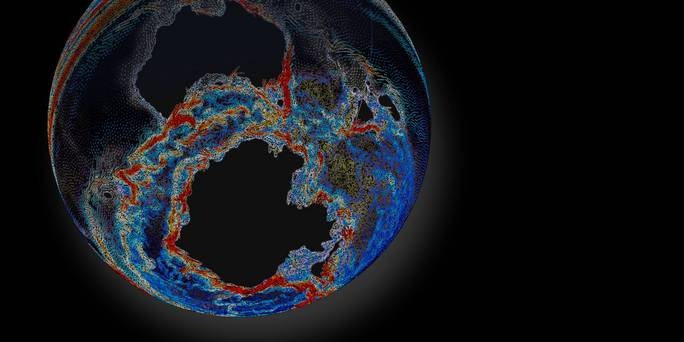
Using supercomputers, scientists reconstructed ancient oceans in extraordinary detail, simulating currents, temperature gradients, atmospheric winds, and evolving ice sheets across millions of years. These models revealed that the current did not simply “switch on” when pathways opened. It required the right combination of circulation dynamics, wind patterns, and climate feedback to fully emerge.
 
In other words, the ACC was not just a consequence of geography.
 
It was a product of a system.
 

The power of simulation

 
Recreating Earth’s ancient oceans is not a task for ordinary computation.
 
These simulations must resolve interactions across vast scales, from swirling ocean eddies to global heat transport, while also accounting for atmospheric circulation, carbon dioxide levels, and ice sheet growth.
 
Each variable influences the others in a tightly coupled system.
 
Supercomputers make this possible.
 
They allow scientists to run “what-if” scenarios across geological time:
 
  • What if the gateways opened earlier?
  • What if CO₂ levels remained higher?
  • What if winds shifted differently?
 
By iterating through these possibilities, researchers can isolate the conditions that gave rise to one of Earth’s most powerful climate engines.
 
It is less like solving a puzzle and more like replaying planetary history.
 

A current that shapes everything

 
Why does this matter?
 
Because the ACC is not just an ocean current, it is a global regulator.
 
Flowing uninterrupted around Antarctica, it acts as a barrier, preventing warmer waters from reaching the continent and helping maintain its vast ice sheets.
 
It connects the Atlantic, Pacific, and Indian Oceans, redistributing heat, carbon, and nutrients across the globe.
 
In many ways, it is the heartbeat of the Southern Ocean.
 
Understanding how it formed is key to understanding how it might change.
 

Looking back to see forward

 
One of the most striking insights from this research is how deeply the past informs the future.
 
Around the time the ACC formed, atmospheric CO₂ levels were roughly 600 parts per million, levels that modern climate scenarios suggest we could approach again.
 
By simulating that ancient world, scientists gain a rare opportunity: to observe how Earth’s systems behaved under conditions similar to those we may soon face.
 
But this is not a prediction in the traditional sense.
 
It is something more powerful.
 
It is understanding.
 

The age of computational Earth science

 
What makes this discovery truly inspiring is not just what it reveals about the ACC, but what it reveals about science itself.
 
We are entering an era where the most important frontiers are not only in space or in the field, but inside machines.
 
Supercomputers now allow us to:
  • Reconstruct the climates that existed tens of millions of years ago
  • Test planetary-scale hypotheses
  • Explore systems too vast, too slow, or too complex to observe directly.
They have become time machines for Earth science.
 

A current, reimagined

 
The Antarctic Circumpolar Current was once thought to be a simple consequence of shifting continents.
 
Now, it emerges as something far more profound: a dynamic, evolving system born from the interplay of ocean, atmosphere, ice, and time.
 
And it took supercomputing to see it clearly.
 
As we confront a changing climate, this lesson resonates deeply. The systems that shape our planet are rarely simple. They are layered, interconnected, and often surprising.
 
But with enough computational power and enough curiosity, we can begin to understand them.
 
Even the ones that circle the Earth unseen.
Russian scientists make multimodal AI breakthrough in protein interaction prediction

At the dynamic intersection of artificial intelligence and computational biology, researchers from the Russian National Research University Higher School of Economics (HSE University) in Moscow have introduced an advanced deep learning model poised to accelerate drug discovery and disease research. Their creation, GSMFormer-PPI, demonstrates outstanding accuracy in predicting protein–protein interactions (PPIs), a fundamental challenge in modern bioinformatics.
 
Protein interactions are central to almost every biological process, from cellular signaling to metabolic regulation. Disruptions or abnormalities in these interactions can lead directly to disease. Experimentally mapping such interactions, however, presents a daunting combinatorial task; even a relatively small group of proteins can generate an immense number of potential interaction pairs.

A multimodal leap forward

What sets GSMFormer-PPI apart is its multimodal architecture, an approach that integrates multiple representations of biological data into a unified predictive framework. Instead of relying on a single data type or naively merging inputs, the model simultaneously processes:
  • Amino acid sequences (via protein language models)
  • Three-dimensional structural data (modeled as graphs)
  • Surface-level biochemical and geometric properties
These distinct data streams are each translated into numerical representations and fed into a transformer-based neural network (a type of deep learning model known for recognizing relationships within complex data). Unlike earlier approaches that simply concatenate features, GSMFormer-PPI explicitly learns relationships between these modalities, enabling deeper insight into how proteins interact at multiple biological scales.
 
This architectural choice reflects a broader trend in supercomputing: moving from brute-force data aggregation toward intelligent, relationship-aware computation. By leveraging transformer models, originally popularized in natural language processing, the researchers bring state-of-the-art AI techniques into the field of molecular science.

Performance that pushes boundaries

Tested on the widely used PINDER dataset (a standard set of protein interaction data), GSMFormer-PPI achieved an accuracy of 95.7%, outperforming established graph-based neural networks such as GCN (Graph Convolutional Network) and GAT (Graph Attention Network).
 
Crucially, ablation studies revealed that performance dropped when any one of the three data modalities was removed. This confirms that the model’s strength lies not just in data diversity, but in its ability to synthesize insights across biological dimensions.
 
As Maria Poptsova, one of the study’s authors, explains, the surface properties of proteins are especially critical: they govern how molecules recognize and bind to one another. By explicitly modeling these alongside sequence and structure, and allowing the AI to learn their interdependencies, the system achieves far greater predictive precision.

Implications for Supercomputing and Drug Discovery

The implications of this work extend well beyond academic curiosity. Predicting protein interactions is a foundational step in identifying disease mechanisms, biomarkers, and therapeutic targets. Traditionally, this process has been bottlenecked by experimental limitations and computational inefficiencies.
 
GSMFormer-PPI offers a pathway to dramatically accelerate this pipeline:
  • Drug target identification: Rapid screening of protein pairs could highlight novel intervention points
  • Biomarker discovery: Improved interaction mapping aids in identifying disease signatures
  • Systems biology: Enables more accurate modeling of cellular networks
From a supercomputing perspective, the model exemplifies the growing importance of hybrid AI architectures that integrate heterogeneous data types. Such systems demand substantial computational resources, not only for training but also for handling complex graph structures and high-dimensional embeddings.
 
As HPC infrastructures continue to evolve, models like GSMFormer-PPI highlight a key trend: the convergence of large-scale compute, advanced neural architectures, and domain-specific data fusion.

A Glimpse of What’s Next

Developed with support from Russia’s AI research initiatives, this work underscores the global momentum behind AI-driven scientific discovery. More importantly, it signals a shift in how computational problems in biology are approached, not as isolated datasets, but as interconnected systems requiring equally sophisticated models.
 
In the era of exaflops, the question is no longer whether we can simulate biological complexity, but how intelligently we can interpret it. GSMFormer-PPI is a compelling step in that direction.

How HPC is revealing alien matter deep inside ice giants

Far from Earth, beneath the tranquil blue atmospheres of Neptune and Uranus, exists a realm unreachable by spacecraft and impossible to replicate in the lab. Here, pressures soar to millions of times greater than Earth’s atmosphere and temperatures exceed those of molten lava. Now, new research suggests this environment may harbor an entirely new state of matter.
 
What makes this discovery remarkable is not just what was found, but how it was found.
 
Through the power of supercomputing and machine-learning.

A hidden state of matter, computed, not observed

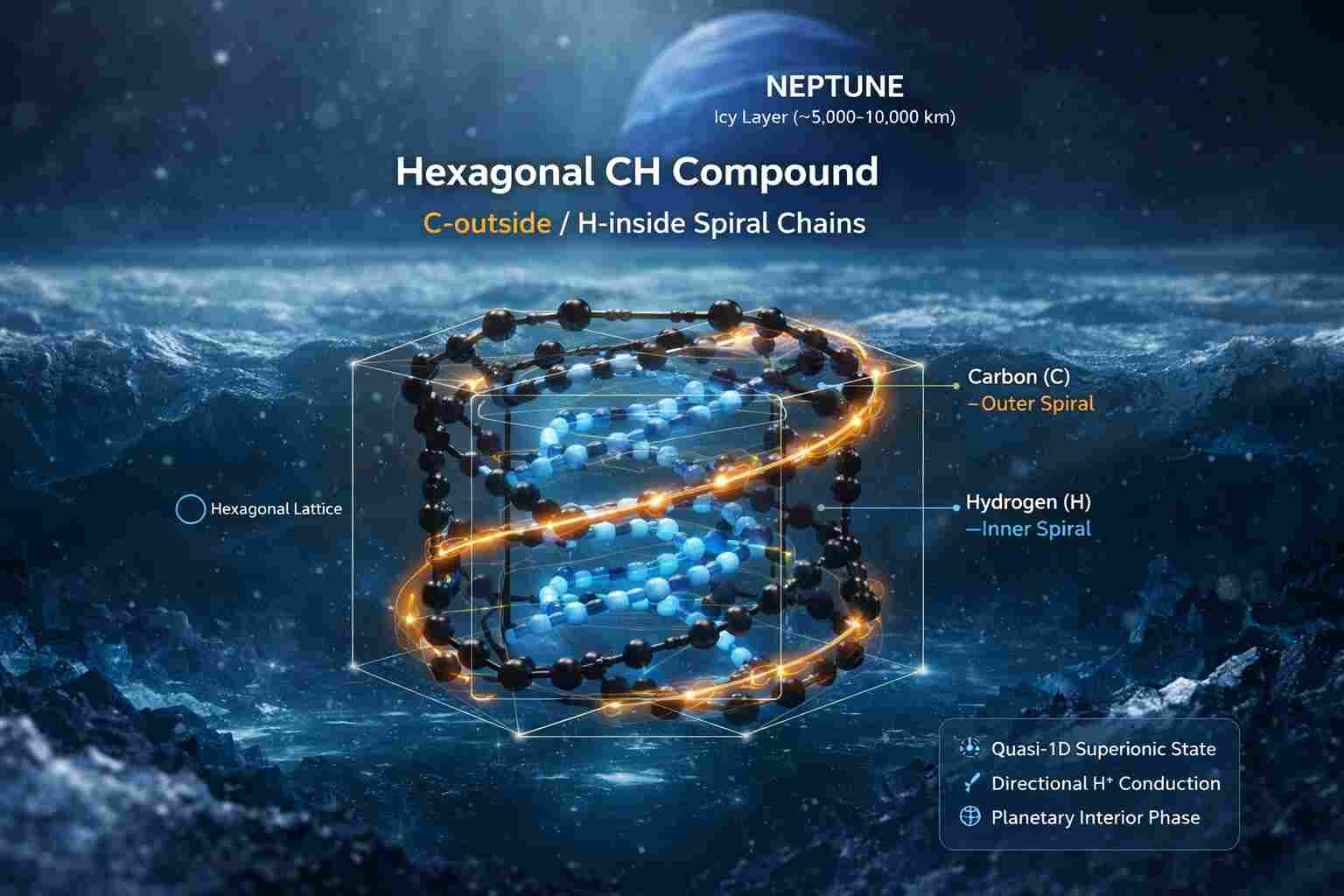
In a study led by researchers at Carnegie Science, scientists predict that deep within these ice giants exists a “superionic” form of carbon hydride, a strange hybrid phase where matter behaves simultaneously like a solid and a liquid.
 
Under extreme planetary conditions, pressures reaching up to 3,000 gigapascals and temperatures of thousands of degrees, atoms reorganize into exotic configurations. In this case, carbon atoms form a rigid lattice while hydrogen atoms flow through it like a fluid, creating what researchers describe as a quasi-one-dimensional superionic state.
 
This is not something that can be captured in a lab or observed by a telescope.
It must be computed into existence.

Supercomputers as planetary probes

To uncover this hidden physics, scientists turned to high-performance computing systems capable of simulating matter at the quantum level. Using first-principles calculations combined with machine-learning-driven interatomic models, researchers recreated the extreme environments of planetary interiors, atom by atom, interaction by interaction.
 
These simulations are staggering in scale and complexity. They must account for quantum mechanical behavior, atomic bonding, thermal fluctuations, and pressure-induced phase transitions, all of which unfold simultaneously across millions of computational steps.
 
In effect, supercomputers have become our deepest drilling instruments, probing worlds we cannot physically access.

Rewriting Planetary Science

The implications stretch far beyond academic curiosity.
 
For decades, scientists have known that Uranus and Neptune contain layers of so-called “hot ices,” mixtures of water, methane, and ammonia under extreme conditions. But the exact behavior of these materials has remained one of planetary science’s greatest mysteries.
 
Now, with the discovery of superionic carbon hydride, researchers are beginning to understand how these planets generate their unusual magnetic fields and internal dynamics. Exotic phases like this may influence heat flow, electrical conductivity, and convection deep within these worlds.
 
And as more than 6,000 exoplanets have already been discovered, these insights don’t just apply to our solar system; they provide a blueprint for understanding planets across the galaxy.

The rise of computational discovery

This breakthrough underscores a profound shift in how science is done.
 
Where exploration once required telescopes or spacecraft, today it increasingly depends on computation. Supercomputers are not just tools for analysis; they are engines of discovery, capable of predicting entirely new states of matter before they are ever observed.
 
In this new paradigm, simulation becomes exploration.
 
Equations become experiments.
 
And code becomes a window into worlds billions of miles away.

Inspiration at planetary scale

There is something deeply inspiring about this moment.
 
Humanity has not yet returned to Uranus or Neptune since Voyager 2 flew past them decades ago.
 
Yet through supercomputing, we are once again exploring their depths, this time not with cameras, but with computation.
 
We are discovering oceans of exotic matter, dynamic interiors, and hidden physical laws, all without leaving Earth.
 
It is a reminder that the frontier of exploration is no longer just out there in space.
 
It is also inside our machines.
 
And with every simulation, every model, every breakthrough, we move closer to understanding not just distant planets, but the fundamental nature of matter itself.
 
Because in the age of supercomputing, even the deepest secrets of the universe are within reach, one calculation at a time.