
Supercomputers unravel the mystery of missing Tatooine-like planets

The idea of planets with twin suns, like Tatooine from Star Wars, has fascinated both scientists and the public for years. Despite binary stars being common throughout our galaxy, planets orbiting two stars (circumbinary planets) remain unexpectedly scarce. Researchers from the University of California, Berkeley, in collaboration with the American University of Beirut, now offer a compelling answer to this puzzle. Their explanation, grounded in Einstein’s general theory of relativity, emerged from sophisticated computational models powered by cutting-edge supercomputing technology.
 
Of the more than 6,000 confirmed exoplanets identified to date, only a handful orbit binary stars; a statistic that stands in stark contrast to expectations, given that stars commonly form in pairs. The team’s analysis shows that as tight binary stars spiral closer over millions of years due to tidal interactions, general relativistic precession, a subtle warping of spacetime predicted by Einstein, changes the dynamics of the entire system in a way that destabilizes potential planets.
 
Planets in a circumbinary orbit experience gravitational tugs from both stars. Under Newtonian physics alone, this complex interplay is already difficult for planets to navigate. But when the binary stars themselves begin to precess, that is, the orientation of their orbit rotates due to relativistic effects, the system can enter a state of secular resonance. At this point, the precession of the stars’ orbit matches that of the planet’s orbit, steadily pumping energy into the planet’s motion. Eventually, the planet’s path becomes highly elongated and chaotic. It can either be flung outward into interstellar space or drawn inward, where it risks destruction by one of its host stars.
 
This resonant disruption, described in the study “Capture into Apsidal Resonance and the Decimation of Planets around Inspiraling Binaries,” was elucidated through orbit-averaged simulations that explore the dynamical evolution of circumbinary systems under a range of initial conditions. These simulations, computationally intensive and numerically sophisticated, map out the phase space of binary–planet interactions and reveal how frequently planets are captured into destructive resonances as binaries tighten. According to the study, roughly eight out of every ten potential planets in tight binary systems encounter this resonance, and three out of four are eventually destroyed or ejected, leaving behind only a few survivors on distant, hard-to-detect orbits.
 
Such high-resolution modeling is intrinsically dependent on supercomputing capabilities. Simulating the long-term evolution of three-body systems, where two stars and a planet influence one another gravitationally, requires solving coupled differential equations with precision over billions of simulated years. Conventional computing alone is insufficient for this scale of calculation; only through HPC systems can researchers explore vast ensembles of scenarios, integrate relativistic effects accurately, and uncover the nuanced mechanisms that shape planetary destinies.
 
For the supercomputing community, this research offers both inspiration and affirmation of the critical role HPC plays in astrophysics. By enabling simulations that incorporate general relativity alongside classical dynamics, supercomputers open windows into processes that cannot be observed directly, but that govern the architecture of planetary systems throughout the galaxy. They allow scientists to test theoretical ideas against virtual models of reality, refining our understanding of how planets form, persist, or perish in the cosmos.
 
The Berkeley-led team clarifies that their findings do not mean binary stars are devoid of planets. Instead, they show that while planets often form around binary stars, most are pushed into orbits that current detection tools, including NASA’s Kepler and TESS, struggle to find. A few planetary survivors may remain, hidden in distant, long-period orbits that will require innovative search techniques to uncover.
 
Looking ahead, researchers plan to apply similar modeling techniques to other astrophysical contexts, such as the environments around pairs of supermassive black holes, to understand how relativistic dynamics influence large-scale cosmic structures. In doing so, they continue to push the boundaries of computational astrophysics, using supercomputers not just as tools for calculation but as engines of discovery in the quest to understand our universe.
ML, supercomputing unite to revolutionize high-power laser optics

Researchers at the University of Strathclyde in Scotland are leveraging advanced computational techniques to transform scientific discovery. By integrating machine learning algorithms with powerful supercomputer models, they have significantly accelerated the design process for robust optical components used in high-power laser systems. This innovative approach not only shortens design cycles but also uncovers new physical phenomena, marking a breakthrough with wide-reaching impacts across science, industry, and emerging technologies.
 
High-power lasers are vital to advancements in nuclear fusion, high-field physics, and advanced manufacturing, but their optical components must endure extreme intensities without failing. Traditional optics are often large, expensive, and challenging to scale, which restricts the development of next-generation laser facilities. To overcome these limitations, Strathclyde’s multidisciplinary team is developing plasma photonic structures, temporary, self-assembled mirrors formed in ionized gas, that can fulfill the same roles at a much smaller and more cost-effective scale.
 
The central challenge lies in navigating a highly complex parameter space where interdependent variables determine performance. Traditional design methods involve resource-intensive, trial-and-error iterations that may require hundreds of thousands to millions of individual evaluations before an acceptable design can be identified. By coupling machine learning algorithms with supercomputer-driven physical models, specifically deep kernel Bayesian optimization (DKBO) paired with particle-in-cell (PIC) simulations, researchers have reduced this process to just a few dozen iterations, enabling rapid identification of high-reflectivity, robust plasma mirror designs.
 
This achievement depends on computationally intensive supercomputer simulations to model the spatio-temporal evolution of transient plasma structures and evaluate performance metrics such as reflectivity and pulse compression. The simulations, executed at high resolution with millions of interacting particles, are inherently demanding and could not be conducted at scale without HPC resources. In fact, the team’s use of national supercomputing services, including the ARCHER2 UK National Supercomputing Service, exemplifies how targeted computational power can transform scientific inquiry.
 
According to lead Dr. Slavi Ivanov of Strathclyde’s Department of Computer and Information Sciences, the integration of DKBO with particle-in-cell models enables not just faster design optimization but also unexpected discovery. In their work, the optimization framework found regimes where incident laser pulses are compressed by the plasma mirror structure, a phenomenon that emerged from the simulations rather than human intuition, underscoring the capacity of machine-assisted design to reveal new physics.
 
Professor Dino Jaroszynski, co-author and distinguished laser physicist, described the research as an engine of discovery that expands the objectives beyond mere performance targets. “By specifying innovative or unconventional design goals, we can uncover mechanisms that might otherwise remain hidden,” he noted, suggesting that this approach could redefine how optical components are conceived for extreme environments.
 
The implications of this work extend well beyond high-power lasers themselves. The general nature of the machine learning and simulation framework means it can be adapted to other optical elements, from beam splitters to focusing devices, and even to real-time experimental optimization workflows where objective functions are derived from empirical measurements. This flexibility opens new pathways for rapid, HPC-enabled design across photonics, telecommunications, and other advanced technologies.
 
Importantly for the supercomputing community, this research illustrates how machine learning and HPC models can be coupled in powerful synergy. Machine learning provides an intelligent search strategy that dramatically reduces the number of required simulation runs, while the supercomputer executes the high-fidelity physical models necessary to evaluate each candidate design. This integrated loop, where algorithms guide simulations and simulations train algorithms, is becoming a hallmark of contemporary computational science.
 
As high-performance computing infrastructure continues to advance in both capability and accessibility, hybrid approaches such as deep kernel Bayesian optimisation are becoming essential tools for addressing complex, multidisciplinary challenges. From the design of next-generation optical components to the discovery of previously unknown physical phenomena, the integration of machine learning with high-fidelity simulation is accelerating innovation and narrowing the gap between theoretical research and practical application.
 
For the Supercomputing community, the Strathclyde plasma mirror project illustrates how supercomputing has evolved beyond traditional numerical analysis into a collaborative force in scientific discovery, enabling researchers to navigate vast design spaces, reveal unexpected behaviors, and redefine how technologies are engineered for extreme operating conditions.

Supercomputing reveals hidden galactic architecture around the Milky Way

Leveraging the capabilities of modern high-performance computing (HPC), astronomers have unraveled a cosmic mystery: the Milky Way and its closest neighboring galaxies are embedded in a sprawling sheet of matter that shapes the movement of surrounding galaxies. This breakthrough, featured in Nature Astronomy, was achieved using advanced simulations powered by cutting-edge supercomputers to model the mass distribution and dynamics of our local universe.
 
For decades, cosmologists have grappled with an apparent contradiction in galactic motion. While most galaxies in the universe recede from one another in accord with the expansion described by the Hubble–Lemaître law, our immediate neighborhood, the Local Group comprising the Milky Way, the Andromeda Galaxy, and dozens of dwarf galaxies, exhibits surprisingly coherent motion patterns that ordinary mass distributions failed to explain. The Andromeda Galaxy itself moves toward the Milky Way at about 100 km/s, a phenomenon long understood as gravitational interaction within the Local Group. Yet the behavior of other nearby galaxies did not align with theoretical expectations.
 
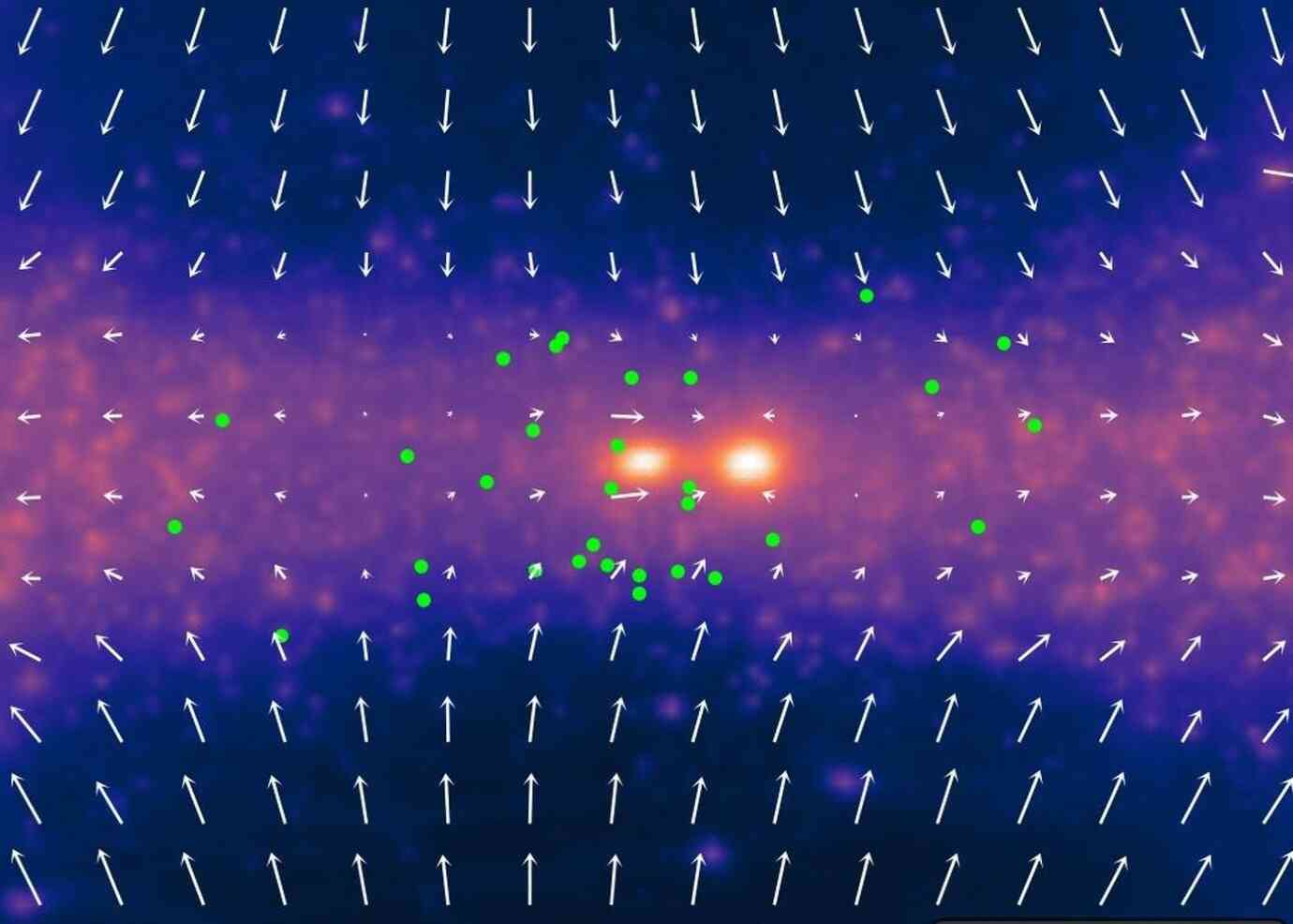
Now, an international team led by doctoral researcher Ewoud Wempe and Professor Amina Helmi at the University of Groningen has shown that the key to this puzzle lies not within the confines of the Local Group alone but in an extended, planar mass structure surrounding it. Using sophisticated cosmological simulations constrained by observational data, including the positions, masses, and velocities of 31 galaxies just beyond the Local Group, the researchers demonstrated that the vast majority of dark matter and visible matter in our vicinity is organized in a flat sheet extending tens of millions of light-years. Above and below this planar structure are vast voids with minimal matter.wempe
 
What sets this discovery apart is the critical role of supercomputing in constructing these “virtual twin” universes. The team’s simulations began with initial conditions seeded by early-universe observations and then evolved forward using numerical methods that solve Einstein’s equations of gravity together with fluid dynamics for dark matter and baryonic matter. Such calculations involve millions of interacting elements and demand parallel computation at scale, the exclusive domain of HPC systems. By performing these simulations on powerful supercomputers, astronomers were able to trace the gravitational influence of the large-scale sheet on galaxy motions and verify that this configuration reproduces observed velocities with high fidelity.
 
According to Helmi, this marks the first time that the distribution and velocity field of dark matter in the region surrounding our galactic neighborhood have been quantitatively constrained in a manner consistent with both ΛCDM cosmology and observed local dynamics. “Astronomers have been trying to solve this problem for decades,” Helmi said. “It is extraordinary that, based purely on the motions of galaxies, we can infer a mass distribution that matches the observed positions and motions of galaxies within and just outside the Local Group.”
 
For the supercomputing community, this achievement is profoundly inspirational. It highlights how modern HPC infrastructures, with their massive parallelism, high memory bandwidth, and optimized numerical libraries, are enabling scientists to probe cosmic questions that were once deemed intractable. These simulations not only illuminate the hidden architecture of our cosmic neighborhood but also exemplify how simulation-based science complements observation, allowing researchers to explore scenarios that cannot be directly imaged or measured.
 
Beyond resolving a decades-old enigma in galactic astronomy, this work reinforces the broader scientific view that large-scale structures, from filaments of the cosmic web to planar mass configurations like the one now identified around the Milky Way, are fundamental to understanding the universe’s evolution. Supercomputers are not just tools for speeding up calculations; they are essential engines of discovery that empower scientists to simulate the universe with realism and precision.
 
As supercomputing technology advances, both in terms of hardware and algorithms, scientists are poised to create increasingly detailed “virtual universes.” These sophisticated simulations will not only put our cosmological models to the test but also inform future telescope and space mission observations, leading to a richer understanding of our cosmic context.
 
According to the study’s authors, uncovering the influence of the Local Sheet on galactic motion is more than just resolving a persistent mystery; it demonstrates the remarkable discoveries possible when computational power, observational insights, and scientific curiosity are combined on a cosmic scale.