Russian prof builds AI that helps discover new space anomalies

The SNAD team, an international network of researchers including Matvey Kornilov, Associate Professor of the HSE University, the National Research University Higher School of Economics in Moscow, Russia, Faculty of Physics, has discovered 11 previously undetected space anomalies, seven of which are supernova candidates. The researchers analyzed digital images of the Northern sky taken in 2018 using a k-D tree to detect anomalies through the ‘nearest neighbor’ method. Machine learning algorithms helped automate the search. The paper is published in New Astronomy3iStock 930030650 1 f1288

Most astronomical discoveries have been based on observations with subsequent computations. While the total number of observations in the 20th century was still relatively small, the volumes of data drastically increased with the arrival of large-scale astronomical surveys. For example, the Zwicky Transient Facility (ZTF), which uses a wide-field view camera to survey the Northern sky, generates ∼1.4 TB of data per night of observation and its catalog contains billions of objects. Manually processing such enormous amounts of data is both expensive and time-consuming, so the SNAD team of researchers from Russia, France, and the US came together to develop an automated solution.

When scientists examine astronomical objects, they observe their light curves, which show variations of an object’s brightness as a function of time. The observers first identify a flash of light in the sky and then follow its evolution to see whether the light becomes brighter or weaker over time, or goes out. In this study, the researchers examined a million real light curves from the ZTF's 2018 catalog and seven simulated live curve models of the types of objects under study. In total, they followed some 40 parameters, including the amplitude of an object's brightness and the timeframe. 

'We described the properties of our simulations using a set of characteristics expected to be observed in real astronomical bodies. In the dataset of approximately a million objects, we were looking for super-powerful supernovae, Type Ia supernovae, Type II supernovae, and tidal disruption events,' explains Konstantin Malanchev, co-author of the paper and postdoc at the University of Illinois at Urbana-Champaign. ‘We refer to such classes of objects as anomalies. They are either very rare, with little-known properties, or appear interesting enough to merit further study.'

The light curve data from real objects were then compared to that of simulations using the k-D tree algorithm. A k-D tree is a geometric data structure for splitting space into smaller parts by cutting it with hyperplanes, planes, lines, or points. In the current research, this algorithm was used to narrow down the search range when looking for real objects with properties similar to those described in the seven simulations.

Subsequently, the team identified 15 nearest neighbors, ie real objects from the ZTF database, for each simulation—105 matches in total, which the researchers then examined visually to check for anomalies. The manual verification confirmed 11 anomalies, of which seven were supernova candidates, and four were active galactic nuclei candidates where tidal disruption events could occur. 

'This is a very good result,' comments Maria Pruzhinskaya, a co-author of the paper and research fellow at the Sternberg Astronomical Institute. ‘In addition to the already-discovered rare objects, we were able to detect several new ones previously missed by astronomers. This means that existing search algorithms can be improved to avoid missing such objects.'

This study demonstrates that the method is highly effective, while relatively easy to apply. The proposed algorithm for detecting space phenomena of a certain type is universal and can be used to discover any interesting astronomical objects, not limited to rare types of supernovae. 

'Astronomical and astrophysical phenomena which have not yet been discovered are in fact anomalies,' according to Matvey Kornilov, Associate Professor of the HSE University Faculty of Physics. 'Their observed manifestations are expected to differ from the properties of known objects. In the future, we will try using our method to discover new classes of objects.'
Dartmouth researchers use new data technique to describe space objects

Supermassive black holes are believed to reside at the center of nearly all large galaxies. The space objects devour galactic gas, dust, and stars. They can even become heavier than some small galaxies.

By knowing how fast a black hole is feeding, its mass, and the amount of radiation nearby, researchers can determine when some black holes underwent their biggest growth spurts. That information, in turn, can tell them about the history of the universe.

As advances such as new images captured by NASA’s James Webb Space Telescope help scientists understand some of the most powerful forces in the universe, a separate Dartmouth study is clarifying the mystery of supermassive black holes in the rapid growth stage, known as active galactic nuclei or AGN.

“The light signatures from these objects have mystified researchers for over a half-century,” says Tonima Tasnim Ananna, a postdoctoral research associate and lead author of a new paper on the special family of black holes.

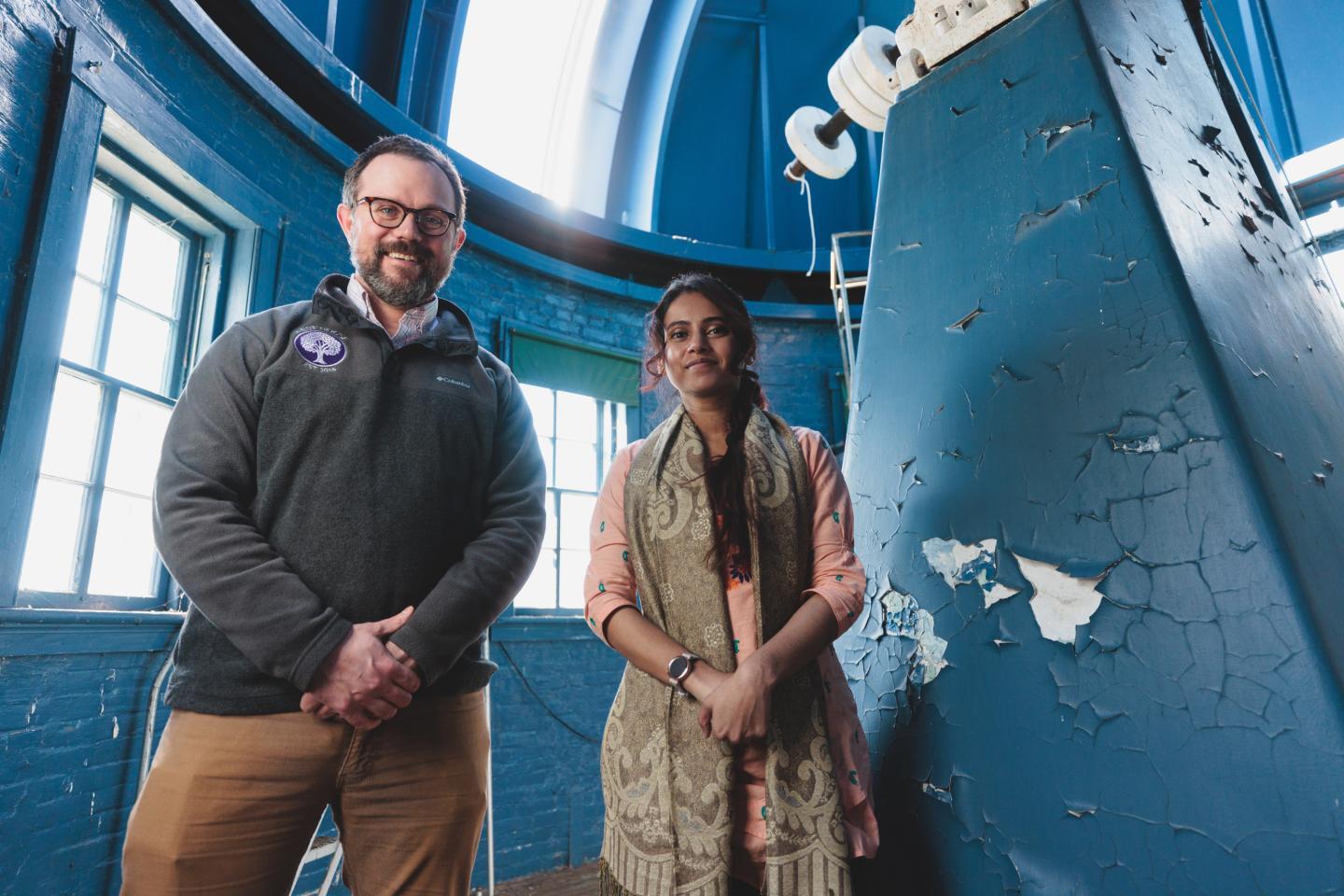
Tonima Tasnim Ananna, postdoctoral research associate, at right, and Ryan Hickox, professor of physics and astronomy, in Dartmouth’s historic Shattuck Observatory. (Photo by Robert Gill)

Light coming from near supermassive black holes can have different colors. They can also vary in brightness and spectral signatures. Until recently, researchers believed that the differences depended on viewing angle and how much a black hole was obscured by its “torus,” a doughnut-shaped ring of gas and dust that usually surrounds active galactic nuclei.

But technical studies from Ananna and others are challenging this model. Ananna and Ryan Hickox, professors of physics and astronomy, have found that the black holes look differently because they are actually in separate stages of the life cycle.

The new Dartmouth study found that the amount of dust and gas surrounding a supermassive black hole is directly related to how actively it is growing. When a black hole is feeding at a high rate, the energy blows away dust and gas. As a result, it is more likely to be unobscured and appear brighter.

The research provides some of the strongest evidence yet that there are fundamental differences between supermassive black holes with different light signatures, and that these differences cannot be explained only by whether the observation is taking place through or around an AGN’s torus.

“This provides support for the idea that the torus structures around black holes are not all the same,” says Hickox, a co-author of the study. “There is a relationship between the structure and how it is growing.”

The finding that it is the feeding rate, not the viewing angle, that determines the light signatures of supermassive black holes stems from a decade-long analysis of nearby AGNs by an international collaboration using Swift-BAT, a high-energy NASA X-ray telescope.

For the study, published in The Astrophysical Journal, Ananna developed a computational technique to assess the effect of obscuring matter on the observed properties of black holes.

The research paper says that it definitively shows the need to revise the prevailing theory of AGN which characterizes obscured and unobscured AGN as similar, despite appearing different due to viewing angle. 

“Over time, we’ve made many assumptions about the physics of these objects. Now we know that the properties of heavily hidden black holes are significantly different from unobscured AGN,” said Ananna.

The answer to the nagging space mystery should allow researchers to create more precise models about the evolution of the universe and how black holes develop.

“One of the biggest questions in our field is where do supermassive black holes come from,” says Hickox. “This research provides a critical piece that can help us answer that question, and I expect it to become a touchstone reference for this research discipline.”

WVU scientists take on pioneering space weather research, forecasting project

A cross-disciplinary team of researchers from West Virginia University is undertaking a pioneering project in space weather research to improve the modeling and forecasting of space weather to safeguard satellites in orbit and infrastructure on Earth. 

Space weather is a relatively unexplored phenomenon that is caused by large bursts of particles released by the sun. The unusually strong bursts result in geomagnetic storms which can cause severe problems for satellites in orbit, and in some cases, unleash problems on Earth, too. Piyush Mehta

“Space weather is an undeniable adversary to our efforts for protecting humans and humankind’s technological infrastructure, including space assets,” said Piyush Mehta, assistant professor, and J. Wayne and Kathy Richard Faculty Fellow of mechanical and aerospace engineering in WVU’s Statler College. “Space weather impacts everything from power delivery and grid security, to communications, satellite operations and collision avoidance, spacecraft damage, radiation exposure for astronauts, and more.”

The team has been awarded $2.4 million over four years from the National Science Foundation in collaboration with colleagues from the University of Texas at Arlington, the Bay Area Environmental Research Institute, and the Electric Power Research Institute under the Grand Challenges in Integrative Geospace Sciences: Advancing National Space Weather Expertise and Research toward Societal Resilience (ANSWERS) program. The project includes co-principal investigators Oleg D. Jefimenko Professor of Physics and Astronomy Earl Scime, Associate Professor Weichao Tu, Research Assistant Professor Christopher Fowler, Professor Paul Cassak from the Department of Physics and Astronomy, and Professor Snehalata Huzurbazar from the Department of Mathematics, Statistics and Data Science at WVU.

The project will encompass a first-of-its-kind experimental investigation to understand how plasma—the most abundant state of matter in our solar system—interacts with elements in the atmosphere around the sun and Earth. 

Scime will lead the laboratory investigation aspect of the project in the Center for KINetic Experimental, Theoretical, and Integrated Computational Plasma Physics in WVU’s Eberly College. The KINETIC Center, funded by NASA, NSF, and the Department of Energy, is the only facility in the world capable of making three-dimensional measurements of the motion of positively charged ions and electrons at small scales.

According to Scime, the big challenge will be to measure how readily particles in the plasma undergo collisions by shooting a beam of electrons through the plasma and measuring how often they collide to reproduce different layers of the Earth’s ionosphere or the solar atmosphere. 

“The award addresses a very acute need in the space weather community for gaining a better understanding of how charged particles and neutral particles in a plasma interact in various environments within the solar system,” Mehta said. “Space weather models presently either ignore the effects of plasma-neutral interactions or rely on dated models and data that have been obtained from simple experiments. We are going to update the information that exists historically, after decades, using a novel experimental investigation.” 

Mehta, the principal investigator of the project, will serve as the project’s coordinator and will lead the efforts for identifying the conditions for which the simulations will be performed, otherwise known as the design of experiments, and the development of contemporary collision frequency models that will be folded into state-of-the-art space weather models. 

Mehta is also an investigator on a second $900,000 ANSWERS project led by Rutgers University that aims to improve our understanding and predictions of several linked space weather components: geoeffective solar eruptions, global magnetic response of Earth to these eruptions, as well as variation of neutral density in the Earth’s thermosphere and its effect on satellite drag. The project is also a collaborative effort between researchers from Rutgers, New Jersey Institute of Technology, Montclair State University, and WVU. 

“The two projects are very relevant to each other,” Mehta said. “In the project led by Rutgers, we want to see how what the sun does translates to the near-Earth environment and trickles down with the energy transfer to the upper atmosphere to understand how that impacts the change in density of the atmosphere, and eventually the change in drag that ultimately impacts satellites in orbit.”

The WVU-led project also incorporates a large educational outreach element that will distribute science kits geared towards exciting and modern science topics to elementary schools in 21 West Virginia counties. The outreach effort will be led by WVU physics Professors Cassak and John Stewart in collaboration with Spark! Imagination and Science Center in Morgantown.

“Substantial research has shown that hands-on activities are key to learning science and motivating students to select STEM careers,” Stewart said. “This equipment may not be currently available to all teachers in West Virginia. We hope the students will first develop an interest in science and curiosity which causes them to investigate further. We hope they begin to see themselves as future scientists and engineers and begin to make the educational choices that make these exciting careers possible.”

As the kits are delivered, teachers will be provided with lesson plans. An outreach presentation will also be made to the classroom to further generate excitement about science.

“None of this would have been possible without having a team at WVU that has complementary expertise,” Mehta said. “It’s truly a multi-disciplinary and multi-institution collaborative project, and by leveraging this, we are aiming to solve a problem that has been very difficult and challenging to solve.”