SUPERCOMPUTING NEWS SUPERCOMPUTING NEWS
    • MEDIA KIT
    • MOST READ
    • RSS FEED
    • ACADEMIA
    • AEROSPACE
    • APPLICATIONS
    • ASTRONOMY
    • AUTOMOTIVE
    • BIG DATA
    • BIOLOGY
    • CHEMISTRY
    • CLIENTS
    • CLOUD
    • DEFENSE
    • DEVELOPER TOOLS
    • EARTH SCIENCES
    • ECONOMICS
    • ENGINEERING
    • ENTERTAINMENT
    • GAMING
    • GOVERNMENT
    • HEALTH
    • OIL & GAS
    • INDUSTRY
    • INTERCONNECTS
    • MANUFACTURING
    • MIDDLEWARE
    • MOVIES
    • NETWORKS
    • PHYSICS
    • PROCESSORS
    • RETAIL
    • SCIENCE
    • STORAGE
    • SYSTEMS
    • VISUALIZATION
    • AcyMailing subscription form

    • ADD YOUR VIDEOS
    • MANAGE VIDEOS
    • CONVERSATION INBOX
    • SOCIAL ADVERTISER
    • SOCIAL NETWORK VIDEOS
    • SURVEYS
    • GROUPS
    • PAGES
    • MARKETPLACE LISTINGS
    • APPLICATIONS BROWSER
    • PRIVACY CONFIRM REQUEST
    • PRIVACY CREATE REQUEST
    • LEADERBOARD
    • POINTS LISTING
      • BADGES
    • TRADE SHOWS
Sign In
Tyler O'Neal, Staff Editor BIG DATA January 16, 2023, 8:18 pm

A black hole repeatedly destroying a star

Animation describing the scientific result published here: Wevers, Coughlin, Pasham et al. (2022), https://ui.adsabs.harvard.edu/abs/202... A mysterious flash of electromagnetic radiation from the center of a galaxy some 800 million light years away was first detected in 2018. The flare lasted for about 2 years and then it disappeared. This behavior is consistent with the supermassive black hole a...

Read more https://www.supercomputingonline.com/gallery/category/news/a-black-hole-repeatedly-destroying-a-star

Syracuse physicist Coughlin builds a model that maps a star’s surprising orbit around a supermassive black hole

Tyler O'Neal, Staff Editor BIG DATA January 16, 2023, 7:00 am

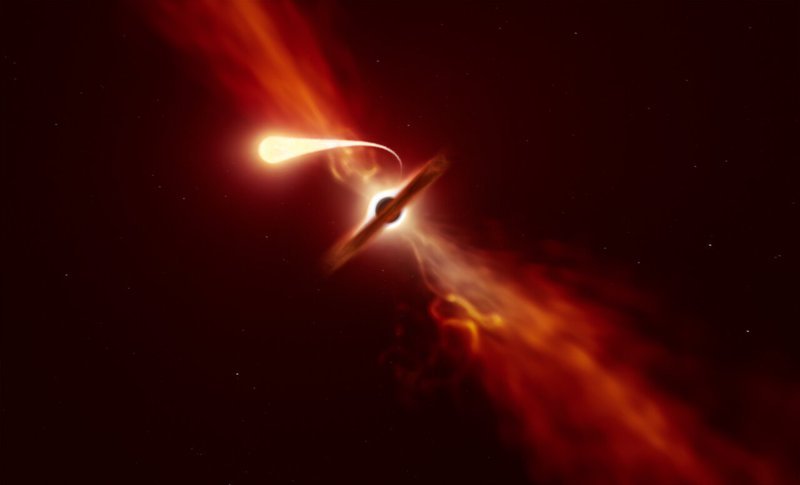
Hundreds of millions of light-years away in a distant galaxy, a star orbiting a supermassive black hole is being violently ripped apart under the black hole’s immense gravitational pull. As the star is shredded, its remnants are transformed into a stream of debris that rains back down onto the black hole to form a very hot, very bright disk of material swirling around the black hole, called an accretion disc. This phenomenon – where a star is destroyed by a supermassive black hole and fuels a luminous accretion flare – is known as a tidal disruption event (TDE), and it is predicted that TDEs occur roughly once every 10,000 to 100,000 years in a given galaxy. 

{media load=media,id=297,width=350,align=left,display=inline}

With luminosities exceeding entire galaxies (i.e., billions of times brighter than our Sun) for brief periods (months to years), accretion events enable astrophysicists to study supermassive black holes (SMBHs) from cosmological distances, providing a window into the central regions of otherwise-quiescent - or dormant - galaxies. By probing these "strong-gravity’’ events, where Einstein's general theory of relativity is critical for determining how matter behaves, TDEs yield information about one of the most extreme environments in the universe: the event horizon – the point of no return – of a black hole. This illustration depicts a star (in the foreground) experiencing spaghettification as it’s sucked in by a supermassive black hole (in the background) during a ‘tidal disruption event’. Credit: ESO/M. Kornmesser
TDEs are usually “once-and-done” because the extreme gravitational field of the SMBH destroys the star, meaning that the SMBH fades back into darkness following the accretion flare. In some instances, however, the high-density core of the star can survive the gravitational interaction with the SMBH, allowing it to orbit the black hole more than once. Researchers call this a repeating partial TDE.

A team of physicists, including lead author Thomas Wevers, Fellow of the European Southern Observatory, and co-authors Eric Coughlin, assistant professor of physics at Syracuse University, and Dheeraj R. “DJ” Pasham, a research scientist at MIT’s Kavli Institute for Astrophysics and Space Research, have proposed a model for a repeating partial TDE. Their findings, published in The Astrophysical Journal Letters, describe the capture of the star by an SMBH, the stripping of the material each time the star comes close to the black hole, and the delay between when the material is stripped and when it feeds the black hole again. The team’s work is the first to develop and use a detailed model of a repeating partial TDE to explain the observations, make predictions about the orbital properties of a star in a distant galaxy, and understand the partial tidal disruption process.

On a Collision Course with a Black Hole

The team is studying a TDE known as AT2018fyk (AT stands for "Astrophysical Transient’’). The star was captured by an SMBH through an exchange process known as “Hills capture,” where the star was originally part of a binary system (two stars that orbit one another under their mutual gravitational attraction) that was ripped apart by the gravitational field of the black hole. The other (non-captured) star was ejected from the center of the galaxy at speeds comparable to ~ 1000 km/s, which is known as a hypervelocity star.

Once bound to the SMBH, the star powering the emission from AT2018fyk has been repeatedly stripped of its outer envelope each time it passes through its point of closest approach with the black hole. The stripped outer layers of the star form the bright accretion disk, which researchers can study using X-Ray and Ultraviolet /Optical telescopes that observe light from distant galaxies.

According to Wevers, having the opportunity to study a repeating partial TDE gives unprecedented insight into the existence of supermassive black holes and the orbital dynamics of stars in the centers of galaxies.

“Until now, the assumption has been that when we see the aftermath of a close encounter between a star and a supermassive black hole, the outcome will be fatal for the star, that is, the star is destroyed,” he says. “But contrary to all other TDEs we know of when we pointed our telescopes to the same location again several years later, we found that it had re-brightened again. This led us to propose that rather than being fatal, part of the star survived the initial encounter and returned to the same location to be stripped of material once more, explaining the re-brightening phase.”

Living to Die Another Day

First detected in 2018, AT2018fyk was initially perceived as an ordinary TDE. For approximately 600 days the source stayed bright in the X-ray, but then abruptly went dark and was undetectable - a result of the stellar remnant core returning to a black hole, explains MIT physicist Dheeraj R. Pasham.

“When the core returns to the black hole it essentially steals all the gas away from the black hole via gravity and as a result, there is no matter to accrete and hence the system goes dark,” Pasham says.

It wasn’t immediately clear what caused the precipitous decline in the luminosity of AT2018fyk because TDEs normally decays smoothly and gradually – not abruptly – in their emission. But around 600 days after the drop, the source was again found to be X-ray bright. This led the researchers to propose that the star survived its close encounter with the SMBH for the first time and was in orbit about the black hole.

Using supercomputer modeling, the team’s findings suggest that the orbital period of the star about the black hole is roughly 1,200 days, and it takes approximately 600 days for the material that is shed from the star to return to the black hole and start accreting. Their model also constrained the size of the captured star, which they believe was about the size of the sun. As for the original binary, the team believes the two stars were extremely close to one another before being ripped apart by the black hole, likely orbiting each other every few days.

So how could a star survive its brush with death? It all comes down to a matter of proximity and trajectory. If the star collided head-on with the black hole and passed the event horizon – the threshold where the speed needed to escape the black hole surpasses the speed of light – the star would be consumed by the black hole. If the star passed very close to the black hole and crossed the so-called "tidal radius" – where the tidal force of the hole is stronger than the gravitational force that keeps the star together – it would be destroyed. In the model they have proposed, the star's orbit reaches a point of closest approach that is just outside of the tidal radius, but doesn't cross it completely: some of the material at the stellar surface is stripped by the black hole, but the material at its center remains intact.

A Repeat Performance?

How, or if, the process of the star orbiting the SMBH can occur over many repeated passages is a theoretical question that the team plans to investigate with future simulations. Syracuse physicist Eric Coughlin explains that they estimate between 1 to 10% of the mass of the star is lost each time it passes the black hole, with the large range due to uncertainty in modeling the emission from the TDE.

“If the mass loss is only at the 1% level, then we expect the star to survive for many more encounters, whereas if it is closer to 10%, the star may have already been destroyed,” notes Coughlin.

The team will keep their eyes on the sky in the coming years to test their predictions. Based on their model, they forecast that the source will abruptly disappear around March 2023 and brighten again when the freshly stripped material accretes onto the black hole in 2025.

The Future of TDE Research

The team says their study offers a new way forward for tracking and monitoring follow-up sources that have been detected in the past. The work also suggests a new paradigm for the origin of repeating flares from the centers of external galaxies.

“In the future, it is likely that more systems will be checked for late-time flares, especially now that this project puts forth a theoretical picture of the capture of the star through a dynamical exchange process and the ensuing repeated partial tidal disruption,” says Coughlin. “We’re hopeful this model can be used to infer the properties of distant supermassive black holes and gain an understanding of their 'demographics,' being the number of black holes within a given mass range, which is otherwise difficult to achieve directly.”

The team says the model also makes several testable predictions about the tidal disruption process, and with more observations of systems like AT2018fyk, it should give insight into the physics of partial tidal disruption events and the extreme environments around supermassive black holes.

“This study outlines a methodology to potentially predict the next snack times of supermassive black holes in external galaxies,” says Pasham. “If you think about it, it is pretty remarkable that we on Earth can align our telescopes to black holes millions of light years away to understand how they feed and grow.”


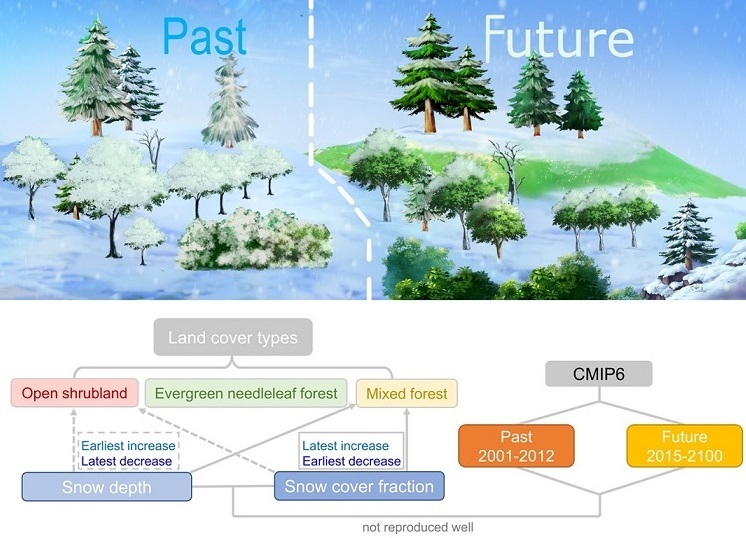
Schematic illustration of the study  CREDIT Xiaodan Guan
Schematic illustration of the study CREDIT Xiaodan Guan

China improves methods that perform parametrization of snow in climate models

Tyler O'Neal, Staff Editor BIG DATA January 13, 2023, 5:16 pm

Seasonal snow is sensitive to climate change and is always taken as a signal of local climate changes. Against the background of global warming, the annual snow cover in the Northern Hemisphere is following an overall decreasing trend. Since snow plays an important role in the water cycle and has significant effects on atmospheric circulation, it is important to be able to simulate it well in climate models. However, as a process that operates on a small scale, snow needs to be approximated (or “parameterized”), and so many studies have attempted to improve the schemes that perform this parametrization of snow in climate models.

In the mid-to-high latitudes of the Northern Hemisphere, the impacts of snow cover dynamics on vegetation show large differences among boreal biomes. Researchers from Lanzhou University, China, selected open shrubland, mixed forest, and evergreen needle leaf forest in the mid-to-high latitudes (45°–70°N), which are highly sensitive to snow changes. Then, over a selected area of North America, Europe, Central Asia, and East Asia, they addressed the unique relationships between snow cover and snow depth for typical vegetation cover types and explored the reproduction of snow accumulation processes by model parameterization. The results have recently been published in Atmospheric and Oceanic Science Letters.

According to the findings of this study, there are different relationships between snow cover and snow depth for these three typical land cover types, and the relationships not only represent the characteristic changes in the processes of snow accumulation and snow melt but can also be used in the model for predicting snow accumulation.

“However, partly because the influence of different land cover types is not fully considered, it was found that state-of-the-art climate models are unable to reproduce the relationships between snow cover and snow depth in both historical and future simulations, which will affect our understanding of the ecological impacts of snowmelt in spring”, says Prof. Xiaodan Guan, the first and corresponding author of this paper.

Therefore, it is important to improve simulation results by considering the interaction between land cover types and snow processes in snow parameterization schemes.

  1. German researchers use MD simulations to learn how to protect biocatalysts from oxygen
  2. Chinese researchers create fluidic memristors with diverse neuromorphic functions

Page 6 of 29

  • 1
  • 2
  • 3
  • 4
  • 5
  • 6
  • 7
  • 8
  • 9
  • 10
POPULAR RIGHT NOW
  • Supercomputers push neural quantum simulation beyond previous limits
    Supercomputers push neural quantum simulation beyond previous limits
  • Intel’s AI supercomputing revival: Q2 financial surge signals new era for CPU-powered HPC infrastructure
    Intel’s AI supercomputing revival: Q2 financial surge signals new era for CPU-powered HPC infrastructure
  • AI infrastructure financing fears shake semiconductor sector
    AI infrastructure financing fears shake semiconductor sector
  • AWS supercomputing investment reaches historic scale as Amazon’s AI strategy powers record financial results
    AWS supercomputing investment reaches historic scale as Amazon’s AI strategy powers record financial results
  • Catching the wave of the future: Supercomputers unlock the hidden dynamics of Venus
    Catching the wave of the future: Supercomputers unlock the hidden dynamics of Venus
  • NCAR supercomputers run planet scale climate experiments impossible in the real world
    NCAR supercomputers run planet scale climate experiments impossible in the real world
  • AI hunts the cosmos: Machine learning helps astronomers discover the first ‘Wandering’ supermassive black hole caught destroying a star
    AI hunts the cosmos: Machine learning helps astronomers discover the first ‘Wandering’ supermassive black hole caught destroying a star
  • Supercomputing for the masses: Meta's vision of a personal superintelligence for everyone
    Supercomputing for the masses: Meta's vision of a personal superintelligence for everyone
  • NVIDIA helps turn AI compute into a new asset class as Wall Street mobilizes $500 billion
    NVIDIA helps turn AI compute into a new asset class as Wall Street mobilizes $500 billion
  • The stars that remember: Supercomputing reveals the hidden histories of massive binary systems
    The star γ Columbae is part of the Southern constellation of Columba, the Dove.
    The star γ Columbae is part of the Southern constellation of Columba, the Dove.
THIS YEAR'S MOST READ
  • Beamforming the future: BeammWave's 6G push signals the rise of orbital-terrestrial wireless networks
    Joakim Axmon
    Joakim Axmon
  • Wall Street wants to trade supercomputing power like oil
    Wall Street wants to trade supercomputing power like oil
  • Cosmic ambition at scale: UK’s supercomputer unlocks a 2.5 petabytes universe
    Cosmic ambition at scale: UK’s supercomputer unlocks a 2.5 petabytes universe
  • Hidden order, revealed at scale: Supercomputing, electron ptychography uncover the inner workings of relaxor ferroelectrics
    Hidden order, revealed at scale: Supercomputing, electron ptychography uncover the inner workings of relaxor ferroelectrics
  • Intel's Q1 results signal supercomputing surge driving Xeon momentum
    Intel's Q1 results signal supercomputing surge driving Xeon momentum
  • Huawei’s Tau Scaling ambition tests the limits of post-Moore semiconductor reality
    He Tingbo from HUAWEI delivered a keynote speech titled "New Semiconductor Path in Practice"
    He Tingbo from HUAWEI delivered a keynote speech titled "New Semiconductor Path in Practice"
  • When stars fall apart: Supercomputing reveals the hidden physics of black holes
    When stars fall apart: Supercomputing reveals the hidden physics of black holes
  • MIT develops computational framework to probe dark matter via gravitational waves
    MIT develops computational framework to probe dark matter via gravitational waves
  • Memory has become the new compute: Why Micron, SK Hynix crossing $1 trillion matters to supercomputing
    Memory has become the new compute: Why Micron, SK Hynix crossing $1 trillion matters to supercomputing
  • AI breaks conservation barriers: Australia’s Wildlife Observatory leverages supercomputing to protect biodiversity
    AI breaks conservation barriers: Australia’s Wildlife Observatory leverages supercomputing to protect biodiversity
  • FRONTPAGE
  • LATEST
  • POPULAR
  • REGISTER
  • SOCIAL
  • VIDEO
  • SUBSCRIPTION
  • RSS
  • GUIDELINES
  • PRIVACY
  • TOS
  • ABOUT
  • +1 (816) 799-4488
  • editorial@supercomputingonline.com
© 2001 - 2026 SuperComputingOnline.com, LLC. All rights reserved. This material may not be published, broadcast, rewritten or redistributed without permission.
Sign In
  • FRONT PAGE
  • LATEST
    • MEDIA KIT
    • MOST READ
    • RSS FEED
    • ACADEMIA
    • AEROSPACE
    • APPLICATIONS
    • ASTRONOMY
    • AUTOMOTIVE
    • BIG DATA
    • BIOLOGY
    • CHEMISTRY
    • CLIENTS
    • CLOUD
    • DEFENSE
    • DEVELOPER TOOLS
    • EARTH SCIENCES
    • ECONOMICS
    • ENGINEERING
    • ENTERTAINMENT
    • HEALTH
    • INDUSTRY
    • INTERCONNECTS
    • GAMING
    • GOVERNMENT
    • MANUFACTURING
    • MIDDLEWARE
    • MOVIES
    • NETWORKS
    • OIL & GAS
    • PHYSICS
    • PROCESSORS
    • RETAIL
    • SCIENCE
    • STORAGE
    • SYSTEMS
    • VISUALIZATION
  • VIDEOS
    • ADD YOUR VIDEOS
    • MANAGE VIDEOS
  • COMMUNITY
    • TRADE SHOWS
    • SOCIAL NETWORK VIDEOS
    • SURVEYS
    • APPLICATIONS BROWSER
    • CONVERSATION INBOX
    • SOCIAL ADVERTISER
    • GROUPS
    • MARKETPLACE LISTINGS
    • PAGES
    • LEADERBOARD
    • POINTS LISTING
      • BADGES
    • PRIVACY CONFIRM REQUEST
    • PRIVACY CREATE REQUEST

Hey there! We noticed you’re using an ad blocker.