

This animation follows the gravitational wave and density
changes in a simulated neutron star merger and compares them to
measurements of a short gamma-ray burst observed by NASA's Compton
mission on July 11, 1991. Dark purple colors represent the
lowest-density material, while yellow-white shows the highest. An
audible tone and a visual frequency scale (at left) track the
steady rise in the frequ...
Astronomers studying archival observations of powerful explosions called short gamma-ray bursts (GRBs) have detected light patterns indicating the brief existence of a superheavy neutron star shortly before it collapsed into a black hole. This fleeting, massive object likely formed from the collision of two neutron stars.
“We looked for these signals in 700 short GRBs detected with NASA’s Neil Gehrels Swift Observatory, Fermi Gamma-ray Space Telescope, and the Compton Gamma Ray Observatory,” explained Cecilia Chirenti, a researcher at NASA’s Goddard Space Flight Center in Greenbelt, Maryland. “We found these gamma-ray patterns in two bursts observed by Compton in the early 1990s.”
A neutron star forms when the core of a massive star runs out of fuel and collapses. This produces a shock wave that blows away the rest of the star in a supernova explosion. Neutron stars typically pack more mass than our Sun into a ball about the size of a city, but above a certain mass, they must collapse into black holes. 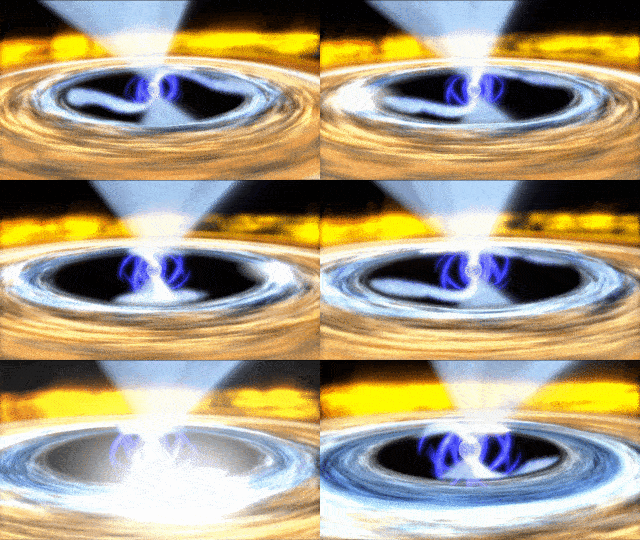
Both the Compton data and supercomputer simulations showed mega neutron stars tipping the scales by 20% more than the most massive, precisely measured neutron star known – dubbed J0740+6620 – which weighs in at nearly 2.1 times the Sun’s mass. Superheavy neutron stars also have nearly twice the size of a typical neutron star or about twice the length of Manhattan Island.
The mega neutron stars spin nearly 78,000 times a minute – almost twice the speed of J1748–2446ad, the fastest pulsar on record. This rapid rotation briefly supports the objects against further collapse, allowing them to exist for just a few tenths of a second, after which they proceed to form a black hole faster than the blink of an eye.
“We know that short GRBs form when orbiting neutron stars crash together, and we know they eventually collapse into a black hole, but the precise sequence of events is not well understood,” said Cole Miller, a professor of astronomy at UMCP and a co-author of the paper. “At some point, the nascent black hole erupts with a jet of fast-moving particles that emits an intense flash of gamma rays, the highest-energy form of light, and we want to learn more about how that develops.”
Short GRBs typically shine for less than two seconds yet unleash energy comparable to what’s released by all the stars in our galaxy over one year. They can be detected more than a billion light-years away. Merging neutron stars also produce gravitational waves, ripples in space-time that can be detected by a growing number of ground-based observatories.
Supercomputer simulations of these mergers show that gravitational waves exhibit a sudden jump in frequency – exceeding 1,000 hertz – as the neutron stars coalesce. These signals are too fast and faint for existing gravitational wave observatories to detect. But Chirenti and her team reasoned that similar signals could appear in the gamma-ray emission from short GRBs.
{media id=295,layout=solo}
Astronomers call these signals quasiperiodic oscillations, or QPOs for short. Unlike, say, the steady ringing of a tuning fork, QPOs can be composed of several close frequencies that vary or dissipate over time. Both the gamma-ray and gravitational wave QPOs originate in the maelstrom of swirling matter as the two neutron stars coalesce.
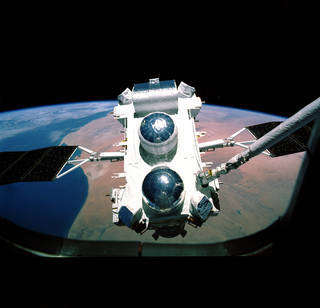
While no gamma-ray QPOs materialized in the Swift and Fermi bursts, two short GRBs recorded by Compton’s Burst And Transient Source Experiment (BATSE) on July 11, 1991, and Nov. 1, 1993, fit the bill.
The larger area of the BATSE instrument gave it the upper hand in finding these faint patterns – the tell-tale flickering that revealed the presence of mega neutron stars. The team rates the combined odds of these signals occurring by chance alone at less than 1 in 3 million.
“These results are very important as they set the stage for future measurements of hypermassive neutron stars by gravitational wave observatories,” said Chryssa Kouveliotou, chair of the physics department at George Washington University in Washington, who was not involved in the work.
By the 2030s, gravitational wave detectors will be sensitive to kilohertz frequencies, providing new insights into the short lives of supersized neutron stars. Until then, sensitive gamma-ray observations and supercomputer simulations remain the only available tools for exploring them.
Compton’s BATSE instrument was developed at NASA's Marshall Space Flight Center in Huntsville, Alabama, and provided the first compelling evidence that gamma-ray bursts occurred far beyond our galaxy. After operating for almost nine years, the Compton Gamma Ray Observatory was deorbited on June 4, 2000, and destroyed as it entered Earth’s atmosphere.
Goddard manages both the Swift and Fermi missions.