

Hungarian researchers reconstruct alternative paths to complex multicellularity in animals, fungi from today's genetic diversity

An international team of researchers with a central contribution from researchers at the Dept. of Biological Physics at Eötvös Loránd University (ELTE) in Budapest has unraveled the evolutionary origins of animals and fungi. The findings demonstrate how genomic data and powerful computational methods allow scientists to answer fundamental questions in evolutionary biology that were previously unapproachable. Animals and fungi are members of the same extended family, called a eukaryotic supergroup. (Photo: Wikipedia)
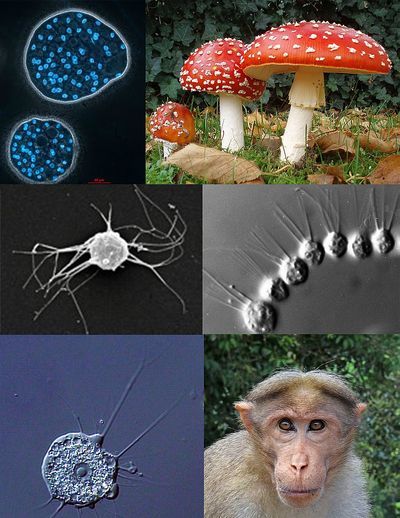
Scientists have always been curious about the evolutionary history of animals and fungi: These two groups of complex multicellular organisms are at first sight entirely dissimilar, but in fact, they are cousins on the Tree of Life. Animals and fungi are members of the same extended family, called a eukaryotic supergroup, and are much more closely related to each other than either are to plants. Understanding how such complex yet contrasting groups evolved within the same eukaryotic supergroup has been challenging due to the lack of a detailed fossil record from when the two groups diverged.

In order to solve this evolutionary enigma, we first had to produce genomic data from the unicellular groups that branch between animals and fungi in the tree of life” — said Iñaki Ruiz-Trillo, Principal Investigator and Professor of Evolutionary Biology at the Institute of Evolutionary Biology in Barcelona and last author of the article.

Instead of relying on fossils, the authors reconstructed the evolution of the two groups from the genetic information found in the genomes of fungi and animals living today. By combining the genomic data produced for these unicellular groups together with genomic data from multiple species of animals and fungi, the researchers reconstructed the trajectory of genetic changes that led to the origin of these two eukaryotic groups using sophisticated computational models of genetic change.

On a methodological level, there are two factors that are having a huge impact in the field of evolutionary biology. One is that currently, it is much easier to produce genomic data for any organism. The second is that nowadays our computers can run much more complex evolutionary models to analyze this data” — commented Gergely J Szöllősi, Principal Investigator at the ERC GENECLOCKS research group and Assistant Professor at the Department of Biological Physics at ELTE and co-author of the article.

The global picture that emerged from analyses is that the genomic differences we see today between modern animals and fungi result from gradual changes that began early in evolution.

The authors' results indicate that this process started immediately after the divergence of the ancestors of the two groups over a billion years ago.   

This surprised us because we expected most changes to have occurred specifically in concomitance with the origin of animals and fungi. What we saw instead is the opposite, most changes in gene content occurred before the origin of the two groups” said Eduard Ocaña-Pallarès, a postdoctoral researcher at ELTE university and first author.

According to the researchers, the line of descent leading to animals began to accumulate genes that would later become essential for animal multicellularity. In contrast, the lineage leading to modern fungi experienced more genetic losses and shifted its genetic content towards metabolic functions. This shift allowed the fungi to adapt to and survive in a bewildering variety of environments. 

Moving from Barcelona to Hungary and joining the ERC GENECLOCKS research group at ELTE was the best decision I could have ever taken from a professional perspective. During my Ph.D. in Barcelona, we generated plenty of genomic data, but all this data is meaningless unless you analyze it with the proper methods. I decided to continue this research in the group of Gergely since I was aware that they were developing cutting-edge software for ancestral gene content reconstruction. This decision was crucial for the success of the project” — concluded Eduard Ocaña-Pallarès, a postdoctoral researcher at the Department of Biological Physics at ELTE.

This work is a great example of how collaboration around the globe can boost science and lead to research excellence,” adds Gergely J. Szöllősi.
Russian physicist shows how disturbers shape El Niño

Physicists and mathematicians of the Ural Federal University (UrFU) have calculated how external factors affect the behavior of El Niño - atmospheric and oceanic processes in the Pacific region. In the mathematical model, they accounted for wind, humidity, temperature, ocean currents, and other parameters that can lead to unpredictable El Niño results. This is a phenomenon in which the temperature of the upper Pacific Ocean rises and the near-surface waters shift eastward. The onset of El Niño affects rainfall, fisheries in Peru, Chile, Ecuador, and climate change on the planet. Description of the features of the unusual phenomenon and its scenarios, the scientists published in the journal Physica D: Nonlinear Phenomena. 

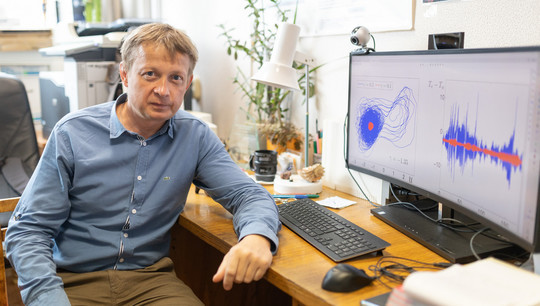
Abnormal temperature fluctuations can also lead to unpredictable results during the El Niño period, Dmitry Alexandrov believes. Photo: Ilya Safarov.“Our calculations have shown that the higher the intensity of the noise, the more unpredictable the consequences, the stronger the disturbances, and the more intense El Niño will manifest itself. And for the system to get out of equilibrium, sometimes you need a little push: a change in humidity or ocean currents,” says Head of the Laboratory of multiscale mathematical modeling at UrFU Dmitri Alexandrov. “The mathematical model allowed us to show how the process will develop under the influence of one or another factor. That is, we did not predict when El Niño would appear or what its consequences for the global climate would be, we calculated possible scenarios of this phenomenon and showed that under some conditions there would be one version of events and under a different set of parameters there would be another.”
According to the calculations of physicists, external factors have a major impact on this phenomenon. For example, the stronger the wind, the greater the temperature amplitude. This, among other things, can throw the system out of balance and cause unpredictable weather phenomena.

“We based on the classical Vallis model, that describes El Niño. It is a simple model. It takes into account the temperature difference between the east and west coasts, the heat exchange between the Pacific Ocean and the atmosphere, and the velocity of air masses. We also took into account external noise - parameters that also affect atmospheric and oceanic processes. For example, changes in pressure, humidity, wind gusts, ocean currents,” says the researcher.

These calculations may come in handy the next time El Niño appears. On the one hand, scientists still cannot predict when El Niño will come next, but, on the other hand, they have learned to predict how El Niño will behave. This is important because El Niño affects the climate as much as global climate change affects this phenomenon.

And if previously it was thought that the consequences of El Niño are observed only in South America, today scientists are confident that the abnormally warm water surface affects the weather of most of the Pacific Ocean, up to the 180th meridian. At the same time during El Niño periods, global weather changes are more pronounced: large-scale changes in ocean temperature, precipitation, atmospheric circulation, and vertical air movement over the tropical Pacific Ocean.

The essence of the process is this: there is a continuous warm current that originates off the coast of Peru and extends to the archipelago southeast of the Asian continent. It is an elongated region of heated water, about the size of the United States. Heated water vaporizes intensively and releases energy into the atmosphere. Clouds form over the heated ocean. Generally, trade winds (constant easterly winds in the tropical zone) move a layer of this warm water away from the U.S. coast toward Asia. Around Indonesia, the current stops, and monsoon rains fall on South Asia. During El Niño, the currents near the equator are warmer than usual, so the trade winds are weaker or not blowing at all. The heated water spreads out to the sides and flows back to the American coast. An anomalous zone of convection appears. Rains and hurricanes are hitting Central and South America.

“We believe that extreme El Niño events may become more frequent in the future and contribute to climate change, just as climate change affects El Niño development. Therefore, El Niño is a process that should be taken into account in global climate models, but this is not done yet, because no one knows how to take into account such an unpredictable and complex phenomenon,” add Dmitri Alexandrov.

China creates hydrodynamic model of the RobDact underwater robot

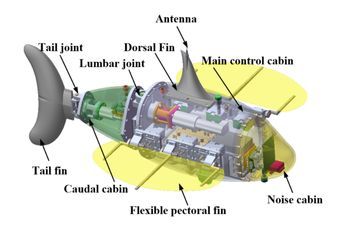
Underwater robots are being widely used as tools in a variety of marine tasks. The RobDact is one such bionic underwater vehicle, inspired by a fish called Dactylopteridae known for its enlarged pectoral fins. A research team has combined computational fluid dynamics and a force measurement experiment to study the RobDact, creating an accurate hydrodynamic model of the RobDact that allows them to better control the vehicle. Scientists from Institute of Automation, Chinese Academy of Science  CREDIT Rui Wang, Institute of Automation, Chinese Academy of Sciences

The team published their findings in Cyborg and Bionic Systems on May 31, 2022.

Underwater robots are now used for many marine tasks, including in the fishery industry, underwater exploration, and mapping. Most traditional underwater robots are driven by a propellor, which is effective for cruising in open waters at a stable speed. However, underwater robots often need to be able to move or hover at low speeds in turbulent waters, while performing a specific task. It is difficult for the propellor to move the robot in these conditions. Another factor when an underwater robot is moving at low speeds in unstable flowing waters is the propeller’s “twitching” movement. This twitching generates unpredictable fluid pulses that reduce the robot’s efficiency.

In recent years, researchers have worked to create underwater robots that mimic living creatures. These bionic vehicles move through the water similar to the ways fish or manta rays move. Compared with traditional underwater propulsion vehicles, these bionic underwater vehicles operate more efficiently and robustly in the water, while being environmentally friendly.

Underwater robots are affected by the surrounding fluid as they move through the water. This phenomenon is called the hydrodynamic effect. While moving in the water, the robot must deal with unknown water flow and force, which can cause unnecessary changes in the robot’s position.

To better control the robot, researchers need a more accurate hydrodynamic model. Creating this model is usually very complex and difficult. In addition, the real underwater environment is changeable and difficult to predict, so the model parameters can shift with a change in the environment. Researchers have been using computational fluid dynamics to create hydrodynamic models for underwater robots. However, the models created with computational fluid dynamics alone are not as precise and practical as they need to be. To overcome this challenge, the research team tried a different approach. “To make the hydrodynamic model more accurate and practical, we combined the computational fluid dynamics and a force measurement experiment,” said Rui Wang, a researcher at the Institute of Automation, Chinese Academy of Sciences.

Using computational fluid dynamics, the researchers identified the parameters in the hydrodynamic model. Then they developed a force measurement platform to obtain the force generated by the RobDact vehicle. With this process, they could obtain both the disturbing force and the force generated by the RobDact in any complex environment. “This could help us have a better understanding of the underwater vehicle’s motion state, and control the underwater vehicle more accurately,” said Qiyuan Cao, a researcher at the Institute of Automation, Chinese Academy of Sciences.

With their experiment, the team was able to determine the hydrodynamic force of the RobDact at different speeds. The force measurement platform they developed allowed them to measure the force of RobDact in the X, Y, and Z directions. They established a mapping relationship between the RobDact fluctuation parameters and the thrust of the vehicle through their force measurement experiments. By merging the rigid body dynamic model of RobDact with the thrust mapping model, the researchers were able to develop an accurate and practical hydrodynamic model of the RobDact in varying motions.

Looking to the future, the researchers intend to study the intelligent control of bionic underwater vehicles using the hydrodynamic model in conjunction with artificial intelligence methods, such as reinforcement learning. “The ultimate goal is to promote the practical application of bionic underwater vehicles in water environment monitoring and underwater search and rescue,” said Wang.

The research team includes Qiyuan Cao and Tiandong Zhang from the Chinese Academy of Sciences, Beijing, and the University of Chinese Academy of Sciences; Rui Wang and Yu Wang from the Chinese Academy of Sciences, Beijing; and Shuo Wang from the Chinese Academy of Sciences, Beijing; the University of Chinese Academy of Sciences, and the Chinese Academy of Sciences, Shanghai.

The research is funded by the Beijing Natural Science Foundation, Beijing Nova Program, National Natural Science Foundation of China, Youth Innovation Promotion Association (Chinese Academy of Sciences), and the Young Elite Scientist Sponsorship Program (China, Association for Science and Technology).