Gravitational waves may reveal nature of dark matter

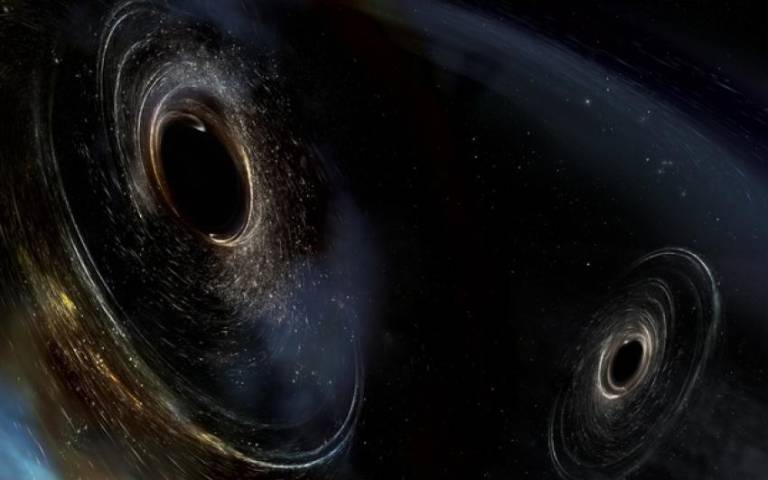
Observations of gravitational waves from merging black holes may reveal new insights about dark matter, suggests a new study from a UCL-led international team.

The study, presented at the 2023 National Astronomy Meeting in Cardiff and now published in the journal Physical Review D, used supercomputer simulations to study the production of gravitational wave signals in simulated universes with different kinds of dark matter.

Their findings show that counting the number of black-hole merging events detected by the next generation of observatories could tell us whether or not dark matter interacts with other particles and therefore help pin down what it is made of.

Cosmologists generally regard dark matter as one of the biggest missing pieces in our understanding of the cosmos. Despite strong evidence that dark matter makes up 85% of all the matter in the Universe, there is currently no consensus on its underlying nature. This includes questions such as whether dark matter particles can collide with other particles such as atoms or neutrinos, or whether they pass straight through them unaffected.

A way to test this is by looking at how galaxies form in dense clouds of dark matter called haloes. If dark matter collides with neutrinos, the dark matter structure becomes dispersed, resulting in fewer galaxies being formed.

The problem with this method is that any galaxies that go missing are very small and very distant from us, so it’s hard to see whether they are there or not, even with the best telescopes available.

Rather than targeting the missing galaxies directly, the authors of this study propose using gravitational waves as an indirect measure of their abundance. Their simulations show that in models where dark matter does collide with other particles, there are significantly fewer black-hole mergers in the distant universe.

While this effect is too small to be seen by current gravitational wave experiments, it will be a prime target for the next generation of observatories that are currently being planned.

The authors hope their methods will help stimulate new ideas for using gravitational wave data to explore the large-scale structure of the Universe, and shine a new light on the mysterious nature of dark matter.

Dr Alex Jenkins (UCL Physics & Astronomy), one of the lead authors of the study, said: “Gravitational waves are a powerful new tool for observing the distant Universe. The next generation of observatories will detect hundreds of thousands of black-hole mergers every year, giving us unprecedented insights into the structure and evolution of the cosmos.”

Co-author Dr Sownak Bose of Durham University said: “Dark matter remains one of the enduring mysteries in our understanding of the Universe. This means it is especially important to continue identifying new ways to explore models of dark matter, combining both existing and new probes to test model predictions to the fullest. Gravitational-wave astronomy offers a pathway to better understand not just dark matter, but the formation and evolution of galaxies more generally.”
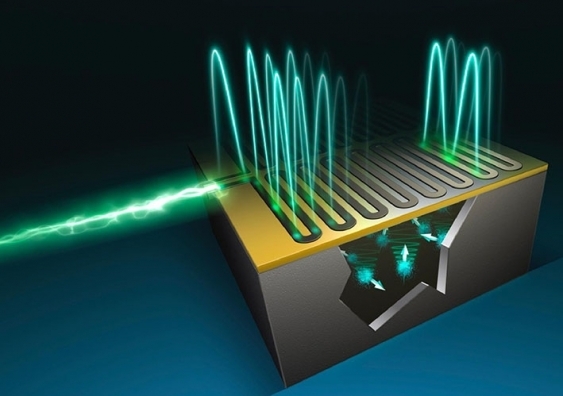
An artist's impression of the ultra-sensitive spin detection device. Image: Tony Melov

Australian engineer Pla invents an ultra-sensitive spin-measuring device

This new spin-measuring device could help scientists - particularly in chemistry and biology - understand the structure and purpose of materials better.

In a paper published over the weekend in the journal Science AdvancesAssociate Professor Jarryd Pla and his team from UNSW School of Electrical Engineering and Telecommunications, together with colleague Scientia Professor Andrea Morello, described a new device that can measure the spins in materials with high precision. The University of New South Wales, also known as UNSW Sydney, is a public research university based in Sydney, New South Wales, Australia. It is one of the founding members of Group of Eight, a coalition of Australian research-intensive universities.

“The spin of an electron – whether it points up or down – is a fundamental property of nature,” says A/Prof. Pla. “It is used in magnetic hard disks to store information, MRI machines use the spins of water molecules to create images of the inside of our bodies, and spins are even being used to build quantum supercomputers.

“Being able to detect the spins inside materials is therefore important for a whole range of applications, particularly in chemistry and biology where it can be used to understand the structure and purpose of materials, allowing us to design better chemicals, drugs, and so on.”

In fields of research such as chemistry, biology, physics, and medicine, the tool that is used to measure spins is called a spin resonance spectrometer. Normally, commercially produced spectrometers require billions to trillions of spins to get an accurate reading, but A/Prof. Pla and his colleagues were able to measure spins of electrons in the order of thousands, meaning the new tool was about a million times more sensitive.

This is quite a feat, as there is a whole range of systems that cannot be measured with commercial tools, such as microscopic samples, two-dimensional materials, and high-quality solar cells, which simply have too few spins to create a measurable signal.

The breakthrough came about almost by chance, as the team was developing a quantum memory element for a superconducting quantum computer. The objective of the memory element was to transfer quantum information from a superconducting electrical circuit to an ensemble of spins placed beneath the circuit.

“We noticed that while the device didn’t quite work as planned as a memory element, it was extremely good at measuring the spin ensemble,” says Wyatt Vine, a lead author on the study. “We found that by sending microwave power into the device as the spins emitted their signals, we could amplify the signals before they left the device. What’s more, this amplification could be performed with very little added noise, almost reaching the limit set by quantum mechanics.”

While other highly sensitive spectrometers using superconducting circuits had been developed in the past, they required multiple components, were incompatible with magnetic fields, and had to be operated in very cold environments using expensive “dilution refrigerators”, which reach temperatures down to 0.01 Kelvin.

In this new development, A/Prof. Pla says he and the team managed to integrate the components on a single chip.

“Our new technology integrates several important parts of the spectrometer into one device and is compatible with relatively large magnetic fields. This is important since measuring the spins they need to be placed in a field of about 0.5 Tesla, which is ten thousand times stronger than the earth’s magnetic field.

“Further, our device operated at a temperature more than 10 times higher than previous demonstrations, meaning we don’t need to use a dilution refrigerator.”

A/Prof. Pla says the UNSW team has patented the technology with a view to potentially commercialize it but stresses that there is still work to be done.

“There is potential to package this thing up and commercialize it which will allow other researchers to plug it into their existing commercial systems to give them a sensitivity gain.

“If this new technology was properly developed, it could help chemists, biologists, and medical researchers, who currently rely on tools made by these large tech companies that work, but which could do something orders of magnitude better.”

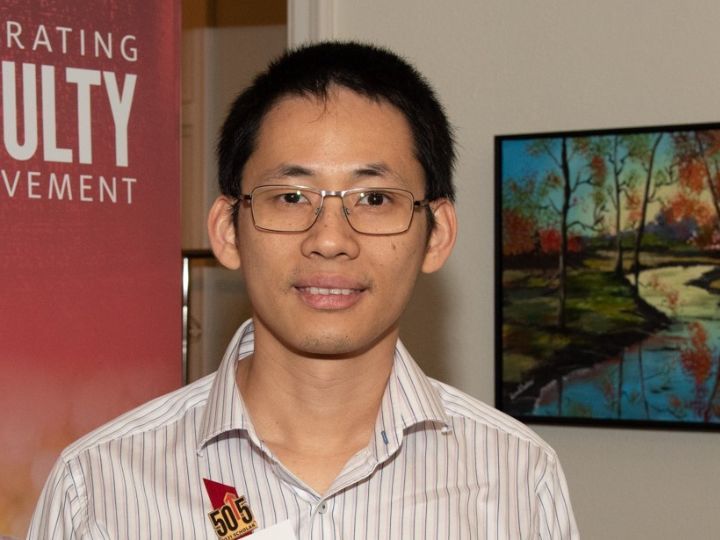
Hien Van Nguyen, University of Houston associate professor of electrical and computer engineering, is developing next-gen artificial intelligence to improve medical diagnostics.

UH engineering prof Nguyen wins NCI grant to create next-gen AI to improve diagnostics 

Despite the remarkable progress in artificial intelligence (AI), several studies show that AI systems do not improve radiologists' diagnostic performance. Diagnostic errors contribute to 40,000 - 80,000 deaths annually in U.S. hospitals. This lapse creates a pressing need: Build next-generation computer-aided diagnosis algorithms that are more interactive to fully realize the benefits of AI in improving medical diagnosis. The new computational framework uses a unique combination of eye-gaze tracking, intention reverse engineering and reinforcement learning to decide when and how an AI system should interact with radiologists.

That’s just what Hien Van Nguyen, the University of Houston associate professor of electrical and computer engineering, is doing with a new $933,812 grant from the National Cancer Institute. He will focus on lung cancer diagnostics. 

“Current AI systems focus on improving stand-alone performances while neglecting team interaction with radiologists,” said Van Nguyen. “This project aims to develop a computational framework for AI to collaborate with human radiologists on medical diagnosis tasks.” 

That framework uses a unique combination of eye-gaze tracking, intention reverse engineering, and reinforcement learning to decide when and how an AI system should interact with radiologists. 

To maximize time efficiency and minimize the amount of distraction on clinical work, Van Nguyen is designing a user-friendly and minimally interfering interface for radiologist-AI interaction.  

The project evaluates the approaches for two clinically important applications: lung nodule detection and pulmonary embolism. Lung cancer is the second most common cancer, and pulmonary embolism is the third most common cause of cardiovascular death.  

“Studying how AI can help radiologists reduce these diseases' diagnostic errors will have significant clinical impacts,” said Van Nguyen. “This project will significantly advance the knowledge of the field by addressing important, but largely under-explored questions.”  

The questions include when and how AI systems should interact with radiologists and how to model radiologists' visual scanning process. 

“Our approaches are creative and original because they represent a substantive departure from the existing algorithms. Instead of continuously providing AI predictions, our system uses a gaze-assisted reinforcement learning agent to determine the optimal time and type of information to present to radiologists,” said Van Nguyen.  

“Our project will advance the strategies for designing user interfaces for doctor-AI interaction by combining gaze-sensing and novel AI methodologies.”