Researchers have successfully conducted the first large-scale supercomputer simulation of a black hole-neutron star merger. The results of the simulation match with puzzling observations and shed light on the behavior of these celestial bodies.
- While astrophysicists previously believed that only supernovae could generate long gamma-ray bursts (GRBs), a 2021 observation uncovered evidence that compact-object mergers also can generate the phenomenon
- Now, a new first-of-its-kind supercomputer simulation confirms and explains this finding
- If the accretion disk around the black hole is massive, it launches a jet that lasts several seconds, matching the description of a long GRB from a merger
According to a report by Northwestern University researchers, it was previously thought that long gamma-ray bursts (GRBs) could not be the result of a neutron star merging with another compact object such as a black hole or another neutron star. However, new observational evidence suggests otherwise. The researchers found that such mergers can indeed lead to long gamma-ray bursts.
Now, another Northwestern team offers a potential explanation for what generated the unprecedented and incredibly luminous burst of light.
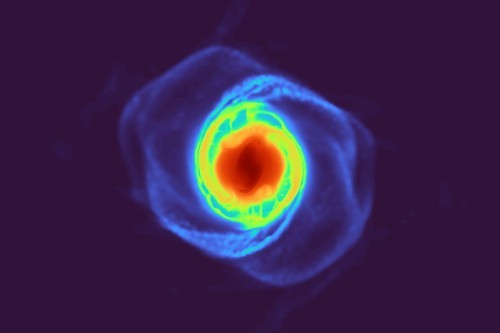
After developing the first supercomputer simulation that follows the jet evolution in a black hole-neutron star merger out to large distances, the astrophysicists discovered that the post-merger black hole can launch jets of material from the swallowed neutron star.
But the key ingredients are the mass of the violent whirlpool of gas (or accretion disk) surrounding the black hole and the strength of the disk’s magnetic field. In massive disks, when the magnetic field is strong, the black hole launches a short-duration jet that is much brighter than anything ever seen in observations. When the massive disk has a weaker magnetic field, however, the black hole launches a jet with the same luminosity and long duration as the mysterious GRB (dubbed GRB211211A) spotted in 2021 and reported in 2022.
Not only does the discovery help explain the origins of long GRBs, but it also gives insight into the nature and physics of black holes, their magnetic fields, and accretion disks.
“So far, no one else has developed any numerical works or simulations that consistently follow a jet from the compact-object merger to the formation of the jet and its large-scale evolution,” said Northwestern’s Ore Gottlieb, who co-led the work. “The motivation for our work was to do this for the first time. And what we found just so happened to match observations of GRB211211A.”
“Neutron-star mergers are captivating multi-messenger phenomena, which result in both gravitational and electromagnetic waves,” said Northwestern’s Danat Issa, who co-led the work with Gottlieb. “However, simulating these events poses a challenge due to the vast spatial and temporal scale separations involved as well as the diverse physics operating across these scales. For the first time, we have succeeded in comprehensively modeling the entire sequence of the neutron star merger process.”
During the research, Gottlieb was a CIERA Fellow at Northwestern’s Center for Interdisciplinary Exploration and Research in Astrophysics (CIERA); now he is a Flatiron Research Fellow at the Flatiron Institute’s Center for Computational Astrophysics. Issa is a graduate student in the Department of Physics and Astronomy at Northwestern’s Weinberg College of Arts and Sciences and a member of CIERA. Issa is advised by paper co-author Alexander Tchekhovskoy, an associate professor of physics and astronomy at Weinberg and a member of CIERA.
Curious kilonova
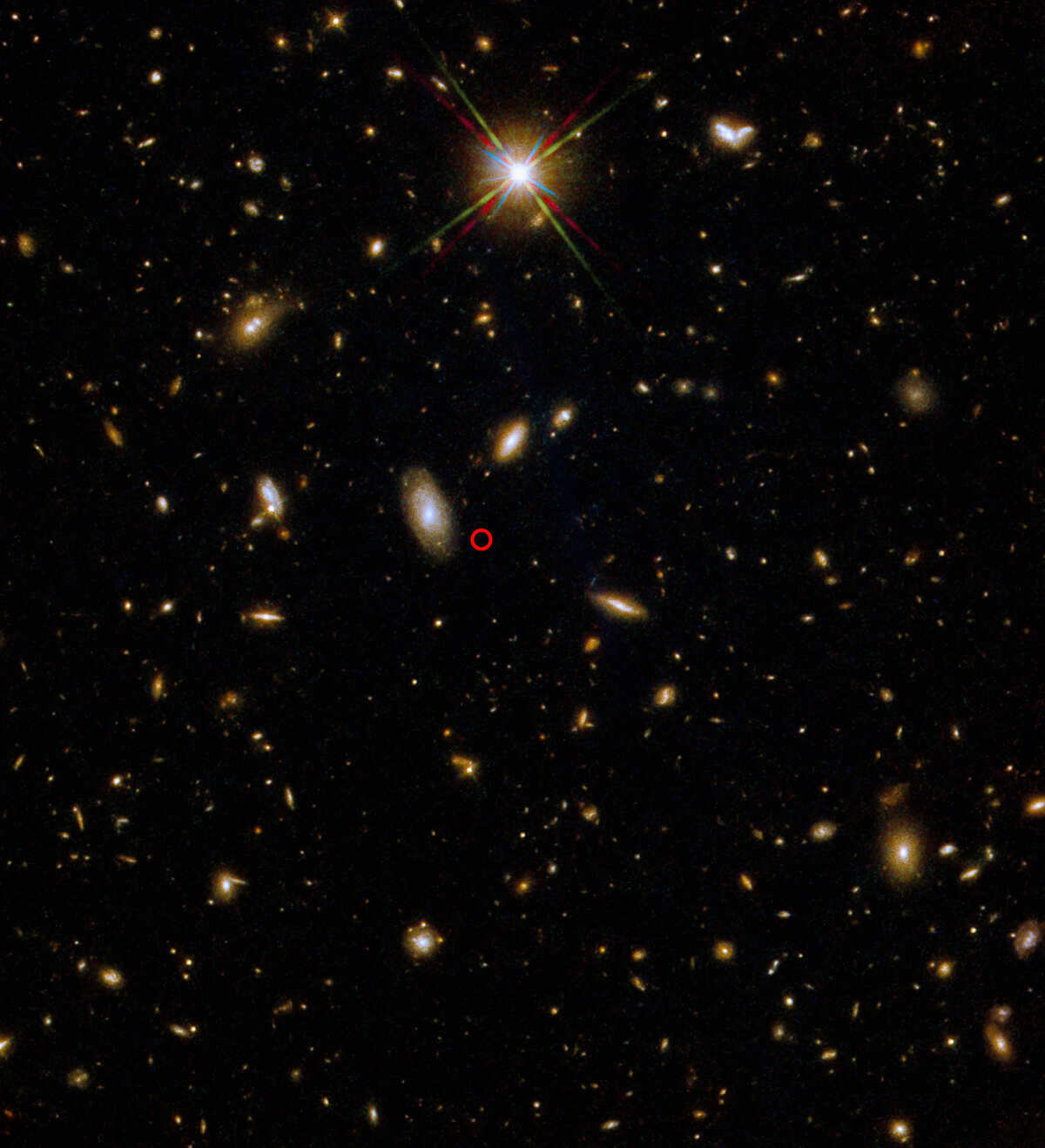
When astronomers first spotted GRB211211A in December 2021, they initially assumed that the 50-second-long event was generated by the collapse of a massive star. But, as they examined the long GRB’s late-time emission, called the afterglow, they uncovered evidence of a kilonova, a rare event that only occurs after the merger of a neutron star with another compact object.
The finding (published in Nature in December 2022) upended the long-established, long-accepted belief that only supernovae could generate long GRBs.
“GRB 211211A reignited interest in the origin of long-duration GRBs that are not associated with massive stars, but likely originating from compact binary mergers,” Gottlieb said.
From pre-merger to long GRB
To further reveal what occurs during compact-merger events, Gottlieb, Issa, and their collaborators sought to simulate the whole process — from before the merger through to the end of the GRB event when the GRB-producing jets shut off. Because it is such an incredibly computationally expensive feat, the entire scenario had never been modeled before. Gottlieb and Issa overcame that challenge by dividing the scenario into two simulations.
First, the researchers simulated the pre-merger phase. Then, they took the output from the first simulation and plugged it into the post-merger simulation.
“Because the space-time used by the two simulations is different, this remap was not as straightforward as we had hoped, but Danat figured it out,” Tchekhovskoy said.
“The daisy chaining of the two simulations allowed us to make the computation much less expensive,” Gottlieb said. “The physics is very complicated in the pre-merger stage because there are two objects. It gets much simpler after the pre-merger because there is only one black hole.”
In the simulation, the compact objects first merged to create a more massive black hole. The black hole’s intense gravity pulled the now-destroyed neutron star’s debris toward it. Before the debris fell into the black hole, some of the debris first swirled around the black hole as an accretion disk. In the configuration studied, the emerging disk was particularly massive with one-tenth the mass of our sun. Then, when the mass fell into the black hole from the disk, it powered the black hole to launch a jet that accelerated to near-light speed.
Disk properties matter
A surprise emerged as the researchers adjusted the strength of the massive disk’s magnetic field. Whereas a strong magnetic field resulted in a short, incredibly bright GRB, a weak magnetic field generated a jet that matched observations of long GRBs.
“The stronger the magnetic field, the shorter is its lifetime,” Gottlieb said. “Weak magnetic fields produce weaker jets that the newly formed black hole can sustain for a longer time. A key ingredient here is the massive disk that can maintain, together with weak magnetic fields, a GRB consistent with observations and comparable to the luminosity and long duration of GRB211211A. Although we found this specific binary system to give rise to a long GRB, we also expect that other binary mergers that produce massive disks will lead to a similar outcome. It’s simply a question of the post-merger disk mass.”
Of course, “long” is relative in this scenario. GRBs are divided into two classes. GRBs with durations of less than two seconds are considered short. If a GRB is two seconds or longer, then it’s considered long. Even events this brief are still exceptionally difficult to model.
“A major portion of this disk material ultimately gets consumed by the black hole, with the whole process lasting mere seconds,” Issa said. “Here lies the main challenge: It is very difficult to capture the evolution of these mergers, using simulations on supercomputers, over several seconds.”
Next up: Neutrinos
Now that Gottlieb and Issa have successfully and comprehensively modeled the full sequence of the merger, they are excited to continue to update and improve their models.
“My current efforts are directed towards enhancing the physical accuracy of the simulations,” Issa said. “This involves the incorporation of neutrino cooling, a vital component that holds the potential to significantly influence the dynamics of the merger process. Furthermore, the inclusion of neutrinos serves as a critical step towards achieving a more accurate assessment of the nuclear composition of the material ejected as a consequence of these mergers. Through this approach, my goal is to provide a more comprehensive and accurate picture of neutron star mergers.”
The unprecedented gamma-ray burst observed in GRB 190114C has been explained by a long-lived jet. While this explanation is supported by the data, further research is needed to confirm the hypothesis and to understand the underlying physical mechanisms.
The study, “Large-scale evolution of seconds-long relativistic jets from black hole-neutron star mergers,” was supported by NASA, the National Science Foundation, and the U.S. Department of Energy.