

Stockholm Resilience Center maps all nine planetary boundaries with six crossed

A team of scientists from around the world has developed a comprehensive framework for assessing planetary resilience. This groundbreaking research identifies nine key processes that impact humanity's ability to thrive safely within our planet's boundaries. Unfortunately, the team's findings show that six of these processes are currently being exceeded, and pressure on all nine is growing. The areas of concern include global warming, the biosphere, deforestation, pollutants, plastic, nitrogen cycles, and freshwater.

“This update on planetary boundaries clearly depicts a patient that is unwell, as pressure on the planet increases and vital boundaries are being breached. We don’t know how long we can keep transgressing these key boundaries before combined pressures lead to irreversible change and harm,” says Stockholm Resilience Center researcher Johan Rockström.

The planetary boundaries framework, which was first introduced in 2009, has been assessed for the third time in a new study. This study is the first to conduct a complete check-up of all nine processes and systems that are responsible for maintaining the stability and resilience of our planet. While the transgression of a boundary does not necessarily result in immediate drastic changes, it indicates a critical threshold of increasing risks to both people and the ecosystems that we are a part of. Planetary Boundaries 2023 b2e84
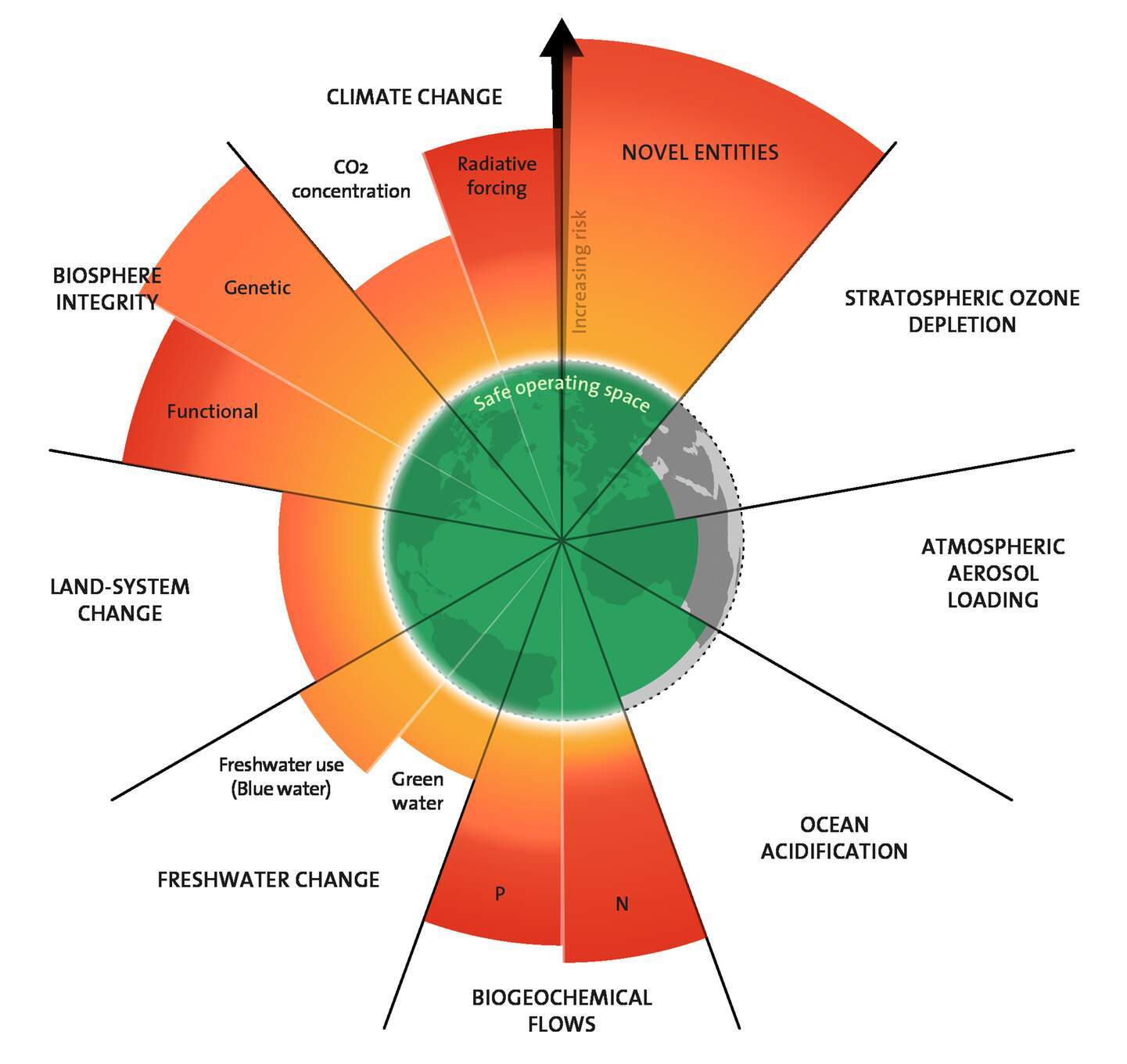
New scientific evidence allows the team to quantify atmospheric aerosol loading. While the boundary is not yet transgressed, rising pressures are evident in regions where air particle pollution impacts monsoon systems.

The assessment confirms that the novel entity boundary, which includes all human-made chemical compounds like microplastics, pesticides, and nuclear waste, has been breached.

The freshwater boundary now considers both green water (held in soil and plants) and blue water (in rivers, lakes, etc.) - both are transgressed.

It is worth noting that a novel method for evaluating biosphere integrity in real-time has been developed. This approach has uncovered signs of compromised ecosystem functionality, indicating that the limit was crossed as early as the late 1800s, when global agriculture and forestry experienced their initial significant expansions.

It is important to comprehend the Earth's climate and ecosystems as a whole system.

In light of these new outcomes, the researchers emphasize that Earth's resilience goes well beyond climate change. 

"The planetary boundaries framework helps scientists to track and communicate how these rising pressures are destabilizing our planet. Earth is a living planet, so the consequences are impossible to predict. That is why we are working more and more with policymakers, businesses, and wider society to try to mitigate pressures on all boundaries,” stresses co-author Sarah Cornell of the Stockholm Resilience Centre at Stockholm University.

The boundary for ozone depletion was exceeded in the 1990s but – thanks to global initiatives, catalyzed by the Montreal Protocol, this boundary is no longer transgressed.

The application of advanced supercomputer models and simulations has proven instrumental in analyzing Earth's ecosystem. Such models facilitate the exploration of the interplay between climate and biosphere interactions. These simulations are conducted over an extended period of several centuries, taking into account both immediate and gradual Earth system processes that culminate in the eventual outcomes of environmental changes triggered today.

"Science and the world at large are really concerned over all the extreme climate events hitting societies across the planet as we move through the third human-amplified El Niño in only 25 years. But what worries us, even more, is the rising signs of dwindling planetary resilience, manifested by the breaching of planetary boundaries, which brings us closer to tipping points, and closes the window to having any chance of holding the 1.5°C planetary climate boundary," Johan Rockström says. 

The planetary boundaries assessment highlights the intricate links between humans and the environment. It provides a framework for systematic efforts to protect, restore, and enhance the Earth's resilience.

“Ultimately, it highlights the environmental consequences of living in the Anthropocene, and our responsibility as future stewards for the planet,” concludes co-author Ingo Fetzer of the Stockholm Resilience Centre at Stockholm University.

The research findings provide a clear reminder of the detrimental impact of human activity on our planet. As of now, six out of the nine planetary boundaries have been breached. If we don't take prompt action to reverse this trend, the resulting consequences could be catastrophic. We must act immediately to safeguard our planet and secure its future well-being.

Hidde ten Berg
Hidde ten Berg

Revolutionizing emergency medicine diagnoses: A new era of accuracy, efficiency with ChatGPT

In a pilot study that will be presented at the European Emergency Medicine Congress, ChatGPT, an artificial intelligence chatbot, was found to be as effective as a trained doctor in suggesting probable diagnoses for patients being evaluated in emergency medicine departments. This is a significant development that demonstrates the potential of AI-powered assistants to aid in healthcare.

Although the researchers say that more work is needed, their findings suggest that the technology could potentially support doctors working in emergency medicine, which could lead to shorter waiting times for patients. The study was conducted by Dr. Hidde ten Berg from the Department of Emergency Medicine and Dr. Steef Kurstjens from the Department of Clinical Chemistry and Hematology, both at Jeroen Bosch Hospital in 's-Hertogenbosch, the Netherlands.

Dr ten Berg told the Congress: “Like a lot of people, we have been trying out ChatGPT and we were intrigued to see how well it worked for examining some complex diagnostic cases. So, we set up a study to assess how well the chatbot worked compared to doctors with a collection of emergency medicine cases from daily practice.”

The Annals of Emergency Medicine has published a research study that provides anonymized data on 30 patients who received treatment at the emergency department of Jeroen Bosch Hospital in 2022. The research team entered the physicians' notes on patients' symptoms, signs, and physical examinations into two versions of ChatGPT (the free 3.5 version and the subscriber 4.0 version). Additionally, they provided the chatbot with the results of lab tests, including blood and urine analysis. For each case, the researchers compared the chatbot's shortlist of probable diagnoses with the shortlist made by emergency medicine doctors and the actual diagnosis of the patient.

During the study, it was discovered that ChatGPT's shortlists had a significant overlap of about 60% with those of the doctors. In 87% of the cases, doctors correctly diagnosed the disease within their top five likely diagnoses, compared to 97% and 87% of ChatGPT versions 3.5 and 4.0, respectively. Dr. Ten Berg acknowledged ChatGPT's ability to provide a list of possible diagnoses and suggest the most probable option. The overlap of the shortlisted diagnoses with those of the doctors indicates that ChatGPT can suggest medical diagnoses like a human doctor.

“For example, we included a case of a patient presenting with joint pain that was alleviated with painkillers, but redness, joint pain, and swelling always recurred. In the previous days, the patient had a fever and sore throat. A few times there was a discoloration of the fingertips. Based on physical exam and tests, doctors suspected rheumatic fever. However, ChatGPT correctly diagnosed vasculitis.

“It’s vital to remember that ChatGPT is not a medical device and there are privacy concerns when using ChatGPT with medical data. However, there is potential here for saving time and reducing waiting times in the emergency department. The benefit of using artificial intelligence could be in supporting doctors with less experience, or it could help in spotting rare diseases.”

Professor Youri Yordanov from the St. Antoine Hospital emergency department (APHP Paris), France, is Chair of the EUSEM 2023 abstract committee and was not involved in the research. He said: “We are a long way from using ChatGPT in the clinic, but it’s vital that we explore new technology and consider how it could be used to help doctors and their patients. People who need to go to the emergency department want to be seen as quickly as possible and to have their problems correctly diagnosed and treated. I look forward to more research in this area and hope that it might ultimately support the work of busy health professionals.”

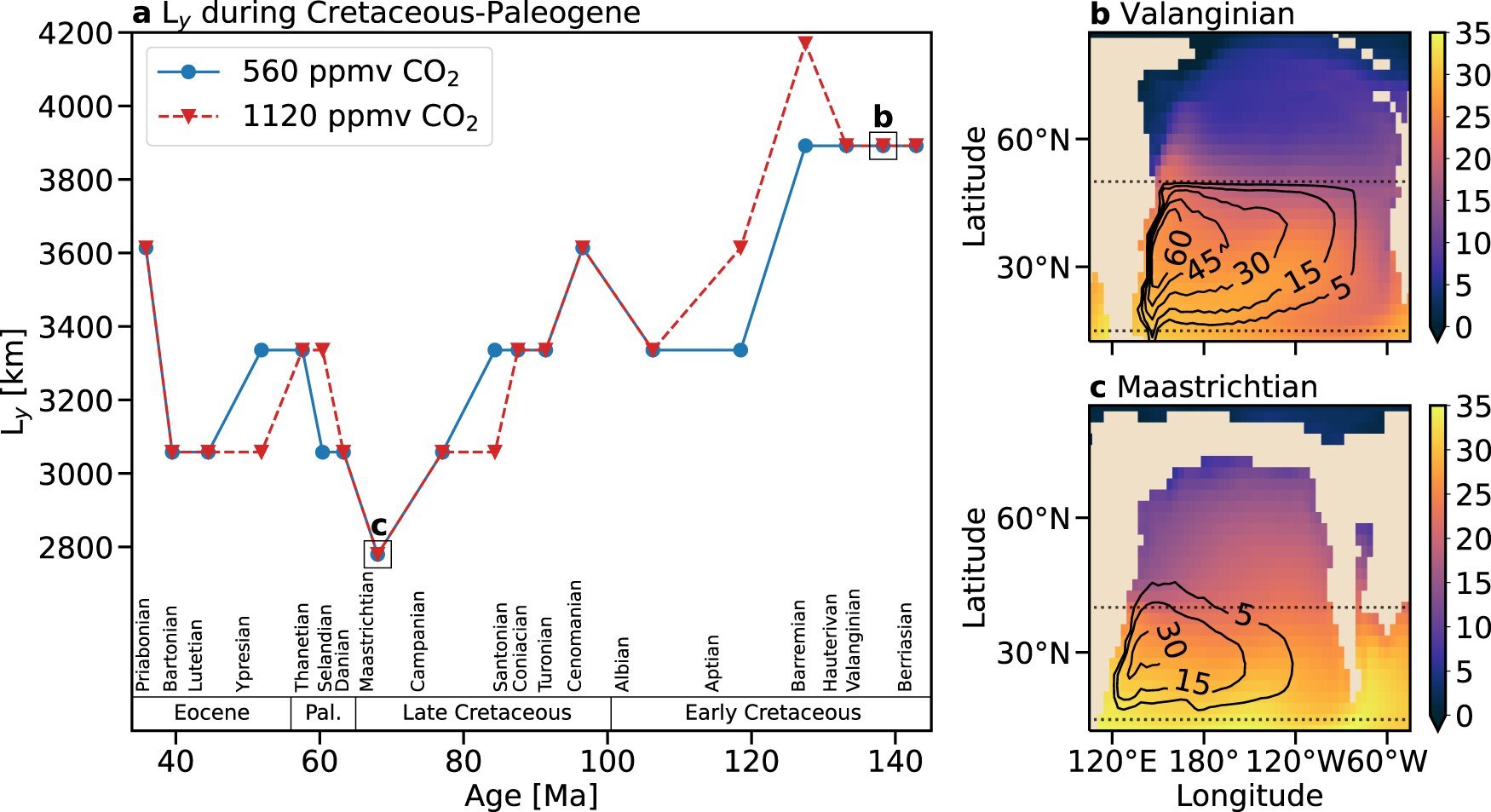
Changes in the meridional extent of the mid-latitudinal gyral basin (Ly) in the Northern paleo-Pacific during the Cretaceous and Paleogene periods for an atmospheric CO2 concentration of 560 ppmv (solid blue curve) and 1120 ppmv (dashed red curve). a Change in Ly during the Early-Late Cretaceous, the Paleocene, and the Eocene epochs. b, c Sea surface temperature (°C, color) and gyral streamlines (Sv, contour; 1 Sv = 106 m3 s−1) in the ocean during the Valanginian (~135 Ma) and the Maastrichtian (~68 Ma) ages for an atmospheric CO2 concentration of 1120 ppmv. Dotted lines mark the latitudes where the wind-stress curl is zero.

Hebrew University conducts a study to determine whether a new mechanism for climate change exists

A recent study has discovered a previously unknown climate mechanism, which provides valuable insights into both past and present climate conditions on Earth. The study focuses on the Cretaceous period, during which high levels of atmospheric carbon dioxide were present. By examining how large ocean currents transported warm water, the research highlights the crucial role these currents played in shaping temperature gradients. The findings suggest that continental shifts during the Cretaceous disrupted these currents, resulting in significant temperature differences between the poles and the tropics. This research not only enhances our understanding of past climate but also emphasizes the importance of ocean currents in shaping modern climate systems.

In Jerusalem, the research study conducted by Hebrew University's Ph.D. candidate, Kaushal Gianchandani, under the guidance of Professors Nathan Paldor and Hezi Gildor from the Institute of Earth Sciences at the Hebrew University, in collaboration with Prof. Ori Adam and Sagi Maor from the Hebrew University has unveiled a previously unknown mechanism that significantly influences Earth's climate.

This cutting-edge research applies a novel analytic model developed by three Hebrew University researchers two years ago, focusing on wind-driven circulation at the ocean's surface and highlighting the pivotal role of ocean basin geometry. This study explores the climate during the Cretaceous period, around 145 to 66 million years ago when there was a lot of carbon dioxide (warming gas) in the air. It looks at how big ocean swirls, which move warm water from the tropics to the poles, influenced the temperature difference between these two regions. This temperature difference is crucial for understanding why there were so many different kinds of plants and animals during the Cretaceous period.

In their research, the scientists aimed to uncover the complex relationship between changes in ocean current patterns (gyral circulation) that result from the arrangement of continents on Earth and variations in temperature gradients during the Cretaceous era when dinosaurs roamed the Earth. To do this, they conducted a thorough analysis using computer models that simulate ancient climates. Their findings revealed that the movement of Earth's continents during the Cretaceous period caused a slowdown in the large swirling ocean currents responsible for carrying warm water from the equator to the poles. This slowdown disrupted the way the ocean regulated its surface temperatures, resulting in a significant increase in temperature differences between the poles and the tropics during that time. These findings align with geological evidence from the Cretaceous era, providing a more comprehensive understanding of past climate dynamics.

Key takeaways:
Discovery of a Previously Unknown Mechanism: The study has unveiled a previously unknown mechanism that significantly influenced Earth's climate during the Cretaceous period. This mechanism is related to changes in the distribution of the continents which affects ocean current patterns and their impact on temperature gradients.

Implications for Contemporary Climate: While the study primarily focuses on the Cretaceous period, it has implications for our understanding of contemporary climate systems. It highlights the importance of ocean gyres (circulation patterns) in shaping climate dynamics, both in the past and today. It underscores the complexity of Earth’s climate and the strong effect that processes other than CO2 concentration might have on it.

Focus on Cretaceous Period: The research primarily focuses on the climate during the Cretaceous period, which occurred approximately 145 to 66 million years ago. This period is of interest because it was characterized by high levels of carbon dioxide in the atmosphere, which is a greenhouse gas that can influence global temperatures.

Role of Ocean Swirls (Gyral Circulation): The study investigates the role of large ocean swirls, known as gyral circulation, in transporting warm water from the tropics to the poles. Understanding how these currents influenced temperature differences between the poles and the tropics is crucial for comprehending the biodiversity and climate of the Cretaceous period.

Impact of Continental Movement: The research findings suggest that the movement of Earth's continents during the Cretaceous period disrupted the large ocean currents responsible for transporting warm water. This disruption led to significant increases in temperature differences between the poles and the tropics during that time.

Validation with Geological Evidence: The study's findings align with geological evidence from the Cretaceous era, providing further support for the proposed mechanisms and enhancing our understanding of past climate dynamics.

This research sheds light on the complex relationship between ocean circulation patterns, equator-to-pole temperature differences, and past climate conditions. Although it primarily contributes to our understanding of our planet's ancient climate, it also emphasizes the significance of oceanic processes in shaping modern climate systems. This knowledge can potentially help us model and predict the effects of climate change in the present era, as ocean circulation patterns continue to play a crucial role in regulating global climate.

The study carried out by Hebrew University has uncovered a previously unknown mechanism that could have a significant impact on Earth's climate. However, further research is necessary to fully comprehend the implications of this mechanism and its potential effects on global climate. Moreover, it is crucial to consider the potential impacts of other factors, such as human activity, that could be influencing the climate. Hence, it is too early to draw any definitive conclusions about the potential impacts of this newly discovered mechanism on Earth's climate.