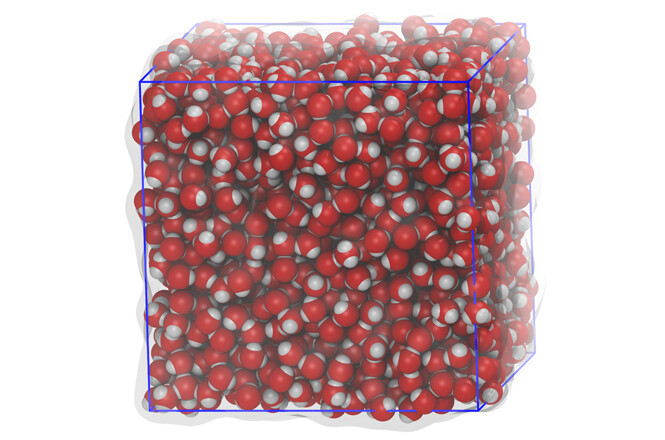
Water models enable the simulation of the behavior of water molecules in a volume and the calculation of important micro- and macroscopic properties from the observed interactions. This study evaluated the shear viscosities of the water models OPC and OPC3 at different temperatures and found that they outperform other conventional models.

Unveiling the shear viscosities of popular water models: A Japanese researcher's perspective

Water is one of the most abundant substances on Earth and partakes in countless biological, chemical, and ecological processes. Thus, understanding its behavior and properties is essential in a wide variety of scientific and applied fields. To do so, researchers have developed various water models to reproduce the behavior of bulk water in molecular simulations. While these simulations can provide valuable insights into the specific properties of water, selecting an appropriate model for the system under study is crucial. Today, two water models have become very popular among biomolecular researchers: the 4-point Optimal Point Charge (OPC) and 3-point OPC (OPC3) models. These models are known for their ability to reproduce several properties of water with high accuracy, including density, heat of vaporization, and dielectric constant. However, there is limited information on whether OPC and OPC3 water models can accurately predict the shear viscosity of water.

The viscosity of water greatly affects how water molecules interact with other substances and surfaces, dictating critical phenomena such as diffusion and absorption. This affects the texture and taste of foods and beverages, as well as how oils and liquids interact with food during cooking. More importantly, the viscosity of water needs to be considered when designing and manufacturing pharmaceutical products, as well as many types of lubricants and polymeric materials. In addition, it influences how water and water-based solutions flow through small tubes, such as those in our circulatory system and in microfluidic devices.

Recently, Associate Professor Tadashi Ando from Tokyo University of Science conducted a study to test the performance of the OPC and OPC3 models, by evaluating their shear viscosities and comparing the values to the experimental calculations. These findings were published in Volume 159, Issue 10 of The Journal of Chemical Physics on September 14, 2023.

First, Dr. Ando set up molecular dynamics simulations of up to 2,000 water molecules using popular water models, including OPC, OPC3, and variants of the Transferable Intermolecular Potential 3-point (TIP3P) and 4-point (TIP4P) models. Next, he used an approach known as the Green-Kubo formalism―a commonly used method from statistical mechanics to study viscosity and heat conduction in various materials― to calculate the viscosity of the models.

The calculated viscosities for both OPC and OPC3 water models were very close to each other for temperatures ranging from 273 K to 373 K. Notably, for temperatures above 310 K, the viscosity predicted by these models was very close to that predicted by previous experimental findings. However, this was not the case at lower temperatures. Dr. Ando explains, "Compared to other water models, the performance of the OPC and OPC3 models in terms of predicting the shear viscosity was lower than that of TIP4P and TIP3P variants, but only for temperatures below 293 K." Notably, at 273 K and 293 K, the shear viscosities of the two models were around 10% and 20% lower, respectively, as compared to those derived experimentally.

In addition to viscosity, Dr. Ando also assessed the performance of the OPC and OPC3 models for predicting other important water properties, such as surface tension and self-diffusion. The performance of OPC and OPC3 for these properties was remarkably accurate. "Based on the results of this study, along with those from previous reports, we can conclude that the OPC and OPC3 are among the best nonpolarizable water models at present, accounting for the various static and dynamic properties of water," highlights Dr. Ando.

The results of this study demonstrate that the shear viscosities of the water models widely used in biomolecular research can vary significantly, and that the choice of model can have a significant impact on the accuracy of the results. Further research is needed to determine the best model for specific applications.
Discover the mysteries of our galaxy by exploring the universe with NASA through their study of gravitational waves!

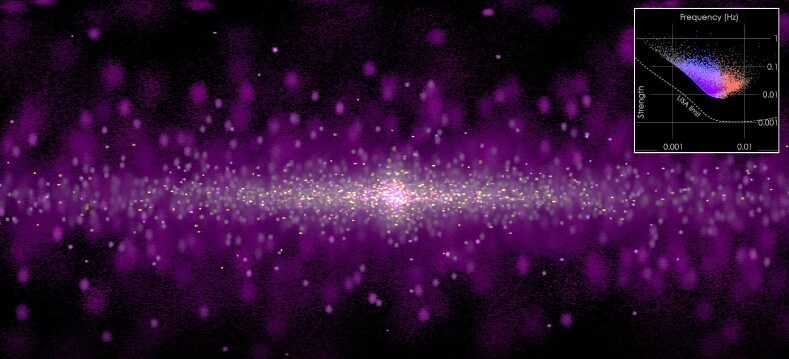
Astronomers have used simulated data to provide an insight into how the sky would look like in gravitational waves – the cosmic ripples in space-time caused by orbiting objects. The produced image showcases how space-based gravitational wave observatories, which are expected to launch in the next decade, will improve our understanding of our galaxy. 

Since 2015, ground-based observatories have detected roughly a hundred events showing the mergers of systems that pair neutron stars, stellar-mass black holes, or both. The signals usually last for less than a minute, have high frequencies, and can occur anywhere in the sky, with their sources located far beyond our galaxy.

“Binary systems also fill the Milky Way, and we expect many of them to contain compact objects like white dwarfs, neutron stars, and black holes in tight orbits,” said Cecilia Chirenti, a researcher at the University of Maryland, College Park, and NASA’s Goddard Space Flight Center in Greenbelt, Maryland. “But we need a space observatory to ‘hear’ them because their gravitational waves hum at frequencies too low for ground-based detectors.”

Astronomers refer to ultra-compact binaries as UCBs, and they anticipate that LISA (Laser Interferometer Space Antenna) - a project led by the European Space Agency (ESA) in conjunction with NASA - will detect tens of thousands of these binary systems in the future. Detecting UCBs is challenging since they are usually dim in visible light, and astronomers have only discovered a few with an orbital period of less than an hour. The discovery of numerous new UCBs is one of the primary goals of LISA. 

To create an all-sky view of the galaxy's UCBs, the team utilized data that simulated the expected distribution and gravitational wave signals of these binary systems. They developed a technique that combines the data into a single view. The Astronomical Journal published a paper describing this technique.

“Our image is directly analogous to an all-sky view of the sky in a particular type of light, such as visible, infrared, or X-rays,” said Goddard astrophysicist Ira Thorpe. “Gravitational waves promise that we can observe the universe in a totally different way, and this image really brings that home. I hope one day I can see a version made with real LISA data on a poster or T-shirt.”

NASA's recent simulation of our galaxy in gravitational waves has provided us with a unique glimpse into the vastness and complexity of the universe. This simulation has opened up a new window of exploration, allowing us to gain a better understanding of the physics of the universe and the mysteries it holds. As we continue to explore the depths of the universe, we can be inspired by the potential for discovery and the possibilities that await us.

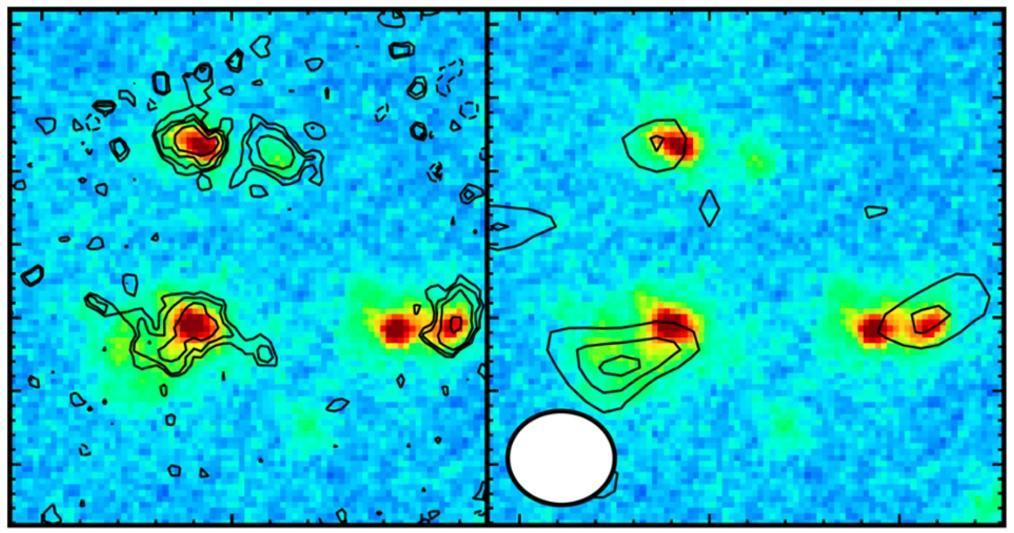
Figure 2. The background color image shows a map of the light intensity (redder color shows stronger emission) in the core region of the protogalactic cluster A2744ODz7p9, acquired with the NIRCam onboard JWST. The size of the image corresponds to about half of the radius of the Milky Way Galaxy. (Left) Contours show the distribution of light emitted by ionized oxygen, obtained with the NIRSpec instrument onboard JWST. 4 galaxies were identified at 13.14 billion light-years away. (Right) Contours show the distribution of dust emission from three of the four galaxies. The white circle in the lower left of the figure indicates the beam size of the ALMA data. Credit: JWST (NASA, ESA, CSA), ALMA (ESO/NOAJ/NRAO), T. Hashimoto et al.

The James Webb Space Telescope, ALMA capture the core of the most distant galaxy protocluster

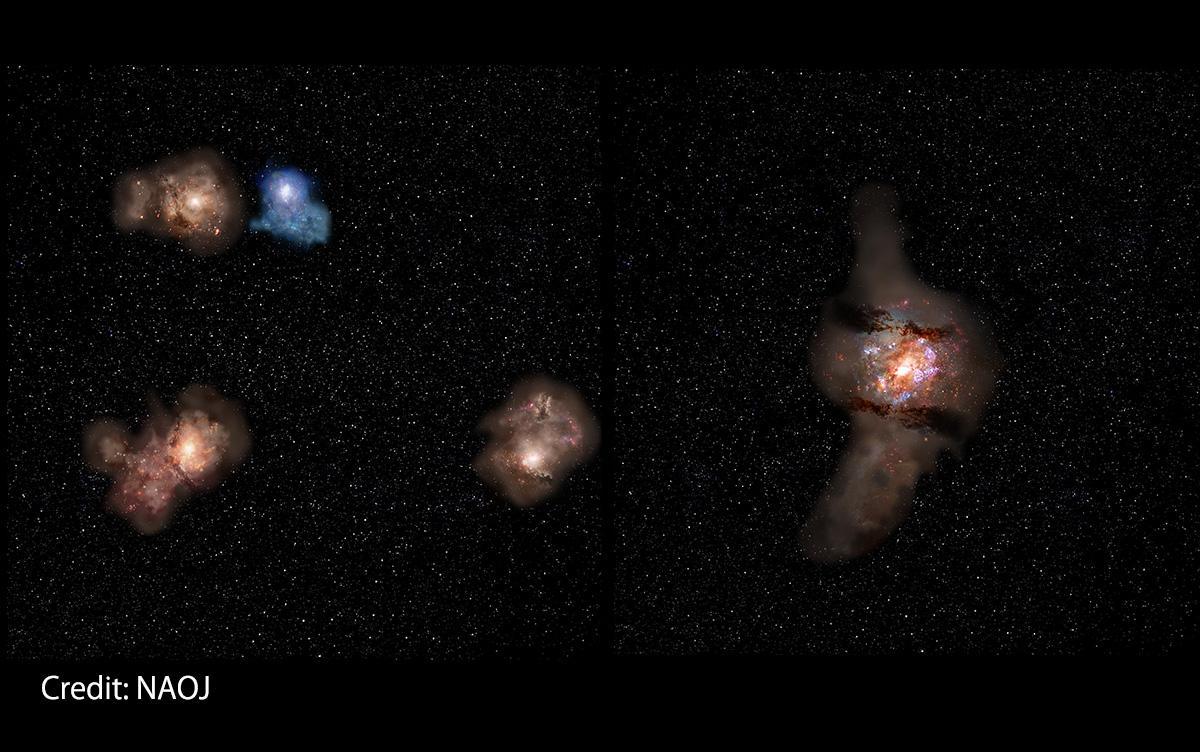
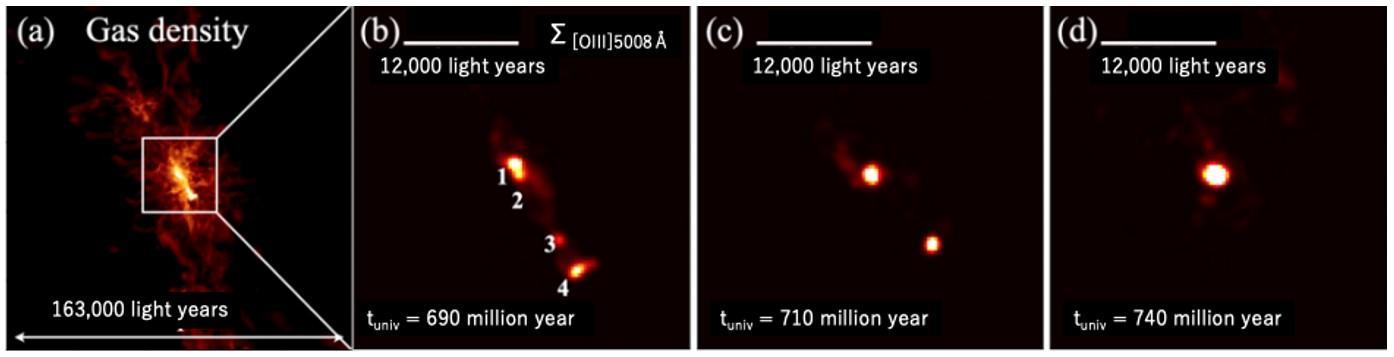
p20230920000100 en 2de95An international team of researchers, led by Assistant Professor Takuya Hashimoto from the University of Tsukuba in Japan and Researcher Javier Álvarez-Márquez from El Centro de Astrobiología (CAB, CSIC-INTA) in Spain, has used the James Webb Space Telescope and the Atacama Large Millimeter/submillimeter Array to observe the most distant galaxy protocluster to date, located 13.14 billion light-years away. The team has successfully captured the "core region" of the galaxy protocluster, which corresponds to a metropolitan area with a particularly high number density of galaxies. They discovered that many galaxies are concentrated in a small area and that the growth of galaxies is accelerated in this region. Additionally, the team used supercomputer simulations to predict the future of this metropolitan area and found that the region will merge into one larger galaxy in tens of millions of years. These findings are expected to shed light on the birth and growth of galaxies. The image describes simulations of the formation of a galaxy cluster similar to A2744z7p9OD, using a supercomputer model. The simulations show a region with high gas density at a cosmological age of 689 million years, and a closer view of the core region, which is observed by the James Webb Space Telescope (JWST). The color map indicates the distribution of oxygen ions. The simulations also show the gradual merging of the four galaxies in the region, which eventually evolve into a larger object. Credit: T. Hashimoto et al.
The study of individual stars' birth and death in galaxies, the birth of new stars from remnants of old ones, and how galaxies grow are important themes in astronomy. They provide insight into our roots in the Universe. Galaxy clusters, one of the largest structures in the Universe, are composed of more than 100 galaxies bound together by mutual gravitational force. Observations of nearby galaxies have shown that the growth of a galaxy depends on its environment. For instance, mature stellar populations are commonly observed in densely collected regions of galaxies. This phenomenon is referred to as the "environment effect." However, it is not well known when the effect first occurred in the history of the Universe. A key to understanding this is observing the ancestors of galaxy clusters soon after the Universe's birth, which are known as galaxy protoclusters or protoclusters. These assemblies consist of about ten distant galaxies. Fortunately, astronomy allows us to observe the distant Universe as it was in the past. For instance, light from a galaxy 13 billion light-years away takes 13 billion years to reach Earth. Therefore, what we observe now is what that galaxy looked like 13 billion years ago. However, light that travels 13 billion light-years becomes fainter, so telescopes that observe it must have high sensitivity and spatial resolution.

A team of researchers led by Assistant Professor Takuya Hashimoto from the University of Tsukuba, Japan, and researcher Javier Álvarez-Márquez from the Spanish Center for Astrobiology used two powerful telescopes, the James Webb Space Telescope (JWST) and the Atacama Large Millimeter/submillimeter Array (ALMA), to study the "core region" of the protocluster A2744z7p9OD. This cluster had been hailed as the most distant proto-cluster at 13.14 billion light-years away based on observations with the JWST by another group of researchers. However, Hashimoto's team discovered that they had not studied the entire core region, which is the metropolitan area with the largest number of galaxy candidates in this protocluster. It was unclear whether the environmental effects of galaxies had begun in this protocluster. Therefore, the team decided to focus their research on the core region. "We wanted to determine if the environmental effects of galaxies had started in the protocluster. Our study will help us better understand the formation and evolution of galaxies in the early universe," said Hashimoto.

During their research, the team utilized the JWST to observe the core region of a protocluster. They used an instrument called NIRSpec, which can observe spectra at wavelengths ranging from visible to near-infrared, to conduct integral field spectroscopy observations. This allowed them to simultaneously acquire spectra from all locations within the field of view. The team was able to detect ionized oxygen-ion light ([OIII] 5008 Å) from four galaxies in a quadrangle region measuring 36,000 light-years along a side. This is equivalent to half the radius of the Milky Way galaxy (Figure 2). The distance of the four galaxies from the Earth was identified as 13.14 billion light years based on the redshift of this light (the elongation of the wavelength due to cosmic expansion). "I was surprised when we identified four galaxies by detecting oxygen-ion emission at almost the same distance. The 'candidate galaxies' in the core region were indeed members of the most distant protocluster," says Yuma Sugahara (Waseda/NAOJ), who led the JWST data analysis.

The research team paid attention to the archival ALMA data, which had already been acquired for this region. This data captures radio emissions from cosmic dust in distant galaxies. After analyzing the data, they were able to detect dust emissions from three out of four galaxies in this region. This is the first time that dust emission has been detected in member galaxies of a protocluster this far back in time. Cosmic dust in galaxies is thought to be supplied by supernova explosions at the end of the evolution of massive stars, which provide material for new stars. Therefore, the presence of large amounts of dust in a galaxy indicates that many of the first-generation stars in the galaxy have already completed their lives and that the galaxy is growing. Professor Luis Colina from El Centro de Astrobiología (CAB, CSIC-INTA) describes the significance of the results: "Emission from cosmic dust was not detected in member galaxies of the protocluster outside the core region. The results indicate that many galaxies are clustered in a small region and that galaxy growth is accelerated, suggesting that environmental effects existed only ~700 million years after the Big Bang."

Additionally, the research team conducted a galaxy formation simulation to test how the four galaxies in the core region formed and evolved. The results showed that a region of dense gas particles existed around 680 million years after the Big Bang. The simulation also showed that four galaxies were formed, similar to the observed core region. To follow the evolution of these four galaxies, the simulation calculated physical processes such as the kinematics of stars and gas, chemical reactions, star formation, and supernovae. The simulations showed that the four galaxies merge and evolve into a single larger galaxy within a few tens of millions of years, which is a short time scale in the evolution of the Universe. Yurina Nakazato, a graduate student at the University of Tokyo who analyzed the simulation data, says "We successfully reproduced the properties of the galaxies in the core region owing to the high spatial resolution of our simulations and the large number of galaxy samples we have. In the future, we would like to explore the formation mechanism of the core region and its dynamical properties in more detail."

Javier Álvarez-Márquez from the Spanish Center for Astrobiology says, "We will conduct more sensitive observations of the proto-cluster A2744z7p9OD with ALMA to see if there are any galaxies that were not visible with the previous sensitivity. We will also apply the JWST and ALMA observations, which have proven to be very powerful, to more protoclusters to elucidate the growth mechanism of galaxies and explore our roots in the Universe."

The James Webb Space Telescope and ALMA have proven to be a powerful combination in exploring the universe. Their joint effort has enabled us to capture the core of the most distant galaxy protocluster ever discovered, providing us with a glimpse of the earliest stages of galaxy formation. This remarkable achievement is a testament to the power of human ingenuity and collaboration and serves as a reminder of the potential of science and technology to unlock the mysteries of the cosmos. With the continued development of these two powerful tools, we can look forward to even more remarkable discoveries in the future.