

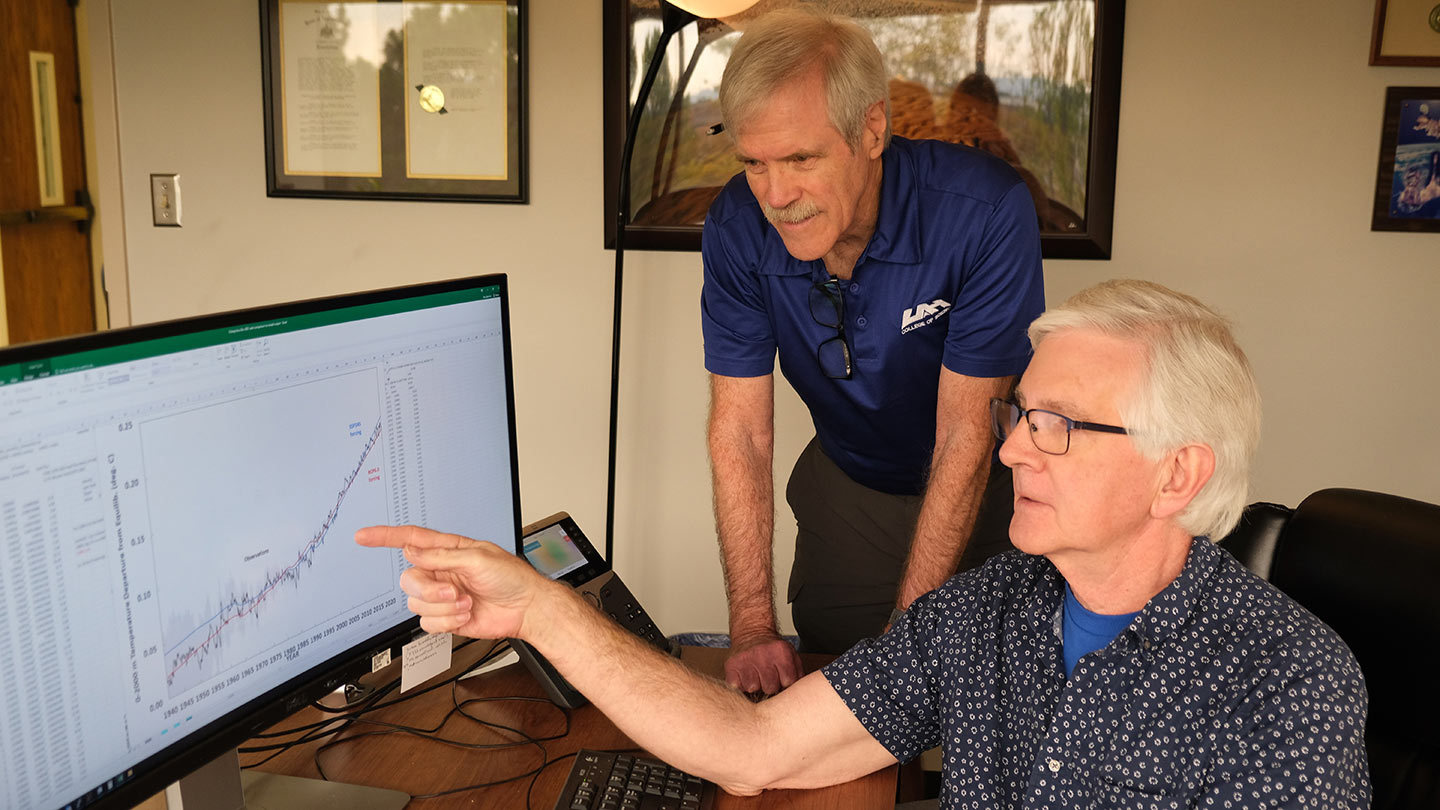
(Left to Right): UAH’s Dr. John Christy reviews results from the one-dimensional climate model Dr. Roy W. Spencer developed.

UAH model reveals secrets of our changing climate

The University of Alabama in Huntsville, which is a part of the University of Alabama System, has conducted a research study that addresses a key question in climate change research. The study aims to determine the amount of warming that can occur due to the addition of carbon dioxide to the atmosphere through fossil fuel burning and other activities, as standards of living increase globally. Over a period of 10 years, Dr. Roy Spencer, a Research Scientist at the UAH Earth System Science Center, and Dr. John R. Christy, the Director of UAH Earth System Science Center and Alabama State Climatologist, developed a one-dimensional climate model to answer this question.

Spencer and Christy’s climate model, based upon objective measured data, found carbon dioxide does not have as big of an effect on the warming of the atmosphere when compared with other climate models.

According to Dr. Spencer, despite decades of research using complex climate models, there has been no consensus on the extent of global warming resulting from a doubling of atmospheric carbon dioxide. As a result, they developed a one-dimensional climate model to provide an answer.

Current climate models vary greatly, ranging from 1.8 to 5.6 degrees Celsius in terms of effective climate sensitivity. However, Spencer and Christy's research found that their one-dimensional model produced a lower value of 1.9 degrees Celsius, indicating a lesser impact of increasing carbon dioxide concentrations on the climate than other models.

Spencer explains that their model, like others, assumes that all climate change is caused by humans. However, if recent warming is partly natural, it would further decrease climate sensitivity.

This unique climate model, developed at UAH, sets itself apart from other models as it relies on actual observations of warming instead of theoretical assumptions about the impact of greenhouse gases on the climate system. The model is one-dimensional and utilizes various datasets of warming in the deep ocean and land from 1970 to 2021, each with its level of uncertainty. By applying the fundamental principles of energy conservation to these datasets, the researchers were able to estimate climate sensitivity.

According to Spencer, the period from 1970 to 2021, spanning 52 years, is of particular significance as it witnessed the most rapid warming and boasts the most dependable observational data on deep-ocean warming. In addition, the model, created by Spencer and Christy, takes into account heat storage in deeper layers of land, which other models do not, and therefore accounts for a phase of rapid growth in atmospheric carbon dioxide.

One of the critical advantages of their straightforward model is that it conserves energy, a requirement that any physics-based model of global warming should meet. Spencer says. “Current computerized climate models continue to have difficulty achieving this aspect.”

Other scientists can easily adapt the simple model to future global temperature measurements as they become available. The UAH climate model uses data to help us understand the complex interactions between the atmosphere, land, and oceans that shape our climate. By incorporating the latest data and technology, this model provides researchers with a valuable tool to explore and gain insight into the intricate dynamics of our climate system. This research has the potential to inform decision-making and help us prepare for the future of our planet. The United States Department of Energy provided support for this research.
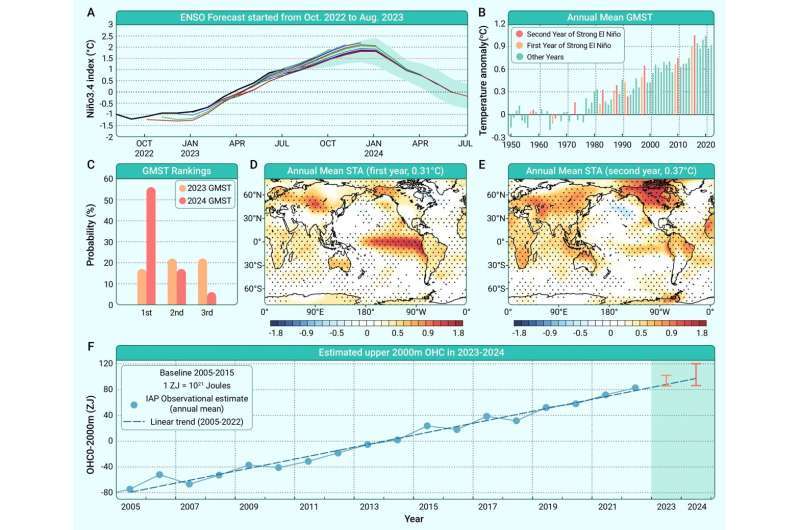

The strong El Niño predicted for 2023-2024 is expected to have serious climate consequences. The ensemble-mean Niño3.4 index forecasts made by IAP ENSO EPS between Oct. 2022 and Aug. 2023 (indicated by solid color lines) show the expected Niño3.4 index values, while the shaded area represents the range of forecasted values starting from Aug. 2023. The observed Niño3.4 index values from Aug. 2022 to Jul. 2023 are represented by a black solid line. The annual time series of GMST anomalies during 1950-2022 (datasets: BEST, GISTEMP v4) are shown in panel B, with orange and red bars indicating the first and second years of nine strong El Niño events, respectively. Panel C shows the statistically forecasted probability of GMSTs to be 1st to 3rd in 2023 and 2024. Panels D and E show the distribution of STAs in the first and second years of strong El Niño composited by the nine events in B. Finally, panel F shows the annual time series of OHC0-2000m during 2005-2022 (represented by blue dots), the corresponding linear trend (represented by a gray dashed line), and the estimated OHC0-2000m in 2023-2024 (represented by red and orange bars) based on linear regression methods with a 90% confidence interval.

The effects of an unprecedented El Niño on climate change in China

Researchers from the Institute of Atmospheric Physics (IAP) of the Chinese Academy of Sciences have predicted that a strong El Niño event will cause global surface temperature to rise and trigger several climate crises in 2023–2024. The El Niño event is known for releasing massive heat into the atmosphere, which will change atmospheric circulation patterns, influence tropical-extratropical interactions, and impact subtropical jets, monsoons, and even polar vortices, resulting in a rapid surge in Global Mean Surface Temperature (GMST).

GMST, which integrates global land surface temperature and sea surface temperature, is one of the vital indicators of climate variability and global warming. Its interannual variability is primarily dominated by ENSO events, with El Niño events having a particularly strong influence due to their capacity to release immense heat into the atmosphere, leading to anomalies in atmospheric circulation and changes in the surface energy balance.

The IAP team's ensemble prediction system indicated earlier in 2023 that there would be an El Niño event in boreal autumn, which may be maintained throughout winter. Based on historical climate data and prior studies, the IAP team revealed the potential extent and consequences of the extreme warming expected in 2023–2024. Their findings indicate a 17% probability that the 2023 GMST will become the highest recorded since 1950 and a staggering 61% probability that it will rank among the top three. In 2024, these probabilities suddenly rise to 56% and 79%, respectively.

During the development of a strong El Niño in 2023, warm anomalies are expected to predominantly affect the tropical central-eastern Pacific, the Eurasian continent, and Alaska. However, in the following year, 2024, warm anomalies are likely to encompass the entire continents, significantly increasing the chance of land-based heatwaves, droughts, and wildfires.

According to Prof. Zheng Fei, corresponding author of the study, "In addition to the surge in surface temperatures, the strong El Niño in 2023-2024 is predicted to trigger a cascade of climate crises."

There are several climate issues that we are currently facing, such as intensifying marine heat waves, ocean deoxygenation, reduced oceanic diversity, damage to marine ecosystems, rising sea levels, and decreasing crop yields. Additionally, China may encounter several climate anomalies during this period. For example, the suppressed winter monsoon in 2023 might result in higher winter temperatures in most regions of China, which could also increase the risk of air pollution. In 2024, northern China may face spring drought, while southern regions will most likely experience extreme rainfall and flooding during the summer season.

To summarize, the strong El Niño that is expected to happen in 2023-2024 will likely cause global surface temperatures to break records and trigger climate crises all over the world. This emphasizes the urgency of taking action to mitigate the consequences of climate change and reduce the risk of further environmental damage.

Assuming that the black hole's spin axis is aligned vertically, the jet's direction is nearly perpendicular to the disk. The misalignment between the black hole spin axis and the disk rotation axis results in the precession of both the disk and jet.

China confirms black hole spin by monitoring radio galaxy M87

An international team of researchers, led by Chinese researcher Dr. CUI Yuzhu, has discovered that the black hole at the center of the nearby radio galaxy M87, which is located 55 million light-years from Earth and is 6.5 billion times more massive than the Sun, exhibits an oscillating jet that swings up and down with an amplitude of about 10 degrees. This confirms the black hole's spin.

The team used a global network of radio telescopes and analyzed telescope data from 2000 to 2022. Through this extensive analysis, they revealed a recurring 11-year cycle in the precessional motion of the jet base, as predicted by Einstein's General Theory of Relativity. This study offers evidence that M87's black hole spins and links the dynamics of the jet with the central supermassive black hole.

Supermassive black holes at the center of active galaxies are known to be the most disruptive celestial objects in our universe. Due to their extraordinary gravitational force and power of plasma outflows, they can accrete tremendous amounts of material. These outflows, known as jets, approach the speed of light and extend thousands of light-years away.

For over a century, physicists and astronomers have been trying to understand how energy is transferred between supermassive black holes, their accretion disks, and relativistic jets. The most widely accepted theory suggests that a spinning black hole can extract energy, which can then be used to eject some of the material surrounding the black hole with tremendous force. However, despite being a crucial factor in this process, the spin of supermassive black holes, which is the most fundamental parameter other than black hole mass, has never been directly observed.

In this study, the research team focused on M87, which is known for having the first observational astrophysical jet that was ever observed in 1918. The jet formation regions that are close to the black hole can be analyzed in detail with Very Long Baseline Interferometry (VLBI) because of their proximity. Recent black hole shadow imaging with the Event Horizon Telescope (EHT) has further allowed researchers to study M87 in detail. By analyzing VLBI data from M87 that was collected over the last 23 years, the team was able to detect the periodic precessional jet at the base of the black hole, which provided insight into the status of the central black hole.

At the heart of this discovery lies a critical question: What force in the universe can alter the direction of such a powerful jet? The answer could be hidden in the behavior of the accretion disk, a structure related to the central supermassive black hole. As materials fall towards the black hole, they form a disk-like structure due to their angular momentum before spiraling inwards and being inevitably drawn into the black hole. However, if the black hole is spinning, it exerts a significant impact on surrounding spacetime, causing nearby objects to be dragged along its axis of rotation, a phenomenon known as "frame-dragging" that was predicted by Einstein's General Theory of Relativity.

The research team's analysis indicates that the rotational axis of the accretion disk does not align with the black hole's spin axis, leading to a precessional jet. Detecting this precession provides unequivocal evidence that the supermassive black hole in M87 is indeed spinning, thus enhancing our understanding of the nature of supermassive black holes.

"We are thrilled by this significant finding," said CUI Yuzhu, a postdoctoral researcher at Zhejiang Lab, a research institution in Hangzhou, and lead and corresponding author of the paper. "Since the misalignment between the black hole and the disk is relatively small and the precession period is around 11 years, accumulating high-resolution data tracing M87's structure over two decades and thorough analysis are essential to obtain this achievement."

"After the success of black hole imaging in this galaxy with the EHT, whether this black hole is spinning or not has been a central concern among scientists," added Dr. Kazuhiro Hada from the National Astronomical Observatory of Japan. "Now anticipation has turned into certainty. This monster black hole is indeed spinning."

The work involved a total of 170 observation epochs, conducted by various radio telescopes across the world, including the East Asian VLBI Network (EAVN), the Very Long Baseline Array (VLBA), the joint array of KVN and VERA (KaVA), and the East Asia to Italy Nearly Global (EATING) network. Among these, China's Tianma 65-meter radio telescope and Xinjiang 26-meter radio telescope played a crucial role in achieving the high sensitivity and angular resolution required for the project. The data obtained from over 20 telescopes provided valuable insights for the study.

"The in-building Shigatse 40-meter radio telescope by Shanghai Astronomical Observatory will further improve the imaging capability of EAVN at millimeters. Especially, the Tibetan Plateau, where the telescope is located, owns one of the most excellent site conditions for (sub-)millimeter wavelength observations. It fulfills our expectations to promote domestic sub-millimeter facilities for astronomical observations," said Prof. SHEN Zhiqiang, Director of the Shanghai Astronomical Observatory of the Chinese Academy of Sciences.

This study provides insights into the enigmatic realm of supermassive black holes, but it comes with its own set of challenges. The exact spin of the M87 supermassive black hole and the structure of its accretion disk remain uncertain. Furthermore, this research predicts that there could be more sources with similar characteristics, which presents a challenge for scientists to discover them.

Recently, China confirmed the existence of a supermassive black hole at the center of radio galaxy M87 and provided evidence of its rapid spin. This discovery has implications for our understanding of how galaxies are formed and evolved. It also highlights the importance of international collaboration in advancing scientific knowledge. As we further explore the mysteries of the universe, this discovery reminds us of the power of human ingenuity and the potential of science to unlock the secrets of the cosmos.