

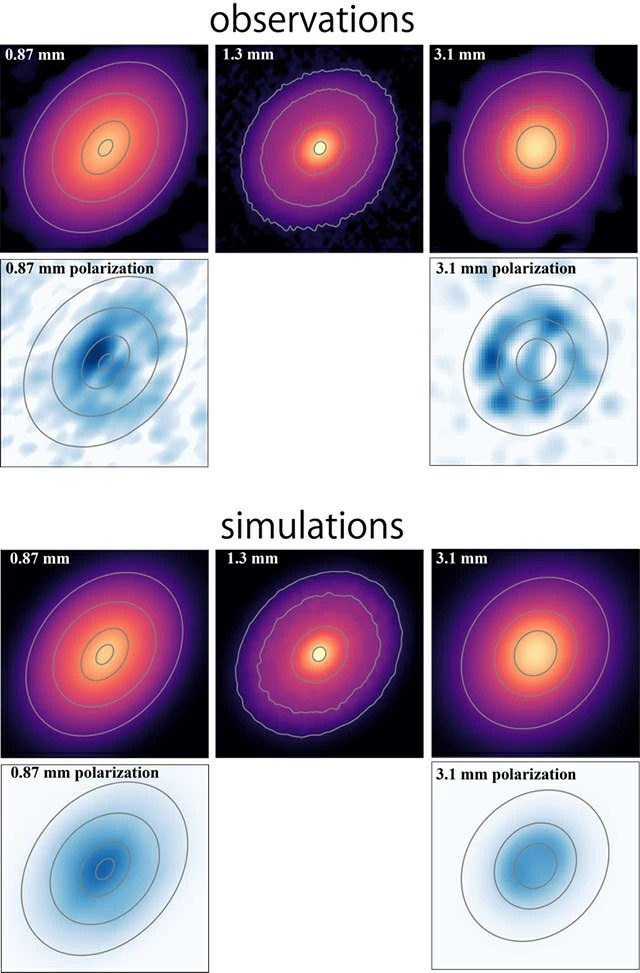
(Top) Radio wave strength maps of the DG Tau disk at wavelengths of 0.87 mm, 1.3 mm, and 3.1 mm observed with ALMA and polarization strength maps of radio waves scattered by dust at wavelengths of 0.87 mm and 3.1 mm. (Bottom) The supercomputer simulation which provides the best agreement with the above observations. Credit: ALMA (ESO/NAOJ/NRAO), S. Ohashi et al.

Japanese astronomers discover the first step towards planet formation; Unveiling the secrets of protostellar disks

A research team led by Project Assistant Professor Satoshi Ohashi from the National Astronomical Observatory of Japan (NAOJ) has achieved a groundbreaking discovery about the formation of planets. They conducted high-resolution and multi-wavelength observations of a protoplanetary disk around a young protostar named DG Taurus (DG Tau). Through their study, they revealed the initial conditions of planet formation, which is crucial to our understanding of the origin of life and the formation of planetary systems. This fascinating finding will be explored in detail.

The formation of planets, such as Earth, is a fascinating and intricate process. Scientists propose that it occurs when interstellar dust and gas accumulate in a protoplanetary disk that surrounds a young protostar. However, the exact mechanisms and timing of planet formation remain unknown. To better understand this process, researchers have focused on studying protoplanetary disks where no planets have formed yet.

To further investigate this topic, a research team examined a young protostar called DG Taurus. They utilized the Atacama Large Millimeter/Submillimeter Array (ALMA) - an international astronomy facility, to observe the structure of the protoplanetary disk and analyze the amount and size of dust in it. Associate Professor Okuzumi from the Tokyo Institute of Technology also contributed significantly to this research.

The team's observations uncovered intriguing findings about the protoplanetary disk surrounding DG Taurus. Unlike older protostellar disks, this particular disk had not formed any ring-like structures, suggesting that it was in the early stages just before planet formation. The absence of such structures indicated that no planets were present yet. Consequently, this observation provided insight into the conditions preceding planet formation.

The study analyzed the radio emission intensity distribution at various wavelengths to estimate the size and density distribution of dust in the disk. The results showed that the dust had grown significantly in the outer part of the disk, beyond 40 astronomical units, which suggests a more advanced planet formation process in this region. Additionally, the dust-to-gas ratio was ten times higher than in normal interstellar space in the inner region, indicating a higher concentration of dust particles. These observations provided valuable insights into the accumulation of material necessary for planet formation.

The study's findings challenged existing theories of planet formation, which proposed that planet formation started in the inner part of the disk. However, observations of DG Taurus suggest that planet formation may start from the outer part of the disk, indicating a need for a reevaluation of current theories and a deeper exploration of the planet formation process.

The success of this study was possible due to the exceptional capabilities of ALMA. Its high spatial resolution of 0.04 arcseconds allowed for detailed observations of the protoplanetary disk, providing valuable information about the size and density of the dust. The detection of radio waves emitted by the dust, including polarized light, enabled the researchers to study the disk's characteristics in unprecedented detail. ALMA's contributions to this research highlight its vital role in advancing our understanding of the universe.

The study of planet formation is not only fascinating but also crucial for understanding how life originated. The interaction between protoplanetary disks and the necessary conditions for life brings up interesting questions about the existence of habitable environments in planetary systems. This study brings us closer to understanding the requirements for life to thrive by examining the initial stages of planet formation.

Exciting avenues for future research have opened up with the discovery of the first step toward planet formation in the protoplanetary disk around DG Taurus. Scientists will continue exploring the dynamics of protoplanetary disks and the processes that lead to planet formation. This knowledge will improve our understanding of the formation and evolution of our solar system and other planetary systems throughout the universe.

The groundbreaking study led by Project Assistant Professor Satoshi Ohashi and his international research team has provided significant insights into the early stages of planet formation. The team observed the protoplanetary disk around DG Taurus and captured the conditions before planet formation, shedding light on the complex processes involved. This research not only deepens our understanding of the origin of life but also paves the way for future discoveries in astrophysics. As scientists continue exploring the mysteries of the universe, we can look forward to uncovering more secrets about planet formation and the potential for life beyond Earth.

Ancient carbon in rocks releases as much Carbon Dioxide as the world’s volcanoes

According to a recent study led by the University of Oxford, natural rock weathering may not act solely as a CO2 sink. The study suggests that this process may also contribute significantly to CO2 emissions, potentially rivaling the output of volcanoes. The findings have important implications for supercomputing climate change modeling.

The research reveals that ancient carbon in rocks may release as much CO2 into the atmosphere as the world's volcanoes. This discovery contradicts the previous understanding that natural rock weathering acted primarily as a CO2 sink. Instead, it could be a significant source of CO2 emissions.

Understanding the impact of ancient carbon in rocks on climate change is crucial. This new information sheds light on an important piece of the puzzle. It's time to update our knowledge and consider the potential consequences of this process.

Are you ready to have your understanding of natural rock weathering turned upside down? New research has shattered the traditional viewpoint that this process acts as a CO2 sink, removing carbon dioxide from our atmosphere. Instead, brace yourself for this shocking revelation: it can function as a colossal source of CO2 emissions, on par with the mighty volcanoes that captivate our imagination. Prepare to explore the mysterious realm where rocks hold secrets that could shape our planet's future!

Rocks contain a large store of carbon, dating back millions of years, from the remains of ancient plants and animals. This "geological carbon cycle" helps regulate the Earth's temperature by absorbing CO2 during chemical weathering. This process counteracts the continuous release of CO2 from volcanoes and forms an essential part of the natural carbon cycle, which has sustained life on Earth for billions of years.

However, the study has discovered an additional natural process of CO2 release from rocks, which is as significant as the CO2 released from volcanoes. This process occurs when rocks that formed on ancient seafloors are pushed back up to the Earth's surface, exposing the organic carbon to oxygen and water, which can react and release CO2. This means that weathering rocks could be a source of CO2, rather than a sink, as previously thought.

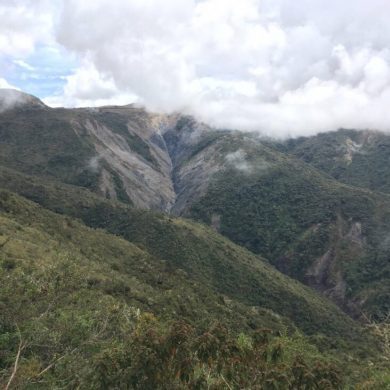
Measuring this CO2 release from rocks has been challenging, but the researchers used a tracer element, rhenium, released into water when rock organic carbon reacts with oxygen. Sampling river water to measure rhenium levels made it possible to quantify CO2 release. The researchers then used a supercomputer to simulate the interplay of physical, chemical, and hydrological processes across the Earth's surface to estimate the total CO2 emitted as rocks weather. They identified many large areas where weathering was a CO2 source, particularly in mountain ranges with high uplift rates, such as the eastern Himalayas, the Rocky Mountains, and the Andes. The global CO2 release from rock organic carbon weathering was found to be 68 megatons of carbon per year.

Although this is significantly less than current human CO2 emissions from burning fossil fuels, it is comparable to the amount of CO2 released by volcanoes. Ongoing research is investigating how changes in erosion due to human activities, alongside anthropogenic climate changes, could increase this natural carbon leak. The researchers are also questioning whether this natural CO2 release will increase over the coming century. "Currently, we don't know – our methods allow us to provide a robust global estimate, but not yet assess how it could change," says Professor Robert Hilton, who leads the ROC-CO2 research project that funded the study. The study's findings will help to improve predictions of our carbon budget.

A large ground finch (Geospiza magnirostris) on Daphne Major, Galápagos Islands, Ecuador. Photo: Erik Enbody

Swedish researchers produce largest genomic datasets of Darwin's finches to date, contributing significantly to the unlocking of secrets of evolution

Researchers from around the world have conducted a study on the recent evolutionary changes in natural populations. They used a large genomic dataset comprising almost 4,000 Darwin's finches in their natural habitat. This study has uncovered the genetic basis for adaptation in this iconic group of birds.

Since Darwin discovered the finches in the Galápagos Islands, scientists have been studying these small songbirds to understand how evolution works. In the last million years, one ancestral species has evolved into 18 different species. Darwin's finches are a great study organism because they can show the early stages of speciation. Peter and Rosemary Grant from Princeton University have been monitoring almost every finch on Daphne Major since the 1970s. Their research has demonstrated that the finches on Daphne Major have evolved in response to environmental changes and interactions between different species.

An international team has sequenced the genomes of almost every finch studied on Daphne, revealing the genetic structure of adaptive change. Erik Enbody, the lead author of the study and a former post-doctoral fellow at Uppsala University, is excited about the opportunity to combine our knowledge of evolutionary change in the distant past with observations in the present. He believes that genomic data is a powerful tool that can help us understand the factors that have shaped the evolution of birds in the field. He also notes that this study would not have been possible without decades of research on Galápagos.

The senior author of the study, Leif Andersson (Uppsala University and Texas A&M University), highlights that only a few genetic loci are responsible for a significant amount of variation in the finch's beak. He suggests that one way these genetic changes evolve is by bundling multiple genes together and subjecting them to natural selection as the environment changes.

Human geneticists may be surprised by these findings, as they reveal that even genetic variants that only contribute minimally to human height can have a significant impact. Meanwhile, research conducted over three decades has shown that the beak of the Medium ground finch has decreased in size. By analyzing the genomes of all the finches on Daphne, scientists have discovered that this change is due to genes transferring from the Small ground finch through hybridization. Additionally, periods of drought have led to individuals with smaller beaks having a better chance of survival.

“This study highlights the value of long-term studies to understand the mechanism of evolutionary change,” says Peter Grant.

The researchers collected a blood drop from the wing vein of each bird and placed a band on them to track their survival time, mating partners, and offspring.

“By collecting blood samples throughout the study, we had the samples available for genomic study when the technology became available,” adds Rosemary Grant.

The study conducted by researchers examined the entire community of four finch species, including the Medium Ground Finch, on the island. The Common cactus finch underwent a gradual transformation towards a blunter beak due to changes in the island's conditions and increased hybridization with the Medium Ground-Finch. This study highlights how species adapt to changing environments through genetic changes that have a significant impact on their characteristics, sometimes transferred between species. As the global environment changes, the Galápagos finches will offer valuable insight into the interactions between birds, their genetic makeup, and their surroundings, shaping the future of wild populations.

Swedish researchers have conducted extensive research on the evolution of Darwin's finches over the last 30 years. This research has produced the largest genomic datasets to date, providing vast information about the evolution of these species. The findings of this research have opened up new avenues of research into the evolutionary history of other species and provided valuable insights into evolutionary processes. The potential impact of these findings includes informing conservation efforts and enhancing our understanding of the evolutionary process.