

Cavendish physicists show that it is possible to coax the behavior of quantum particles set in motion

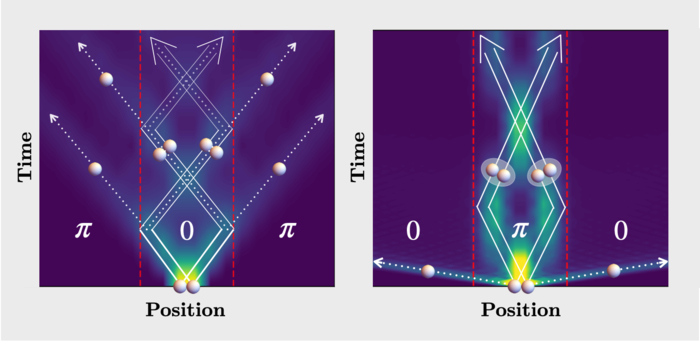
In the world of fundamental particles, you are either a fermion or a boson but a new study from the University of Cambridge shows, for the first time, that one can behave like the other as they move from one place to another. Left: The particles start out as bosons and move together (solid lines) left and right before impinging on a 0-π; border, where they are partially reflected (solid lines) and partially split (dotted lines). For each splitting, one particle escapes the bosonic region. Right: Starting as pseudo-fermions, the particles move in a “superposition” of two ways: in one, they rapidly move apart as ordinary fermions and pass straight through the π-0 borders (dotted lines); in the other, they are bound together, move very slowly, and are forever trapped in the fermionic region (solid lines).  CREDIT Lau and Dutta
Researchers from the Cavendish Laboratory have modeled a quantum walk of identical particles that can change their fundamental character by simply hopping across a domain wall in a one-dimensional lattice.

Their findings, published as a Letter in Physical Review Research, open up a window to engineer and control new kinds of collective motion in the quantum world.

All known fundamental particles fall in two groups: either a fermion (“matter particle”) or a boson (“force carrier”), depending on how their state is affected when two particles are exchanged. This “exchange statistics” strongly affects their behavior, with fermions (electrons) giving rise to the periodic table of elements and bosons (photons) leading to electromagnetic radiation, energy, and light.

In this new study, the theoretical physicists show that, by applying an effective magnetic field that varies in space and with the particle density, it is possible to coax the same particles to behave as bosons in one region and (pseudo)fermions in another. The boundaries separating these regions are invisible to every single particle and, yet, dramatically alter their collective motion, leading to striking phenomena such as particles getting trapped or fragmenting into many wave packets.

“Everything that we see around us is made up of either bosons or fermions. These two groups behave and move completely differently: bosons try to bunch together whereas fermions try to stay separate,” explained first author Liam L.H. Lau, who carried out this research during his undergraduate studies at the Cavendish Laboratory and is now a graduate student at Rutgers University.

"The question we asked was what if the particles could change their character as they moved around on a one-dimensional lattice, our notion of space.”

This research is partly motivated by the remarkable prospects of being able to control the nature of particles in the laboratory. In particular, certain two-dimensional materials have been found to host particle-like excitations that are in between bosons and fermions – called “anyons” – which could be used to build robust quantum supercomputers. However, in all setups so far, the nature of the particles is fixed and cannot be changed in space or time.

By analyzing mathematical models, the present study shows how one can juxtapose bosonic, fermionic, and even “anyonic” spatial domains in the same physical system, and explores how two particles can move in surprising ways through these different regions.

“The boundaries separating these regions are very special, because they are transparent to single particles and, yet, control the final distribution by how they reflect or transmit two particles arriving together!” said Lau. The researchers illustrate this “many-body” effect by studying different arrangements of the spatial domains, which give rise to strikingly different collective motion of the two particles.

“These variable two-particle interferences are fascinating in their own rights, but the new questions they open up for many particles are even more exciting,” said Dr. Shovan Dutta, the study’s co-author who conceived and supervised the research in the Cavendish and has recently moved to the Max Planck Institute for the Physics of Complex Systems.

“Our work builds on recent progress in engineering artificial magnetic fields for neutral atoms, and the predictions can be tested experimentally in existing optical-lattice setups,” added Dutta. “This will open access to a rich class of controllable many-particle dynamics and, potentially, technological applications, including in quantum sensing.”
Woolpert provides advanced planning, technical services for Broward County (Fla.) airports

The $5 million multi-year contract includes airport modeling solutions, geospatial technology, and UAS integration.

Woolpert was selected by the Broward County Aviation Department (BCAD) to provide advanced planning, consulting, and technical services for Fort Lauderdale-Hollywood International Airport and North Perry Airport. The $5 million, multi-year contract will support geospatial solutions, dynamic planning and development management, advanced air mobility, and general airport planning solutions.

Woolpert will provide a wide range of planning, technology, and geospatial services. These include enterprise geospatial applications, unmanned aircraft systems integration, building information modeling, and FAA Airports GIS Program support. New projects and procedures will be implemented to help BCAD stay compliant through the Airport Data and Information Portal process for new and ongoing construction projects.

Woolpert Aviation Program Director and Senior Associate Ed Copeland said the goal is to look for ways to enhance and more fully integrate existing systems and databases to create additional efficiencies and lower costs, while at the same time evaluating new technologies and concepts to support and advance the full life cycle of planning and engineering through construction, operations and maintenance specific to the BCAD environment.

“In addition to providing on-call and on-site staff extension support, this contract will help Broward County develop a UAS program that includes a framework and protocols for AAM that will best support their evolving airport operations,” Copeland said. “These advanced planning and technical services will enable BCAD to implement a strategic plan for the next five years, ensuring the county and its residents benefit from these rapidly developing technologies and are well-positioned for the future of aviation.”

This contract is now underway.

JAIST prof Maezono discovers a new crystal structure as a candidate for superconductivity

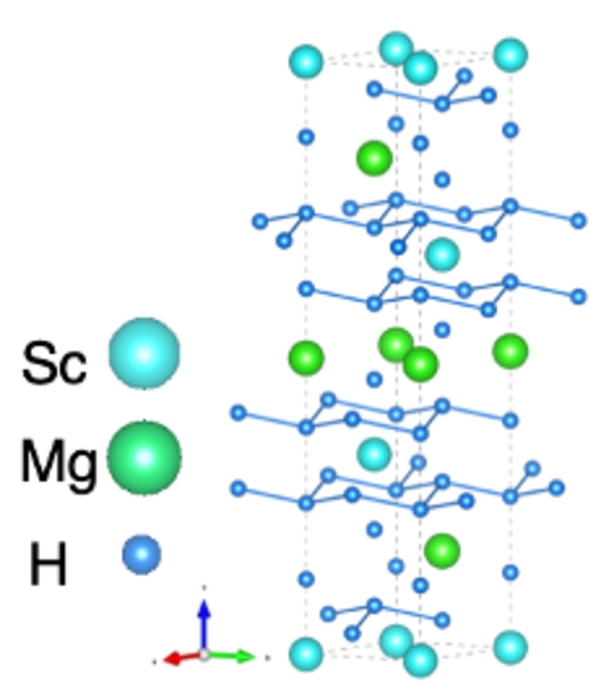
Superconductivity refers to the loss of electrical resistance of a material and requires extremely low temperatures (< -200°C) to persist. This low temperature, otherwise known as the transition temperature, has been a limiting factor in the application of superconductors, and finding materials that can display superconductivity at higher temperatures has become an important research objective worldwide. Newly discovered crystal structure of the superconductor realizing higher transition temperature.  CREDIT Ryo Maezono from JAIST.

A breakthrough has been made with hydrogen-rich compounds (called hydrides) containing rare earth or alkaline metals, which display room temperature superconductivity at high pressures (100-200 GPa). These metal hydrides have cage-like structures of hydrogen atoms stacked on top of each other enabling them to withstand the high pressures required for the superconductivity phenomenon.  Many of the crystal structures and compositions for these hydrides have been predicted by combining various binary metal hydrides.

Now, in a study published in The Journal of Physical Chemistry on January 26, 2022, a group of researchers led by Professor Ryo Maezono from the Japan Advanced Institute of Science and Technology (JAIST) has used a supercomputer to make similar predictions for viable high-temperature ternary metal hydride superconductors containing Magnesium (Mg), an alkaline metal, and Scandium (Sc), a rare earth element. “MgH2 and ScHare known to be stable phases at ambient pressure. Therefore, MgH2 and ScH2 can be used to chemically synthesize the ternary Mg−Sc−H compounds”, explains Prof. Maezono.

For their search, the researchers initially started with certain Mg-Sc-H compounds (MgSc3Hx, MgSc2Hx, MgScHx, Mg2ScHx, and Mg3ScHx, where x = 2−12, 14, 16, and 18). Starting with random initial structures, they used the supercomputer to determine possible combinations and crystal structures that would result in a valid superconductor in a pressure range of 100-200 GPa.

To achieve superconductivity, the predicted compound must meet certain conditions: it must be thermodynamically stable, i.e., it cannot degrade into its elementary components, have a high transition temperature, have a valid synthesis route, and possess a structure capable of withstanding high pressures where the phenomenon takes place. In the simulations, four hydrogen-rich structures were found to meet the criteria: R3̅m-MgScH6, C2/m-Mg2ScH10, Immm-MgSc2H9, and Pm3̅m-Mg-(ScH4)3.

Out of the crystal structures, R3̅m-MgScH6 was found to have the highest transition temperature of (23.3 K) at 200 GPa and 41 K at 100 GPa. The compound was found to possess a hexagonal crystal structure, in which each Mg and Sc atom is surrounded by 14 H atoms (Figure 1). The transition temperature was, however, much lower than that of the binary halide counterparts (LH10 and YH10) and this low temperature was attributed to the low density of states at the Fermi level due to the lower hydrogen content.

Among the metal hydrides, ternary metal hydrides that contain hydrogen bonded to two other metals are promising candidates for low-pressure, room-temperature superconductivity. It was, however, a challenging and time-consuming process to predict the appropriate elements and crystal structure that resulted in a superconducting ternary hydride due to a large number of possible combinations with metals. With the help of supercomputers, researchers are now able to quickly determine potential superconducting candidates. The discovery of the Mg-Sc-H compounds as valid superconductors is the third such prediction for ternary hydrides made by the research group using computer simulations. “This is the third news with 'Mg/Sc' compounds following the preceding findings with 'La/Y' in December 2021 and 'Y/Mg' in January 2022. New findings are being launched one after another,” says Prof. Maezono.

Despite having low transition temperatures, the predicted Mg-Sc-H compounds remain stable at pressures that are lower than those normally observed for high-temperature superconductors. Simulations like these are enabling researchers to understand the contributions of each element towards the superconductivity phenomenon, accelerating the development of high-temperature superconductors.