

JAIST increases the accuracy of atomic force calculations with the space-warp coordinate transformation

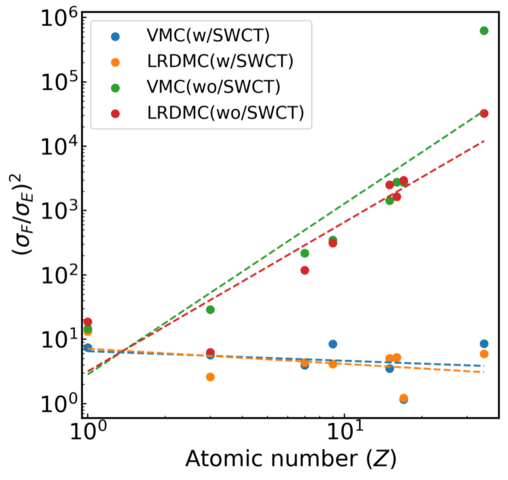
Japanese researchers developed a method to accurately calculate atomic forces for elements with high atomic numbers with quantum Monte Carlo simulations TITLE: Figure1. Plot of force and energy variance ratio as a function of atomic number, Z.  CAPTION: This figure shows the ratios between the force and energy variances evaluated for several molecules. We found that the ratio scales as Z2.5 without the SWCT in the QMC calculations, while the ratio is independent of Z with the SWCT both in the VMC and LRDMC calculations, indicating that the computational cost of QMC forces with respect to Z is no worse than that of energy. Indeed, the accessible system size is not affected by QMC force calculations when the SWCT variance-reduction technique is applied.  Photo courtesy: Kousuke Nakano from JAIST.
Atomic forces are primarily responsible for the motion of atoms and their versatile arrangement patterns, which is unique for different types of materials. Atomic simulation methods are a popular choice for the calculation of these forces, the understanding of which can vastly enhance existing knowledge on how to improve a material’s function at an atomic level.

Quantum Monte Carlo (QMC) methods are high-precision, state-of-the-art simulation methods, which are used to obtain many-body wave functions, essential for the calculation of atomic forces. These methods have recently gained importance, owing to their ability to simulate the microscopic behavior of matter with extremely high accuracy, and for overcoming the disadvantages of conventional simulation methods.

The two major QMC methods are the variational Monte Carlo (VMC) method and the fixed node diffusion Monte Carlo (FNDMC) method. FNDMC methods provide more accurate results than the VMC methods since the latter is highly dependent on the quality of the trial wave function to calculate necessary parameters, such as the ground state wave function of atoms.
While QMC methods are reliable for the calculation of ground-state energies of atoms, they result in very high calculation costs for atomic forces of elements with higher atomic numbers. Moreover, there is no consensus among the research community on an efficient algorithm for QMC force evaluation, which should ideally scale well with the number of electrons and atomic number. This leads to a few inaccuracies in atomic force calculations for elements with high atomic numbers.

To address this shortcoming, a group of researchers led by Assistant Professor Kousuke Nakano from the Japan Advanced Institute of Science and Technology, recently proposed a space-warp coordinate transformation (SWCT) method, to reduce the calculation costs incurred while calculating atomic forces.

For this study, which was published in The Journal of Chemical Physics, the team utilized a “TurboRVB” software developed by Dr. Nakano et al., which implemented a ‘lattice regularized’ version of the FNDMC method, also known as the LRDMC method. Using this software, they calculated the all-electron VMC and LRDMC forces, with and without the space-warp coordinate transformation, for mono and heteronuclear atom dimers, using the following atoms: H2, Li2, N2, F2, P2, S2, Cl2, and Br2. Furthermore, they calculated the LRDMC forces using Reynolds (RE) and Variational-Drift (VD) approximation methods.

An analysis of these calculations revealed that the energy surface values derived from the LRDMC method gave equilibrium bond lengths and harmonic frequencies values, very close to previously derived experimental values for atomic dimers, in turn improving the corresponding VMC results. Moreover, the LRDMC forces calculations using both RE and VD approximations led to an improvement in VMC forces, although VD approximation-based calculations resulted in high computational costs.

Our findings indicate that the application of the so-called space-warp coordinate transformation (SWCT) is essential to reduce the computational cost of forces in QMC. Specifically, the ratio of computational costs between QMC energy and forces scales as Z2.5 without the SWCT, where Z is the atomic number. In contrast, the application of the SWCT makes the ratio independent of Z, says Dr. Nakano while discussing the findings of this study.

This is one of the most important findings of the study, suggesting that the application of SWCT methods yields a constant ratio of the computational cost of force to energy, regardless of the atomic number of the material.

“The accurate forces obtained by QMC could contribute to in-silico material designs, to design important materials such as medicines and molecular catalysts”, states Dr. Nakano, while highlighting the real-life applications of this study.

Thus, the SWCT method can enhance the application of the quantum Monte Carlo method to calculate atomic forces for substances that cannot be dealt with by conventional approaches – which will provide much-needed relief to researchers who rely on these conventional methods. These findings highlight the accuracy and reliability of the SWCT method and its utility for the development of important technologies in the field of material science.
NIST researchers resurrect, improve a technique for detecting transistor defects

A traditional method gets a new lease on life and may provide a new standard for measuring electric current. 

Researchers at the National Institute of Standards and Technology (NIST) have revived and improved a once-reliable technique to identify and count defects in transistors, the building blocks of modern electronic devices such as smartphones and computers. Over the past decade, transistor components have become so small in high-performance computer chips that the popular method, known as charge pumping, could no longer count defects accurately. NIST’s new and improved method is sensitive enough for the most modern, minuscule technology, and can provide an accurate assessment of defects that could otherwise impair the performance of transistors and limit the reliability of the chips in which they reside. Webp.net resizeimage 2022 02 04T200807.552 fc757

The new, modified charge pumping technique can detect single defects as small as the diameter of a hydrogen atom (one-tenth of a billionth of a meter) and can indicate where they’re located in the transistor. Researchers could also use the new capability to detect and manipulate a property in each electron known as quantum spin. The ability to manipulate individual spins has applications in both basic research and quantum engineering and computing.

Transistors act as electrical switches. In the on position, which represents the “1” of binary digital information, a designated amount of current flows from one side of a semiconductor to the other. In the off position, representing the “0” of binary logic, the current ceases to flow.

Defects in a transistor can interfere with the reliable flow of current and significantly degrade the performance of transistors. These defects could be broken chemical bonds in the transistor material. Or they could be atomic impurities that trap electrons in the material. Scientists have devised several ways to categorize defects and minimize their impact, tailored to the structure of the transistor under study.

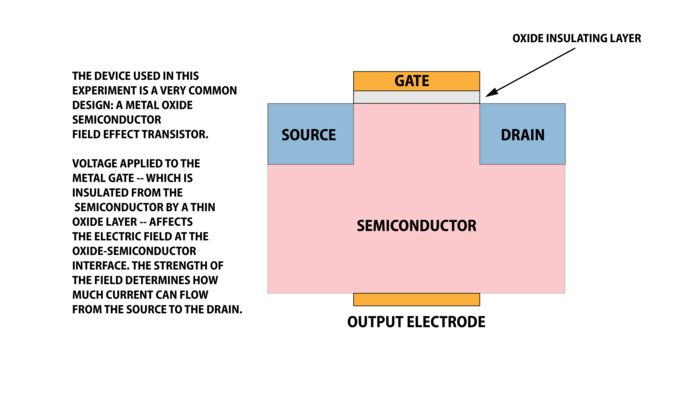
In the traditional design known as the metal oxide semiconductor field-effect transistor (MOSFET), a metal electrode called the gate sits atop a thin insulating layer of silicon dioxide. Below the insulating layer lies the interface region that separates the insulating layer and the main body of the semiconductor. In a typical transistor, current travels through a narrow channel, only one billionth of a meter thick, that extends from the source, which lies on one side of the gate, to a “drain” on the other side. The gate controls the amount of current in the channel.

Charge pumping is a two-step process in which the examiner alternately pulses the gate with a positive test voltage, then a negative one. (The transistor does not act as an on/off switch during this testing mode.) In traditional charge pumping, the alternating voltage pulses are applied at a single, set frequency.

In the first step of the test, the positive voltage attracts or pumps electrons, which are negatively charged, to the boundary or interface between the gate’s insulating layer and the body of the transistor. Some of the pumped electrons become trapped in defects at the interface, but there are many electrons left over. In the second step, a negative voltage is applied, to rid the interface of the excess electrons, leaving only the trapped ones behind. The negative voltage also attracts positive charge carriers, known as “holes,” to the region, where they combine with electrons trapped in the defects. This activity generates a current proportional to the number of defects. The greater the output current, the larger the number of defects.

In the recent past, the current was indeed a reliable measure of defects. However, the insulating oxide layer in modern transistors is now so thin — just 10 to 20 hydrogen atoms wide — that an effect from the realm of quantum mechanics comes into play, confounding measurements using the traditional charge-pumping method.

According to quantum theory, electrons and other subatomic particles can never be truly trapped; there’s always some probability they will escape or “tunnel” out of an enclosure or boundary layer. The thinner the material, the higher the probability that electrons will escape, creating a tunneling current. As transistor dimensions shrank, the tunneling current leaking through the insulating oxide layer made it nearly impossible to detect defects with ordinary charge pumping. Scientists all but abandoned the technique.

NIST researchers James Ashton, Mark Anders, and Jason Ryan have now found a way to salvage the technique so that it not only works for ultrathin transistor components but is also more sensitive, enabling scientists to record signals from a single defect. The solution arose when the scientists came to a key realization: The current that results from quantum tunneling remains virtually the same, regardless of the frequency at which charge pumping pulses the positive and negative voltages.

Armed with that knowledge, the team revised the charge pumping technique by alternately applying the method’s positive and negative voltages at two different frequencies rather than the single frequency used in the traditional method. Applying the voltages at two different frequencies gave the researchers two different output currents. By subtracting one output current from the other, the constant signal from the quantum tunneling current dropped out. With the confounding tunneling current eliminated, the researchers were able to detect defects in transistors with ultrasmall features. The researchers reported their development of the frequency-modulated charge pumping technique online in the Feb. 2 Applied Physics Letters.

“We’ve given charge pumping a new lease on life,” said Ashton.

“The modulated-frequency technique is now useful for looking at single interface defects, which gives engineers control of single electron charges in a very sensitive measurement scheme,” he added.

Since only one electron is involved, the output current is equal to multiples of the electron’s charge, a fundamental physics constant calculated by NIST and other institutions.

Because the method can detect single electrons, it may serve as a sensitive probe of an electron’s quantum spin. Modulated-frequency charge pumping may provide a valuable guide to scientists who are now exploring how electron spin might store and transfer information in a computer of the future. It may also prove useful in quantum metrology, as a potential new way of determining a quantum standard of electrical current.

UCF lands new project to study effect of rain on hypersonic travel

The work will help researchers learn what conditions make for safe hypersonic travel

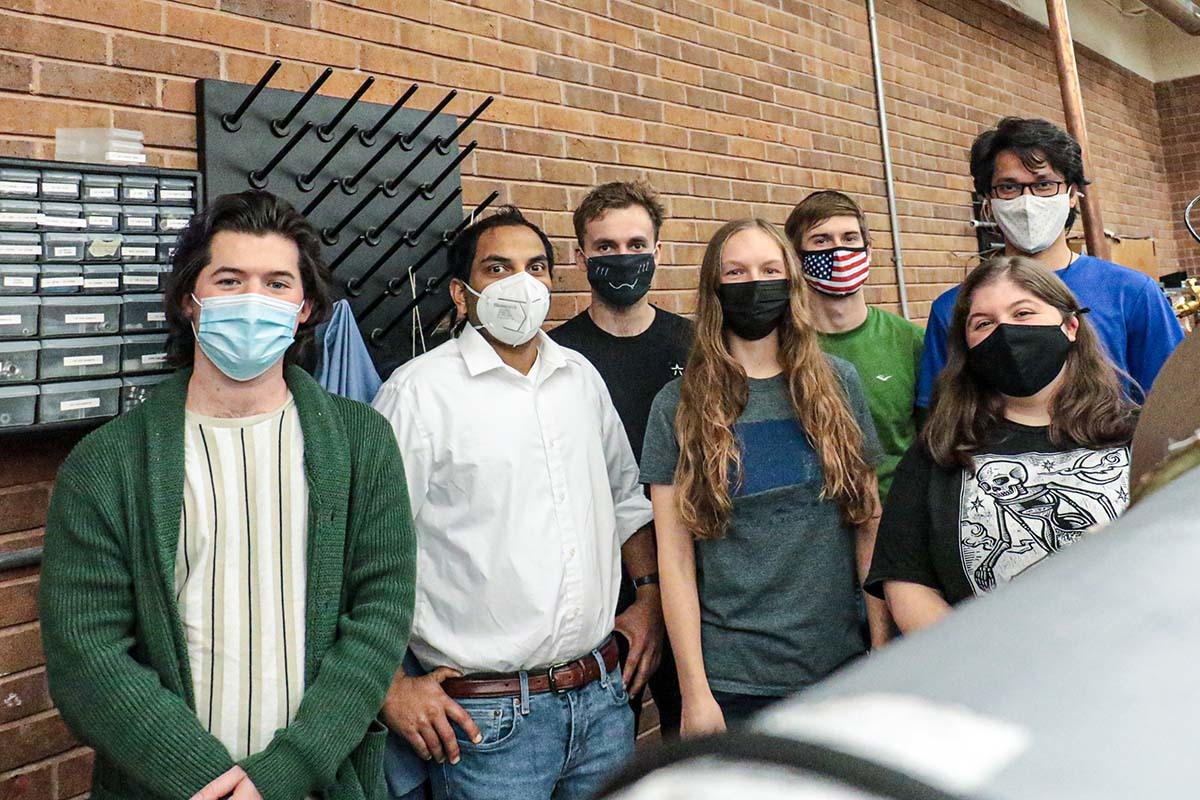
The University of Central Florida researchers are part of a new $1 million project funded by the Air Force Office of Scientific Research to better understand and predict how and why raindrops are affected when they cross a hypersonic shock wave. hypersonic raindrop Mechanical and Aerospace Engineering Professor Subith Vasu’s research team will perform experiments using a shock tube to study the effects of hypersonic shockwaves on droplets. Pictured here are team members, from left to right, Nicolas Berube, Subith Vasu, Artem Arakelyan, Jacklyn Higgs, Daniel Dyson, Sydney Briggs and Farhan Arafin.group for web 9db0a

Hypersonic speeds are those at Mach 5 and higher, or five times greater than the speed of sound. The U.S. is currently working on developing hypersonic systems for defense and travel. 

The new project is important because colliding with something as light as a single raindrop could cause a lot of damage at hypersonic speeds. The work will inform researchers as to whether or not the raindrop maintains its single droplet form or breaks up into tens of much smaller droplets.

“If you have a rain droplet with a tenth of an inch diameter and you hit it at Mach 8, it can create a load as heavy as the weight of an elephant,” says Michael Kinzel, project co-investigator and an assistant professor in UCF’s Department of Mechanical and Aerospace Engineering. “So, you can’t put an elephant on the wing of an aircraft, and it’ll support it, right? It’s a huge load. And these would be hitting all over parts of the vehicle.”

Knowing the impact of different size raindrops on hypersonic aircraft and rockets will help predict when to fly, as light rainstorms may not affect travel as much as heavy storms.

The researchers want to narrow down what conditions make for safe hypersonic travel through the rain. The knowledge could prevent damage and improve the accuracy of hypersonic rockets launched through rain and clouds, Kinzel says.

“This work will help lead to structural integrity when designing hypersonic vehicles,” Kinzel says. “And it develops a framework to understand how to design in that context as well as understand limitations of hypersonic flight with respect to some weather conditions.”

Kinzel will work to model the effects of raindrops on hypersonic travel by using supercomputer simulations.

Subith Vasu, a professor in UCF’s Department of Mechanical and Aerospace Engineering and co-investigator, will perform experiments using a shock tube to study the effects of hypersonic shock waves on droplets, such as behavior and timescale of breakup.

Unique test facilities combined with state-of-the-art optical and laser diagnostic systems will be used to understand the interaction of droplet and shock wave, Vasu says.

“The work is important for deterrence and the national security of the United States, and we are proud to be involved in this prestigious effort,” Vasu says.  “The knowledge gained from hypersonics research could have other applications as well, including space exploration.”

Boston University is leading the project and will be working closely with Kinzel and Vasu to understand droplet behavior when impacted at hypersonic speeds. UCF will be receiving about $560,000 for the three-year project. UCF will be collaborating with engineers and scientists from the Air Force Research Laboratory and Lockheed Martin, both closely involved in the development of a variety of hypersonic vehicles.

The project further highlights UCF’s expertise in the area of hypersonic propulsion.

Kinzel received his doctorate in aerospace engineering from Pennsylvania State University and joined UCF in 2018. In addition to being a member of UCF’s Department of Mechanical and Aerospace Engineering, a part of UCF’s College of Engineering and Computer Science, he also works with UCF’s Center for Advanced Turbomachinery and Energy Research.

Vasu received his doctorate in mechanical engineering from Stanford University and joined UCF’s Department of Mechanical and Aerospace Engineering in 2012. He is a member of UCF’s Center for Advanced Turbomachinery and Energy Research, is an associate fellow of the American Institute of Aeronautics and Astronautics, and is a member of the International Energy Agency’s Task Team on Energy. Vasu is a recipient of DARPA’s Director’s Fellowship, DARPA Young Faculty Award, the Young Investigator grant from the Defense Threat Reduction Agency, American Chemical Society’s Doctoral New Investigator, American Society of Mechanical Engineers Dilip Ballal Early Career award, and the Society of Automotive Engineers SAE Ralph R. Teetor Educational Award. He has received many of the highest honors at UCF including the UCF Luminary and Reach for the Stars awards.