NRL, NASA combine to produce sun imagery with unprecedented clarity

Early returns from the U.S. Naval Research Laboratory's camera on NASA's latest mission to study the Sun's corona revealed on Dec. 4 a star more complex than ever imagined.

NRL's Wide-field Imager for Parker Solar Probe, or WISPR, the only imaging instrument aboard the NASA Parker Solar Probe mission, is now 84 percent of the way to the Sun.

WISPR produced multiple scientifically relevant photos, capturing the beginning of a dust-free zone around the Sun, detailed plasma eruptions, magnetic flux ropes, and the first image of a magnetic island around the Sun, a small region of space with a circulating magnetic field.

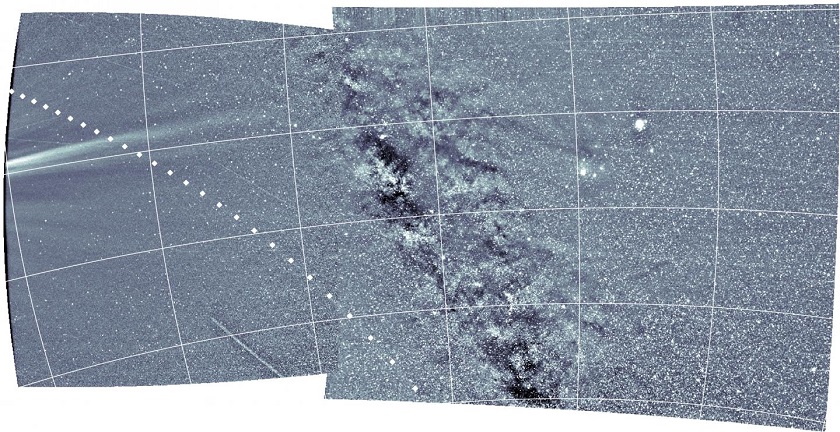
"The images help in the modeling of the behavior and the transport of the solar wind to Earth," said Russ Howard, an NRL astrophysicist, and principal WISPR investigator. "They allow us to develop more accurate models by putting proper physics in the models." This image recorded by U.S. Naval Research Laboratory Wide-field Imager for Parker Solar Probe (WISPR) cameras on April 6, 2019 captured the solar outflow and coronal structures on the left, and the Milky Way and three planets observed across the combined field of view. WISPR is the only imaging instrument aboard the NASA Parker Solar Probe mission.{module INSIDE STORY}
Understanding how the solar wind behaves is important to the Navy and Marine Corps because when the winds reach Earth, they can impact GPS, spacecraft operations, and ground-based power grids.

WISPR, designed, developed and led by NRL, records visible-light images of the solar corona and solar outflow in two overlapping cameras, which together cover more than 100-degrees angular width from the Sun.

The findings just released stem from Parker Solar Probe's most recent approach to the Sun during a quiet part of the solar cycle and set the stage for discoveries when the Sun is more active.

"Parker is going to swoop past the sun three or four times a year for the next few years, getting successively closer each time," said Karl Battams, a computational scientist at NRL. "Every encounter is going to give us a view that humankind has never seen, and along with that a lot of new questions - and hopefully quite a few answers - about what we are seeing."

Parker Solar Probe recently completed its third perihelion or closest approach to the Sun. By the end of its 7-year-long mission, the spacecraft will have circled the Sun a total of 24 times. In 2024, the Parker Solar Probe is expected to have traveled 96 percent of the distance to the Sun.

"We're explorers and we're getting in closer and closer until we're finally at the Sun," Howard said. "It's mindboggling because you're going to see things that we can't even imagine."

The Parker Solar Probe is a robotic spacecraft NASA launched in August 2018, whose mission is repeatedly probing and making observations of the outer corona of the Sun. WISPR is one of four instruments on Parker Solar Probe.
RUB researchers discover an alloy that retains its memory at high temperatures

Even after the hundredth time, the material returns to its original shape when heated.

Using supercomputer simulation, Alberto Ferrari calculated a design proposal for a shape memory alloy that retains its efficiency for a long time even at high temperatures. Alexander Paulsen manufactured it and experimentally confirmed the prediction. The alloy of titanium, tantalum, and scandium is more than just a new high-temperature shape memory alloy. Rather, the research team from the Interdisciplinary Centre for Advanced Materials Simulation (Icams) and the Institute for Materials at Ruhr-Universität Bochum (RUB) has also demonstrated how theoretical predictions can be used to produce new materials more quickly. The group published its report in the journal Physical Review Materials from 21 October 2019. Their work was showcased as Editor’s suggestion.

Avoiding the unwanted phase

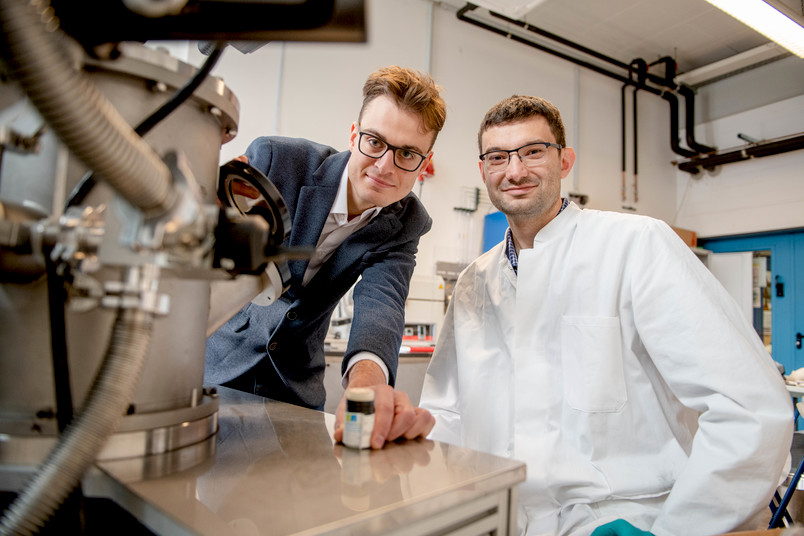
Shape memory alloys can re-establish their original shape after deformation when the temperature changes. This phenomenon is based on a transformation of the crystal lattice in which the atoms of the metals are arranged. Researchers refer to is as phase transformation. “In addition to the desired phases, there are also others that form permanently and considerably weaken or even completely destroy the shape memory effect,” explains Dr. Jan Frenzel from the Institute for Materials. The so-called omega phase occurs at a specific temperature, depending on the composition of the material. To date, many shape memory alloys for the high-temperature range would withstand only a few deformations before they became unusable once the omega phase set in. Alexander Paulsen (right) and Alberto Ferrari have brought theory and practice together.{module INSIDE STORY}

Promising shape memory alloys for high-temperature applications are based on a mixture of titanium and tantalum. By changing the proportions of these metals in the alloy, researchers can determine the temperature at which the omega phase occurs. “However, while we can move this temperature upward, the temperature of the desired phase transformation is unfortunately lowered in the process,” says Jan Frenzel. 

Admixture alters properties

The RUB researchers attempted to understand the mechanisms of the onset of the omega phase in detail, in order to find ways to improve the performance of shape memory alloys for the high-temperature range. To this end, Alberto Ferrari, Ph.D. researcher at Icams, calculated the stability of the respective phases as a function of temperature for different compositions of titanium and tantalum. “He was able to use it to confirm the results of experiments,” points out Dr. Jutta Rogal from Icams.

In the next step, Alberto Ferrari simulated small amounts of third elements being added to the shape memory alloy of titanium and tantalum. He selected the candidates according to specific criteria, for example, they should be as non-toxic as possible. It emerged that an admixture of a few percents of scandium would have to result in the alloy functioning for a long time even at high temperatures. “Even though scandium belongs to the rare earths and is, consequently, expensive, we only need very little of it, which is why it’s worth using anyway”, explains Jan Frenzel. 

{media id=234,layout=solo}

Prediction is accurate

Alexander Paulsen then produced the alloy calculated by Alberto Ferrari at the Institute for Materials and tested its properties in an experiment: the results confirmed the calculations. A microscopic examination of the samples later proved that even after many deformations no omega phase was found in the crystal lattice of the alloy. “We have thus expanded our basic knowledge of titanium-based shape memory alloys and developed possible new high-temperature shape memory alloys,” says Jan Frenzel. “Moreover, it’s great that the computer simulation predictions are so accurate.” Since the production of such alloys is very complex, the implementation of computer-aided design proposals for new materials promises much faster success.

CU CIRES scientists evaluate spectral, pixel-based approaches for detecting solar flares, more in real-time

New machine learning tool can improve space weather forecasts, understanding of solar data

Supercomputers can learn to find solar flares and other events in vast streams of solar images and help NOAA forecasters issue timely alerts, according to a new study. The machine-learning technique, developed by scientists at CIRES and NOAA's National Centers for Environmental Information (NCEI), searches massive amounts of satellite data to pick out features significant for space weather. Changing conditions on the Sun and in space can affect various technologies on Earth, blocking radio communications, damaging power grids, and diminishing navigation system accuracy.

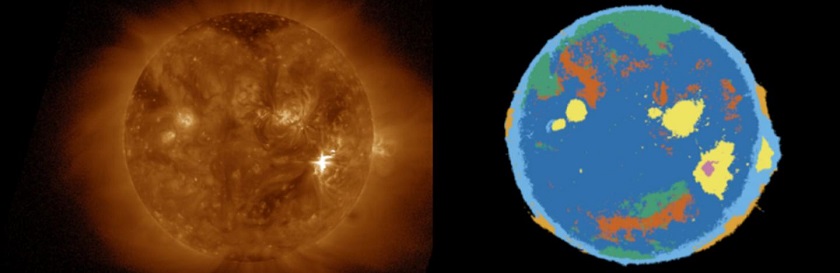
"Being able to process solar data in real-time is important because flares erupting on the Sun impact Earth over the course of minutes. These techniques provide a rapid, continuously updated overview of solar features and can point us to areas requiring more scrutiny," said Rob Steenburgh, a forecaster in the NOAA Space Weather Prediction Center (SWPC) in Boulder. CAPTION This new technique transforms observations during the September 6th, 2017, solar flare into understandable, multi-colored maps. Different colors identify different solar phenomena.  CREDIT Dan Seaton and J. Marcus Hughes/CU Boulder, CIRES & NCEI{module INSIDE STORY}

The research was published in October in the Journal of Space Weather and Space Climate.

To predict incoming space weather, forecasters summarize current conditions on the Sun twice daily. Today, they use hand-drawn maps labeled with various solar features--including, active regions, filaments, and coronal hole boundaries. But solar imagers produce a new set of observations every few minutes. For example, the Solar Ultraviolet Imager (SUVI) on NOAA's GOES-R Series satellites runs on a 4-minute cycle, collecting data in six different wavelengths every cycle.

Just keeping up with all of that data could take up a lot of a forecaster's time. "We need tools to process solar data into digestible chunks," said Dan Seaton, a CIRES scientist working at NCEI and one of the paper's co-authors. CIRES is part of the University of Colorado Boulder.

So J. Marcus Hughes, a computer science graduate student at CU Boulder, CIRES scientist in NCEI and lead author of the study, created a supercomputer algorithm that can look at all the SUVI images simultaneously and spot patterns in the data. With his colleagues, Hughes created a database of expert-labeled maps of the Sun and used those images to teach a computer to identify solar features important for forecasting. "We didn't tell it how to identify those features, but what to look for--things like flares, coronal holes, bright regions, filaments, and prominences. The computer learns how through the algorithm," Hughes said.

The algorithm identifies solar features using a decision-tree approach that follows a set of simple rules to distinguish between different traits. It examines an image one pixel at a time and decides, for example, whether that pixel is brighter or dimmer than a certain threshold before sending it down a branch of the tree. This repeats until, at the very bottom of the tree, each pixel fits only one category or feature--a flare, for example.

The algorithm learns hundreds of decision trees--and makes hundreds of decisions along each tree--to distinguish between different solar features and determine the "majority vote" for each pixel. Once the system is trained, it can classify millions of pixels in seconds, supporting forecasts that could be routine or require an alert or warning.

"This technique is really good at using all the data simultaneously," Hughes said. "Because the algorithm learns so rapidly it can help forecasters understand what's happening on the Sun far more quickly than they currently do."

The technique also sees patterns humans can't. "It can sometimes find features we had difficulty identifying correctly ourselves. So machine learning can direct our scientific inquiry and identify important characteristics of features we didn't know to look for," Seaton said.

The algorithm's skill at finding patterns is not only useful for short-term forecasting, but also for helping scientists evaluate long-term solar data and improve models of the Sun. "Because the algorithm can look at 20 years' worth of images and find patterns in the data, we'll be able to answer questions and solve long-term problems that have been intractable," Seaton said.

NCEI and SWPC are still testing the tool for tracking changing solar conditions so forecasters can issue more accurate watches, warnings, and alerts. The tool could be made officially operational as early as the end of 2019.