

Cambridge researchers discover water vapor in many exoplanets, the amounts are lower than expected

The most extensive survey of atmospheric chemical compositions of exoplanets to date has revealed trends that challenge current theories of planet formation and has implications for the search for water in the solar system and beyond.

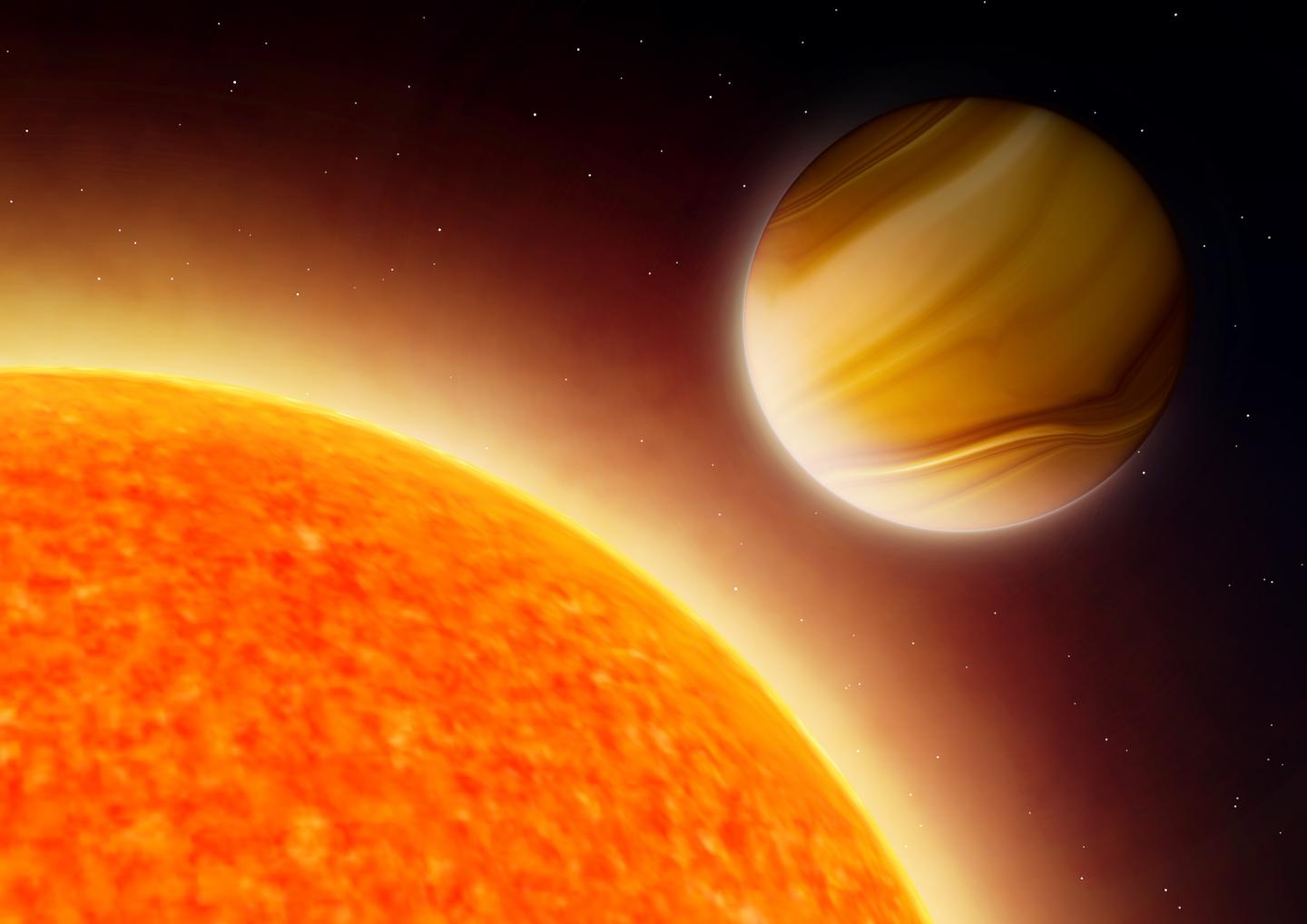
A team of researchers, led by the University of Cambridge, used atmospheric data from 19 exoplanets to obtain detailed measurements of their chemical and thermal properties. The exoplanets in the study span a large range in size - from 'mini-Neptunes' of nearly 10 Earth masses to 'super-Jupiters' of over 600 Earth masses - and temperature, from nearly 20C to over 2000C. Like the giant planets in our solar system, their atmospheres are rich in hydrogen, but they orbit different types of stars. CAPTION The most extensive survey of atmospheric chemical compositions of exoplanets to date has revealed trends that challenge current theories of planet formation and has implications for the search for water in the solar system and beyond.  CREDIT Amanda Smith{module INSIDE STORY}
The researchers found that while water vapour is common in the atmospheres of many exoplanets, the amounts were surprisingly lower than expected, while the amounts of other elements found in some planets were consistent with expectations. The results, which are part of a five-year research programme on the chemical compositions of planetary atmospheres outside our solar system, are reported in the Astrophysical Journal Letters.

"We are seeing the first signs of chemical patterns in extra-terrestrial worlds, and we're seeing just how diverse they can be in terms of their chemical compositions," said project leader Dr Nikku Madhusudhan from the Institute of Astronomy at Cambridge, who first measured low water vapour abundances in giant exoplanets five years ago.

In our solar system, the amount of carbon relative to hydrogen in the atmospheres of giant planets is significantly higher than that of the sun. This 'super-solar' abundance is thought to have originated when the planets were being formed, and large amounts of ice, rocks and other particles were brought into the planet in a process called accretion.

The abundances of other elements have been predicted to be similarly high in the atmospheres of giant exoplanets - especially oxygen, which is the most abundant element in the universe after hydrogen and helium. This means that water, a dominant carrier of oxygen, is also expected to be overabundant in such atmospheres.

The researchers used extensive spectroscopic data from space-based and ground-based telescopes, including the Hubble Space Telescope, the Spitzer Space Telescope, the Very Large Telescope in Chile and the Gran Telescopio Canarias in Spain. The range of available observations, along with detailed computational models, statistical methods, and atomic properties of sodium and potassium, allowed the researchers to obtain estimates of the chemical abundances in the exoplanet atmospheres across the sample.

The team reported the abundance of water vapour in 14 of the 19 planets, and the abundance of sodium and potassium in six planets each. Their results suggest a depletion of oxygen relative to other elements and provide chemical clues into how these exoplanets may have formed without substantial accretion of ice.

"It is incredible to see such low water abundances in the atmospheres of a broad range of planets orbiting a variety of stars," said Madhusudhan.

"Measuring the abundances of these chemicals in exoplanetary atmospheres is something extraordinary, considering that we have not been able to do the same for giant planets in our solar system yet, including Jupiter, our nearest gas giant neighbour," said Luis Welbanks, lead author of the study and PhD student at the Institute of Astronomy.

Various efforts to measure water in Jupiter's atmosphere, including NASA's current Juno mission, have proved challenging. "Since Jupiter is so cold, any water vapour in its atmosphere would be condensed, making it difficult to measure," said Welbanks. "If the water abundance in Jupiter were found to be plentiful as predicted, it would imply that it formed in a different way to the exoplanets we looked at in the current study."

"We look forward to increasing the size of our planet sample in future studies," said Madhusudhan. "Inevitably, we expect to find outliers to the current trends as well as measurements of other chemicals."

These results show that different chemical elements can no longer be assumed to be equally abundant in planetary atmospheres, challenging assumptions in several theoretical models.

"Given that water is a key ingredient to our notion of habitability on Earth, it is important to know how much water can be found in planetary systems beyond our own," said Madhusudhan.

CU researchers preserve, release trove of public, low-frequency radio data

At AGU's Fall Meeting, the preeminent international Earth and space science meeting, researchers unveiled the world's largest database of Extremely Low Frequency (ELF)/Very Low Frequency (VLF) data. The open-access database is named WALDO, which stands for Worldwide Archive of Low-frequency Data and Observations. Researchers will be able to access nearly 1000 terabytes (TB) of data to further scientific efforts in fields like space weather, ionospheric remote sensing, earthquake forecasting, and subterranean prospecting. Space weather effects can produce anything from beautiful auroras in the night sky to destructive effects on power grids and satellites, so both scientists and engineers are motivated to understand them and ultimately predict them.

The work to preserve hundreds of terabytes of ELF/VLF electromagnetic wave measurements and open it for researchers worldwide is a joint project of Stanford University, Georgia Institute of Technology and the University of Colorado Denver with support from the National Science Foundation and Department of Defense. {module INSIDE STORY}

"It's exciting that we saved this data all these years because right now is the time when it is becoming most valuable with advances in computing power, Big Data algorithms and artificial intelligence," said Mark Golkowski, PhD, professor of Electrical Engineering, College of Engineering, Design and Computing, CU Denver.

Golkowski and Morris Cohen, PhD, associate professor in the School of Electrical and Computer Engineering at Georgia Tech initiated the WALDO project as the culmination of a legacy that began at Stanford following World War II. Professor Robert Helliwell pioneered the field and the use of large antennas to capture low-frequency radio waves in remote locations like Antarctica and Alaska to study the complex physics of near-Earth space. Helliwell at Stanford eventually passed the torch to Professor Umran Inan, who served as advisor to Golkowski and Cohen when they were students in his research program.

"If there is one thing our advisor instilled in us, it was the sanctity of high quality science observations and the importance of preserving them." says Golkowski. "Unfortunately, this kind of archival work is often put on the back burner and it's only later that people say, 'if only we had data from 10 years ago, we would know if this was an anomaly or not.' Losing data is like the burning of the library at Alexandria. When it's gone, it's gone."

For years, researchers have transferred data from magnetic tapes to CDs to DVDs as technology advanced and outdated storage methods threatened the data. The advent of massive cloud storage has the added benefit of making the data accessible to researchers all over the world.

Through the efforts of Golkowski and Cohen and their students, nearly 80,000 DVDs of data is uploading to the cloud. At the time of the meeting, 200TB of data is uploaded, with another 800 TB to go.

While most data is from the last 20 years, some recordings date back to the 1970s and 80s.

WALDO will also be a living repository, capturing ongoing data being collected by Georgia Tech and the University of Colorado Denver. For example, data collected during the 2017 Great American Solar Eclipse will be publicly available.

"The recordings capture a snapshot of the Earth's quickly changing atmosphere and space environment, which is why the effort to maintain the data we already have is crucial for future research. "It's shown me the effort necessary as a civilization to keep from losing the past," says Cohen. "While there is no question that the data on WALDO is a record of the planet's past and can inform on its present, anybody with experience in data analysis knows that one often has to comb through a lot of noise and lackluster observations to find the gem that will advance knowledge."

"This was the inspiration for the 'WALDO' name based on the children's cartoon character always hiding among the masses in his characteristic sweater," says Golkowski.

Golkowski and Cohen hope that opening up the database will inspire new discoveries and new uses for the datasets. Ever improving computational power and data algorithms will no doubt play a role.

"We have a sense of the known unknowns. But who knows who many unknown unknowns are still out there. By making this data public, our hope is for other researchers to use these data sets in ways we haven't imagined yet," said Cohen, who applied WALDO data and found that signals at 60 Hz and its harmonics--the annoying noise that comes from power grids--can be used as a diagnostic for power grids and cybersecurity systems.

At CU Denver, Golkowski has used ELF observations of lightning to diagnose the upper lower atmosphere, which could eventually improve communication systems.

"Finally!", quipped Cohen, "we have an answer to the question `Where's WALDO?"

UW Medicine machine learning technique shows how individual cancer cells react to drugs

sci-Plex profiles gene expression in thousands of individual cells when a sample is perturbed; the technology holds promise for cancer, infection, prenatal medicine, and other research

A new technique reported in Science this week overcomes several limitations of typical high-throughput chemical screens conducted on cell samples. Such screens are commonly used to try to discover new cancer drugs and in many other biomedical applications.

Most current screens of this nature offer either a coarse readout, such as cell survival, proliferation or alterations in cell shapes, or only a specific molecular finding, such as testing whether a particular enzyme is blocked.

Because of the huge gap between those extremes, most assays routinely miss subtle gene expression or cell state changes that might unveil mechanisms triggered inside perturbed cells. Such assays can also fail to detect nuances that might indicate unexpected side effects of drugs being tested, or varying reactions among genetically identical cells to the same drug, or why cells become resistant to treatment that was previously working well.

To address these limitations, a research team representing many fields collaborated to develop a more informative technique. {module INSIDE STORY}

"This technology actually occupies a niche between the two common kinds of assays," said one of the lead researchers, Sanjay R. Srivatsan, an M.D./Ph.D. student in the Medical Scientist Training Program at the University of Washington School of Medicine in Seattle. "You can get a sort of global view of the cellular responses. We think it's going to be really powerful to categorize drugs, for example, and say what their mechanism is."

The new technology combines improvements in labeling cell nuclei with advances in profiling in which genes are expressed in each of millions of cells. This was accomplished at a single-cell resolution and in a cost-effective manner. They named the new screening method sci-Plex.

In the Dec. 5 online edition of Science, the researchers report their proof-of-concept findings. The lead authors of the paper, in addition to Srivatsan, are Jose L. McFaline-Figueroa, a postdoctoral fellow in genome sciences at the UW medical school; and Vijay Ramani, a former UW genome sciences graduate student who is now a Sandler Faculty Fellow at the University of California.

The senior researchers were Cole Trapnell, UW School of Medicine associate professor of genome sciences and an investigator at the Brotman Baty Institute for Precision Medicine in Seattle, and Jay Shendure, a UW medical school professor of genome sciences and scientific director of the Brotman Baty Institute. Shendure is also a Howard Hughes Medical Institute investigator and directs the Allen Institute Discovery Center for Cell Lineage Tracing.

"The sci-Plex technique allows us to pool lots of genetically different cells and see what happens to many individual cells as they are perturbed in many different ways," said Trapnell. "We then collect all the data together and analyze it using modern tools from machine learning and data science to understand something about what each of those drugs does to the cells."

To put sci-Plex through its paces, the researchers applied it to a screen using three kinds of cancer cell lines (leukemia, lung cancer, and breast cancer) treated with 180 compounds used for cancer, HIV and autoimmune disease therapies. The cells were labeled with a nuclear hashing of small, single strands of DNA.

This hashing identifies different cells and permits scientists to map which cells received which drug. In just one experiment, the researchers measured gene expression in 650,000 single cells from more than 5,000 independently treated samples.

The results indicated significant differences in the ways some of the cancer cells reacted to specific compounds. They also revealed shared patterns among cells with regard to other chemical families as well as some properties that distinguished drugs within a chemical family.

The researchers delved more deeply into the mode of action of one class of cancer drugs, HDAC inhibitors. They saw that the gene regulatory changes matched the proposition that these inhibitors stopped cancer cell proliferation by blocking access to an energy source.

Describing another aspect of the research, Srivistan said, "It was really cool that we could use gene expression profiles to categorize the potency of drugs. With changes in dose over four orders of magnitude, we could see a smooth increase in the cellular response."

Overall, the sci-Plex results suggest that it could be scaled to thousands of samples to target diverse biochemical pathways, catalysts, regulators, and modes of action.

"Some of this work could pertain to the treatment of disease, in helping medical researchers understand how certain drugs produce their effects, how the cell stage influences effectiveness, and why some medications work on some cells, but not on others," Trapnell said.

"Physicians also give many people the same handful of drugs, and they work for some people and not for others," Trapnell added. "Potentially sci-Plex could help us better understand why that is."

Trapnell said he believes sci-Plex could be a useful tool for precision medicine: "Ultimately when someone gets sick with cancer, we want to kill the whole tumor, all of the cells, not just some of the cells. So understanding why some individual cells respond one way to a drug and others respond differently is critical to designing therapies that will be completely effective."

A distinct advantage of sci-Plex, the researchers noted, is that it can distinguish how a compound affects subsets of cells. In addition to those that makeup tumors, such subsets could also include lab-dish living models such as reprogrammed cells, organoids, and synthetic embryos.

The researchers predict that the ease and low cost of nuclear hashing, combined with the flexibility and scalability of their methods for single-cell sequencing, could give sci-Plex many basic research and practical applications in biomedicine. For example, it might help in building a comprehensive atlas of cellular responses to pharmaceutical interventions.

"It's a very generalizable strategy," Srivatsan said. "It can be performed with reagents which any scientist can acquire and it can be used in many ways."

Trapnell agreed. "I'm really interested in how the single-cell genomics scientific community picks this up for things we didn't anticipate. That happens all the time in our field. Technology developers and experimental biologists are repurposing techniques in all kinds of ways that the original developers did not envision."