


The surface of Titan. Credits:Credit: NASA/JPL; University of Arizona; University of Idaho

Doubts cast on claims of Titan's lakes being shaped by waves

The recent study conducted by MIT researchers, suggesting that waves may be shaping the lakes and seas on Saturn's moon Titan, has sparked debate among experts in the field. The research used simulations on supercomputers to analyze erosion patterns on Titan's shorelines, but it has been met with skepticism due to its indirect approach and lack of concrete evidence.

Titan is known for its unique landscape, featuring rivers, lakes, and seas filled with liquid methane and ethane, which has long intrigued scientists. The initial confirmation of Titan's liquid bodies came in 2007 through images captured by NASA's Cassini spacecraft. However, the presence of waves on Titan has remained a contentious issue, with conflicting interpretations from researchers.

The MIT team, led by Professor Taylor Perron, aimed to shed light on this debate by modeling erosion scenarios on Titan's seas. Their simulations suggested that waves were the most likely cause of shaping the moon's shorelines. While the results are intriguing, the researchers themselves acknowledge that more direct observations are needed to confirm the presence of waves on Titan.

The study's lead author, Rose Palermo, emphasized the need for caution when interpreting the results, stating, "We can say, based on our results, that if the coastlines of Titan’s seas have eroded, waves are the most likely culprit." However, the lack of direct evidence of wave activity on Titan's surface leaves room for doubt regarding the validity of their conclusions.

Critics argue that relying on modeling and simulations, rather than empirical research, makes it difficult to support claims about wave erosion on Titan. The complex nature of Titan's environment and the limitations of remote observations make it difficult to draw definitive conclusions without physical evidence of wave activity.

As the scientific community grapples with the tantalizing possibility of waves shaping Titan's lakes, many remain cautious about embracing the findings as conclusive proof. The debate over the role of waves in sculpting Titan's landscape is far from settled, highlighting the need for further research and direct observations to unravel the mysteries of this enigmatic moon.

In the quest to unveil the secrets of Titan's alien seas, skepticism serves as a reminder of the importance of rigorous scientific inquiry and the critical assessment of speculative claims. Until concrete evidence of wave activity on Titan emerges, the question of whether its lakes are truly shaped by waves will continue to be met with skepticism by the scientific community.

Map displaying the amount of litter (measured in parts per million) in the Mediterranean Sea, as estimated by satellite.

Space tech, supercomputers revolutionize marine pollution surveillance

Collaborative efforts led by international researchers have resulted in a new method for monitoring marine litter from space. This breakthrough was made possible by supercomputers and advanced search algorithms. The escalating issue of marine litter, especially plastic waste, has become a global environmental concern. It has been challenging to monitor litter on water surfaces due to the vastness of the ocean and the limitations of field measurements. However, satellite-based observations offer a promising solution for large-scale monitoring of marine pollution.

A study revealed that international researchers, including the Joint Research Centre (JRC), successfully identified thousands of floating litter accumulation patches, called "windrows," in the Mediterranean Sea. This breakthrough also helped identify the most polluted areas, and seasonal variability patterns, and evaluate land-based emissions.

A consortium of space companies and research institutes from six nations, funded by the European Space Agency, analyzed a historical series of 300,000 satellite images of the Mediterranean Sea to locate minute litter windrows. Through the use of supercomputers and advanced search algorithms, they were able to identify thousands of litter windrows, ranging from a few hundred meters to 20 kilometers in length. This effort culminated in the creation of the most comprehensive map of marine litter pollution to date.

The implications of this achievement extend into various aspects of environmental conservation. While the satellites were not originally designed for detecting litter, their capability enabled scientists to identify the most contaminated areas and track changes over time. Furthermore, the prospects of deploying specialized satellites designed for monitoring ocean plastics hold promise for enhancing detection capabilities and reshaping the landscape of combating plastic pollution.

The deployment of supercomputers and refined search algorithms holds the potential for addressing a range of issues, from oil spills and cargo losses to facilitating search and rescue missions at sea.

This incredible innovation is in line with EU policies and initiatives aimed at addressing the challenges of plastic pollution and the preservation of marine ecosystems. This development promises to transform our understanding of marine pollution by using semi-automatic analysis of remote sensing imagery, leading to more cost-effective management solutions.

By renewing optimism for the protection of our planet's oceans, this achievement exemplifies the transformative power of collaborative efforts, technological innovation, and the unwavering pursuit of environmental conservation. The pioneering advancements in marine litter surveillance, driven by the combination of space technology and supercomputing, shine a beacon of hope for a cleaner and more sustainable future for our planet's invaluable marine ecosystems.

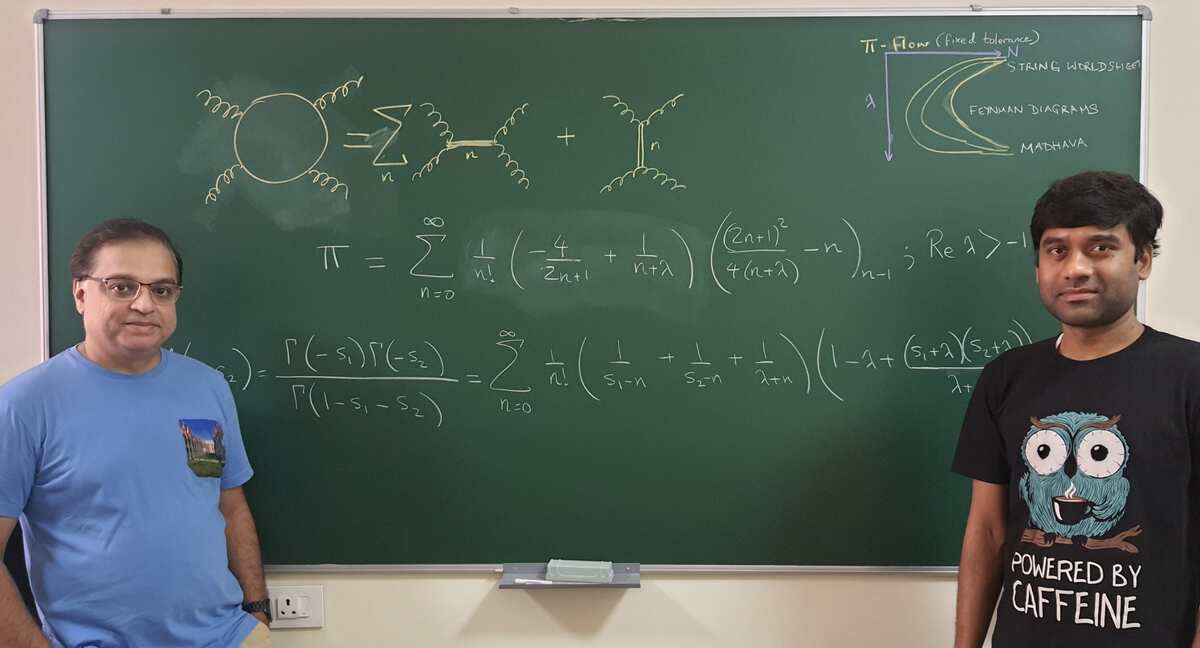
Aninda Sinha (left) and Arnab Saha (right)  CREDIT Manu Y
Aninda Sinha (left) and Arnab Saha (right) CREDIT Manu Y

IISc physicists discover the novel representation of pi through advanced modeling

A team of scientists at the Indian Institute of Science (IISc) has achieved a breakthrough in the fields of physics and mathematics by discovering a new series representation for the irrational number π, also known as pi. The research, conducted within the realm of string theory, has introduced a novel approach for deriving pi from calculations related to complex processes like quantum scattering of high-energy particles.

Led by post-doctoral researcher Arnab Saha and Professor Aninda Sinha from the Center for High Energy Physics (CHEP) at IISc, the study has resulted in the formulation of a unique formula that closely approximates the historically significant series for pi put forward by Indian mathematician Sangamagrama Madhava in the 15th century. This marks the first-ever series for pi recorded in history.

Sinha explains, "Our initial focus was not specifically on uncovering a new perspective on pi. Instead, our efforts were concentrated on delving into high-energy physics within the domain of quantum theory, to develop a model with refined parameters to understand particle interactions. The discovery of a new method for interpreting pi naturally emerged from this pursuit."

The research team's specialization in string theory, a theoretical framework proposing that all quantum processes in nature originate from various modes of vibrations on a string, primarily revolves around the interactions of high-energy particles. The study aims to unravel the complexities of understanding particle interactions by employing minimal and straightforward factors. This approach falls under the purview of "optimization problems," which involves modeling intricate processes while considering numerous parameters for each moving particle, including factors such as mass, vibrations, and degrees of freedom relevant to its movement.

Saha, who has been actively engaged in addressing the optimization problem, sought to establish an efficient model for representing these particle interactions. As part of this endeavor, he collaborated with Sinha to combine two mathematical tools—an Euler-Beta Function and the Feynman Diagram—to develop an efficient model. Euler-Beta functions, widely used to solve problems in various branches of physics and engineering, including machine learning, were integrated with the Feynman Diagram, a mathematical representation explaining energy exchange during particle interactions and scattering.

The integration of these mathematical tools has not only resulted in an efficient model that illuminates particle interactions but has also led to an innovative series representation of pi. In mathematics, a series is used to represent a parameter such as pi in its fundamental form. Sinha explains, "Finding the correct number and combination of parameters to rapidly approach the exact value of pi has long presented a challenge. The series discovered by our team combines specific parameters in a manner that enables rapid attainment of the value of pi, which can then be incorporated into calculations relating to the deciphering of high-energy particle scattering."

The implications of these findings are profound, as they have opened up new avenues for advancing our understanding of complex mathematical and physical phenomena. Sinha highlights that while the practical applications of these theoretical findings are not yet fully realized, historical precedents—such as Paul Dirac's groundbreaking work in 1928, which ultimately led to the design of Positron Emission Tomography (PET)—underscore the potential for unforeseen practical applications arising from fundamental theoretical research.

The research, while currently theoretical, represents a significant milestone in the fields of mathematical and theoretical physics. As indicated by Sinha, "Engaging in such research, despite its potential non-immediate practical applications, offers the pure pleasure of engaging in theory for the sake of advancing the frontiers of scientific knowledge."