

Nuclear fusion experiment data now public

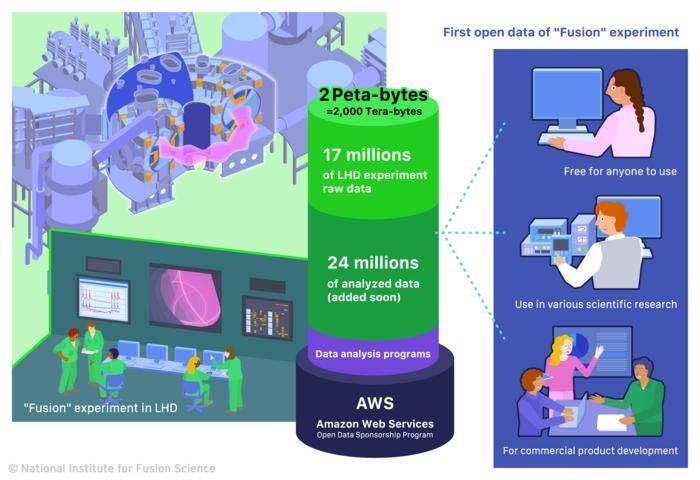
In Toki, Japan, the Large Helical Device (LHD) at the National Institute for Fusion Science (NIFS) has achieved a new world record by generating approximately 0.92 terabytes (TB) of data per experiment. This is the closest amount of data generation to ITER, the International Thermonuclear Experimental Reactor, which is expected to produce nearly 1 TB of data per experiment in a decade. In a major milestone, all LHD experiment data is now available on the "cloud" through Amazon Web Services (AWS) Simple Storage Service (S3).

Following the adoption of "Open Science" by G7 countries in 2023, NIFS established its Open Access and Research Data policies in February and October 2022. Since 2023, all data from LHD experiments has been immediately accessible to the public after acquisition and analysis completion. The computing program source codes for data analysis are also openly available, aligning with the FAIR principles.

To facilitate faster and easier data analysis due to the large number and size of individual data, NIFS has joined the AWS Open Data Sponsorship Program and transferred approximately 2 petabytes of LHD experiment data to AWS's cloud storage, Amazon S3. This move allows users to access a computing environment with a suite of data analysis programs, simplifying data analysis and promoting extensive data utilization.

The open LHD data is available to the public and industries around the world, even for those without prior understanding of LHD experiment data. This initiative aims to universalize fusion energy research. NIFS views the AWS program as a reliable, uninterrupted data service that is not dependent on network capabilities and systems. The open data is expected to encourage participation in fusion energy research and development by industries and newcomers from other countries.

In the future, NIFS plans to register approximately 40 million LHD data with DOI (Digital Object Identifier) to enhance their findability and accessibility. This process will take several years due to the large number of data entities.

The results will be presented at the 14th IAEA Technical Meeting on Control Systems, Data Acquisition, Data Management, and Remote Participation in Fusion Research, which is scheduled from July 15 to July 19, 2024, in São Paulo, Brazil. AWS Japan Country Leader for AWS Worldwide Public Sector, Ushio Usami, expressed hope that the open data would be beneficial in various scientific fields worldwide and drive technological innovation in different industries. Dr. Keiichi Nakano, Chief Researcher at the National Institute of Informatics (NII), also emphasized the importance of the NII Research Data Cloud (NII RDC) for the global implementation of Open Science.
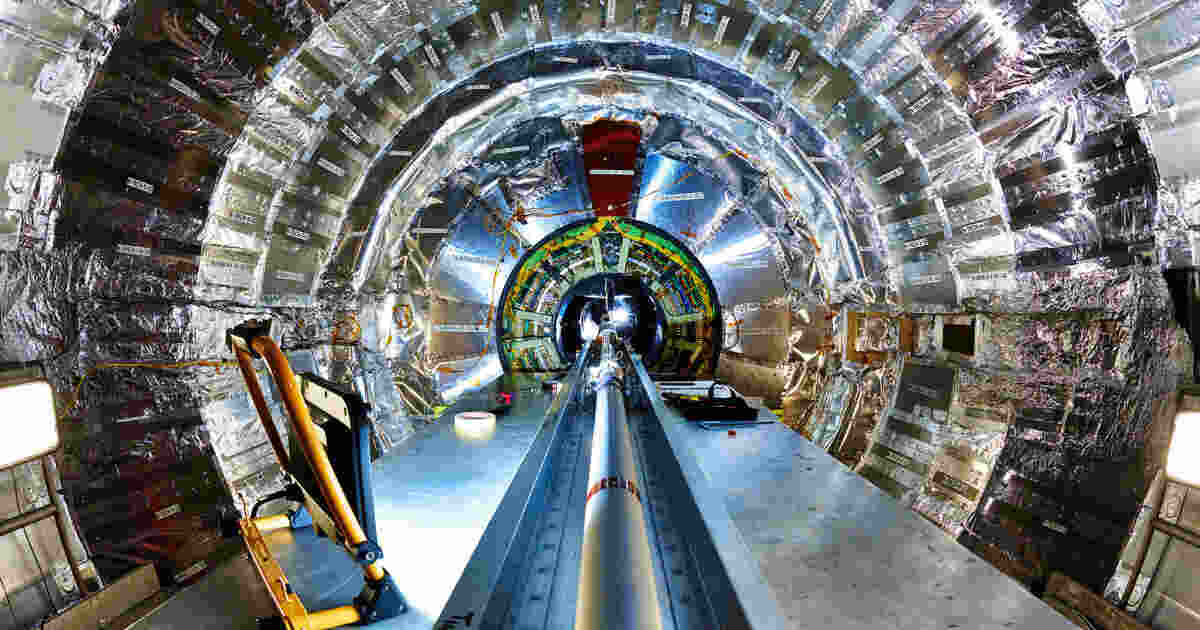
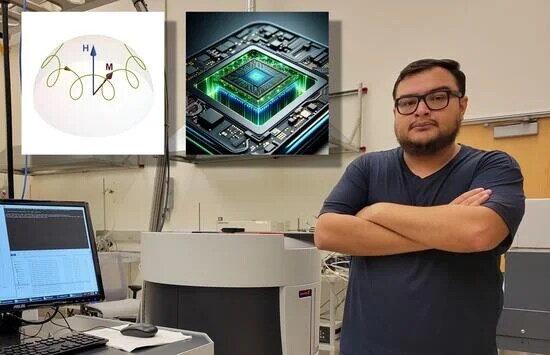
Image credit: Thitikorn07/iStock/Getty Images Plus.

Rochester physicists confirm ‘spooky action at a distance’ through quantum entanglement of top quarks

A team of physicists at the University of Rochester, led by Professor Regina Demina, has recently conducted an experiment at the European Center for Nuclear Research (CERN) that has produced a significant result relating to quantum entanglement. The team has confirmed that entanglement persists between unstable top quarks and their antimatter partners at distances much farther than what can be covered by information transmitted at the speed of light. This finding is a testament to what Albert Einstein called “spooky action at a distance” and could have far-reaching implications in the field of quantum information science.

Entanglement is a coordinated behavior of minuscule particles that occurs when they interact and then move apart. Even when separated, the measurement of a single particle’s properties, such as position, momentum, or spin, instantaneously affects the results of the other particle, thus making their states seemingly inseparable. Until now, quantum entanglement has been observed only between stable particles, such as electrons and photons. This study has broken new ground by observing the phenomenon between unstable particles called top quarks.

The finding, reported by the Compact Muon Solenoid (CMS) Collaboration, confirmed quantum entanglement between the heaviest fundamental particles – top quarks. The researchers’ findings have opened up a new avenue for exploration of the quantum nature of the world at energies beyond what is currently accessible. CERN, based near Geneva, Switzerland, enabled this breakthrough through the Large Hadron Collider (LHC), which facilitates research by discharging high-energy particles around a 17-mile underground track at speeds approaching that of light.

While entanglement forms the foundation of quantum information science, the discovery of persistent entanglement between top quarks and antimatter is unlikely to be applied to building a quantum computer. However, research like that conducted by Demina and her team sheds light on how long entanglement persists and what ultimately breaks it. This study can contribute significantly to our understanding of what led to the loss of the quantum connection in our world, and theorists believe that the universe was in an entangled state after the initial fast expansion stage.

The researchers achieved these noteworthy results by confirming the spin correlation between top quarks and their antimatter partners, thereby manifesting what Einstein called “spooky action at a distance.” The discovery has provided new insight into the persistence of quantum entanglement.

Regina Demina, the leader of the study, recorded a video for CMS' social media channels, where she explains her group’s result using an analogy of an indecisive king of a distant land referred to as “King Top.” The concept enables the viewer to understand the relationship between Anti-Top, King Top’s antiparticle, and the entangled state of their minds at any moment in time.

Demina’s research group consisted of herself, graduate student Alan Herrera, and postdoctoral fellow Otto Hindrichs. As a graduate student, Demina was part of the team that discovered the top quark in 1995 and co-led a team of scientists from across the US that designed a tracking device, playing a crucial role in the 2012 discovery of the Higgs boson.

The study positions the University of Rochester's research at the forefront of the field of particle physics. The research conducted at CERN continues to expand our understanding of the nature of the universe, with the findings contributing to the growth of the rapidly growing field of quantum information science.

Rodolfo Rodriguez
Rodolfo Rodriguez

Propelling ferromagnets into the realm of ultra-fast communication, computation tech

A team of researchers at the University of California, Riverside, has made a significant breakthrough in understanding and utilizing ultra-fast spin behavior in ferromagnets. This research, featured in Physical Review Letters, opens the door for the development of high-frequency applications that could revolutionize future communication and computation technologies.

Currently, smartphones and computers operate at gigahertz frequencies, but there is a push to make them even faster. This research suggests that it may be possible to achieve terahertz frequencies using conventional ferromagnets, which could lead to communication and computation technologies operating at speeds a thousand times faster than current benchmarks.

Ferromagnets, which have electrons with aligned spins, exhibit a phenomenon called "spin waves," which are crucial for processing information and signals in emerging computer technologies.

Dr. Igor Barsukov, an associate professor of physics and astronomy at UC Riverside, explained that the interaction of electron spins with electrons and the crystal lattice of ferromagnets causes them to experience friction. This friction leads to the acquisition of inertia by the spins, resulting in an additional form of spin oscillation called nutation, which occurs at ultra-high frequencies and holds great promise for future computer and communication technologies.

The study also highlighted the potential of nutational auto-oscillations generated by injecting a spin current with the "wrong" sign, as explained by the first author of the paper, a graduate student in the Barsukov Group and scientist at HRL Labs, LLC.

Coauthor Allison Tossounian, previously an undergraduate student in the Barsukov Group, recognized the promise of these self-sustained oscillations for the next generation of computation and communication technologies.

Dr. Barsukov emphasized the impact of introducing a second-time derivative in the equation of motion by spin inertia, leading to the emergence of counterintuitive phenomena. By harmonizing spin-current-driven dynamics and spin inertia, and identifying similarities between the spin dynamics in ferromagnets and ferrimagnets, the study could accelerate technological innovation by leveraging synergies between these fields.

Additionally, Dr. Barsukov highlighted the growing interest in ferrimagnets, which have two antiparallel spin lattices with an unequal amount of spin, as potential candidates for ultrafast applications.

While acknowledging ongoing technological challenges, Dr. Barsukov pointed out significant advances in understanding spin currents and materials engineering for ferromagnets over recent decades. These developments, combined with the confirmation of nutation, have paved the way for ferromagnets to emerge as leading contenders for ultra-high frequency applications.

The study, titled "Spin inertia and auto-oscillations in ferromagnets," received support from the National Science Foundation.