Bielefeld wins five million euros for the 'de.NBI' bioinformatics network

Further funding for the project based in Bielefeld five years after its start

It should be possible for researchers in the life sciences to draw on powerful technological services throughout Germany when they need to analyze large data sets. This is why the Federal Ministry of Education and Research (BMBF) invested about 80 million euros in a major large-scale project: the German Network for Bioinformatics Infrastructure (de.NBI). Bielefeld University is coordinating the project. On Thursday 13 February, scientists and politicians celebrated the fifth anniversary and the previous successes of the network with a symposium in Berlin. These successes include a distributed cloud infrastructure, eight service centers throughout the nation, and 40 participating bioinformatics groups. The BMBF has now announced continued funding for the de.NBI. Until the end of 2021, Bielefeld University alone will have up to 5.3 million euros at its disposal to continue the project.

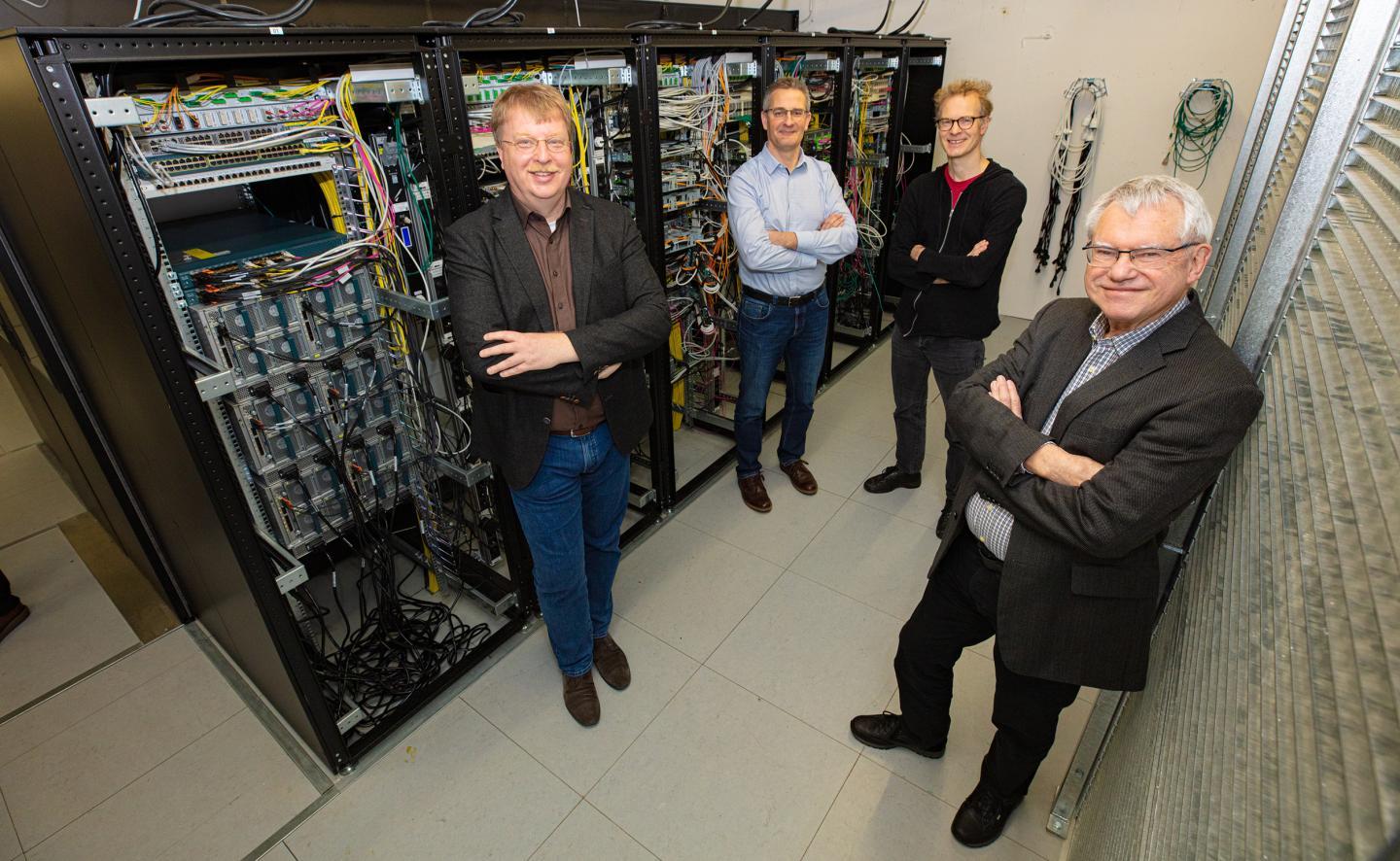
The administration office of the de.NBI (pronounced 'Dennbi') is located at Bielefeld University's Center for Biotechnology (CeBiTec). Up to now, it has brought together a total of 250 scientists who are cooperating in building up the bioinformatics infrastructure throughout Germany. 'The progress they have made since 2015 is the topic of the symposium,' says the de.NBI coordinator Professor Dr. Alfred Pühler. CAPTION For the de.NBI, they are coordinating supercomputing power and services for bioinformatics in Germany (from left to right): Professor Dr Andreas Tauch, Professor Dr Alexander Sczyrba, Professor Dr Jens Stoye, and Professor Dr Alfred Pühler.  CREDIT Photo: Bielefeld University/M.-D. Müller{module INSIDE STORY}
The network offers researchers in the life sciences IT infrastructure that can be used to analyze data over de.NBI's own computer network. 'We took an innovative approach here and set up a national cloud at what are now six locations,' says Professor Dr. Alexander Sczyrba, head of the Computational Metagenomics research group at Bielefeld University's Faculty of Technology. 'This cloud is available free of charge to all researchers in the life sciences. It is restricted to Germany, thereby ensuring that no sensitive research data leave the country.' More than 100 bioinformatics programs are available to researchers in the life sciences with which to analyze their data.

However, supercomputing power and software alone would not be enough to support bioinformatics research. 'What is decisive is to enable researchers to acquire the necessary competencies to handle the technology and to support them with services,' says Alfred Pühler. The network has succeeded in setting up eight service centers throughout Germany in which 40 groups of bioinformatics experts offer their IT services, advice, and training courses.

The centers focus on different fields covering, among others, human, plant, and microbial bioinformatics. 'Bielefeld runs the service center for microbial bioinformatics focusing on the bioinformatics analysis of all molecular data on micro-organisms but also on microbial communities,' says Professor Dr. Jens Stoye, head of the Genome Informatics research group at the Faculty of Technology. Research at Bielefeld University also profits from the de.NBI according to Professor Dr. Martin Egelhaaf, Bielefeld University's Vice-rector for Research and Research Transfer. 'Thanks to the possibilities provided by the network, our scientists can perform bioinformatic analyses more quickly and with fewer complications than before. That applies to the greatest variety of disciplines--from biotechnology to medicine,' says Egelhaaf.

'Each year, the network organizes more than 80 training courses on how to use the bioinformatics programs. This means that we have trained more than 6,000 scientists since the beginning of the initiative,' says Professor Dr. Andreas Tauch. He heads the de.NBI administration office that coordinates the network's services and training courses and refers users to the specialized service centers.

'Bielefeld University has become an outstanding center for bioinformatics infrastructure in Germany,' concludes the Network Coordinator Alfred Pühler. He emphasizes that the de.NBI is designed to become a permanent structure. 'Scientists in the life sciences depend on having a stable central infrastructure so that they can process their enormous data sets and communicate them in uncomplicated ways,' says Pühler. Currently, they are working on a way to make the network permanent. 'The Federal Ministry of Education and Research (BMBF) has agreed to finance the network until the end of 2021 to give more time for these discussions.'

Data centers use less energy than you think

The new, comprehensive analysis presents more nuanced presents of global energy use

If the world is using more and more data, then it must be using more and more energy, right? Not so, says a comprehensive new analysis.

Researchers at Northwestern University, Lawrence Berkeley National Laboratory, and Koomey Analytics have developed the most detailed model to date of global data center energy use. With this model, the researchers found that, although demand for data has increased rapidly, massive efficiency gains by data centers have kept energy use roughly flat over the past decade.

This detailed, comprehensive model provides a more nuanced view of data center energy use and its drivers, enabling the researchers to make strategic policy recommendations for better managing this energy use in the future.

"While the historical efficiency progress made by data centers is remarkable, our findings do not mean that the IT industry and policymakers can rest on their laurels," said Eric Masanet, who led the study. "We think there is enough remaining efficiency potential to last several more years. But ever-growing demand for data means that everyone -- including policymakers, data center operators, equipment manufacturers, and data consumers -- must intensify efforts to avoid a possible sharp rise in energy use later this decade." CREDIT David Lohner{module INSIDE STORY}

The paper will be published on Feb. 28 in the journal Science.

Masanet is an adjunct professor at Northwestern's McCormick School of Engineering and the Mellichamp Chair in Sustainability Science for Emerging Technologies at the University of California, Santa Barbara. He conducted the research with a Ph.D. student and coauthor Nuoa Lei at Northwestern.

Filled with computing and networking equipment, data centers are central locations that collect, store and process data. As the world relies more and more on data-intensive technologies, the energy use of data centers is a growing concern.

"Considering that data centers are energy-intensive enterprises in a rapidly evolving industry, we do need to analyze them rigorously," said study co-author Arman Shehabi, a research scientist at Lawrence Berkeley National Laboratory. "Less detailed analyses have predicted rapid growth in data center energy use, but without fully considering the historical efficiency progress made by the industry. When we include that missing piece, a different picture of our digital lifestyles emerges."

To paint that more complete picture, the researchers integrated new data from numerous sources, including information on data center equipment stocks, efficiency trends, and market structure. The resulting model enables a detailed analysis of the energy used by data center equipment (such as servers, storage devices, and cooling systems), by type of data center including supercomputing centers and by world region.

The researchers concluded that recent efficiency gains made by data centers have likely been far greater than those observed in other major sectors of the global economy.

"Lack of data has hampered our understanding of global data center energy use trends for many years," said co-author Jonathan Koomey of Koomey Analytics. "Such knowledge gaps make business and policy planning incredibly difficult."

Addressing these knowledge gaps was a major motivation for the research team's work. "We wanted to give the data center industry, policymakers, and the public a more accurate view of data center energy use," said Masanet. "But the reality is that more efforts are needed to better monitor energy use moving forward, which is why we have made our model and datasets publicly available."

By releasing the model, the team hopes to inspire more research into the topic. The researchers also translated their findings into three specific types of policies that can help mitigate future growth in energy use, urging policymakers to act now:

  • Extend the life of current efficiency trends by strengthening IT energy standards such as ENERGY STAR, providing financial incentives and disseminating best energy efficiency practices;
  • Increase research and development investments in next-generation supercomputing, storage, and heat removal technologies to mitigate future energy use, while incentivizing renewable energy procurement to mitigate carbon emissions in parallel;
  • Invest in data collection, modeling, and monitoring activities to eliminate blind spots and enable more robust data center energy policy decisions.

Large exoplanet could have the right conditions for life

Astronomers have found an exoplanet more than twice the size of Earth to be potentially habitable, opening the search for life to planets significantly larger than Earth but smaller than Neptune.

A team from the University of Cambridge used the mass, radius, and atmospheric data of the exoplanet K2-18b and determined that it's possible for the planet to host liquid water at habitable conditions beneath its hydrogen-rich atmosphere. The results are reported in The Astrophysical Journal Letters.

The exoplanet K2-18b, 124 light-years away, is 2.6 times the radius and 8.6 times the mass of Earth and orbits its star within the habitable zone, where temperatures could allow liquid water to exist. The planet was the subject of significant media coverage in the autumn of 2019, as two different teams reported the detection of water vapor in its hydrogen-rich atmosphere. However, the extent of the atmosphere and the conditions of the interior underneath remained unknown. CAPTION Artist's impression of K2-18b.  CREDIT Amanda Smith{module INSIDE STORY}

"Water vapor has been detected in the atmospheres of a number of exoplanets but, even if the planet is in the habitable zone, that doesn't necessarily mean there are habitable conditions on the surface," said Dr. Nikku Madhusudhan from Cambridge's Institute of Astronomy, who led the new research. "To establish the prospects for habitability, it is important to obtain a unified understanding of the interior and atmospheric conditions on the planet - in particular, whether liquid water can exist beneath the atmosphere."

Given the large size of K2-18b, it has been suggested that it would be more like a smaller version of Neptune than a larger version of Earth. A 'mini-Neptune' is expected to have a significant hydrogen 'envelope' surrounding a layer of high-pressure water, with an inner core of rock and iron. If the hydrogen envelope is too thick, the temperature and pressure at the surface of the water layer beneath would be far too great to support life.

Now, Madhusudhan and his team have shown that despite the size of K2-18b, its hydrogen envelope is not necessarily too thick and the water layer could have the right conditions to support life. They used the existing observations of the atmosphere, as well as the mass and radius, to determine the composition and structure of both the atmosphere and interior using detailed numerical models and statistical methods to explain the data.

The researchers confirmed the atmosphere to be hydrogen-rich with a significant amount of water vapor. They also found that levels of other chemicals such as methane and ammonia were lower than expected for such an atmosphere. Whether these levels can be attributed to biological processes remains to be seen.

The team then used the atmospheric properties as boundary conditions for models of the planetary interior. They explored a wide range of models that could explain the atmospheric properties as well as the mass and radius of the planet. This allowed them to obtain the range of possible conditions in the interior, including the extent of the hydrogen envelope and the temperatures and pressures in the water layer.

"We wanted to know the thickness of the hydrogen envelope - how deep the hydrogen goes," said co-author Matthew Nixon, a Ph.D. student at the Institute of Astronomy. "While this is a question with multiple solutions, we've shown that you don't need much hydrogen to explain all the observations together."

The researchers found that the maximum extent of the hydrogen envelope allowed by the data is around 6% of the planet's mass, though most of the solutions require much less. The minimum amount of hydrogen is about one-millionth by mass, similar to the mass fraction of the Earth's atmosphere. In particular, a number of scenarios allow for an ocean world, with liquid water below the atmosphere at pressures and temperatures similar to those found in Earth's oceans.

This study opens the search for habitable conditions and bio-signatures outside the solar system to exoplanets that are significantly larger than Earth, beyond Earth-like exoplanets. Additionally, planets such as K2-18b are more accessible to atmospheric observations with current and future observational facilities. The atmospheric constraints obtained in this study can be refined using future observations with large facilities such as the upcoming James Webb Space Telescope.