Harvard's Shaw builds a new mechanistic model that reveals earthquake processes at a Colorado oil field

Earthquakes generated by controlled fluid injection at Colorado’s Rangely oil field were caused by destabilizing fault pore pressure changes, according to a new mechanistic model applied to data from the decades’ old project

The Rangely experiment, conducted from 1969 to 1973, is one of the oldest studies of recorded seismicity due to subsurface fluid injection and is considered to be a pioneering study in the field of induced seismicity. The experiment is being revisited in light of results from studies of the significantly increased seismicity in the central United States and elsewhere due to fluid injection during oil and gas extraction.

During the Rangely experiment, water was injected cyclically into the site’s Weber sandstone, a rock reservoir located 1700 meters below the surface. By 1970, the Weber was producing about 30,000 barrels of oil per day. Data on microseismicity, stress magnitude, and orientation, and reservoir pore pressure were collected before, during, and after the experiment, offering a unique data set for future investigations.

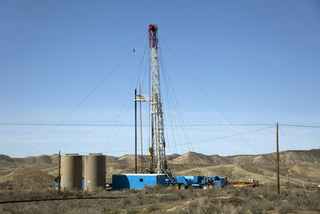
In the Bulletin of the Seismological Society of America, Josimar Silva, Ruben Juanes, John Shaw, and colleagues at Harvard University and MIT took a detailed look at the small earthquakes generated by the Rangely experiment, using new modeling capabilities to examine fluid diffusion and rock poroelastic mechanisms at the site. Most earthquakes generated during the experiment were too small to be felt, with the largest at magnitude 3.1, and originated along one fault running through the field. A tall drill rig and drill bits with liquid storage tanks at the Rangely Oil Field in 2014. | milehightraveler/ iStock

The researchers defined two groups of earthquakes during the experiment—an “upper cluster” close to the injection wells within the reservoir receiving the injected fluids, and a “lower cluster” outside of this injection space. They conclude from their models that upper cluster earthquakes should be considered induced by the injection, but that pore pressure diffusion caused only small changes in stress at the lower cluster such that these events are triggered.

One of the important and somewhat surprising findings from the study said Shaw, “involves the role of the fault itself as a conduit for fluid flow.”

The model suggests that highly permeable rock fractures adjacent to the fault were necessary to create “a permeability pathway through which the fluids could actually flow from the injection site to the sources of many earthquakes,” said Shaw.

“We need to consider in all cases that fault zones are not only subject to the stresses and the fluid pressure changes that may destabilize them or produce earthquakes,” he added, “but they’re also important to understand as the conduits for fluid flow.”

Shaw said the experiment was unique cooperation for the time between Chevron, the operator of the field, and the U.S. Geological Survey. The time was right for Shaw and colleagues to revisit the Rangely data, he said, because “we have the new capability of modeling fluid flow in the subsurface, coupled with a geomechanical model to try to understand how production and injection operations affect the stability of faults.”

The area around the oil field is not tectonically active in the sense of having ongoing natural seismicity, Shaw said, but the experiment and their modeling show how “even small perturbations in the subsurface caused by human activities can actually destabilize faults that have the right orientations and the right properties.”

Shaw and his colleagues plan to apply their model to other regions that could be similarly destabilized by pore pressure changes caused by human activity, such as the Los Angeles basin, and other subsurface injection sites such as carbon sequestration or geothermal power reservoirs.

Their mechanistic model could be combined with other studies of induced earthquakes “to make us more capable of understanding these phenomena and hopefully find ways to manage them,” he said.

Iowa State agronomist updates predictive erosion models, maps of the Midwest's soil topography

Climate change and soil erosion feed into one another in an environmental feedback loop that can have big consequences for Iowa's land, but an Iowa State University agronomist is developing new models to illuminate these complex interactions.

Developing these new supercomputer models of soil erosion and topography changes requires both innovative big-data technology as well as painstaking validation of soil measurements in the real world, said Bradley Miller, an ISU assistant professor of agronomy. Miller recently received support from the National Science Foundation to continue his research to develop updated soil maps of Iowa as well as erosion models capable of predicting how environmental conditions will influence Iowa's soil in the future.

NSF awarded Miller a faculty early career development grant worth $574,000 to support the research. The award program is the most prestigious award NSF grants to early-career faculty. Bradley Miller takes soil samples from a field. Part of Miller's research aims to bridge geomorphology, or the study of how landforms change over time, with soil science

Climate models predict more precipitation and flooding in the Midwestern United States as a result of climate change, which will accelerate soil erosion. More erosion, in turn, will diminish the ability of soils to store water, which can lead to nutrient loss and higher peaks during flooding events.

"The soil landscape is part of the system interacting with climate, which traditionally we have treated as not changing," Miller said. "The work that we will be doing will enable the inclusion of a changing soil landscape in the climate, crop, and flooding models."

Bridging geomorphology and soil science

Although there has been a great deal of research and a wide variety of approaches for studying soil erosion and landscape evolution, they have been limited by the ability to validate the models only on a few hillslopes at a time, Miller said. Geomorphology models focus on changes in the shape of hillslopes, while soil erosion models tend to account for the mass of soil transported down hillslopes. Often, those models don't reach the same conclusions when making predictions, Miller said.

So part of his research aims to bridge geomorphology, or the study of how landforms change over time, with soil science. To do so, he and his lab group are comparing data on Iowa's topography gathered by light detection and ranging (LiDAR) technology, which uses pulsed lasers mounted on airplanes to take detailed scans of the Earth. Miller has analyzed LiDAR data gathered across Iowa in 2009 and will compare how that data changed over the course of a decade. The researchers will then validate the erosion models with the real-world observations of elevation change detected by the LiDAR data.

All that data will then inform the creation of new predictive models of soil erosion as well as facilitate the researchers' ability to create new soil maps for the entire state. Keeping soil models updated requires a large quantity of "boots on the ground," Miller said. Models that account for the redistribution of soil down slopes and the resulting change in topography will allow for more efficiently updated soil maps and better forecasting of what the map will look like in the future.

The rate of soil loss through erosion is often measured in tons per acre, but Miller said those statistics are often difficult to visualize. New soil maps will create a more striking visual to help Iowans better grasp soil erosion.

"Citing a bunch of big numbers can sometimes lose people," he said. "We're going to convert this into a map so you can actually see what has changed in the landscape. I think maps are immensely powerful."

Updated soil maps and predictive erosion models will be of obvious use to Iowa's agricultural sector, but Miller said they will have many more applications as well. Soil maps inform decisions on construction and development in communities across the state. In fact, just about any big land-use decision will benefit from having updated soil maps, Miller said.

"Because our land is so important, we need to feed this information into models," Miller said. "This is the foundational information that helps us make better decisions."

Ancient maths could foil future cyber hackers

Mathematical equations dating back thousands of years are being studied to explore new ways of encrypting personal data

Ancient mathematical problems dating back to Babylonian times could hold the key to keeping our personal data and online payments safe from hackers in the future.

A new project by a University of Reading mathematician, in collaboration with Microsoft, will study equations that have fascinated mathematicians for thousands of years, and explore how they might aid the development of encryption software to protect data from hackers using more and more powerful computers.

Dr Rachel Newton was today (Thursday 15 October) announced as a recipient of a share of £109 million of UK Research and Innovation (UKRI) funding. She was one of 101 recipients of Future Leaders Fellowships, aimed at establishing the careers of world-class research and innovation leaders at universities and businesses across the country.

Dr Newton said: "Recent advances in quantum computing, and its potential use by hackers in the future, pose a growing data security threat, at a time when more and more of our economic, administrative and social interactions take place online.

"The cybersecurity industry is appealing to mathematicians for support in developing new encryption systems based on harder mathematical problems. I plan to be part of this fight by using ancient mathematical problems in a modern context.

"Research in number theory could pave the way for advances that would make buying something online or withdrawing money from a cashpoint far more secure in future, and help us stay one step ahead of hackers." {module INSIDE STORY}

The new project will look at Diophantine equations - mathematical equations with multiple unknown values that are named after the ancient Greek mathematician Diophantus of Alexandria, although their study has been documented thousands of years earlier in ancient Babylonia.

Previous research in this area has led to the development of elliptic curve cryptography, which is widely used today to encrypt data and protect our card details during online purchases. Users of this security system include the USA National Security Agency and Microsoft.

The cryptosystems that protect our data rely on the difficulty of solving mathematical problems, but with quantum supercomputers being developed that can solve problems in seconds which would have previously taken 10,000 years, encryption systems must also make advances so as not to be compromised.

Dr Newton and her collaborators will use a range of mathematical techniques, including number theory, algebra and geometry, to study Diophantine equations. Alongside this, she will collaborate with Microsoft to investigate possible applications to cryptography.

The Future Leaders Fellows will each receive between £400,000 and £1.5 million over an initial four years to fund their research.

Announcing the successful fellows at Thursday's Future Leaders Conference, Science Minister Amanda Solloway said: "We are committed to building back better through research and innovation, and supporting our science superstars in every corner of the UK.

"By backing these inspirational Future Leaders Fellows, we will ensure that their brilliant ideas can be transferred straight from the lab into vital everyday products and services that will help to change all our lives for the better."