

Iowa State agronomist updates predictive erosion models, maps of the Midwest's soil topography

Climate change and soil erosion feed into one another in an environmental feedback loop that can have big consequences for Iowa's land, but an Iowa State University agronomist is developing new models to illuminate these complex interactions.

Developing these new supercomputer models of soil erosion and topography changes requires both innovative big-data technology as well as painstaking validation of soil measurements in the real world, said Bradley Miller, an ISU assistant professor of agronomy. Miller recently received support from the National Science Foundation to continue his research to develop updated soil maps of Iowa as well as erosion models capable of predicting how environmental conditions will influence Iowa's soil in the future.

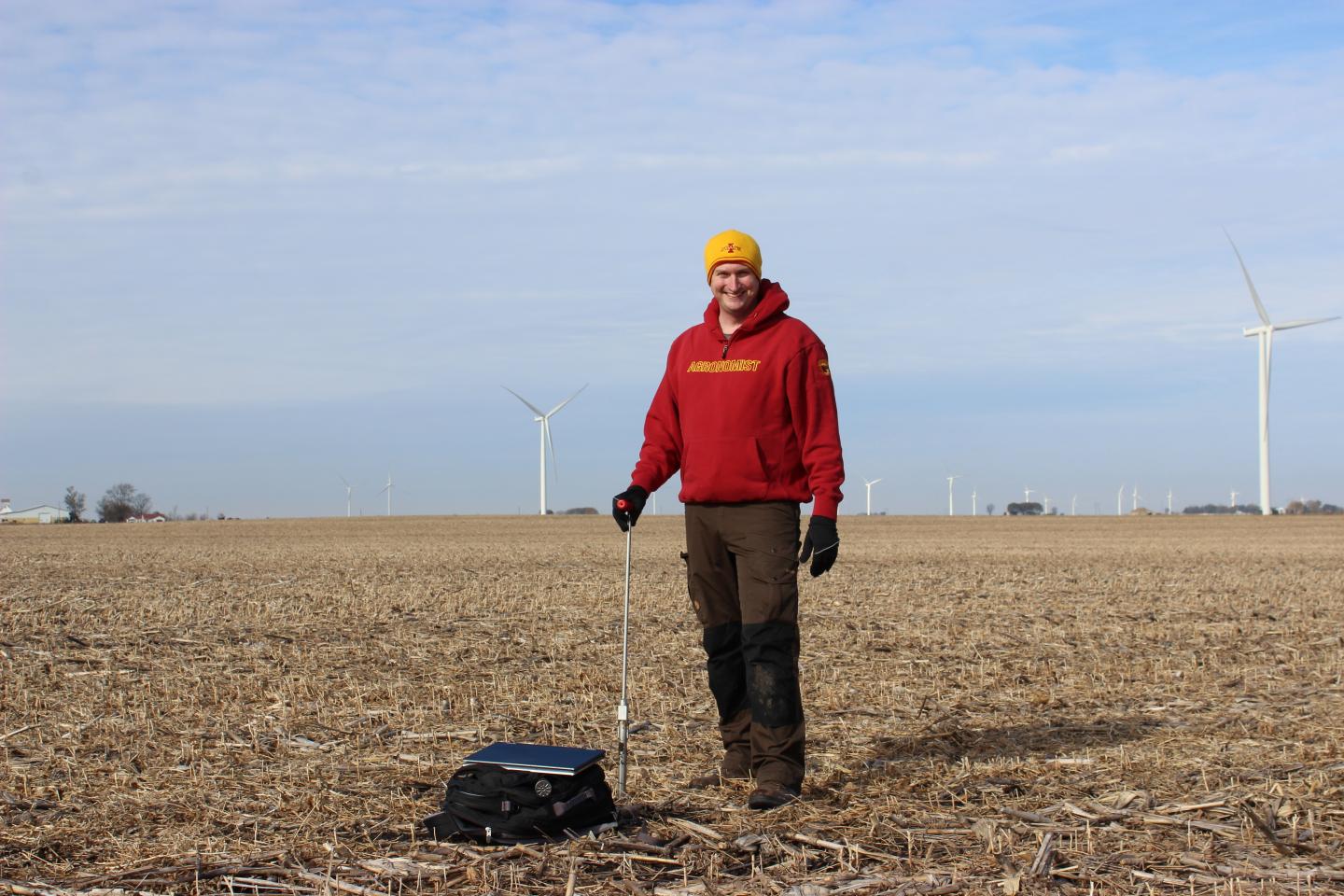
NSF awarded Miller a faculty early career development grant worth $574,000 to support the research. The award program is the most prestigious award NSF grants to early-career faculty. Bradley Miller takes soil samples from a field. Part of Miller's research aims to bridge geomorphology, or the study of how landforms change over time, with soil science
Climate models predict more precipitation and flooding in the Midwestern United States as a result of climate change, which will accelerate soil erosion. More erosion, in turn, will diminish the ability of soils to store water, which can lead to nutrient loss and higher peaks during flooding events.

"The soil landscape is part of the system interacting with climate, which traditionally we have treated as not changing," Miller said. "The work that we will be doing will enable the inclusion of a changing soil landscape in the climate, crop, and flooding models."

Bridging geomorphology and soil science

Although there has been a great deal of research and a wide variety of approaches for studying soil erosion and landscape evolution, they have been limited by the ability to validate the models only on a few hillslopes at a time, Miller said. Geomorphology models focus on changes in the shape of hillslopes, while soil erosion models tend to account for the mass of soil transported down hillslopes. Often, those models don't reach the same conclusions when making predictions, Miller said.

So part of his research aims to bridge geomorphology, or the study of how landforms change over time, with soil science. To do so, he and his lab group are comparing data on Iowa's topography gathered by light detection and ranging (LiDAR) technology, which uses pulsed lasers mounted on airplanes to take detailed scans of the Earth. Miller has analyzed LiDAR data gathered across Iowa in 2009 and will compare how that data changed over the course of a decade. The researchers will then validate the erosion models with the real-world observations of elevation change detected by the LiDAR data.

All that data will then inform the creation of new predictive models of soil erosion as well as facilitate the researchers' ability to create new soil maps for the entire state. Keeping soil models updated requires a large quantity of "boots on the ground," Miller said. Models that account for the redistribution of soil down slopes and the resulting change in topography will allow for more efficiently updated soil maps and better forecasting of what the map will look like in the future.

The rate of soil loss through erosion is often measured in tons per acre, but Miller said those statistics are often difficult to visualize. New soil maps will create a more striking visual to help Iowans better grasp soil erosion.

"Citing a bunch of big numbers can sometimes lose people," he said. "We're going to convert this into a map so you can actually see what has changed in the landscape. I think maps are immensely powerful."

Updated soil maps and predictive erosion models will be of obvious use to Iowa's agricultural sector, but Miller said they will have many more applications as well. Soil maps inform decisions on construction and development in communities across the state. In fact, just about any big land-use decision will benefit from having updated soil maps, Miller said.

"Because our land is so important, we need to feed this information into models," Miller said. "This is the foundational information that helps us make better decisions."
Ancient maths could foil future cyber hackers

Mathematical equations dating back thousands of years are being studied to explore new ways of encrypting personal data

Ancient mathematical problems dating back to Babylonian times could hold the key to keeping our personal data and online payments safe from hackers in the future.

A new project by a University of Reading mathematician, in collaboration with Microsoft, will study equations that have fascinated mathematicians for thousands of years, and explore how they might aid the development of encryption software to protect data from hackers using more and more powerful computers.

Dr Rachel Newton was today (Thursday 15 October) announced as a recipient of a share of £109 million of UK Research and Innovation (UKRI) funding. She was one of 101 recipients of Future Leaders Fellowships, aimed at establishing the careers of world-class research and innovation leaders at universities and businesses across the country.

Dr Newton said: "Recent advances in quantum computing, and its potential use by hackers in the future, pose a growing data security threat, at a time when more and more of our economic, administrative and social interactions take place online.

"The cybersecurity industry is appealing to mathematicians for support in developing new encryption systems based on harder mathematical problems. I plan to be part of this fight by using ancient mathematical problems in a modern context.

"Research in number theory could pave the way for advances that would make buying something online or withdrawing money from a cashpoint far more secure in future, and help us stay one step ahead of hackers." {module INSIDE STORY}

The new project will look at Diophantine equations - mathematical equations with multiple unknown values that are named after the ancient Greek mathematician Diophantus of Alexandria, although their study has been documented thousands of years earlier in ancient Babylonia.

Previous research in this area has led to the development of elliptic curve cryptography, which is widely used today to encrypt data and protect our card details during online purchases. Users of this security system include the USA National Security Agency and Microsoft.

The cryptosystems that protect our data rely on the difficulty of solving mathematical problems, but with quantum supercomputers being developed that can solve problems in seconds which would have previously taken 10,000 years, encryption systems must also make advances so as not to be compromised.

Dr Newton and her collaborators will use a range of mathematical techniques, including number theory, algebra and geometry, to study Diophantine equations. Alongside this, she will collaborate with Microsoft to investigate possible applications to cryptography.

The Future Leaders Fellows will each receive between £400,000 and £1.5 million over an initial four years to fund their research.

Announcing the successful fellows at Thursday's Future Leaders Conference, Science Minister Amanda Solloway said: "We are committed to building back better through research and innovation, and supporting our science superstars in every corner of the UK.

"By backing these inspirational Future Leaders Fellows, we will ensure that their brilliant ideas can be transferred straight from the lab into vital everyday products and services that will help to change all our lives for the better."

Skoltech scientists use ML to optimize hydraulic fracturing design for oil wells

Skoltech researchers and their industry colleagues have created a data-driven model that can forecast the production from an oil well stimulated by multistage fracturing technology. This model has high commercialization potential, and its use can boost oil production via optimized fracturing design. The research, supported by Gazprom Neft Science and Technology Center, was published in the Journal of Petroleum Science and Engineering.

Hydraulic fracturing, essentially pumping fluid at high pressures into the reservoir formation, which creates fractures and help bring hydrocarbons to the well and ultimately to the surface, is one of the most widely used techniques for stimulation of oil and gas production. Over the last decades, the technical complexity of HF has grown so much that it now requires extensive design and prior modeling with complex multi-module simulators.

"At the same time, bridging the predictions of these simulators with reality is still a major problem of calibrating, verifying and validating models on real data. Moreover, to close the loop between fracturing simulator and production data, one needs to couple fracturing design modeling with a reservoir simulator, which increases complexity and uncertainty even more. As an alternative, we decided to look right at the field data on frac design and production, which is the measure of success," explains Professor Andrei Osiptsov, Head of Multiphase Systems Lab at the Skoltech Center for Hydrocarbon Recovery and a coauthor of the study. {module INSIDE STORY} E

Researchers of the M-Phase Lab together with their colleagues at CDISE led by Professor Evgeny Burnaev, head of ADASE group, decided to see whether a data-driven approach to HF design based on machine learning can help address this challenge.

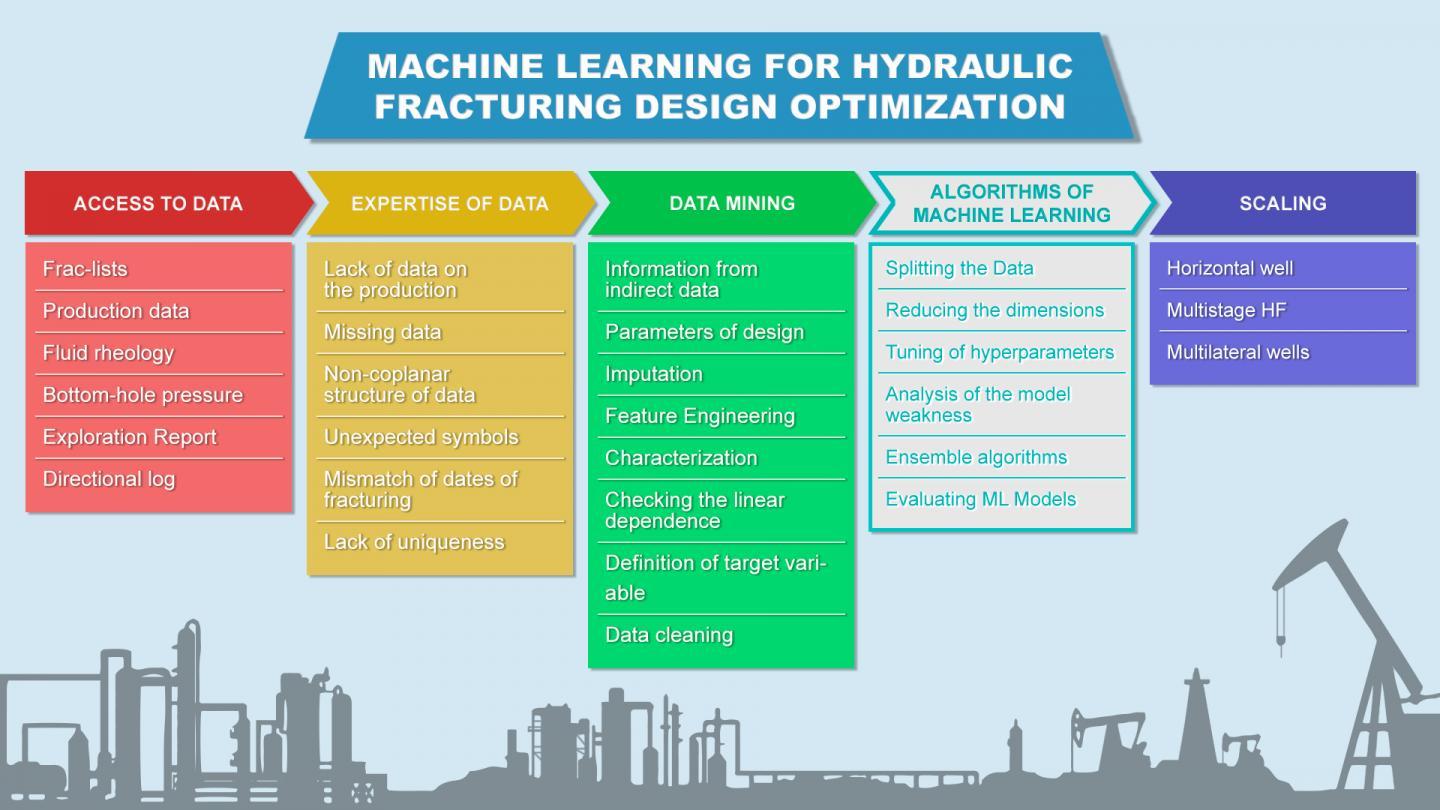
The key component of their project, which was initiated in 2018, is a digital database on fracturing jobs and oil production from some 6 thousand wells in around 20 oilfields in Western Siberia, Russia, within the perimeter of JSC Gazprom Neft. Each data point contains 92 variables on the reservoir, well and the fracturing design parameters as well as 16 oil production parameters.

"We managed to collect and clean up a very big database of completed works on hydraulic fracturing. By applying machine learning methods to this database, we can already predict hydraulic fracturing results with good accuracy, depending on the process parameters. We still have to solve the difficult task of building optimal recommendations for choosing the parameters of the hydraulic fracturing process based on this forecast," says Professor Burnaev, a coauthor of the study.

Albert Vainshtein, senior engineer and project manager at the M-Phase Lab and a coauthor of the study, notes that the project was "very challenging right from the start" due to ambiguity of real data, high uncertainty and heterogeneity.

"I think that the development of a digital database will allow us to test various hypotheses which, in turn, will clear up multiple hidden patterns of the fracturing processes. As an example, it is important to determine at which injected proppant tonnage our cumulative oil production stops increasing. Depending on the conditions, a common approach is to inject 60 tons per fracturing stage. Using the machine learning model and statistics, we can confirm or reject this hypothesis," says Anton Morozov, a Skoltech PhD student and research intern at the M-Phase Lab.

Scientists have already produced pilot well fracturing design recommendations based on their machine learning approaches, which have been delivered to the industry partner. They hope an upcoming field-testing campaign will show the potential of their technology for oil production. Still, Burnaev reiterates that there is "quite a large amount of uncertainty in the input data describing the design of a hydraulic fracturing system". In the next phase of the project, they aim to develop new methods for estimating this uncertainty.

"Working with real field data takes courage and care, as it is very sensitive and requires special handling procedures. It would have been impossible without unconditional support from our technology partner, Gazpromneft Science and Technology Center, and the largest production entity of the operator, Gazpromneft Khantos, which is our ultimate client on this project," Osiptsov says.

"Our data-driven approach opens an avenue towards a recommendation system which would advise DESC engineers on the optimum set of fracturing design parameters, or at least narrowing down the intervals, where this optimum design can be found," he concludes.

Grigory Paderin, who leads the Optimal Hydraulic Fracturing project at the Gazprom Neft Science and Technology Center, also noted that this project "is not just a unique scientific challenge aimed at optimizing hydraulic fracturing design, it is also very important for the digitization of processes at Gazprom Neft. It allows us to take a new look at the value of our data and to reconsider our attitudes towards collecting, storing and processing this data."