

SUPERCOMPUTING NEWS SUPERCOMPUTING NEWS
    • MEDIA KIT
    • MOST READ
    • RSS FEED
    • ACADEMIA
    • AEROSPACE
    • APPLICATIONS
    • ASTRONOMY
    • AUTOMOTIVE
    • BIG DATA
    • BIOLOGY
    • CHEMISTRY
    • CLIENTS
    • CLOUD
    • DEFENSE
    • DEVELOPER TOOLS
    • EARTH SCIENCES
    • ECONOMICS
    • ENGINEERING
    • ENTERTAINMENT
    • GAMING
    • GOVERNMENT
    • HEALTH
    • OIL & GAS
    • INDUSTRY
    • INTERCONNECTS
    • MANUFACTURING
    • MIDDLEWARE
    • MOVIES
    • NETWORKS
    • PHYSICS
    • PROCESSORS
    • RETAIL
    • SCIENCE
    • STORAGE
    • SYSTEMS
    • VISUALIZATION
    • AcyMailing subscription form

    • ADD YOUR VIDEOS
    • MANAGE VIDEOS
    • CONVERSATION INBOX
    • SOCIAL ADVERTISER
    • SOCIAL NETWORK VIDEOS
    • SURVEYS
    • GROUPS
    • PAGES
    • MARKETPLACE LISTINGS
    • APPLICATIONS BROWSER
    • PRIVACY CONFIRM REQUEST
    • PRIVACY CREATE REQUEST
    • LEADERBOARD
    • POINTS LISTING
      • BADGES
    • TRADE SHOWS
Sign In
Tyler O'Neal, Staff Editor May 9, 2020, 6:24 am

Russian supercomputer modeling reveals behavior of individual lipid molecules

Lipids are essential building blocks of cell membranes, which control the exchange of substances and energy between a cell and its environment. Developed at the Moscow Institute of Physics and Technology, a new open-source software tool PCAlipids aims to analyze lipid behavior. The new program has been presented in a paper that comes out in print in the upcoming July 1 issue of Biochimica et Biophysica Acta -- Biomembranes.

Every living cell is surrounded by a membrane that serves a number of vital functions, from facilitating the uptake of materials essential for survival to controlling cell regulatory processes. What enables this wide range of functions is the unique structure of the membrane: almost rigid proteins incorporated in a flexible lipidic layer. CAPTION Lipids are essential building blocks of cell membranes, which control the exchange of substances and energy between a cell and its environment. Developed at the Moscow Institute of Physics and Technology, a new open-source software tool PCAlipids aims to analyze lipid behavior.  CREDIT Daria Sokol/MIPT Press Office{module INSIDE STORY}
The lipid composition of membranes has been found to influence how the individual proteins and the membrane as a whole function, therefore emphasizing the importance of lipids. However, the exact molecular mechanism of lipid-protein interplay is yet to be uncovered. PCAlipids is an important step toward understanding that mechanism.

Ways to examine lipid-protein interplay in membranes

The studies of membrane proteins and lipids cannot rely on the same techniques. While a host of experimental methods are available to study protein functioning, they lack either temporal or spatial resolution for analyzing lipids. To close this gap, various computational techniques are employed.

One of them, molecular dynamics simulations, enable researchers to examine the dynamics of a molecular system with atomic precision and at a timescale of picoseconds, or trillionths of a second. In order to achieve biologically relevant temporal and spatial scales, the interatomic interactions of quantum nature are simplified to classical representation. The method involves calculating the forces that act on each atom and solving the associated Newton's equations of motion. The set of parameters used to define interatomic forces is called a force field.

To make sure that force fields are reliable, they undergo validation: Simulation results are contrasted with actual experimental data. The force fields used to model the behavior of the protein-lipid systems in cell membranes require such validation, too. That defines the focus of the tools that aim to analyze the simulations of membrane systems: It is mainly the experimentally measurable quantities that are extracted from the simulations. Due to the limitations of experimental techniques, the currently used analyses focus on large groups of lipids, while the behavior of individual lipids does not get much attention.

New software to analyze individual lipids

Pavel Buslaev, Khalid Mustafin, and Ivan Gushchin from the MIPT Research Center for Molecular Mechanisms of Aging and Age-Related Diseases have developed an open-source script called PCAlipids that analyzes the structure of individual lipid molecules at a given moment and describes their conformational changes -- the reshaping of molecules. A method known as principal component analysis underlies the script.

"PCAlipids is a piece of software that enables describing the motion of an individual molecule. While our study focused on lipids, the method is applicable to other molecules as well," explained Buslaev, who is a researcher at the MIPT Laboratory of Structural Analysis and Engineering of Membrane Systems.

"As of now, it is not possible to experimentally measure the values analyzed by PCAlipids," he added. "However, we have proposed several experiments. Hopefully, this will lead to the development of a new experimental area. The resulting data could then be contrasted with simulated lipid behavior to refine model parameters."

PCAlipids first identifies groups of atoms moving together. Next, it defines a new basis, such that the first basis vector is associated with the collective motion that has the largest amplitude and involves the largest number of atoms. The second most important motion determines the second basis vector and so on.

The analysis that follows relies on the established basis and aims to determine the effects of various factors on the lipid molecules. For example, an additional compound can be introduced into the simulation. If that affects the first, most significant collective motions, it means the compound will have a major influence on the membrane. Otherwise, its impact will below. The manner in which the collective motions are impacted can reveal the mechanisms behind the compound's effects.

Effects of temperature, cholesterol, and more on lipids

The team from MIPT used the new software to study the effects of temperature, cholesterol, and membrane curvature on individual lipids. These parameters have long been known to influence the behavior of the membrane as a whole, but it remained unknown how they affect individual molecules.

Lowering the temperature causes the membrane to undergo a phase transition: The lipids become largely ordered. PCAlipids helped to highlight the beginning of phase transition and quantitatively describe how the number of possible lipid structures varies as the freezing point is approached. It turned out that this number remains stable up until freezing, but the rate of transitions between these structures grows progressively slower.

Cholesterol is a crucial cell membrane component that promotes lipid order. PCAlipids revealed that significant collective motions become more compact in the presence of cholesterol. The simulation also exposed the mechanism that mediates the effects of cholesterol on lipid order.

The cell membrane is flexible and tends to bend a lot, which is vital to its functioning. This leads to one membrane layer being convex and the other concave. Both configurations proved to accommodate the same range of possible lipid structures; however, the rate of transitions between different structures is noticeably higher in the convex layer.

The study has demonstrated that PCAlipids can be used to investigate the structure of lipid systems. The tool replicates the findings of prior research but also reveals details that remained elusive up until now. This illustrates the potential of the new software developed at MIPT to provide insights into the processes that occur in cell membranes.
Where, when will oil spills reach the beach?

Tyler O'Neal, Staff Editor April 6, 2020, 2:14 pm

In October 2018, the Tunisian Ro-Ro passenger ship "Ulysse" rammed into the hull of the Cyprus-flagged container ship "Virginia", which was anchored in international waters off the northern tip of Corsica, an area known for its pristine waters and beaches. Bunker fuel from Virginia leaked out of her tanks through a breach several meters long, threatening the marine environment and coastal areas. 530 m3 of oil was released, and in 36 hours the slick had lengthened to cover approximately 35 km.

Predicting the drift of oil slicks on water surfaces and in coastal zones is fundamental for responding to spill events and to mitigate their impacts on the environment, allowing for more efficient use of emergency response resources.

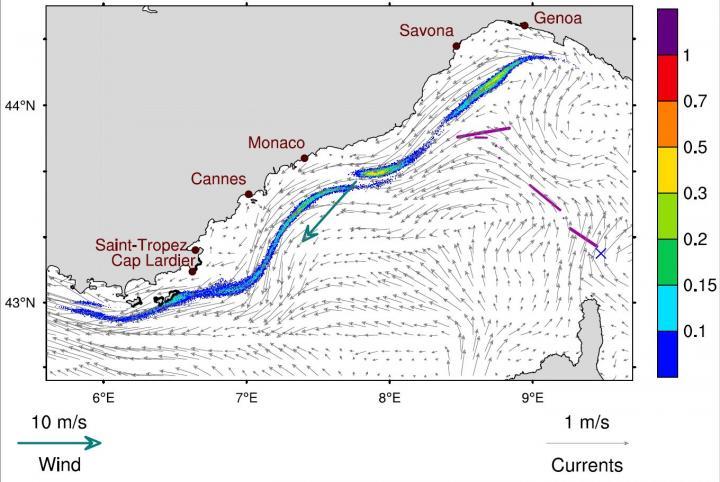
A recently published scientific paper tells about the collaboration that was formed for this purpose, between the researchers of the CMCC Foundation - Euro-Mediterranean Center on Climate Change and REMPEC, the Regional Marine Pollution Emergency Response Centre for the Mediterranean Sea, based in Malta, right after the collision of Ulysse with Virginia. CAPTION Pink polygons indicate the area where the model was restarted from on 10 Oct. 2018. A blue cross marks the ships' point collision.  CREDIT ©Svitlana Liubartseva, CMCC Foundation{module INSIDE STORY}

"Thanks to a joint effort involving an efficient and timely exchange of information, we received observational data from REMPEC and used these real observations as the starting point for our model in order to calculate the forecast", explains Svitlana Liubartseva, a researcher at the CMCC Foundation and first author of the study. "We worked day and night, and provided REMPEC with 5 forecast bulletins during the oil spill tracking and recovery operations."

Forecast of currents, wind, waves and sea surface temperatures are critical for predicting the spread and fate of oil. The study is focused on the ability to realistically predict the times and places where oil reaches coastlines thanks to the oceanographic model MEDSLIK-II, developed by CMCC Foundation. The model results were verified by comparing available observational data.

"Using the oceanographic and atmospheric dataset provided by the Copernicus Marine Environment Monitoring Service (CMEMS) and the European Centre for Medium-Range Weather Forecasts (ECMWF) we produced forecasts of the oil drift. The CMEMS output has a high resolution of about 4 km, that allowed us to produce a rather good quality of prediction of when and where the oil reached the beaches", specifies Dr. Liubartseva.

For the first 16 days after the accident, the model was able to generate reliable predictions, forecasting the oil movements at least 7 days in advance. Researchers were able to predict almost precisely the place and time where the oil would reach the coast for the first time. After more than 9 days drifting at sea, it landed near Saint-Tropez (France). Due to a lack of observational data, in the long run, there was a deterioration in the model solution, as the oil drifted for about one month. Nevertheless, the research demonstrates that the CMCC model facilitates the use and optimization of anti-pollution resource deployment and increases coastal preparedness.

CMCC researchers are now at work to further improve the predictability of oil spill drift and transformation. On the one hand, there is the need to improve the resolution of the models, making their grid finer and finer, which will involve studying more oil spill events to get better predictions.

Page 7 of 7

  • 1
  • 2
  • 3
  • 4
  • 5
  • 6
  • 7
POPULAR RIGHT NOW
  • Supercomputers replace ‘bathtub’ flood maps with physics-based digital twins of Britain’s coastline
    Supercomputers replace ‘bathtub’ flood maps with physics-based digital twins of Britain’s coastline
  • Supercomputers push neural quantum simulation beyond previous limits
    Supercomputers push neural quantum simulation beyond previous limits
  • Intel’s AI supercomputing revival: Q2 financial surge signals new era for CPU-powered HPC infrastructure
    Intel’s AI supercomputing revival: Q2 financial surge signals new era for CPU-powered HPC infrastructure
  • AI infrastructure financing fears shake semiconductor sector
    AI infrastructure financing fears shake semiconductor sector
  • AWS supercomputing investment reaches historic scale as Amazon’s AI strategy powers record financial results
    AWS supercomputing investment reaches historic scale as Amazon’s AI strategy powers record financial results
  • Catching the wave of the future: Supercomputers unlock the hidden dynamics of Venus
    Catching the wave of the future: Supercomputers unlock the hidden dynamics of Venus
  • NCAR supercomputers run planet scale climate experiments impossible in the real world
    NCAR supercomputers run planet scale climate experiments impossible in the real world
  • AI hunts the cosmos: Machine learning helps astronomers discover the first ‘Wandering’ supermassive black hole caught destroying a star
    AI hunts the cosmos: Machine learning helps astronomers discover the first ‘Wandering’ supermassive black hole caught destroying a star
  • Supercomputing for the masses: Meta's vision of a personal superintelligence for everyone
    Supercomputing for the masses: Meta's vision of a personal superintelligence for everyone
  • NVIDIA helps turn AI compute into a new asset class as Wall Street mobilizes $500 billion
    NVIDIA helps turn AI compute into a new asset class as Wall Street mobilizes $500 billion
THIS YEAR'S MOST READ
  • Beamforming the future: BeammWave's 6G push signals the rise of orbital-terrestrial wireless networks
    Joakim Axmon
    Joakim Axmon
  • Wall Street wants to trade supercomputing power like oil
    Wall Street wants to trade supercomputing power like oil
  • Cosmic ambition at scale: UK’s supercomputer unlocks a 2.5 petabytes universe
    Cosmic ambition at scale: UK’s supercomputer unlocks a 2.5 petabytes universe
  • Hidden order, revealed at scale: Supercomputing, electron ptychography uncover the inner workings of relaxor ferroelectrics
    Hidden order, revealed at scale: Supercomputing, electron ptychography uncover the inner workings of relaxor ferroelectrics
  • Intel's Q1 results signal supercomputing surge driving Xeon momentum
    Intel's Q1 results signal supercomputing surge driving Xeon momentum
  • When stars fall apart: Supercomputing reveals the hidden physics of black holes
    When stars fall apart: Supercomputing reveals the hidden physics of black holes
  • MIT develops computational framework to probe dark matter via gravitational waves
    MIT develops computational framework to probe dark matter via gravitational waves
  • Huawei’s Tau Scaling ambition tests the limits of post-Moore semiconductor reality
    He Tingbo from HUAWEI delivered a keynote speech titled "New Semiconductor Path in Practice"
    He Tingbo from HUAWEI delivered a keynote speech titled "New Semiconductor Path in Practice"
  • Explainable AI moves into the watershed: FAMU-FSU engineers build predictive framework for real-time E. coli forecasting
    FAMU-FSU College of Engineering Assistant Professor Nasrin Alamdari. (Scott Holstein/FAMU-FSU College of Engineering)
    FAMU-FSU College of Engineering Assistant Professor Nasrin Alamdari. (Scott Holstein/FAMU-FSU College of Engineering)
  • Multi-layer simulations reveal the hidden supply chain of solar prominences
    Multi-layer simulations reveal the hidden supply chain of solar prominences
  • FRONTPAGE
  • LATEST
  • POPULAR
  • REGISTER
  • SOCIAL
  • VIDEO
  • SUBSCRIPTION
  • RSS
  • GUIDELINES
  • PRIVACY
  • TOS
  • ABOUT
  • +1 (816) 799-4488
  • editorial@supercomputingonline.com
© 2001 - 2026 SuperComputingOnline.com, LLC. All rights reserved. This material may not be published, broadcast, rewritten or redistributed without permission.
Sign In
  • FRONT PAGE
  • LATEST
    • MEDIA KIT
    • MOST READ
    • RSS FEED
    • ACADEMIA
    • AEROSPACE
    • APPLICATIONS
    • ASTRONOMY
    • AUTOMOTIVE
    • BIG DATA
    • BIOLOGY
    • CHEMISTRY
    • CLIENTS
    • CLOUD
    • DEFENSE
    • DEVELOPER TOOLS
    • EARTH SCIENCES
    • ECONOMICS
    • ENGINEERING
    • ENTERTAINMENT
    • HEALTH
    • INDUSTRY
    • INTERCONNECTS
    • GAMING
    • GOVERNMENT
    • MANUFACTURING
    • MIDDLEWARE
    • MOVIES
    • NETWORKS
    • OIL & GAS
    • PHYSICS
    • PROCESSORS
    • RETAIL
    • SCIENCE
    • STORAGE
    • SYSTEMS
    • VISUALIZATION
  • VIDEOS
    • ADD YOUR VIDEOS
    • MANAGE VIDEOS
  • COMMUNITY
    • TRADE SHOWS
    • SOCIAL NETWORK VIDEOS
    • SURVEYS
    • APPLICATIONS BROWSER
    • CONVERSATION INBOX
    • SOCIAL ADVERTISER
    • GROUPS
    • MARKETPLACE LISTINGS
    • PAGES
    • LEADERBOARD
    • POINTS LISTING
      • BADGES
    • PRIVACY CONFIRM REQUEST
    • PRIVACY CREATE REQUEST

Hey there! We noticed you’re using an ad blocker.