Cornell researchers use machine learning to predict antibiotic resistance spread

Genes aren’t only inherited through birth. Bacteria can pass genes to each other, or pick them up from their environment, through a process called horizonal gene transfer, which is a major culprit in the spread of antibiotic resistance.

Cornell researchers used machine learning to sort organisms by their functions and use this information to predict with near-perfect accuracy how genes are transferred between them, an approach that could potentially be used to stop the spread of antibiotic resistance.

The team’s paper, “Functions Predict Horizontal Gene Transfer and the Emergence of Antibiotic Resistance,” published Oct. 22 in Science Advances. The lead author is doctoral student Hao Zhou.

“Organisms basically can acquire resistance genes from other organisms. And so it would help if we knew which organisms bacteria were exchanging with, and not only that, but we could figure out what are the driving factors that implicate organisms in this transfer,” said Ilana Brito, assistant professor and the Mong Family Sesquicentennial Faculty Fellow in Biomedical Engineering in the College of Engineering, and the paper’s senior author. “If we can figure out who is exchanging genes with who, then maybe it would give insight into how this actually happens and possibly even control these processes.”

Many novel traits are shared through gene transfer. But scientists haven’t been able to determine why some bacteria engage in gene transfer while others do not.

Instead of testing individual hypotheses, Brito’s team looked to bacteria genomes and their various functions – which can range from DNA replication to metabolizing carbohydrates – in order to identify signatures that indicate “who” were swapping genes and what was driving these networks of exchange.

Brito’s team used several machine-learning models, each of which teased out different phenomena embedded in the data. This enabled them to identify multiple networks of different antibiotic resistance genes, and across strains of the same organism.

For the study, the researchers focused on organisms associated with soil, plants and oceans, but their model is also well-suited to look at human-associated organisms and pathogens, such as Acinetobacter baumannii and E. coli, and within localized environments, such as an individual’s gut microbiome.

They found the machine-learning models were particularly effective when applied to antibiotic resistance genes.

“I think one of the big takeaways here is that the network of bacterial gene exchange – specifically for antibiotic resistance – is predictable,” Brito said. “We can understand it by looking at the data, and we can do better if we actually look at each organism's genome. It’s not a random process.”

One of the most surprising findings was that the modeling predicted many possible antibiotic resistance transfers between human-associated bacteria and pathogens that haven’t yet been observed. These probable, yet undetected, transfer events were almost exclusive to human-associated bacteria in the gut microbiome or oral microbiome.

The research is emblematic of Cornell’s recently launched Center for Antimicrobial Resistance, according Brito, who serves on the center’s steering committee.

“One can imagine that if we can predict how these genes spread, we might be able to either intervene or choose a specific antibiotic, depending what we see in a patient’s gut,” Brito said. “More broadly, we may see where certain types of organisms are predicted to transfer with others in a certain environment. And we think there might be novel antibiotic targets in the data. For example, genes that could cripple these organisms, potentially, in terms of their ability to persist in certain environments or acquire these genes.”
Toshiba shrinks quantum key distribution technology to a semiconductor chip

Toshiba develops the world’s first QKD system based on the quantum transmitter, receiver, and random number generator chips; Quantum chips manufactured using standard semiconductor processes; Significant advances towards mass deployment of quantum communications

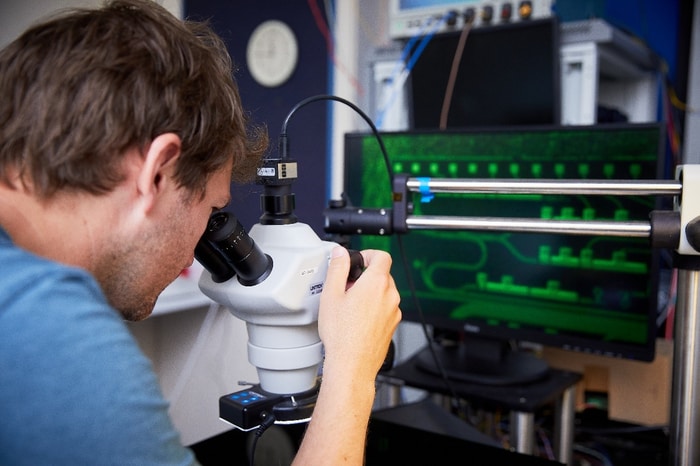
Toshiba Europe Ltd today announced it has developed the world’s first chip-based quantum key distribution (QKD) system. This advance will enable the mass manufacture of quantum security technology, bringing its application to a much wider range of scenarios including Internet of Things (IoT) solutions. A Toshiba scientist examines a QKD chip under the microscope at the company’s Cambridge Research Laboratory

QKD addresses the demand for cryptography which will remain secure from attack by the supercomputers of tomorrow. In particular, a large-scale quantum computer will be able to efficiently solve the difficult mathematical problems that are the basis of the public key cryptography widely used today for secure communications and e-commerce. In contrast, the protocols used for quantum cryptography can be proven secure from first principles and will not be vulnerable to attack by a quantum computer, or indeed any computer in the future.

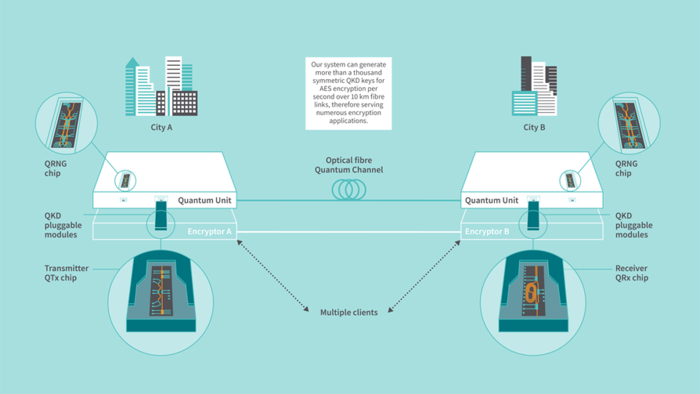
The QKD market is expected to grow to approximately $20 billion worldwide in FY2035. Large quantum-secured fiber networks are currently under construction in Europe and South-East Asia, and there are plans to launch satellites that can extend the networks to a global scale. In October 2020, Toshiba released two products for fiber-based QKD, which are based on discrete optical components. Together with project partners, Toshiba has implemented quantum-secured metro networks and long-distance fiber-optic backbone links in the UK, Europe, the US, and Japan.  Overview of a chip-based quantum cryptography communication system

Manufacturing advances

For quantum cryptography to become as ubiquitous as the algorithmic cryptography we use today, the size, weight, and power consumption must be further reduced. This is especially true for extending QKD and quantum random number generators (QRNG) into new domains such as the last-mile connection to the customer or IoT. The development of chip-based solutions is essential to enabling mass-market applications, which will be integral to the realization of a quantum-ready economy.

Toshiba has developed techniques for shrinking the optical circuits used for QKD and QRNG into tiny semiconductor chips. These are not only much smaller and lighter than their fiber optic counterparts but also consume less power. Most significantly, many can be fabricated in parallel on the same semiconductor wafer using standard techniques used within the semiconductor industry, allowing them to be manufactured in much larger numbers. For example, the quantum transmitter chips developed by Toshiba measure just 2x6mm, allowing several hundred chips to be produced simultaneously on a wafer. 

Andrew Shields, Head of Quantum Technology at Toshiba Europe, remarked, “Photonic integration will allow us to manufacture quantum security devices in volume in a highly repeatable fashion. It will enable the production of quantum products in a smaller form factor, and subsequently, allow the rollout of QKD into a larger fraction of the telecom and datacom network.” 

Taro Shimada, Corporate Senior Vice President and Chief Digital Officer of Toshiba Corporation comments, “Toshiba has invested in quantum technology R&D in the UK for over two decades. This latest advancement is highly significant, as it will allow us to manufacture and deliver QKD in much larger quantities. It is an important milestone towards our vision of building a platform for quantum-safe communications based upon ubiquitous quantum security devices.” 

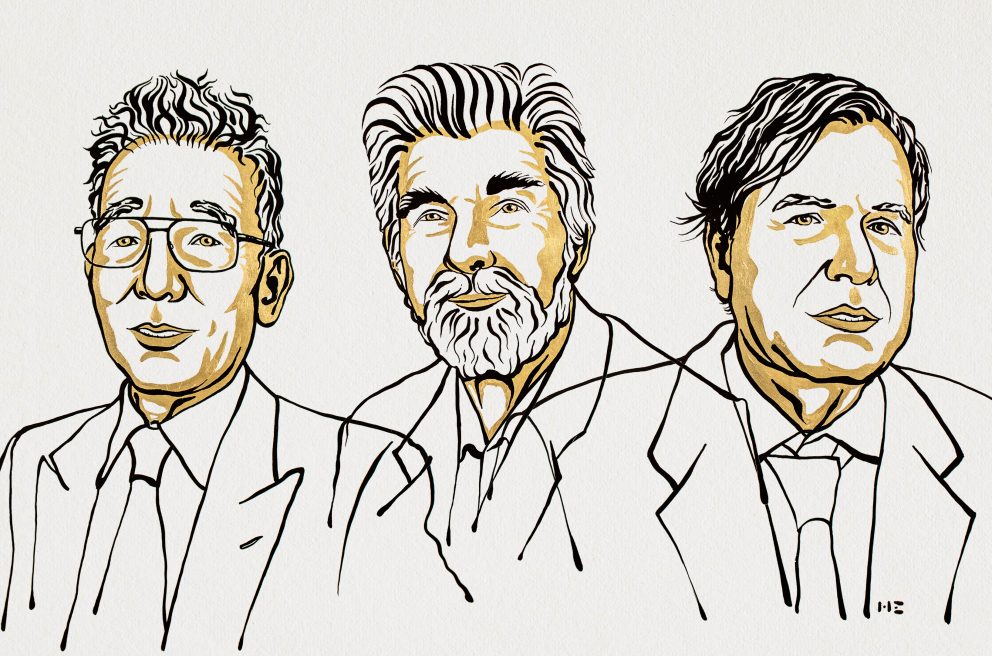
The Nobel Prize in Physics is awarded to Syukuro Manabe, Klaus Hasselman, Giorgio Parisi

The Nobel Prize in Physics is one half jointly awarded to Syukuro Manabe, Klaus Hasselman, and the other half Giorgio Parisi.

Laureates Syukuro Manabe and Klaus Hasselman are awarded the Nobel Prize for their groundbreaking contributions to the physical model of the earth's climate to help predict global warming, and how humans influence it.

Laureate Giorgio Parisi is awarded the Nobel Prize for the groundbreaking discovery of the interplay of disorder in physical systems, revolutionizing the theory of disordered materials and random processes. Manabe, Hasselmann and Parisi. Ill. Niklas Elmehed © Nobel Prize Outreach.

Syukuro Manabe, born in 1931 in Shingu, Japan, demonstrated how increased carbon dioxide in the atmosphere could affect the surface temperature of the Earth. His work exploring the interaction between radiation and the vertical transportation of air masses laid the foundations for the development of current climate models. He is currently a Senior Meteorologist at Princeton University, USA.

Klaus Hasselmann, currently a Professor at Max Planck Institute for Meteorology in Hamburg, Germany, created a model to show how the weather and the climate are linked. He also developed methods for showing how nature and human activity impact the climate. His methods have been used to prove that the increased temperature in the atmosphere is due to human emissions of carbon dioxide.

Giorgio Parisi, Professor at Sapienza University of Rome, Italy, discovered in around 1980, hidden patterns in disordered complex materials making it possible to understand and describe different materials and phenomena.

Prize amount: 10 million Swedish kronor, with one half jointly to Syukuro Manabe and Klaus Hasselmann and the other half to Giorgio Parisi.