

MD simulations show a rare quaternary compound FeO2H2He stabilized under high pressure

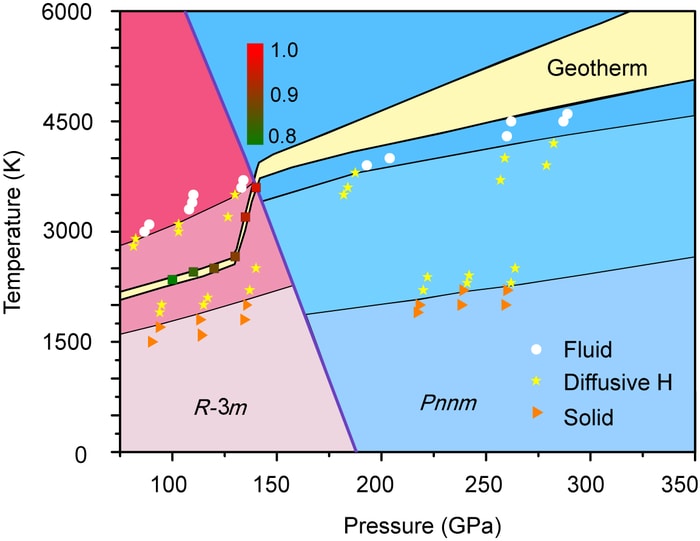
This study is led by Prof. Hanyu Liu, Prof. Yanming Ma at the College of Physics, Jilin University located in Changchun, China, and Prof. Changfeng, Chen at the Department of Physics and Astronomy, University of Nevada. Their supercomputer simulations present evidence of direct and prevalent chemical association of hydrogen and helium facilitated by their reaction with recently discovered iron peroxide FeO2 in forming rare quaternary compound FeO2H2He, which has been predicted to be viable in a large region of the pressure-temperature phase diagram. Most interestingly, in a wide swath of the phase space corresponding to Earth's lowest-mantle regions, this quaternary compound stays in a superionic state hosting liquid-like hydrogen inside the FeO2He sublattice that remains intact in crystalline form. This exotic solid-liquid mixture state of matter makes an unusually conducive environment promoting close coalescence of hydrogen and helium. “These results highlight a compelling case of a hydrogen-helium chemical association, which may be harbored in deep-Earth regions, providing crucial guidance for exploring the novel solid and superionic phases of FeO2H2He in laboratory experiments and also for modeling interiors of giant solar and extrasolar planets,” Liu says. The phase boundary is marked by the thick black line and different structures within each phase are determined based on the molecular dynamics results, where triangles, stars, and circles represent, respectively, the solid, superionic (with diffusive H atoms), and liquid structures. Also presented are the phase coexistence probabilities, as indicated by the colored scale bar shown in the inset, in the context of the Boltzmann distribution for the FeO2H2He structures relative to the dehydrogenation products FeO2H, H2 and He at selected points along the geotherm in the pressure range of 100-140 GPa. The yellow region presents the geotherm of the Earth's core.  CREDIT ©Science China Press
Hydrogen and helium are the most abundant elements in the universe and play crucial roles in geological and astrophysical environments, but they are known to be inert toward each other across wide pressure-temperature and concentration ranges and remain largely immiscible up to multi-megabar pressures and 3,000-4,000 K temperatures. Given their prominent presence and influence on the formation and evolution of celestial bodies, it is of great interest and significance to explore and decipher the nature of interactions between hydrogen and helium, the especially possible chemical association that would have considerable impacts in many scientific fields, from chemistry, physics, geoscience to astrophysics.

By employing an advanced crystal structure search method called CALYPSO, they identified a quaternary compound FeO2H2He, which could be stabilized in a wide range of pressure and temperature conditions. Further molecular dynamics simulations indicate a novel superionic state of FeO2H2H, which hosted liquid-like diffusive hydrogen in the FeO2He sublattice. Meanwhile, a conducive environment for hydrogen-helium chemical association was identified, where the pressure and temperature conditions correspond to the Earth's lowest mantle regions. “These results suggested the surprising chemically facilitated coalescence of otherwise immiscible molecular species highlights a promising avenue for exploring this long-sought but [a] hitherto unattainable state of matter”, Liu says, “this finding raises strong prospects for exotic H-He mixtures inside Earth, as well as providing implications for other astronomical bodies.

Oregon State University finds citizen scientists’ contributions a boon to snowpack modeling

Data gathered by backcountry skiers, avalanche forecasters, and other snow recreationists and professionals has the potential to greatly improve snowpack modeling, research by the Oregon State University College of Engineering indicates. Snowpack research pic by Kendra Sharp

Findings, published in the journal Hydrology and Earth System Sciences, stem from a NASA-funded project known as Community Snow Observations, or CSO, part of NASA’s Citizen Science for Earth Systems program.

The paper is the first documentation of CSO’s power to make snowpack modeling better through “organic, opportunistic” data – a notable outcome, said researcher David Hill.

“We have shown citizen scientist contributions are very valuable and that we can do great things in the absence of observational network infrastructure,” said Hill, professor of civil engineering at OSU. “In this study, we used a new data set collected by CSO participants in coastal Alaska to improve snow depth and snow-water equivalent outputs from a snow process model.”

In western North America, snow’s role in ecosystem function and water resource management is critical, the scientists say, and around the world, more than a billion people live in watersheds where snow is a major component of the hydrologic system.

“Snowpack dynamics in the mountains have a big role in connecting atmospheric processes and the hydrologic cycle with downstream water users,” said Chris Cosgrove, an OSU graduate student during the research. “At our Alaska field site, hydroelectric power generation is the principal concern, but in the lower 48, many agricultural producers and municipal water systems rely on seasonal snow.”

In 2017, NASA enlisted Hill and doctoral student Ryan Crumley, as well as researchers at the University of Washington, the University of Alaska Fairbanks, and the Alaska Division of Geological & Geophysical Surveys, to recruit citizen scientists and incorporate their data into supercomputer models that generate important snowpack information for scientists, engineers and land and watershed managers.

Community Snow Observations kicked off in February 2017 and since then thousands of data entries have been made. Led by Hill, Gabe Wolken of Alaska Fairbanks, and Anthony Arendt of the University of Washington, the project first focused primarily on Alaskan snowpacks. Researchers then recruited citizen scientists in the Pacific Northwest and the Rocky Mountain region.

The work is ongoing and getting involved in Community Snow Observations is easy. A smartphone, the free Mountain Hub application, and an avalanche probe with graduated markings in centimeters are the only tools needed.

As citizen scientists make their way through the mountains, they use their avalanche probes to take snow depth readings that they then upload into Mountain Hub, an app for the outdoor community.

That’s all there is to it.

“We’ve now taken our modeling work operational,” Hill said. “We serve up real-time grids on snow information at many sites across the United States, including the central Cascades in Oregon, at mountainsnow.org. The general public can go there and view real-time information on snow, snow changes, and other things like satellite measurements of snow.”

In the recently published research, Hill and Crumley, who’s now at the Los Alamos National Laboratory, teamed with Wolken, Arendt, Cosgrove, and OSU graduate student Christina Aragon to look at how snowpack models for the Thompson Pass region of Alaska’s Chugach Mountains improved when citizen science measurements were incorporated.

“Improvements were seen in 62% to 78% of the simulations depending on the model year,” Aragon said. “Our results suggest that even modest measurement efforts by citizen scientists have the potential to improve efforts to model snowpack processes in high mountain environments.”

Information about snow distribution reaches scientists from many sources, including telemetry stations and remote sensing via light detection and ranging, or LIDAR, but the simplicity of the citizen science data gathering approach allows for many gaps to be filled, the scientists say.

“Snow depth measurements can be made accurately and quickly by anyone with a measuring device,” Crumley said. “The potential of mobilizing a new type of data set collected by people like snowshoers and snow machiners is significant because those folks often go to remote mountain environments where so far there haven’t been many observations recorded. All of those people can gather data at scales much greater than the capacity of a small group of scientists.”

(ISC)² cybersecurity workforce study sheds new light on talent demand amid a lingering pandemic

New 2021 data finds continued resilient growth trajectory for cybersecurity profession offers practical solutions for closing the gap

(ISC)² has released the findings of its 2021 (ISC)2 Cybersecurity Workforce Study. The study reveals updated figures for both the Cybersecurity Workforce Estimate and the Cybersecurity Workforce Gap in 2021, provides key insights into the makeup of the profession, and explores the challenges and opportunities that exist for professionals and hiring organizations.

The study reveals a decrease in the global workforce shortage for the second consecutive year from 3.12 million down to 2.72 million cybersecurity professionals. There are two significant contributing factors to this year's workforce gap estimate. The first is that 700,000 new entrants joined the field since 2020, contributing to a sharp increase in the available supply, now up to 4.19 million people. The second is that the workforce gap for every region other than Asia-Pacific increased. Data suggests that slower economic recovery from the pandemic and its impact on small businesses and critical sectors like IT services (a major cybersecurity employer in the region) is contributing to the relative softness in demand for cybersecurity professionals compared to North America, Europe, and Latin America. However, Asia-Pacific still has the largest regional workforce gap of 1.42 million.

Even with 700,000 new entrants, demand continues to outpace the supply of talent. The global cybersecurity workforce needs to grow 65% to effectively defend organizations' critical assets.

"Any increase in the global supply of cybersecurity professionals is encouraging, but let's be realistic about what we still need and the urgency of the task before us," said Clar Rosso, CEO, (ISC)². "The study tells us where talent is needed most and that traditional hiring practices are insufficient. We must put people before technology, invest in their development, and embrace remote work as an opportunity. And perhaps most importantly, organizations must adopt meaningful diversity, equity, and inclusion practices to meet employee expectations and close the gap."

How Organizations Overcome Their Gap
This year's research provides fresh perspectives into how organizations are overcoming their workforce gaps. Study participants shared their organizations' planned talent and technology investments, including:

  • More training (36%); providing more flexible working conditions (33%); and investing in diversity, equity, and inclusion (DEI) initiatives (29%)
  • Using cloud service providers (38%); deploying intelligence and automation for manual tasks (37%); involving cybersecurity staff earlier in third-party relationships (32%)

The study uncovered the avoidable consequences that occur when cybersecurity staff is stretched too thin. Participants said they experienced misconfigured systems (32%); not enough time for proper risk assessment and management (30%); slowly patched critical systems (29%); rushed deployments (27%).

Participants also offered opinions on what specialized skills and roles their teams lack, aligned with the roles outlined in the U.S. government's National Initiative for Cybersecurity Education (NICE) Framework. They cited categories such as Securely Provision (48%); Analyze (47%); and Protect and Defend (47%) as the top areas of need, but the data also shows a strong need for help across all roles.

Lasting Pandemic Impact
The percentage of cybersecurity professionals working remotely in some capacity due to the pandemic remains unchanged at 85%; however, 37% report they must now come to the office at times compared to 31% in 2020. In addition to the advantages of remote work as a public health measure, organizations cited improved workplace flexibility (53%); accelerated innovation and digital transformation efforts (37%); and stronger collaboration (34%) as some of the ways the pandemic has changed their organizations for the better.

Security challenges arising from remote workforces included the rapid deployment of new collaboration tools (31%); lack of security awareness among remote workers (30%); and rising concern for the physical security of distributed assets (29%). 

Additional highlighted findings include:

  • Cybersecurity professionals have consistently expressed very high levels of job satisfaction over the last four years—a record 77% of respondents reported they are satisfied or extremely satisfied with their jobs.
  • More cybersecurity professionals are getting their start outside of IT— 17% transitioned from unrelated career fields, 15% gained access through cybersecurity education and 15% explored cybersecurity concepts independently. Alternate points of entry are more common for women than men – only 38% of female participants started their careers in IT compared to 50% of male participants.
  • The average salary of a cybersecurity professional before taxes is U.S. $90,900—up from U.S. $83,000 among respondents in 2020. Salaries of certified cybersecurity professionals are U.S. $33,000 higher than those with no certifications.
  • Cloud computing security is once again the top priority for cybersecurity professionals' skills development in the next two years.