Muscle dynamics and hydrodynamics of undulatory swimmers balance to minimize energy consumption
A new computational analysis suggests that maximizing swimming speeds while minimizing energy costs depends on an optimal balance between a fish's muscle dynamics and the way its size, shape, and swimming motion affect its movement through the water. Grgur Tokic and Dick Yue of the Massachusetts Institute of Technology present these findings in PLOS Computational Biology.
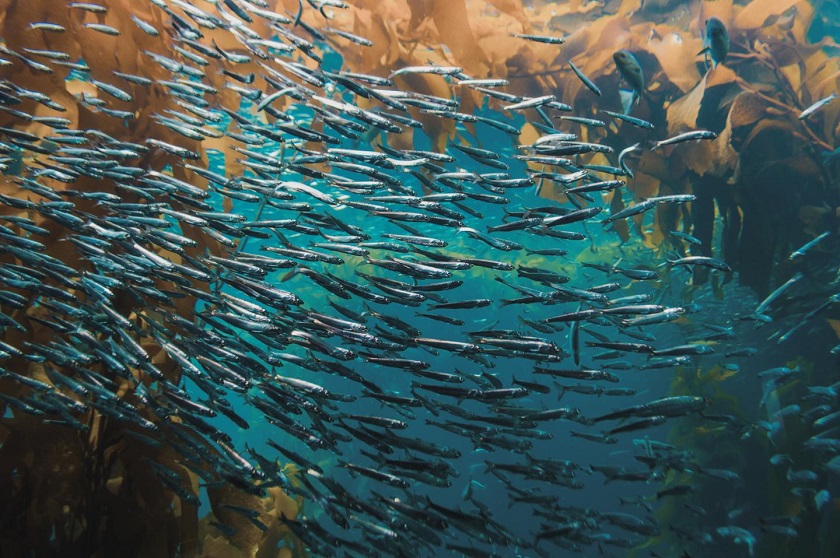
Fish and other organisms, such as salmon and dolphins, swim in an undulating manner that enables high speeds at low energy costs. Many recent insights into energy consumption during swimming have arisen from advances in the understanding of fish muscle biomechanics or modeling of swimming hydrodynamics--how a fish moves through water according to its size, shape, and swimming motion. However, few studies have combined the two.
For a more complete picture, Tokic and Yue employed a mathematical model they previously developed that combines muscle biomechanics with swimming hydrodynamics. They used the model to conduct an extensive analysis of energy consumption during swimming--starting from energy supplied to muscles and tracking how that energy is transformed into useful hydrodynamic propulsion. {module In-article}
In contrast to previous research, the new analysis shows that, in order to minimize energy consumed by a fish with a given body mass swimming a given distance, it needs not to swim at maximum efficiency, calculated as power produced by muscles versus power consumed. To achieve maximum swimming speeds, fish muscles need not operate at maximum power levels. These findings are supported by real-world observations of swimming organisms across nine orders of magnitude in size.
"Our findings are surprising, but they are borne out by first principles from the underlying physics," Yue says. "They suggest that energetics of swimming can be substantially improved by optimizing the balance between muscle performance and hydrodynamics."
While this study simulated an idealized model organism, the researchers hope next to model the swimming energetics of realistic fish, such as tuna or salmon. Potential practical applications of this work could include the development of man-made, biomimetic swimming apparatuses with unprecedented efficiency.
New research aims to open the 'black box' of computer vision
It can take years of birdwatching experience to tell one species from the next. But using an artificial intelligence technique called deep learning, Duke University researchers have trained a computer to identify up to 200 species of birds from just a photo.
The real innovation, however, is that the A.I. tool also shows its thinking, in a way that even someone who doesn't know a penguin from a puffin can understand.
The team trained their deep neural network -- algorithms based on the way the brain works -- by feeding it 11,788 photos of 200 bird species to learn from, ranging from swimming ducks to hovering hummingbirds.
CAPTION A Duke team trained a computer to identify up to 200 species of birds from just a photo. Given a photo of a mystery bird (top), the A.I. spits out heat maps showing which parts of the image are most similar to typical species features it has seen before. CREDIT Chaofan Chen, Duke University{module In-article}
The researchers never told the network "this is a beak" or "these are wing feathers." Given a photo of a mystery bird, the network can pick out important patterns in the image and hazard a guess by comparing those patterns to typical species traits it has seen before.
Along the way, it spits out a series of heat maps that essentially say: "This isn't just any warbler. It's a hooded warbler, and here are the features -- like its masked head and yellow belly -- that give it away."
Duke computer science Ph.D. student Chaofan Chen and undergraduate Oscar Li led the research, along with other team members of the Prediction Analysis Lab directed by Duke professor Cynthia Rudin.
They found their neural network can identify the correct species up to 84% of the time -- on par with some of its best-performing counterparts, which don't reveal how they can tell, say, one sparrow from the next.
Rudin says their project is about more than naming birds. It's about visualizing what deep neural networks are seeing when they look at an image.
Similar technology is used to tag people on social networking sites, spot suspected criminals in surveillance cameras, and train self-driving cars to detect things like traffic lights and pedestrians.
The problem, Rudin says, is that most deep learning approaches to computer vision are notoriously opaque. Unlike traditional software, deep learning software learns from the data without being explicitly programmed. As a result, exactly how these algorithms 'think' when they classify an image isn't always clear.
Rudin and her colleagues are trying to show that A.I. doesn't have to be that way. She and her lab are designing deep learning models that explain the reasoning behind their predictions, making it clear exactly why and how they came up with their answers. When such a model makes a mistake, its built-in transparency makes it possible to see why.
For their next project, Rudin and her team are using their algorithm to classify suspicious areas in medical images like mammograms. If it works, their system won't just help doctors detect lumps, calcifications and other symptoms that could be signs of breast cancer. It will also show which parts of the mammogram it's homing in on, revealing which specific features most resemble the cancerous lesions it has seen before in other patients.
In that way, Rudin says, their network is designed to mimic the way doctors make a diagnosis. "It's case-based reasoning," Rudin said. "We're hoping we can better explain to physicians or patients why their image was classified by the network as either malignant or benign."
Drexel researchers' program designs materials with human-like microvasculature
The complex network of veins that keeps us cool during the heat of summer has inspired engineers to create novel thermal management systems. But replicating the circulatory system, in form or function, has been no easy task. Recently, a team of researchers from Drexel University and North Carolina State University has created a computational platform that could be the key to mimicking the body's evolutionary optimized cooling system. Microvasculature
In a study published in the International Journal of Heat and Mass Transfer, Ahmad Najafi, PhD, a professor in Drexel's College of Engineering, and his faculty collaborator, Jason Patrick, PhD, from North Carolina State University, report on how a computational technique they developed can quickly produce designs for 3D printing carbon-fiber composite materials with an internal vasculature optimized for active-cooling.
"When you get hot, the body sends a signal to the circulatory system to pump more blood to the surface of the skin - this is why we sometimes get red in the face," Najafi said. "This is a natural method for dissipating heat that works so well, scientists and engineers have been trying for years to replicate in mechanical cooling systems, like the ones that keep cars and computers from overheating."
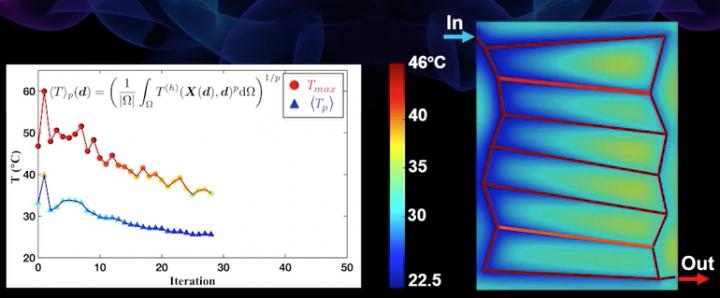
Researchers from Drexel University have created a program that optimizes the microvascular configuration of materials that could be used to cool technology that runs hot -- like computers and automobiles.{module In-article}
Najafi and Patrick's latest paper describes an integrated platform to design and create bioinspired microvascular composites that can do just that.
In minutes, their computer program, coined HyTopS, which is short for hybrid topology/shape optimization, can produce a schematic for a vascular network with the ideal shape, size and distribution of micro-vessels to actively cool a material via liquid circulation - a trick that took Mother Nature more than a few evolutionary cycles to perfect.
Microvascular fiber-composites are currently being developed to cool everything from electric vehicles to next-generation aircraft, where increasingly higher performance is turning up the heat they generate.
"These modern materials could revolutionize everything from hypersonic space vehicles to battery packaging in electric cars and even supercomputer cooling systems. As things move faster, and energy output and computing power continue to increase, an enormous amount of heat is generated that requires new approaches to cooling," Patrick said. "Inspired by circulatory systems in living organisms, internal micro-vasculature provides an effective means for thermal regulation in synthetic materials."
This branch of bioinspired-based research has only been around for a decade or so, but the results it has generated are already quite promising, according to Najafi/Patrick who started their academic careers at the University of Illinois Urbana-Champaign developing microvascular materials for self-healing, active cooling and beyond.
Part of their recent research thrust is to replace more traditional metallic systems that transfer heat via water or air. While it's been a reliable solution, anyone who has carried an air conditioner window unit will surely understand why a different cooling system would be an improvement for any vehicle or component that is trying to cut weight.
"Microvascular composites offer many advantages over existing liquid and air-cooling systems, primarily, they are much lighter with comparable strength, but they are also very durable - which is important if you consider the widespread effect of corrosion on metallic components," Najafi said. "And if you consider these among other factors, it's easy to see why they are being sought in aerospace, automotive and energy sectors."
To put their optimization method to the test, the researchers designed and built a microvascular carbon-fiber composite using 3D printing and tested its cooling abilities against a reference design from prior studies. After heating the carbon-composites to a maximum temperature, liquid coolant (similar to the one in your car) was pumped through each vascular network to begin the cooling process.
The HyTopS-optimized carbon-composite was not only cooler, but more uniform in terms of surface temperature distribution, and was able to cool down faster than the reference design.
In addition to the superior performance of the optimized material, the advantage of the HyTopS method is that it automatically calculates the impact of changes to the diameter and arrangement of the channels, as well as how they are connected to one another. It takes into consideration the material makeup and the overall geometry of the system is cooled and corresponding heat transfer characteristics. And it factors in parameters related to the manufacturing process, so the final design is a realistic microvascular material that can be made by 3D printing or other accessible fabrication approaches.
"It's nearly impossible to reproduce the entire complexity of natural microvascular, but our program allows for a great deal of optimization input and considers manufacturing parameters to ensure the design can actually be constructed," Najafi said.
The collaborative team intends to use the HyTopS method to explore other intriguing and interdisciplinary aspects of microvascular composites, including structural mechanics and electromagnetics.


 {module In-article}