

Israeli startup CogniFiber's photonics breakthrough brings closer the reality of AI deployments

CogniFiber has announced an interface data injection landmark in its product integration tests. CogniFiber’s approach implements direct analog neuromorphic photonic supercomputing (“pure-photonics”), removing all bottlenecks from AI inference so that the task speed is limited only by the input clock. Dr. Eyal Cohen

Demonstrating capabilities 40% beyond initial projections, their soon-to-be-launched pure-photonic system is expected to reach a staggering speed of 100 million tasks per second, far surpassing NVIDIA’s DGX A100’s estimated 5 million tasks per second or Lightmatter’s Envise Server of 24 million tasks per second. These capabilities, in conjunction with modest power consumption, allow companies to deploy powerful computing resources, boasting just shy of 350 thousand tasks per watt. As traditional silicon-based semiconductor developers work to fit ever-more transistors into a small chip to boost processing power, data centers and hyperscalers are left managing high costs due to lower reliability, high power consumption, and cooling constraints.

To address these needs, CogniFiber developed a full solution based on proprietary fiber-based technology together with standard optical communication devices. This requires a fraction of the space to achieve similar computing power, while significantly reducing cooling and operational overhead. “Our initial findings are outstanding, displaying the capabilities to support the mega data centers of tomorrow,” said Dr. Eyal Cohen, Co-founder & CEO of CogniFiber. “Operating at room temperature without dissipating significant heat to its surroundings means data centers can offer customers greater uptime reliability with lower cost.” 

The push for miniaturization of today’s servers is allowing engineers to begin processing large pools of IoT and AI data in record time in a cost-effective manner. This also holds commercial implications for businesses who want to have on-prem or localized servers that take up less space. “Our new approach to developing and harnessing large data processing capabilities allows for companies to begin bringing AI and Machine Learning capabilities to the edge of their networks,” said Professor Zeev Zalevsky, Co-founder & CTO of Cognifiber. 

Beyond computing capabilities, power consumption has been a top-of-mind issue for data centers for years. As demand grows, operators are under the microscope regarding the environmental impact of their operations as they invest heavily in the energy needed to cool and operate thousands of advanced servers. CogniFiber’s pure-photonics systems and their reduced energy demands show great promise in reducing global greenhouse emissions while continuing to provide the advanced capabilities needed for tomorrow’s technologies.
Japanese scientists improve MD simulations for modeling how molecules interact with proteins for developing drugs

A computational method for simulating the interaction between small molecules and proteins has been enhanced by an all-RIKEN team in Japan. This improvement promises to boost the speed and accuracy of designing new drugs.

Many biological processes are regulated by the interactions between small molecules known as ligands and large proteins. Since many drugs work by mimicking the interactions of natural ligands with proteins, it is vital to accurately simulate such interactions when designing new drugs.

Molecular dynamics (MD) simulations have been used extensively to simulate interactions between ligands and proteins. But even with today’s supercomputers, they can only simulate a few binding and unbinding events between a protein and a ligand, whereas, in reality, a ligand can interact with a protein in various different ways.

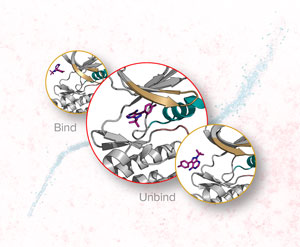
Now, Yuji Sugita and Suyog Re and co-workers at the RIKEN Center for Biosystems Dynamics Research have extended a molecular dynamics simulation using the replica-exchange molecular dynamics method to allow it to compute hundreds of binding and unbinding events. RIKEN researchers have used an enhanced molecular dynamics simulation to simulate the interaction between tyrosine kinase Src, a signaling protein in cells that can turn on protein synthesis and cellular growth, and an inhibitor (magenta), which inhibits the protein by binding to it. Overexpression of the gene that codes for tyrosine kinase Src has been linked with breast, ovarian and colon cancer. The background image shows a colored transmission electron micrograph of tyrosine kinase Src.  Credit: Insets: © 2019 RIKEN Center for Biosystems Dynamics Research; background image: © LINDA BARTLETT/NATIONAL CANCER INSTITUTE/SCIENCE PHOTO LIBRARY

The team demonstrated its potential by simulating the interaction between an inhibitor and a protein kinase—a class of proteins that has a large range of functions and has been implicated in various diseases, including cancer. Their enhanced technique was able to simulate the interaction, which involved about 100 binding and unbinding events. The calculation took about a month using the K supercomputer. In contrast, conventional molecular dynamics simulation techniques would take at least ten times longer. {module INSIDE STORY}

The method has other advantages besides speed. “We don’t need prior knowledge of the bound-state interactions, which is often brought from well-defined crystal structures obtained using x-ray diffraction, to search for compounds that bind to proteins,” notes Re.

It will also enable researchers to investigate binding that occurs early in the interaction. “Much prior work on drug design has focused on the final bound state, but our work suggests that early bound states are also important since they can change the fate of drugs,” explains Re. “If we can calculate those early bound states, the possibility of drug design could increase significantly—this is a new idea.”

It is an exciting time for the group since RIKEN is due to introduce a new supercomputer, Fugaku, in 2021 to replace the K supercomputer. “We’re expecting Fugaku to be more than 100 times faster than the K computer,” says Sugita. “A target that might take more than a month to simulate using the K computer might take a day with Fugaku.”

The team has ambitious plans. “Our next step is to simulate protein-ligand interactions in a concentrated protein solution,” says Sugita. “But ultimately we’d like to study drug discovery in a living cell—that’s a totally new world.”

A new theory for how black holes and neutron stars shine bright

Columbia researchers suggest radiation that lights the densest objects in our universe is powered by the interplay of turbulence and reconnection of super-strong magnetic fields

For decades, scientists have speculated about the origin of the electromagnetic radiation emitted from celestial regions that host black holes and neutron stars--the most mysterious objects in the universe.

Astrophysicists believe that this high-energy radiation--which makes neutron stars and black holes shine bright--is generated by electrons that move at nearly the speed of light, but the process that accelerates these particles has remained a mystery.

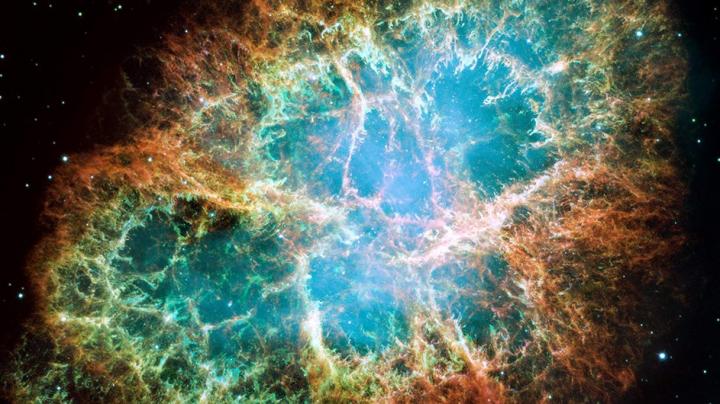
Now, researchers at Columbia University have presented a new explanation for the physics underlying the acceleration of these energetic particles. CAPTION The rapidly spinning neutron star embedded in the center of the Crab nebula is the dynamo powering the nebula's eerie interior bluish glow. The blue light comes from electrons whirling at nearly the speed of light around magnetic field lines from the neutron star. The neutron star, the crushed ultra-dense core of the exploded star, like a lighthouse, ejects twin beams of radiation that appear to pulse 30 times a second. CREDIT Image: NASA, ESA, J. Hester (Arizona State University){module INSIDE STORY}

In a study published in the December issue of The Astrophysical Journal, astrophysicists Luca Comisso and Lorenzo Sironi employed massive supercomputer simulations to calculate the mechanisms that accelerate these particles. They concluded that their energization is a result of the interaction between chaotic motion and reconnection of super-strong magnetic fields.

"Turbulence and magnetic reconnection--a process in which magnetic field lines tear and rapidly reconnect--conspire together to accelerate particles, boosting them to velocities that approach the speed of light," said Luca Comisso, a postdoctoral research scientist at Columbia and first author on the study.

"The region that hosts black holes and neutron stars is permeated by an extremely hot gas of charged particles, and the magnetic field lines dragged by the chaotic motions of the gas, drive vigorous magnetic reconnection," he added. "It is thanks to the electric field induced by reconnection and turbulence that particles are accelerated to the most extreme energies, much higher than in the most powerful accelerators on Earth, like the Large Hadron Collider at CERN."

When studying turbulent gas, scientists cannot predict chaotic motion precisely. Dealing with the mathematics of turbulence is difficult, and it constitutes one of the seven "Millennium Prize" mathematical problems. To tackle this challenge from an astrophysical point of view, Comisso and Sironi designed extensive super-computer simulations --among the world's largest ever done in this research area--to solve the equations that describe the turbulence in a gas of charged particles.

"We used the most precise technique--the particle-in-cell method--for calculating the trajectories of hundreds of billions of charged particles that self-consistently dictate the electromagnetic fields. And it is this electromagnetic field that tells them how to move," said Sironi, assistant professor of astronomy at Columbia and the study's principal investigator.

Sironi said that the crucial point of the study was to identify role magnetic reconnection plays within the turbulent environment. The simulations showed that reconnection is the key mechanism that selects the particles that will be subsequently accelerated by the turbulent magnetic fields up to the highest energies.

The simulations also revealed that particles gained most of their energy by bouncing randomly at an extremely high speed off the turbulence fluctuations. When the magnetic field is strong, this acceleration mechanism is very rapid. But the strong fields also force the particles to travel in a curved path, and by doing so, they emit electromagnetic radiation.

"This is indeed the radiation emitted around black holes and neutron stars that make them shine, a phenomenon we can observe on Earth," Sironi said.

The ultimate goal, the researchers said, is to get to know what is really going on in the extreme environment surrounding black holes and neutron stars, which could shed additional light on fundamental physics and improve our understanding of how our Universe works.

They plan to connect their work even more firmly with observations, by comparing their predictions with the electromagnetic spectrum emitted from the Crab Nebula, the most intensely studied bright remnant of a supernova (a star that violently exploded in the year 1054). This will be a stringent test for their theoretical explanation.

"We figured out an important connection between turbulence and magnetic reconnection for accelerating particles, but there is still so much work to be done," Comisso said. "Advances in this field of research are rarely the contribution of a handful of scientists, but they are the result of a large collaborative effort."

Other researchers, such as the Plasma Astrophysics group at the University of Colorado Boulder, are making important contributions in this direction, Comisso said.