

Genomic medicine simulations explain the diversity of cancer evolution

Constructing a mathematical basis for developing therapeutic strategies against cancer using a supercomputer

Understanding the principles of cancer evolution is important in designing a therapeutic strategy. A research group at The Institute of Medical Science, The University of Tokyo (IMSUT) announced a new simulation model that describes various modes of cancer evolution in a unified manner.

"We clarified the conditions under which each of the evolutionary modes is realized by performing simulation analysis using a supercomputer. Our findings have allowed us to explain the underlying principles of the evolutionary diversity of cancer." said lead scientist Atsushi Niida, Senior Assistant Professor, Laboratory of Molecular Medicine, Human Genome Center of IMSUT.

To build a unified evolutionary simulation model 

Cancer can be regarded as a disease of evolution, which results from the natural selection of cells with high proliferative and malignant potential, following the accumulation of mutations in their genomes. Moreover, because cancer has a high evolutionary potential, it easily adapts to treatment-related changes in its environment and acquires therapeutic resistance. Four main evolutionary modes in cancer. Red stars represent normal driver mutations such as single nucleotide mutations. A green star represents large-scale genetic alterations at the chromosomal or genomic level that produce copy number or structural abnormalities. E) An evolutionary model that explains the temporal shift of the principle generating ITH during colorectal tumorigenesis.{module INSIDE STORY} 
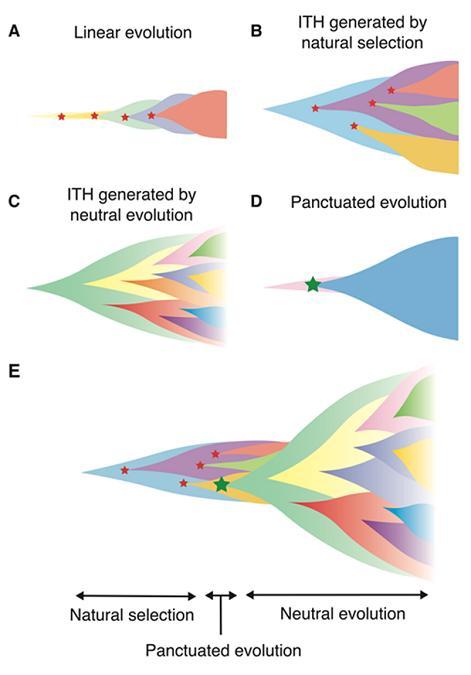
Previous genomic studies have shown that cancer evolution can be roughly divided into four modes of evolution. However, it has remained unclear what conditions give rise to each mode. Therefore, the research group has built a unified evolutionary simulation model that can recapitulate a variety of evolutionary modes.

By performing massively parallel simulation with various conditions on SHIROKANE, a supercomputer at IMSUT, the research group determined the conditions under which each evolution mode is generated. By providing a mathematical basis for understanding cancer evolution, this study is expected to contribute to the understanding of therapeutic resistance in cancer and the development of novel therapeutic strategies.
Various mathematical principles that explain the evolution of cancer

Classically, cancer evolution has been regarded as a process of evolution, in which normal cells evolve step-wise into a homogeneous cell population with high malignancy by serially acquiring driver mutations that favor cell growth and survival while undergoing natural selection.

However, in recent years, multi-region sequencing, which analyzes DNA samples obtained from multiple regions of a tumor, has demonstrated intratumor heterogeneity (ITH); that is, multiple clones with different mutations are generated during the course of cancer evolution and coexist in a single tumor. Also, depending on the types of cancers, driver mutations present only in a fraction of cells contribute to ITH; that is, natural selection appears to shape ITH.

On the other hand, it has been found that ITH can be shaped by the accumulation of neutral mutations that do not affect the growth and survival of cells; that is, ITH can be generated by neutral evolution. The evolutionary principle underlying ITH has not only varied among cancer types, but Niida and colleagues have also found that a temporal shift occurs during colorectal tumorigenesis (Saito et al.,2018); that is, it has been found that, in early lesions, ITH is shaped by natural selection while in advanced cancer, ITH is shaped by neutral evolution. Also, in contrast to the gradual evolution that results from the stepwise accumulation of single nucleotide mutations as assumed above, punctuated evolution has attracted attention. This is an evolutionary model in which large changes occur over a short time at the chromosomal and genomic levels, such as copy number changes and structural abnormalities, explosively expanding from a few initial cells.

Thus far, four evolutionary modes have been proposed, but there are many unclear points concerning under what conditions these modes occur. Simulation using an agent-based model is considered to be a useful tool for understanding the principle of cancer evolution. The agent-based model assumes the components of a system called an agent and specifies rules for the autonomous behavior of the agent itself and the interactions between agents and the environment.

Viewing each cell as an agent, ITH can be easily represented by the difference in the internal state of each agent. Niida and colleagues have recently developed MASSIVE, a new methodology of parameter sensitivity analysis, which examines the dynamics of agent-based simulations (Niida et al., 2019). MASSIVE takes an approach completely different from conventional parameter sensitivity analysis methods; it makes it possible to intuitively search a large parameter space by combining massively parallel computing with interactive data visualization.

Based on the above, in order to clarify the conditions under which the above-mentioned four different evolution modes are realized, we have constructed a unified evolution simulation model that can recapitulate various evolution modes using an agent-based model. Parameter sensitivity analysis utilizing MASSIVE was performed on SHIROKANE, a supercomputer of IMSUT. They found that linear evolution occurs when strong driver mutations are assumed, while ITH is generated by natural selection when the driver mutations are weak. Moreover, the simulation revealed that the generation of ITH by neutral evolution requires a high neutral mutation rate, and the presence of cancer stem cells also contributes to neutral evolution by promoting the accumulation of neutral mutations.

Punctuated evolution could also be reproduced by assuming an explosive driver gene that enables cells to overcome the resource limitation required for cell proliferation. Furthermore, it was shown by simulation that punctuated evolution triggers the above-described temporal shift of the principle underlying ITH from natural selection to neutral evolution in colorectal tumorigenesis (Fig. 1E). This result also helps us understand that each mode works not as discrete, exclusive modes but rather blend continuously as a series of phases of cancer evolution.

The results of all the simulation analyses in this research can be searched interactively at https://www.hgc.jp/~aniida/canevosim/index.html.

Contributing to a deeper understanding of therapeutic resistance in cancer

"In this study, we clarified the principle underlying the diversity of cancer evolution by simulation analysis using a supercomputer. Since cancer has a high evolutionary potential, it adapts to the environment changed by therapy and easily acquires therapeutic resistance, so understanding the evolutionary principle of cancer is an important problem for designing therapeutic strategies." Niida emphasized

By providing a mathematical basis for understanding cancer evolution, this study is expected to contribute to the understanding of therapeutic resistance in cancer and the development of novel therapeutic strategies.

Dr. Morton wins £1.2 million to use cutting-edge supercomputer simulations for better understanding of the Sun

Researchers from Northumbria University have been awarded £1.2m to help advance our understanding of the Sun and its impact on the planets within our solar system.

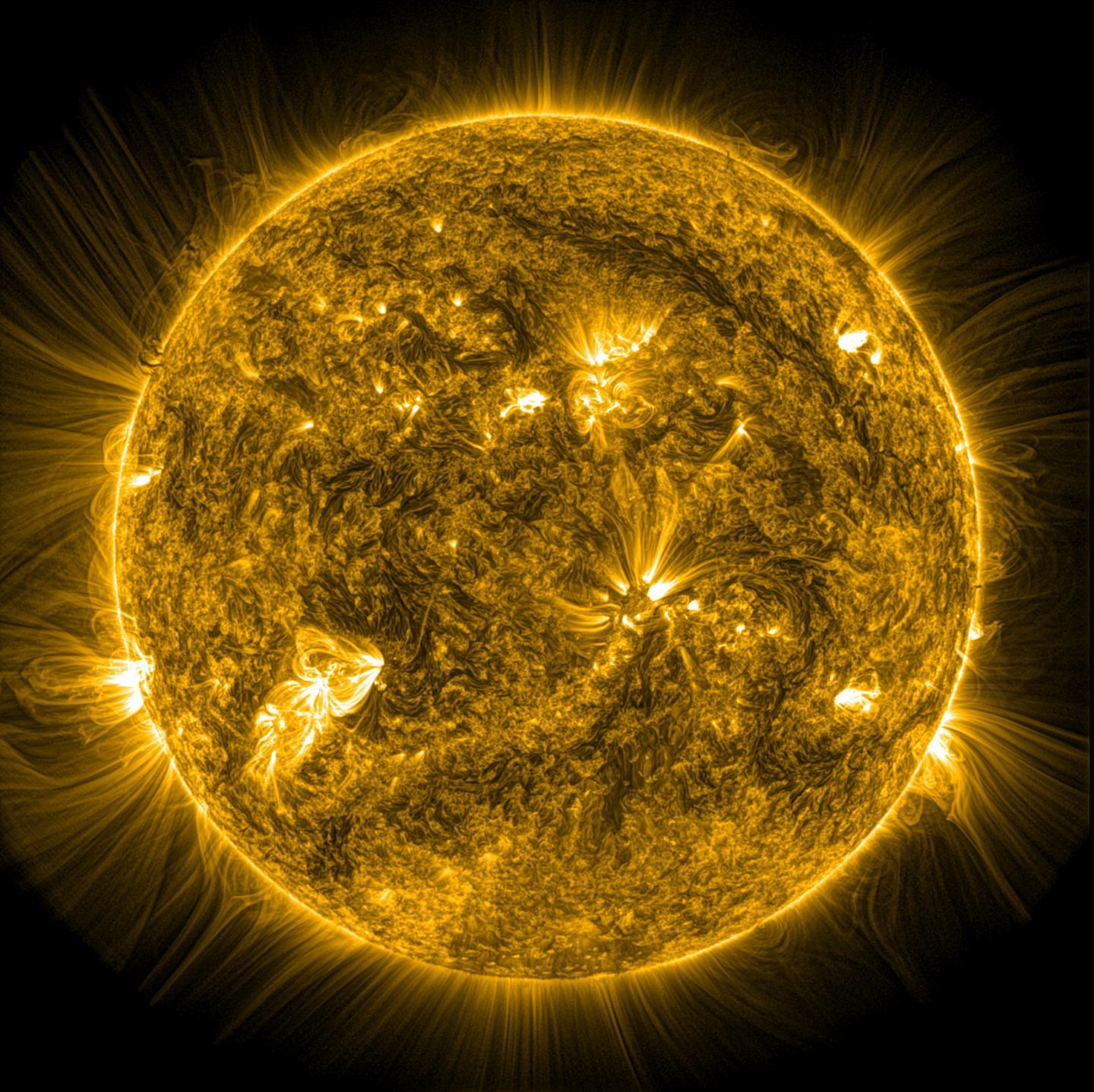
The team, led by solar physicist Dr. Richard Morton, will spend the next four years exploring some of the fascinating phenomena associated with our closest star – including powerful solar winds and the giant, planet-sized concentrations of magnetic fields known as sunspots.

They will use advanced mathematical techniques and cutting-edge supercomputer simulations to create models of the Sun which will provide new insight into the physics behind its activity.

The project, Revealing the Pattern of Solar Alfvénic Waves (RiPSAW), is being funded through UK Research and Innovation (UKRI) after Dr. Morton was awarded a prestigious 2020 UKRI Future Leader Fellowship. {module INSIDE STORY} 230759 web 64397

He will work alongside colleagues at Northumbria, as well as scientists at the National Center for Atmospheric Research and Harvard Smithsonian Centre for Astrophysics in the United States, and the Instituto de Astrofísica de Canaria in Spain.

The aim of the RiPSAW project is to examine the role of magnetic waves in the heating the Sun’s atmosphere to a million degrees and generating powerful solar winds. As Dr. Morton explains: “Many stars possess their own weather systems, although these systems are extreme compared to those we experience on Earth.

“In our solar system, a hot, million-degree wind blows off the Sun at colossal speeds reaching millions of miles per hour, washing over the planets.

“The Earth’s magnetic field protects us by deflecting this wind, but other planetary bodies in the solar system have been exposed to its influence – for example, the Sun’s wind is known to have stripped Mars of its atmosphere.

“We know the Sun loses over 10 trillion tonnes of material each year through its winds, so are also interested in finding out how these winds contribute to a star’s evolution, and how they might influence the habitability of exoplanets around other Sun-like stars.”

Magnetic waves, also known as Alfvén waves, can transfer energy through a star’s atmosphere and are considered an important feature of any magnetic star.

Exciting results from Dr. Morton’s recent observations of the Sun have found evidence that magnetic waves high in the atmosphere react to sound waves leaking out from the inside of the Sun, challenging our current knowledge of how energy is transported through a star’s atmosphere.

The RiPSAW project will use new methods drawn from statistics and machine learning to analyze high-quality data of the Sun from state-of-the-art solar instruments, such as NASA’s Solar Dynamic Observatory.

Dr. Morton is among 90 academics awarded a 2020 UKRI Future Leader Fellowship. The scheme aims to grow the strong supply of talented individuals needed to ensure a vibrant environment for research and innovation in the UK.

The Fellowships are open to researchers and innovators from across the business, universities, and other organizations. Investment of up to £1.5 million over four years is available to enable the next generation of researchers to benefit from outstanding support to develop their careers, and to work on difficult and novel challenges.

Speaking about all 90 fellows announced, Sir Mark Walport, Chief Executive of UK Research and Innovation said: “The Future Leaders Fellowships are UKRI’s flagship talent program, designed to foster and nurture the research and innovation leaders of the future. We are delighted to support these outstanding researchers and innovators across universities, research organizations, and businesses.”

Dr. Morton added: “I feel very grateful to have been awarded such a fantastic fellowship. It will make a huge difference in my career and provides a fantastic opportunity for me to build and develop my own research group. I can’t wait to get started.”

UNSW Sydney research suggests laws of nature not as constant as previously thought

Those looking forward to a day when science's Grand Unifying Theory of Everything could be worn on a t-shirt may have to wait a little longer as astrophysicists continue to find hints that one of the cosmological constants is not so constant after all.

In an academic paper, scientists from UNSW Sydney reported that four new measurements of light emitted from a quasar 13 billion light years away reaffirm past studies that have measured tiny variations in the fine structure constant.

UNSW Science's Professor John Webb says the fine structure constant is a measure of electromagnetism - one of the four fundamental forces in nature (the others are gravity, weak nuclear force and strong nuclear force). {module INSIDE STORY}

"The fine structure constant is the quantity that physicists use as a measure of the strength of the electromagnetic force," Professor Webb says.

"It's a dimensionless number and it involves the speed of light, something called Planck's constant and the electron charge, and it's a ratio of those things. And it's the number that physicists use to measure the strength of the electromagnetic force."

The electromagnetic force keeps electrons whizzing around a nucleus in every atom of the universe - without it, all matter would fly apart. Up until recently, it was believed to be an unchanging force throughout time and space. But over the last two decades, Professor Webb has noticed anomalies in the fine structure constant whereby electromagnetic force measured in one particular direction of the universe seems ever so slightly different.

"We found a hint that that number of the fine structure constant was different in certain regions of the universe. Not just as a function of time, but actually also in direction in the universe, which is really quite odd if it's correct...but that's what we found."

LOOKING FOR CLUES

Ever the sceptic, when Professor Webb first came across these early signs of slightly weaker and stronger measurements of the electromagnetic force, he thought it could be a fault of the equipment, or of his calculations or some other error that had led to the unusual readings. It was while looking at some of the most distant quasars - massive celestial bodies emitting exceptionally high energy - at the edges of the universe that these anomalies were first observed using the world's most powerful telescopes.

"The most distant quasars that we know of are about 12 to 13 billion light years from us," Professor Webb says.

"So if you can study the light in detail from distant quasars, you're studying the properties of the universe as it was when it was in its infancy, only a billion years old. The universe then was very, very different. No galaxies existed, the early stars had formed but there was certainly not the same population of stars that we see today. And there were no planets."

He says that in the current study, the team looked at one such quasar that enabled them to probe back to when the universe was only a billion years old which had never been done before. The team made four measurements of the fine constant along the one line of sight to this quasar. Individually, the four measurements didn't provide any conclusive answer as to whether or not there were perceptible changes in the electromagnetic force. However, when combined with lots of other measurements between us and distant quasars made by other scientists and unrelated to this study, the differences in the fine structure constant became evident.

A WEIRD UNIVERSE

"And it seems to be supporting this idea that there could be a directionality in the universe, which is very weird indeed," Professor Webb says.

"So the universe may not be isotropic in its laws of physics - one that is the same, statistically, in all directions. But in fact, there could be some direction or preferred direction in the universe where the laws of physics change, but not in the perpendicular direction. In other words, the universe in some sense, has a dipole structure to it.

"In one particular direction, we can look back 12 billion light years and measure electromagnetism when the universe was very young. Putting all the data together, electromagnetism seems to gradually increase the further we look, while towards the opposite direction, it gradually decreases. In other directions in the cosmos, the fine structure constant remains just that - constant. These new very distant measurements have pushed our observations further than has ever been reached before."

In other words, in what was thought to be an arbitrarily random spread of galaxies, quasars, black holes, stars, gas clouds and planets - with life flourishing in at least one tiny niche of it - the universe suddenly appears to have the equivalent of a north and a south. Professor Webb is still open to the idea that somehow these measurements made at different stages using different technologies and from different locations on Earth are actually a massive coincidence.

"This is something that is taken very seriously and is regarded, quite correctly with scepticism, even by me, even though I did the first work on it with my students. But it's something you've got to test because it's possible we do live in a weird universe."

But adding to the side of the argument that says these findings are more than just coincidence, a team in the US working completely independently and unknown to Professor Webb's, made observations about X-rays that seemed to align with the idea that the universe has some sort of directionality.

"I didn't know anything about this paper until it appeared in the literature," he says.

"And they're not testing the laws of physics, they're testing the properties, the X-ray properties of galaxies and clusters of galaxies and cosmological distances from Earth. They also found that the properties of the universe in this sense are not isotropic and there's a preferred direction. And lo and behold, their direction coincides with ours."

LIFE, THE UNIVERSE, AND EVERYTHING

While still wanting to see more rigorous testing of ideas that electromagnetism may fluctuate in certain areas of the universe to give it a form of directionality, Professor Webb says if these findings continue to be confirmed, they may help explain why our universe is the way it is, and why there is life in it at all.

"For a long time, it has been thought that the laws of nature appear perfectly tuned to set the conditions for life to flourish. The strength of the electromagnetic force is one of those quantities. If it were only a few per cent different to the value we measure on Earth, the chemical evolution of the universe would be completely different and life may never have got going. It raises a tantalising question: does this 'Goldilocks' situation, where fundamental physical quantities like the fine structure constant are 'just right' to favour our existence, apply throughout the entire universe?"

If there is a directionality in the universe, Professor Webb argues, and if electromagnetism is shown to be very slightly different in certain regions of the cosmos, the most fundamental concepts underpinning much of modern physics will need revision.

"Our standard model of cosmology is based on an isotropic universe, one that is the same, statistically, in all directions," he says.

"That standard model itself is built upon Einstein's theory of gravity, which itself explicitly assumes constancy of the laws of Nature. If such fundamental principles turn out to be only good approximations, the doors are open to some very exciting, new ideas in physics."

Professor Webb's team believe this is the first step towards a far larger study exploring many directions in the universe, using data coming from new instruments on the world's largest telescopes. New technologies are now emerging to provide higher quality data, and new artificial intelligence analysis methods will help to automate measurements and carry them out more rapidly and with greater precision.