Hydrogen energy has the potential to be a key measure to meet the United Nations net zero emissions target, but its industrial use has been hindered by the difficulty in its storage and handling. Hydrogen becomes a gas at a very low temperature (-252°C), which makes its storage at room temperature challenge. The interaction between hydrogen and its storage material is simply too weak to persist at room temperature. This makes the design of storage materials crucial to achieving the goal of bringing hydrogen energy into daily use.
This is where computational materials design comes in. A lot of time and effort can be saved during the development of hydrogen technology by designing a material on a computer and simulating its capacity for hydrogen storage. But the predictions become very limited in their use unless they are accurate and can be made at a reasonable computational cost. The scientists develop a computationally expensive, but highly accurate novel method for predicting hydrogen storage: “Improving prediction reliability for simulations can help accelerate the development of materials for hydrogen fuel storage and lead to a more energy-efficient society,” says Dr.Kenta Hongo from the Japan Advanced Institute of Science and Technology (JAIST), Ishikawa, Japan, who led the study. 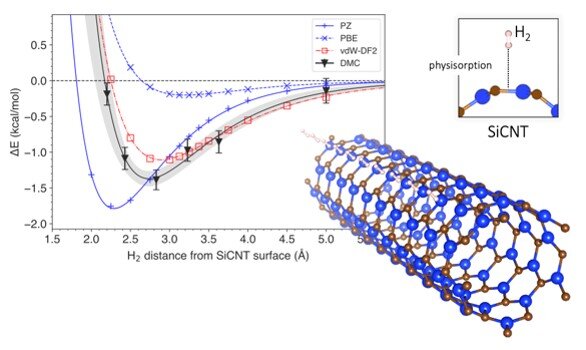
One of the fundamental forces of attraction between objects is the van der Waals force, which defines the interaction between atoms or molecules based on the distance between them. Since the Van der Waals force is the consequence of quite complicated quantum processes, conventional treatments could not describe it well, and hence the simulations so far are at the level of rough estimations of it. But is it right to do that when simulating hydrogen storage? This was the primary concern of Dr. Hongo and the team.
To answer this question, they looked at silicon-carbide nanotubes, one of the most promising materials for hydrogen storage. Using a computational technique called diffusion Monte Carlo (DMC), they created a model that accounted for van der Waals forces when simulating the storage of hydrogen in silicon-carbide nanotubes. Most conventional models consider the interactions between hydrogen and silicon-carbide nanotubes as a whole, but the DMC method uses the power of a supercomputer to reconstruct the interaction mechanism faithfully by following the arrangement of individual electrons. This makes the DMC model the most accurate method of prediction to date. Using the DMC model, the researchers were also able to predict how much energy would be required to dislodge hydrogen from its storage, and how far away the hydrogen was likely to be from the surface of the silicon-carbide nanotube. They then compared the results from their modeling to those obtained via conventional prediction methods.
Conventional prediction methods are usually based on a computational technique called the density functional theory (DFT). DFT uses functionals (model descriptions of quantum interactions) that describe the spatial variations of electron density to determine the properties of complex systems. While there have been several DFT-based studies on the storage of hydrogen on silicon-carbide nanotubes, none of them have incorporated van der Waals forces in their predictions. Van der Waals-corrected DFT functionals have, however, been employed in the prediction of other materials. Dr. Hongo and their team simulated hydrogen storage using a wide range of DFT functionals, those with van der Waals corrections and those without. They found that the DFT functionals without van der Waals corrections misestimated energy required for hydrogen storage by 4–14%. On the other hand, van der Waals-corrected DFT functionals produced results that were quite similar to those of DMC. Moreover, they found that the contribution of the van der Waals force to the storage energy was about 9–29%, which is hardly insignificant.
These findings, Dr. Hongo believes, can be a stepping stone for further innovation in hydrogen storage simulation technology. “Although the DMC method is computationally expensive, it can be used to clarify the peculiarities (tendencies of prediction error) of each prediction method. This will help us understand which prediction to trust, and also how to modify prediction methods to make them more useful,” he explains.
With powerful computational predictions like this to speed up its development, it is easy to see hydrogen technology becoming an everyday reality soon!
After completing a profound transformation, DataCore is investing to accelerate growth and establish itself as the independent leader in software-defined storage
DataCore Software has announced that Abhijit Dey, Chief Product Officer, and Gregg Machon, Vice President, Americas Sales, have joined the company’s executive leadership team. Both executives bring a wealth of experience in the data storage and IT infrastructure industries, helping the company to meet the growing demand for its complete, best-of-breed software-defined storage solutions for block, file, and object storage.
The additions come at a time of transformation and growth for DataCore. The company has made a significant investment in R&D, resulting in an increase of technical talent of more than 40% in the last two years alone while modernizing software development and testing practices, opening a center of excellence in Bangalore, India, and a new office in Austin, Texas.
“The momentum we are seeing at DataCore underscores our longstanding commitment to building both a world-class product portfolio as well as recruiting and developing the best talent around the world,” said Dave Zabrowski, CEO of DataCore. “As we continue our expansion and welcome industry leaders like Abhijit and Gregg to our team, our top priority remains serving our customers and providing them with the software-defined storage platform that improves data access and protection while also reducing overall costs.”
The increase in resources dedicated to innovation will allow the company to continue accelerating its portfolio of best-of-breed storage products, which now include SANsymphony, vFilO, and Swarm, covering block, file, and object storage as well as automatic data movement and optimization. Last year the company made a strategic investment and joint venture in MayaData, sponsors of the leading container-attached storage technology for Kubernetes, OpenEBS.
Throughout the challenges the world is facing with the pandemic, DataCore remains a healthy, well-funded, and growing company: it had its 12th consecutive year of positive cash flow and double-digit growth in net new revenue over the last few quarters in which the company has added an average of over 100 net new customers per quarter, with a strong performance in government, healthcare, and CSP (cloud service provider) verticals.
“DataCore’s continued growth is a direct result of our global partner and customer base and the trust they put in our technology every day,” said Dey. “Our solutions underscore our strategic DataCore ONE vision: to help customers realize the power of software-defined storage, to break silos and hardware dependencies, and to unify the storage industry, thereby enabling IT to make storage smarter, more effective, and easier to manage for our users.”
Dey is a product and R&D executive with decades of experience in IT infrastructure product innovation. An expert in the intersection between strategy, product management, and customer success, he has utilized his leadership experience to transform multiple large-scale and start-up corporations. Dey joins Datacore from Agari, a leader in cybersecurity, where he was the Senior Vice President of Product Management and R&D. Prior to Agari, Abhijit served as Vice President of Engineering at Druva, where he led the company’s SaaS-based data protection business. Dey also led various products in software-defined-storage, cloud-based backup, archival, enterprise vault, and analytics at Veritas and Symantec Corporation.
“I’m thrilled to join a fast-growing and innovative market leader like DataCore and to build a greater awareness of and demand for our portfolio with the IT channel throughout the Americas,” said Machon. “As organizations increasingly seek software-defined storage for their primary and secondary storage requirements, we are seeing growing demand for a unified software-defined platform that can simplify and optimize storage tiers, managed by modern technologies such as predictive analytics and artificial intelligence.”
Machon is a seasoned sales and channel executive with experience building profitable, leveraged channel sales models and programs across the world within the storage industry. Most recently, Machon helped build Qumulo’s worldwide channel and OEM organization and led the company’s expansion into APAC through its OEM partnership with HPE. Before Qumulo, he led the North America storage channels for Hewlett Packard Enterprise, which he joined through the $1.2B acquisition of Nimble Storage. There he was responsible for the overall channel go-to-market strategy to maximize sales productivity and customer satisfaction. Prior to HPE and Nimble Storage, Machon was the Director of Worldwide Channels at SolidFire. He has also served in leadership roles at NetApp, Isilon, and EMC.
DataCore’s award-winning software-defined storage portfolio includes:
- DataCore SANsymphony software for block-based storage enables users to centrally automate and manage capacity provisioning and data placement across diverse storage environments, providing the benefits of hardware independence, flexibility, availability, performance, and efficiency/cost savings.
- DataCore Swarm object storage software, designed from the ground up to securely manage billions of files and petabytes of information. Swarm provides a foundation for hyper-scale data storage, access, and analysis while guaranteeing data integrity and eliminating hardware dependencies.
- vFilO software, a next-generation distributed file and object storage virtualization technology uniquely designed to help enterprises organize, optimize, and control large volumes of data scattered on-premises and in the cloud. It simplifies shared access, control and protection of distributed file systems while maximizing efficiency and minimizing costs.