UC chemists use quantum simulations to understand a solvent that holds promise for green energy

To understand the fundamental properties of an industrial solvent, chemists with the University of Cincinnati turned to a supercomputer.

UC chemistry professor and department head Thomas Beck and UC graduate student Andrew Eisenhart ran quantum simulations to understand glycerol carbonate, a compound used in biodiesel and as a common solvent.

They found that the simulation provided detail about hydrogen bonding in determining the structural and dynamic properties of the liquid that was missing from classical models. The study was published in the Journal of Physical Chemistry B.

Glycerol carbonate could be a more environmentally friendly chemical solvent for things like batteries. But chemists have to know more about what's going on in these solutions. They studied the compounds potassium fluoride and potassium chloride.

"The study we did gives us a fundamental understanding of how small changes to a molecular structure can have larger consequences for the solvent as a whole," Eisenhart said. "And how these small changes make its interactions with very important things like ions and can have an effect on things like battery performance."

Water is a seemingly simple solvent, as anyone who has stirred the sugar in their coffee can attest.

"People have studied water for hundreds of years -- Galileo studied the origin of flotation in water. Even with all that research, we don't have a complete understanding of the interactions in water," Beck said. "It's amazing because it's a simple molecule but the behavior is complex."

For the quantum simulation, the chemists turned to UC's Advanced Research Computing Center and the Ohio Supercomputer Center. Quantum simulations provide a tool to help chemists better understand interactions on an atomic scale. UC chemistry professor Thomas Beck, left, and graduate student Andrew Eisenhart used quantum simulations to understand the solvent glycerol carbonate.  CREDIT Colleen Kelley/UC Creative

"Quantum simulations have been around for quite a while," Eisenhart said. "But the hardware that's been evolving recently -- things like graphics processing units and their acceleration when applied to these problems -- creates the ability to study larger systems than we could in the past."

"How do ions dissolve in this liquid compared to water? First, we had to understand what the basic structure was of the liquid," Beck said.

The research was funded by a grant from the National Science Foundation. 

Every lithium-ion battery contains a solvent. Finding a better one could improve energy storage and efficiency.

"The world is moving in a sustainable direction. It's pretty clear that wind and solar will be two major contributors along with other green energy," Beck said. "But the energy generated is intermittent. So you need methods for large-scale energy storage so that if it's cloudy for two days, a city can stay running."
American astronomers find secrets of Japanese Universes

Astronomers have played a game of guess-the-numbers with cosmological implications. Working from a mock catalog of galaxies prepared by a Japanese team, two American teams correctly guessed the cosmological parameters used to generate the catalog to within 1% accuracy. This gives us confidence that their methods will be able to determine the correct parameters of the real Universe when applied to observational data.

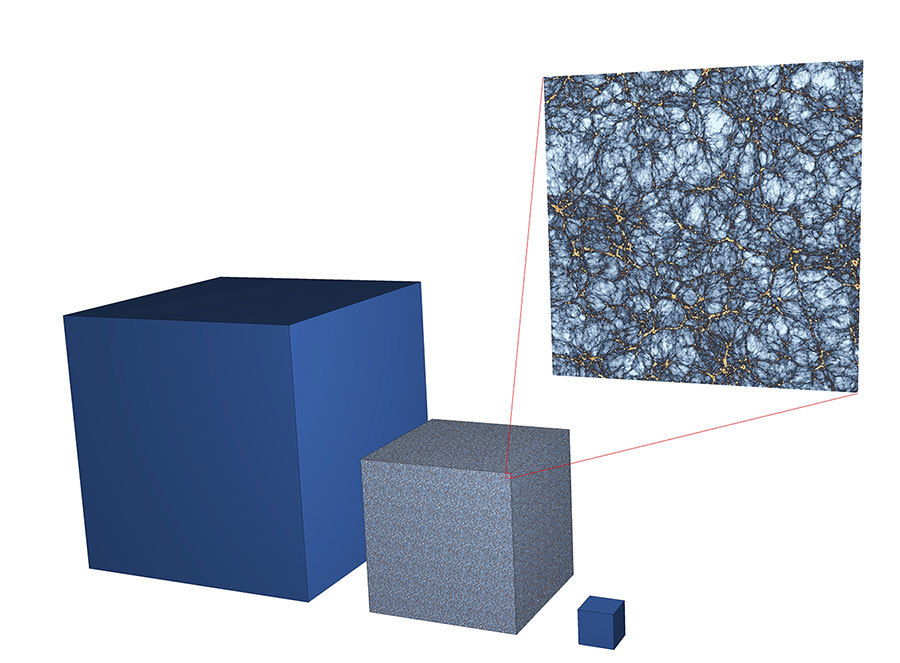
The basic equations governing the evolution of the Universe can be derived from theoretical calculations, but some of the numbers in those equations, the cosmological parameters, can only be derived through observations. Cosmological parameters tied to the unobservable parts of the Universe, like the amount of dark matter or the expansion of the Universe driven by dark energy, must be inferred by looking at their effects on the distribution of visible galaxies. There is always uncertainty when working with the dark part of the Universe, and it is hard to be sure that the models and data analysis are accurate. The volume of the challenge data prepared by the Japanese team (center), compared to the total volume of the real Universe observable by light (left), and the volume of one of the largest galaxy survey catalogs, the Sloan Digital Sky Survey (right). From left to right, the volumes would be equivalent to cubes with edges of 75 billion light-years, 40 billion light-year, and 9 billion light-years. The marbling in the simulation shows areas of high (red) and low (blue) density. (Credit: Takahiro Nishimichi)

To test the data analysis, a Japanese team led by Takahiro Nishimichi at Kyoto University and the Kavli IPMU, The Kavli Institute for the Physics and Mathematics of the Universe, at the University of Tokyo used the ATERUI II supercomputer at the National Astronomical Observatory of Japan to create 10 mock universes with a total volume 100 times greater than even the most extensive galaxy surveys so far. The large volume, large dynamical range, and high resolution achievable only with the world’s most powerful supercomputer dedicated to astronomy were needed to separate systematic errors in the analysis models from random errors due to meaningless coincidences in the data. The cosmological parameters used to evolve these mock universes were chosen randomly from the range of reasonably expected values. The Japanese team prepared a catalog listing the positions of the galaxies in the simulation similar to the catalogs produced by real telescopes observing the heavens. The Japanese team then challenged other astronomers to guess the numbers used to generate the catalog.

Two American teams accepted the challenge. Working independently and using different methods, both teams analyzed the Japanese data with tools used for real astronomy surveys. Each team had only one chance to guess the numbers, and both teams produced answers within 1% of the real values. This shows that these methods should give correct results when applied to real observational data.

So what were the correct numbers? They’re still secret so that more teams can play guess-the-numbers. In this way, the challenge data will continue to support the development and testing of cosmic analysis techniques.

These results appeared as Nishimichi et al. “Blinded challenge for precision cosmology with large-scale structure: results from effective field theory for the redshift-space galaxy power spectrum” in Physical Review D on December 28, 2020.

Japanese researchers demo the world's fastest spintronics p-bit

Tohoku University researchers have, for the first time, developed the technology for the nanosecond operation of the spintronics-based probabilistic bit (p-bit) - dubbed the poor man's quantum bit (q-bit).

The late physicist R.P. Feynman envisioned a probabilistic computer: a computer that is capable of dealing with probabilities at scale to enable efficient computing.

"Using spintronics, our latest technology made the first step in realizing Feynman's vision," said Shun Kanai, professor at the Research Institute of Electrical Communication at Tohoku University and lead author of the study.

Magnetic tunnel junctions (MTJs) are the key component of non-volatile memory or MRAM, a mass-produced memory technology that uses magnetization to store information. There, thermal fluctuation typically poses a threat to the stable storage of information.

P-bits, on the other hand, function with these thermal fluctuations in thermally unstable (stochastic) MTJs. Prior collaborative research between Tohoku University and Purdue University demonstrated a spintronics-based probabilistic computer at room temperature consisting of stochastic MTJs with millisecond-long relaxation times.

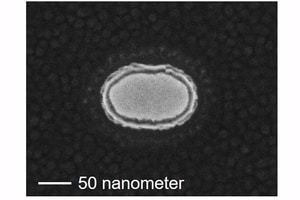
In order to make probabilistic computers a viable technology, it is necessary to develop stochastic MTJs with much shorter relaxation times which reduces the fluctuation timescale of the p-bit. Doing so would effectively increase the computation speed/accuracy. A top-view scanning electron microscopy image of a magnetic tunnel junction device. © K. Hayakawa et al.

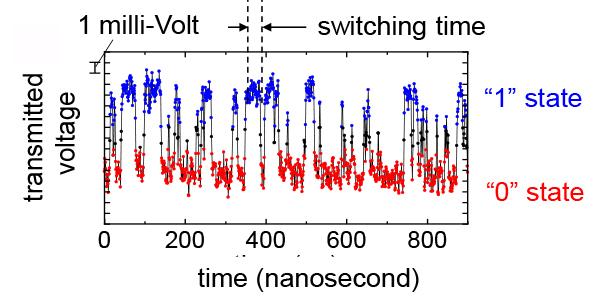
The Tohoku University research group, comprising Kanai, professor Hideo Ohno (the current Tohoku University president), and professor Shunsuke Fukami, produced a nanoscale MTJ device with an in-plane magnetic easy axis (Fig. 1). The magnetization direction updates every 8 nanoseconds on average - 100 times faster than the previous world record (Fig 2).

The group explained the mechanism of this extremely short relaxation time by utilizing entropy - a physical quantity used to represent the stochasticity of systems that had previously not been considered for magnetization dynamics. Deriving a universal equation governing the entropy in magnetization dynamics, they discovered that the entropy rapidly increases in MTJs with an in-plane easy axis with larger magnitudes of perpendicular magnetic anisotropy. The group intentionally employed an in-plane magnetic easy axis for achieving shorter relaxation times.

"The developed MTJ is compatible with current semiconductor back-end-of-line processes and shows substantial promise for the future realization of high-performance probabilistic computers," added Kanai. "Our theoretical framework of magnetization dynamics including entropy also has a broad scientific implication, ultimately showing the potential of spintronics to contribute to debatable issues in statistical physics." Real time measured transmitted voltage signal which reflects the magnetization state as well as bit state. Relaxation time, defined as a switching time averaging over 100 million times a second, was observed. ©K. Hayakawa et al.