

Purdue prof leads research into deep fakes

Falsified images, research documents among the latest areas of focus

Deep fake videos of actor Tom Cruise on Tik Tok can create some confusing fans. A deep fake video of a drug company CEO announcing COVID-19 vaccine failures, however, could cause panic.

Ferreting out deep fake videos is the work of Edward Delp, the Charles William Harrison Distinguished Professor of Electrical and Computer Engineering at Purdue University, who is leading one of the teams in the Semantic Forensics program created by the Defense Advanced Research Projects Agency for the U.S. Department of Defense.

The program, which has been ongoing since late last year, is a continuation of Delp’s innovative previous work into tools to detect deep fakes and manipulated media. Only now the research is extending much further to include other video styles and media such as images and documents.

“Not only do we want to be able to detect when a piece of media has been manipulated, but we want to be able to attribute it: Who did it, why did they do it and what was their intent?” said Delp, director of the Video and Imaging Processing Laboratory at Purdue. “It’s called detection, attribution, and characterization. We’re trying to solve the whole problem.” Edward Delp, the Charles William Harrison Distinguished Professor of Electrical and Computer Engineering and director of the Video and Imaging Processing Laboratory at Purdue University, is leading a team of experts for the U.S. Department of Defense researching ways to detect several forms of manipulated media. (Purdue University photo/John Underwood)
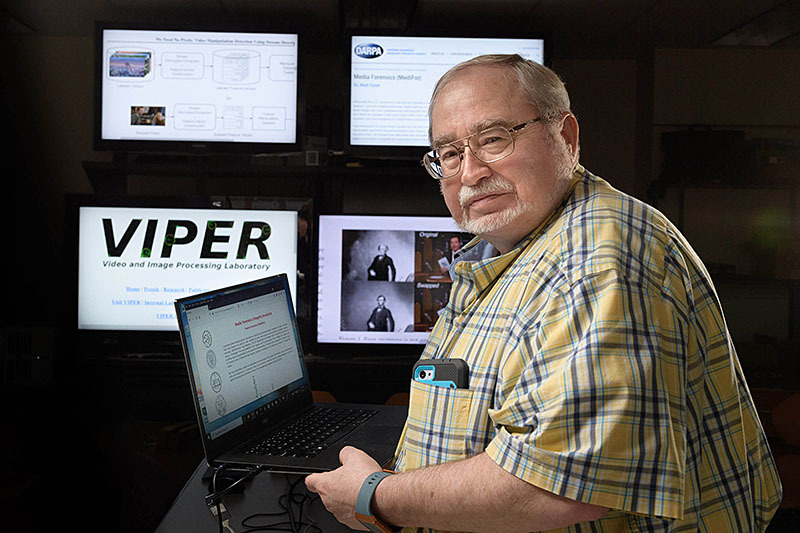
Delp has worked on video tampering as part of a larger research into media forensics, focusing on sophisticated techniques based on artificial intelligence and machine learning to create an algorithm that detects deep fakes.

For this program, Delp is overseeing a team of technical experts from the University of Notre Dame, the University of Campinas in Brazil, and three Italian universities: Politecnico di Milano, the University of Siena, and the University Federico II of Naples.

The team has complementary skills and backgrounds in computer vision and biometrics, machine learning, digital forensics, as well as signal processing and information theory.

The team is moving away from studying deep fakes that concentrate only on faces, instead of looking at fake street scenes and fake biological imagery like microscope images and X-rays.

“Think about the insurance fraud if you have a doctor who could generate fake X-rays of patients and start turning those into the insurance companies,” Delp said.

Something as seemingly harmless as a driver putting a camera in a car to record heading down the road can have other applications. Delp said the video can be manipulated to make it look like it’s a different road or neighborhood and used to try and fool an autonomous vehicle system.

Delp said the team is doing some unique things with document validity, particularly with regard to research papers.

“One of the things we’re looking at is, with the COVID pandemic there has been a lot of scientific papers put forward that have falsified data,” he said. “We are building a tool that will look at a scientific paper; in particular look at the images and figures and determine whether they’ve been manipulated.”

Delp said the problem, called research integrity, has been an ongoing issue for almost 15 years, particularly in the biomedical community.

Also being examined are articles trying to be passed off as originating from specific newspapers. Delp said the work is called style detection and examines the writing style guides of a number of nationwide newspapers.

Delp said the premise is if someone writes an article and then tries to fake it, saying it comes from the New York Times; they probably did not read the style guide and will not have the appropriate word usage as a result.

Style detection is one of the team’s long-term projects.
China demos universal quantum error-correcting code with superconducting qubits

Universal fault-tolerant quantum supercomputing relies on the implementation of quantum error correction. An essential milestone is the achievement of error-corrected logical qubits that genuinely benefit from error correction, outperforming simple physical qubits. Although tremendous efforts have been devoted to demonstrating quantum error-correcting codes with different quantum hardware, previous realizations are limited to be against certain types of errors or to prepare special logical states. It remains one of the greatest and also notoriously difficult challenges to realize a universal quantum error-correcting code for more than a decade.

In a new research article published in the Beijing-based National Science Review, scientists at the University of Science and Technology of China, the Tsinghua University, and at the University of Oxford, present their latest work on the experimental exploration of five-qubit quantum error-correcting code with superconducting qubits. The authors realized the [[5,1,3]] code on a superconducting quantum processor, verified the viability of experimental realization of quantum error-correcting codes with superconducting qubits.

These scientists completed the important step towards the implementation of quantum error correction. This is achieved first by dedicated experimental optimization of superconducting quantum qubits, enabling the realization of more than a hundred quantum gates. Focusing on the five-qubit quantum error-correcting code, the so-called 'perfect code' that corrects single generic qubit errors, they theoretically compiled and optimized its encoding process to have the minimal possible number (eight) of nearest-neighbor controlled-phase gates. These experimental and theoretical advances finally enabled the realization of the basic ingredients of a fully functional five-qubit error-correcting code, involving the encoding of a general logical qubit into an error-correcting code, with the subsequent verification of all key features including the identification of an arbitrary physical error, the power for transversal manipulation of the logical state, and state decoding.

"The device for the implementation of the five-qubit error-correcting code is a 12-qubit superconducting quantum processor. Among these 12 qubits, we chose five adjacent qubits to perform the experiment. The qubits are capacitively coupled to their nearest neighbors. The capacitively coupled XY control lines enable the application of single-qubit rotation gates by applying microwave pulses, and the inductively coupled Z control lines enable the double-qubit controlled-phase gates by adiabatically tune the two-qubit state |11> close to the avoid level crossing of |11> and |02>. After careful calibrations and gate optimizations, we have the average gate fidelities as high as 0.9993 for single-qubit gates and 0.986 for two-qubit gates. With the implementation of only single-qubit rotation gates and double-qubit controlled-phase gates, we realized the circuit for encoding and decoding of the logical state." they state in an article titled "Experimental exploration of five-qubit quantum error-correcting code with superconducting qubits."

"On a superconducting quantum processor, we experimentally realized the logical states |0>_L, |1>_L, |±>_L, and |±i>_L that are eigenstates of the logical Pauli operators X_L, Y_L, and Z_L, and the magic state |T>_L= (|0>_L+e^{i\pi/4}|1>_L)/\sqrt{2} that cannot be realized by applying Clifford operations on any eigenstate of the logical Pauli operators," they add. "Finally, the state fidelity of |T>_L reaches 54.5(4)%."

"The quality of the prepared logical states can also be divided into its overlap with the logical code space and its agreement with the target logical state after projecting it into the code space," they stated. After projecting to the code space, the average value is as high as 98.6(1)%. "Since projecting to the code space is equivalent to post-selecting all +1 stabilizer measurements, our result also indicates the possibility of high fidelity logical state preparation with future non-destructive stabilizer measurements."

After the realization of the logical state, the scientists proceed with the verification of error correction/detection ability of the five qubit code. "As shown in Fig.2(a) we do indeed find, for each case, the corresponding syndrome pattern that identifies the location of the single-qubit error," they added.

Then, the scientists implemented and verified the transversal logical operations, and performed the quantum process tomography within the code space to characterize these logical operations. "We determine gate fidelities of the logical X_L, Y_L, and Z_L operations to be 97.2(2)%, 97.8(2)%, and 97.3(2)%, respectively," they stated.

"Finally, after encoding the single-qubit input state into the logical state, we apply the decoding circuit, see Fig. 4(a), to map it back to the input state," they added. "After quantum process tomography from the four output states, the process fidelity is determined as 74.5(6)% as shown in Fig. 4(b)."

"An essential milestone on the road to fault-tolerant quantum computing is the achievement of error-corrected logical qubits that genuinely benefit from error correction, outperforming simple physical qubits," they add. "Direction for future works include the realization of non-destructive error detection and error correction, and the implementation of logical operations on multiple logical qubits for the five-qubit code. Our work also has applications in error mitigation for near-term quantum supercomputing."

INRS prof Orgiu makes a promising breakthrough for a better design of electronic materials

A deeper understanding of molecular vibrations can increase electron velocity in semiconductor materials

Finding the best materials for tomorrow's electronics is the goal of Professor Emanuele Orgiu of the Institut national de la recherche scientifique (INRS). Among the materials in which Professor Orgiu is interested, some are made of molecules that can conduct electricity. He has demonstrated the role played by molecular vibrations on electron conductivity on crystals of such materials. This finding is important for applications of these molecular materials in electronics, energy, and information storage. The study, conducted in collaboration with a team from the INRS and the University of Strasbourg (France), was published in the prestigious Advanced Materials journal.

Scientists were interested in observing the relationship between the structure of materials and their ability to conduct electricity. To this end, they measured the speed of propagation of electrons in crystals formed by these molecules. In their study, the authors compared two perylene diimide derivatives, which are semiconducting molecules of interest because of their use on flexible devices, smart clothes, or foldable electronics. The two compounds encompassed within the study have similar chemical structures but feature very different conduction properties.

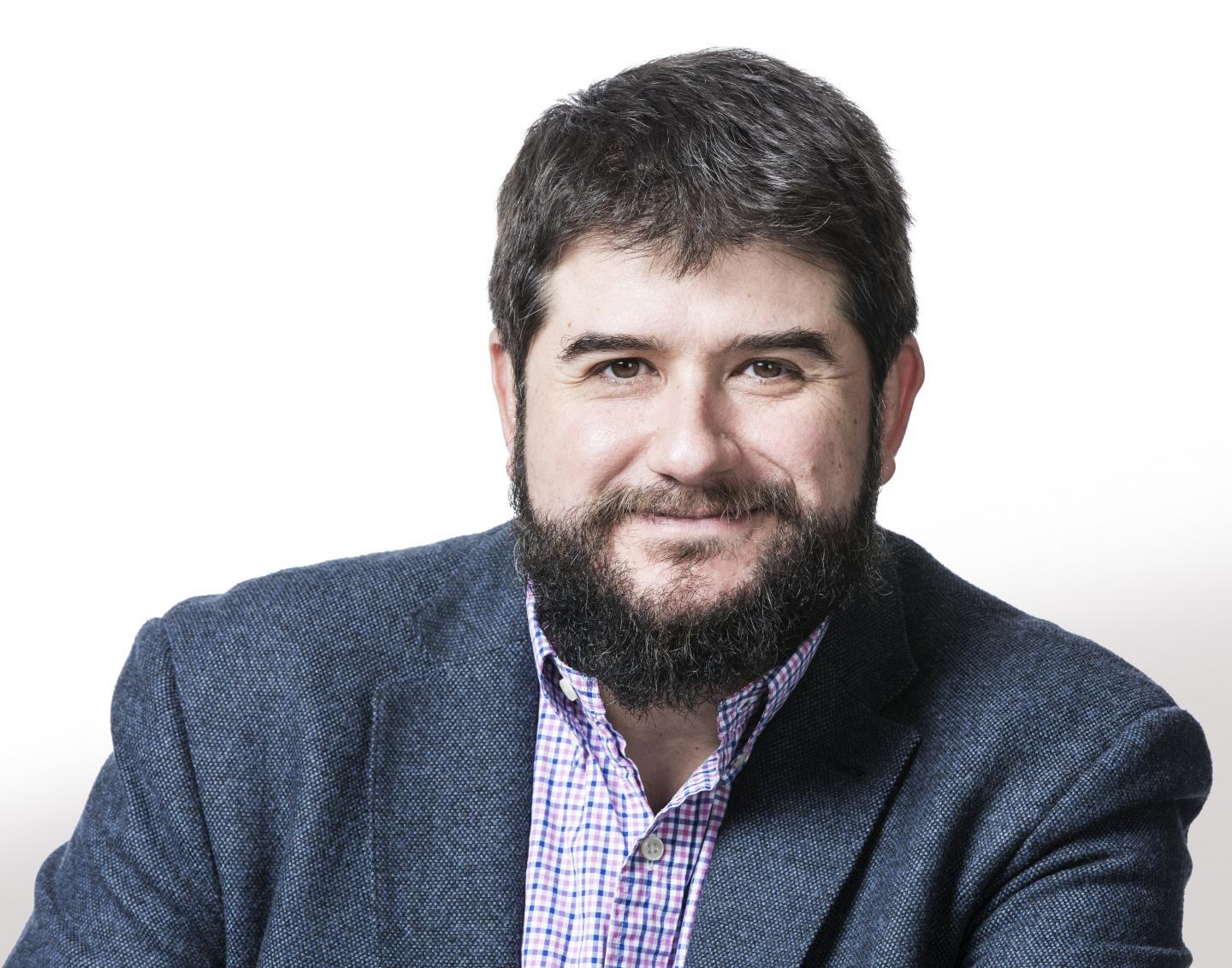
With the goal of determining what caused this difference, the research group was able to establish that the different molecular vibrations composing the material were responsible for the different electrical behavior observed in devices. "For a current to flow through a material, electrons must 'hop' from one molecule to the neighboring one. Depending on the level of 'movement' of the molecules, which depends on the amplitude and energy of the related vibrations (called phonons), the electrons can move more or less easily through the material," explains Professor Orgiu, whose research team is the first to demonstrate which vibrations have the greatest influence on electron flows. INRS Professor Emanuele Orgiu is a specialist in molecular and device physics.  CREDIT Christian Fleury (INRS)

An Ad Hoc Molecular Design to Make Electrons Travel Faster

This breakthrough paves the way for the development of even more efficient materials for electronics. "By knowing what type of vibrations allows charges to move more easily, we are providing chemists with a formula for synthesizing the right materials, rather than going in blindly," explains Marc-Antoine Stoeckel. This research opens up new applications that could not be envisaged with silicon, the most widely used material in electronics, including supercomputers.

Professor Orgiu collaborated with INRS Professor Luca Razzari to measure the vibrations of the molecules. The two researchers are now working on a new spectroscopic technique that would enable them to visualize the vibrations when electrons are present. This will allow them to see if charges affect molecular vibrations.