Italian researchers explore irradiating COVID-19 cough droplets with UV-C lamps

Using supercomputer numerical modeling of saliva droplets' diffusion produced by coughs, researchers in Italy explore deactivating COVID-19 virus particles via UV-C light

One of the primary ways the COVID-19 virus is transmitted is via airborne diffusion of saliva microdroplets, so it is paramount to find methods to kill the virus in airborne microdroplets.

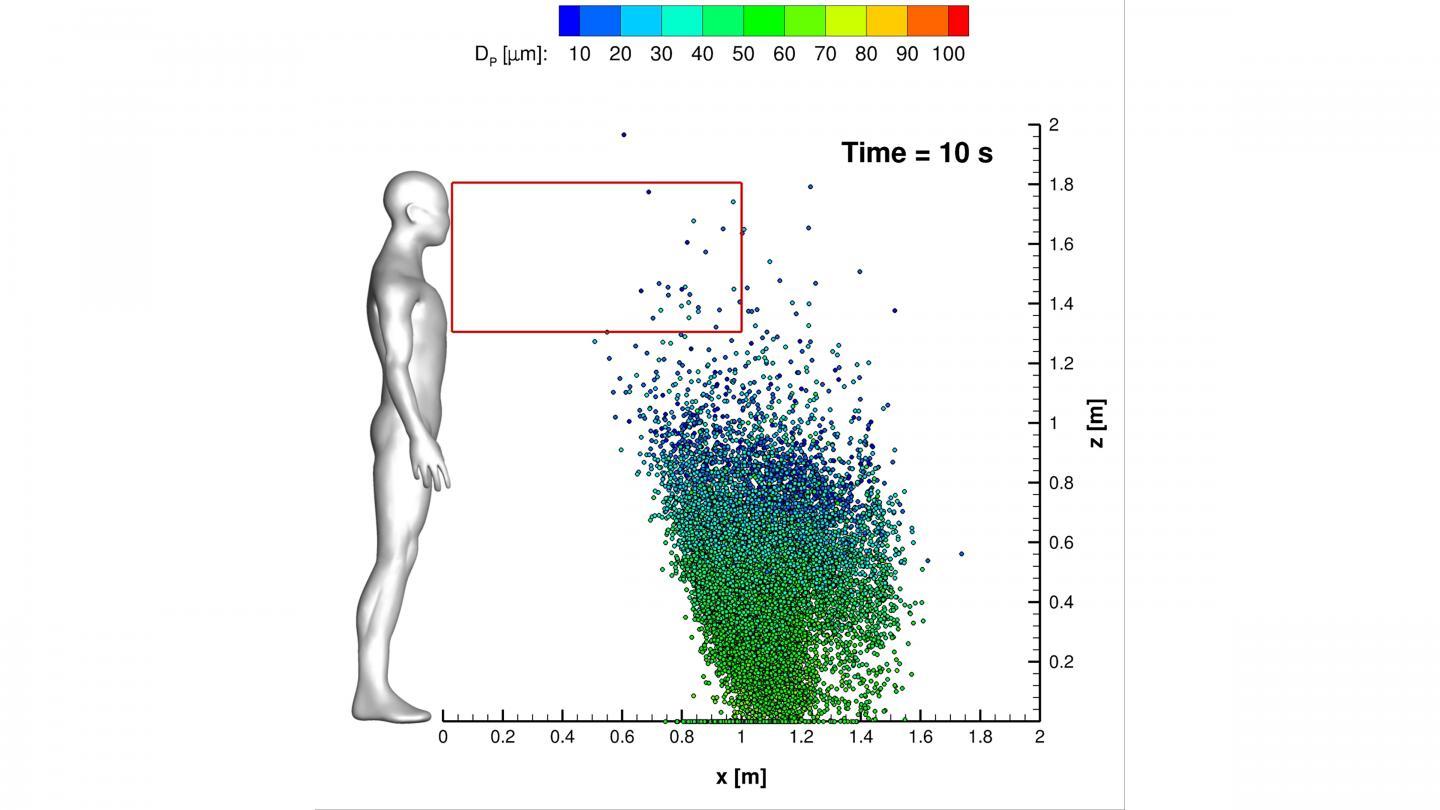
The extreme confusion that abounded at the beginning of the pandemic about safe social distances, mask-wearing, and social behavior inspired Marche Polytechnic University researchers, who happen to be intrigued by saliva droplet diffusion, to search for answers and ways to help. In Physics of Fluids, Marche Polytechnic University researchers describe using a supercomputer to do numerical modeling of cough droplets irradiated by UV-C light: The red zone (from your chest down) is the area of highest risk, so while your face may only receive a few cough droplets, it is critical to wash your hands and keep them away from your face.  CREDIT V. D'Alessandro, M. Falone, L. Giammichele, and R. Ricci
In Physics of Fluids, from AIP Publishing, Valerio D'Alessandro and colleagues describe using a supercomputer to do numerical modeling of cough droplets irradiated by UV-C light. They also report exploring the social distances required to prevent virus transmission.

The researchers zeroed in on the evolution of a saliva droplet cloud, accounting for the inertia, buoyancy, and weight of each droplet and its aerodynamic interaction with the environment.

"We are interested in the possibility of deactivating virus particles via UV-C light," D'Alessandro said. "So, we explored the interaction of saliva droplets with an external source of UV-C radiation, a lamp."

UV-C is a well-established germicidal technique because it interferes with virus RNA replication.

"UV-A and UV-B also kill germs and are present within the sun's rays, but with these, it takes 15 to 20 minutes to kill a virus," said D'Alessandro. "The sun's rays disinfect surfaces during the summer, which is one reason why transmission is reduced then, but it can't be used for real-time disinfection. That's why we decided to explore the effect of UV-C radiation on viruses."

The researchers' work addresses key points still not completely understood. First, they determined that 1 meter (3.2 feet) of social distancing is not completely safe to avoid virus transmission. This is particularly important because this is the social distancing rule in Italy and its schools.

"While 1 meter of distance can suffice in a one-on-one situation, you can still get hit with cough droplets from the chest down," D'Alessandro said. "It's necessary to avoid touching your eyes, nose, or mouth with your hands. We found 2 meters (6.5 feet) to be a much safer distance."

D'Alessandro and colleagues stress that the largest droplets travel about 1 meter. Over this distance, they discovered only smaller droplets, which transport a reduced amount of the virus.

"It's important to emphasize that these results were obtained without any background wind, and if this is present, the distance is almost doubled," he said. "So we need to wear face masks, especially when in close proximity."

They also found "it is possible to reduce the contamination risk by about 50% when irradiating saliva droplet clouds with UV-C radiation -- without providing a dangerous dose to people," said D'Alessandro. "This is critically important because disinfection systems based on UV-C are not always acceptable. UV-C kills the virus, but higher doses for humans can be dangerous."

High exposures to UV-C are known to cause skin and eye tumors.

"Our work helps correct the understanding of safe social distancing," said D'Alessandro. "Also, our computations can help to design new real-time disinfection devices based on UV-C that can reduce the risk of COVID-19 transmission and other viruses within particular situations, such as for supermarket cashiers or people in similar situations."

The article "Eulerian-Lagrangian modeling of cough droplets irradiated by ultraviolet-C light in relation to SARS-CoV-2 transmission" is authored by V. D'Alessandro, M. Falone, L. Giammichele, and R. Ricci. It will appear in Physics of Fluids on March 9, 2021 (DOI: 10.1063/5.0039224). After that date, it can be accessed at https://aip.scitation.org/doi/10.1063/5.0039224.
Toshiba's bleeding-edge FPGAs take fintech, logistics to new level

Multi-chip architecture points way to continued increases in performance of Toshiba's optimization supercomputer; potential to create a game-changing shift in complex financial transactions and robotics

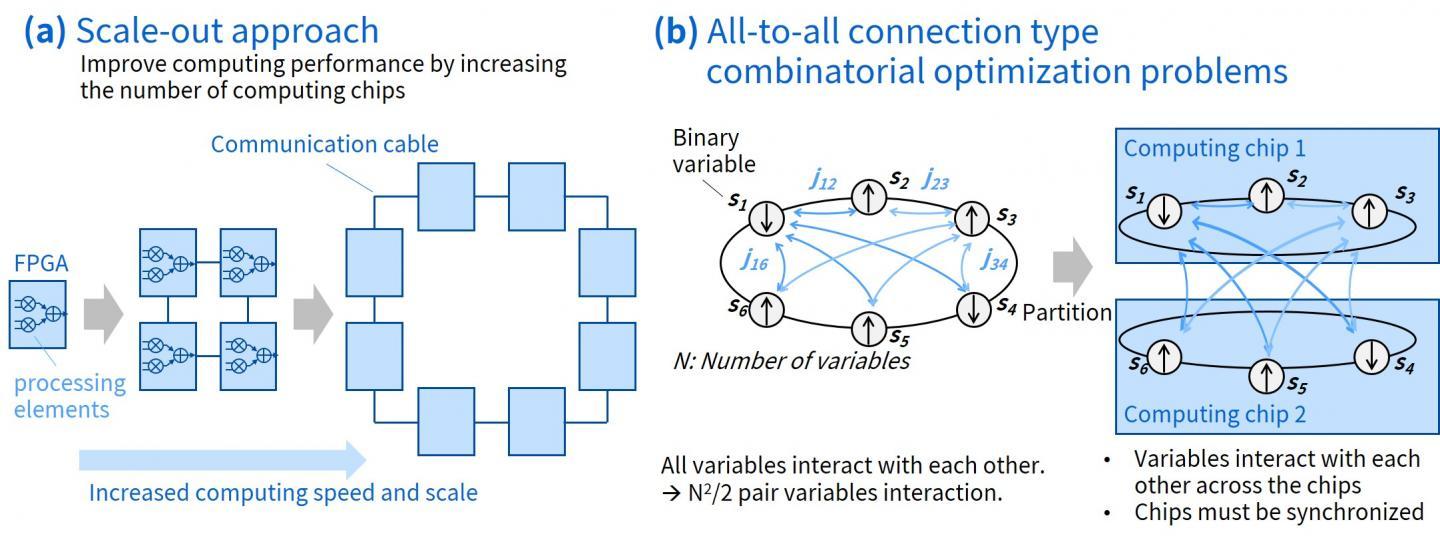
Toshiba Corporation has announced a scale-out technology that minimizes hardware limitations, an evolution of its optimization supercomputer, the Simulation Bifurcation Machine (SBM), that supports continued increases in computing speed and scale. Toshiba expects the new SBM to be a game-changer for real-world problems that require large-scale, high-speed, and low-latency, such as simultaneous financial transactions involving large numbers of stock, and complex control of multiple robots. The research results were published in an academic journal. (a) Scale-out approach: improve computing performance by increasing the numbers of computing chips; (b) All-to-all connection type combinatorial optimization problems: all variables interact with each other.

Speed and scale are keys to success in industrial sectors as different as finance, logistics, and communications, all of which have to deal with a large number and make complex decisions in the shortest time possible. Aiming to bring higher efficiencies to these and other businesses, Toshiba has addressed combinatorial optimization problems by developing high-speed, high-accuracy algorithms and corresponding practical supercomputer solutions. The company recently announced the second generation of its simulated bifurcation algorithms, implemented on classical computers via a single field-programmable gate array (FPGA), that surpasses computers in obtaining optimal solutions for various combinatorial optimization problems at high speed.

Toshiba continues to pursue better performance of the SBM by installing more FPGAs in the supercomputer, an approach called scale-out in computer architecture and has successfully demonstrated the world's first simultaneous scale-out of computing speed and problem size for all-to-all connection type combinatorial optimization problems. At the heart of the technology is a partitioned version of the simulated bifurcation algorithm that enables multiple FPGAs to exchange information on variables with each other, and that triggers an autonomous synchronization mechanism in minimizing the communications overhead to an extent that does not affect overall performance (Figures 1 & 2). Toshiba's new scale-out technology: A new multi-chip architecture featuring a partitioned version of the simulated bifurcation algorithm (partitioned SB) and an autonomous synchronization mechanism.

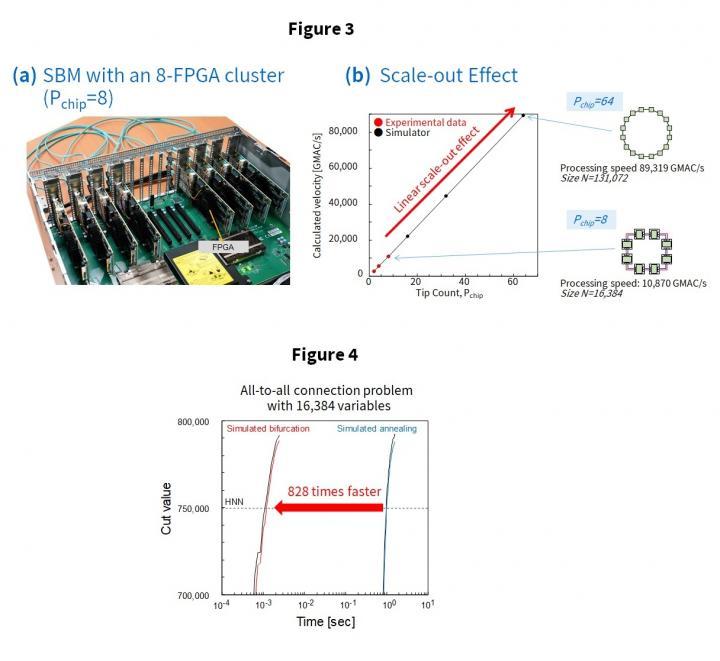
Trials have shown that an SBM with a cluster of eight FPGA (Figure 3a) achieves computational throughput 5.4 times higher than an SBM with a single FPGA, and solve problems 16 times larger; and simulation results with a 64 FPGA SBM have demonstrated that the relationship between the computing speed and number of FPGA is exactly linear (Figure 3b), indicating that the technology can continue to increase the scale-out with the same effect.

The 8 FPGA SBM also obtains solutions 828 times faster than an implementation of simulated annealing (SA), a widely used optimization technique, demonstrating that the SBM makes much more efficient use of computational resources than the SA (Figure 4). Figure 3: (a) SBM with an 8-FPGA cluster. (b) scale-out effect / Figure 4: Comparison of the computing time on 8 FPGA SBM and SA.

Commenting on the application of the technology, Kosuke Tatsumura, Chief Research Scientist at Toshiba Corporation's Corporate Research & Development Center, said: "Fast computing speed, large computing scale, and low latency to provide solutions are the critical values the new SBM can offer to business. For example, we expect the financial industry can benefit if they can trade more stocks simultaneously, and robots in the logistic industry will perform better with zero-time-lag computation. We hope the new technology will take fintech and logistics to a new level."

UCL Antikythera Research Team recreates a mechanical Cosmos for the world's first computer

Researchers at UCL have solved a major piece of the puzzle that makes up the ancient Greek astronomical calculator known as the Antikythera Mechanism, a hand-powered mechanical device that was used to predict astronomical events.

Known to many as the world's first analog computer, the Antikythera Mechanism is the most complex piece of engineering to have survived from the ancient world. The 2,000-year-old device was used to predict the positions of the Sun, Moon, and the planets as well as lunar and solar eclipses.

Published in Scientific Reports, the paper from the multidisciplinary UCL Antikythera Research Team reveals a new display of the ancient Greek order of the Universe (Cosmos), within a complex gearing system at the front of the Mechanism.

Lead author Professor Tony Freeth (UCL Mechanical Engineering) explained: "Ours is the first model that conforms to all the physical evidence and matches the descriptions in the scientific inscriptions engraved on the Mechanism itself.

"The Sun, Moon, and planets are displayed in an impressive tour de force of ancient Greek brilliance."

The Antikythera Mechanism has generated both fascination and intense controversy since its discovery in a Roman-era shipwreck in 1901 by Greek sponge divers near the small Mediterranean island of Antikythera.

The astronomical calculator is a bronze device that consists of a complex combination of 30 surviving bronze gears used to predict astronomical events, including eclipses, phases of the moon, positions of the planets, and even dates of the Olympics.

Whilst great progress has been made over the last century to understand how it worked, studies in 2005 using 3D X-rays and surface imaging enabled researchers to show how the Mechanism predicted eclipses and calculated the variable motion of the Moon.

However, until now, a full understanding of the gearing system at the front of the device has eluded the best efforts of researchers. Only about a third of the Mechanism has survived and is split into 82 fragments - creating a daunting challenge for the UCL team.

The biggest surviving fragment, known as Fragment A, displays features of bearings, pillars, and a block. Another, known as Fragment D, features an unexplained disk, 63-tooth gear, and plate.

Previous research had used X-ray data from 2005 to reveal thousands of text characters hidden inside the fragments, unread for nearly 2,000 years. Inscriptions on the back cover include a description of the cosmos display, with the planets moving on rings and indicated by marker beads. It was this display that the team worked to reconstruct.

Two critical numbers in the X-rays of the front cover, of 462 years and 442 years, accurately represent cycles of Venus and Saturn respectively. When observed from Earth, the planets' cycles sometimes reverse their motions against the stars. Experts must track these variable cycles over long time periods to predict their positions.

"The classic astronomy of the first millennium BC originated in Babylon, but nothing in this astronomy suggested how the ancient Greeks found the highly accurate 462-year cycle for Venus and 442-year cycle for Saturn," explained a Ph.D. candidate and UCL Antikythera Research Team member Aris Dacanalis.

Using an ancient Greek mathematical method described by the philosopher Parmenides, the UCL team not only explained how the cycles for Venus and Saturn were derived but also managed to recover the cycles of all the other planets, where the evidence was missing.

Ph.D. candidate and team member David Higgon explained: "After considerable struggle, we managed to match the evidence in Fragments A and D to a mechanism for Venus, which exactly models its 462-year planetary period relation, with the 63-tooth gear playing a crucial role."

Professor Freeth added: "The team then created innovative mechanisms for all of the planets that would calculate the new advanced astronomical cycles and minimize the number of gears in the whole system so that they would fit into the tight spaces available."

"This is a key theoretical advance on how the Cosmos was constructed in the Mechanism," added co-author, Dr. Adam Wojcik (UCL Mechanical Engineering). "Now we must prove its feasibility by making it with ancient techniques. A particular challenge will be the system of nested tubes that carried the astronomical outputs."