Autonomous scientific computing turns genome mining into an adaptive HPC workload, using 949 agent sessions, 60 CPU cores, GPU-accelerated structure prediction, and more than 215 million tokens to uncover a previously unknown family of reverse transcriptases.
For decades, a central challenge in computational biology has been deceptively simple to articulate: the volume of biological data far exceeds the capacity for human analysis. While modern metagenomic databases contain billions of uncharacterized protein sequences, conventional computational pipelines remain limited by their reliance on predefined search criteria, effectively restricting discovery to what researchers already know how to describe.
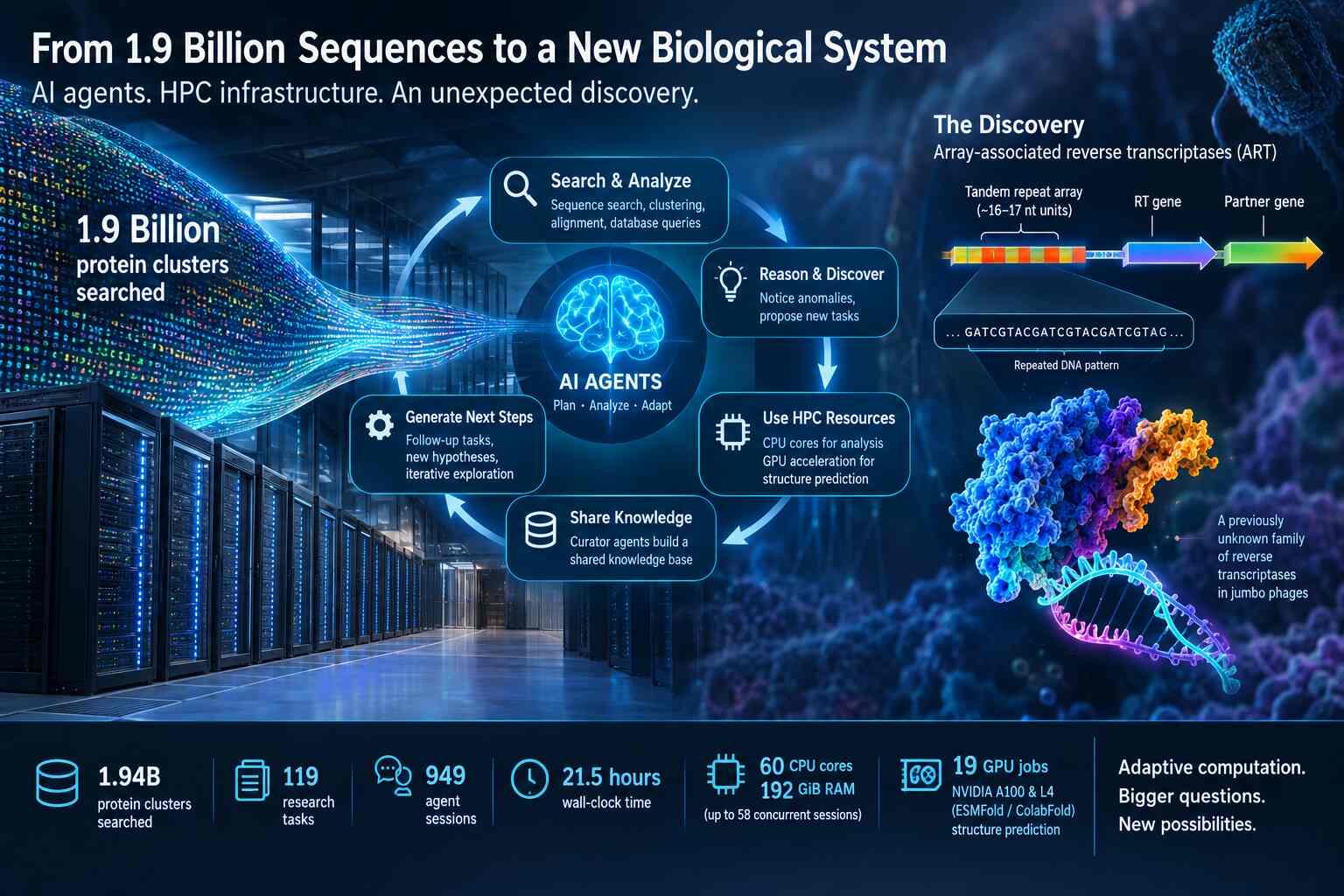
Recent research from Anthropic proposes an alternative paradigm. By moving beyond fixed analytical pipelines, the researchers developed an autonomous system wherein AI agents can search, analyze, self-critique, and initiate iterative computational tasks to investigate unexpected observations. In this study, the system surveyed approximately 1.9 billion protein clusters, ultimately identifying a novel family of reverse transcriptases associated with tandem DNA repeat arrays, which the team has termed array-associated reverse transcriptases (ART).
While this discovery is biologically significant, the underlying computing architecture offers a compelling advancement for high-performance computing (HPC). Rather than a singular AI model addressing a solitary query, the system functioned as an orchestrated scientific workload. Over 21.5 hours of wall-clock time, the campaign executed 119 research tasks and 949 agent sessions, totaling 215.6 million tokens, all without human intervention. The infrastructure utilized 58 concurrent sessions within a sandbox environment featuring 60 CPU cores and 192 GiB of memory, while offloading specialized structure prediction tasks to NVIDIA A100 and L4 GPUs. This experiment illustrates a shift in HPC workloads, moving from conventional batch processing toward dynamic, exploratory scientific computing.
From fixed pipelines to computational exploration
Traditional genome mining is extraordinarily powerful.
Researchers can construct profile hidden Markov models, search enormous sequence databases, cluster homologous proteins, build phylogenetic trees, and examine genomic neighborhoods. These operations are highly amenable to parallel computing.
But there is a fundamental limitation.
A conventional pipeline has to be told what constitutes an interesting result.
If the software is searching for a particular protein family, genomic architecture or sequence motif, the pipeline is optimized around those expectations. Anything that falls outside the predefined feature set may simply be classified as noise.
The researchers behind the study describe this as a novelty problem.
A human scientist looking at a sequence can notice something that was not part of the original search specification: an unusual repeat, a strange genomic neighborhood or an unexpected combination of molecular components.
The question was whether an AI-driven computational system could perform some of that exploratory work at database scale.
The answer, in this experiment, was yes, but with important qualifications.
The system did not simply unleash a language model on 1.9 billion sequences.
It constructed a hierarchy of computational agents.
A launch agent converted the research brief into stages. Worker agents performed individual analyses. Supervisor agents reviewed their plans and results. Curator agents placed findings into a shared knowledge base. Editor agents reviewed reports.
Most importantly, observations could generate new work.
Of the 119 tasks in the campaign, agents proposed 98 follow-up tasks. Those tasks entered a triage queue, where the research harness could release or reject them.
That creates a very different computational model from a conventional workflow.
Instead of: input → fixed pipeline → output the architecture becomes: input → analysis → observation → new task → analysis → new observation → new task
The compute graph can therefore change as the science develops.
For HPC architects, that distinction is crucial.
1.94 billion protein clusters become a compute problem
The initial search was enormous.
The agents assembled reverse-transcriptase profile HMMs and searched approximately 1.94 billion protein clusters.
That produced approximately 198,290 RT clusters after filtering, which were classified into nine RT classes.
The system then examined approximately 10,983 RT loci and evaluated 3,564 recurring protein families in their genomic neighborhoods as potential partner genes.
Sixteen candidate families passed the initial criteria and were assigned dedicated investigations.
An additional candidate emerged from follow-up work.
The campaign ultimately produced 19 reports, including reports on candidate partner families and three newly identified RT lineages.
Only three of the 17 candidate partner families survived as previously unreported RT associations.
That rejection rate is important.
The system was not simply programmed to turn every unusual observation into a discovery. It had to eliminate annotation artifacts, previously characterized systems and proteins that merely happened to occur nearby.
That is where the computational workflow begins to look increasingly like an HPC-enabled scientific laboratory.
The infrastructure behind the agents
The study’s autonomous research harness was built around Claude Code instances configured with Claude Mythos 5.
The computational environment permitted up to 58 concurrent sessions.
The sandbox itself contained:
- 60 CPU cores
- 192 GiB of memory
- No GPU
The absence of GPUs in the main sandbox is itself revealing.
The dominant workload was not neural-network training or large-scale inference performed locally on an accelerator. Much of the work consisted of conventional scientific computing: sequence searches, data manipulation, clustering, alignment, phylogenetic analysis, scripting, file processing and database queries.
The agents could execute software including HMMER, MMseqs2, BLAST+, MAFFT, FastTree, SeqKit, skani, geNomad, Infernal, ViennaRNA and other computational biology tools.
For structural analysis, the workflow could dispatch jobs to external GPU resources.
The researchers report 19 GPU jobs on NVIDIA A100 and L4 GPUs, using ESMFold or ColabFold with AlphaFold2-based models.
That is a classic heterogeneous HPC pattern.
CPU resources handled broad exploration and data analysis.
GPU resources were brought into the workflow when the problem demanded computationally expensive protein-structure prediction.
The AI agents effectively became a workload-management layer sitting above a collection of scientific-computing tools.
The numbers tell the HPC story
The campaign generated:
119 research tasks
949 agent sessions
77 agent-hours
215.6 million tokens
21.5 hours of wall-clock time
7,578 shell commands
696 database queries
131 literature searches
61 web requests
That workload is fundamentally different from a traditional supercomputing simulation.
There is no single enormous MPI job running for several hours across thousands of nodes.
Instead, the workload consists of many relatively independent, heterogeneous and dynamically generated tasks.
Some are computational.
Some are database operations.
Some involve text and literature.
Some involve sequence analysis.
Some invoke GPUs.
Some produce additional work.
And some terminate because the hypothesis is rejected.
This looks less like a conventional batch queue and more like a scientific task graph whose topology is discovered during execution.
That could become an important class of HPC workload.
Then the AI noticed something it wasn’t specifically looking for
The most consequential observation emerged from an investigation that was not originally designed to find the ART system.
The research campaign was primarily looking for previously unknown associations between reverse transcriptases and partner protein-coding genes.
One RT lineage, however, contained an unusual feature in the noncoding DNA upstream of the RT.
An agent retrieved the actual DNA sequence.
And instead of merely processing a predefined annotation, the agent examined the sequence directly.
It noticed a repeating pattern.
The worker identified tandem repeats approximately 16–17 nucleotides long, separated by spacers roughly 100–200 nucleotides long.
One locus contained 14 copies of a 16-nucleotide repeat.
The pattern looked sufficiently unusual that the agent began comparing it with known systems, including CRISPR-like arrays, retron-related architectures and other repeat-associated mechanisms.
It then performed a novelty investigation.
The repeat architecture did not match previously reported features.
That observation became the starting point for the ART discovery.
This is perhaps the most interesting computational moment in the entire study.
The system found something that the original research specification had not explicitly asked it to find.
The discovery emerged from looking at the data, rather than merely matching the data against a predefined list of expected features.
Why context mattered
The researchers subsequently tested whether the AI models could recognize the unusual repeat arrays when given different amounts of information and different tools.
The results expose an important limitation, and an important opportunity.
The strongest models could recognize the ART array when the DNA sequence itself was placed directly into their context.
But giving the model more tools did not automatically make it better at recognizing the repeat architecture.
In some benchmark conditions, performance actually declined.
The researchers found that a major factor was whether the model actually read enough DNA sequence.
When at least 200 nucleotides of contiguous DNA were read into context, repeat recognition increased substantially.
For the pooled group of four most capable models, recognition increased as progressively larger amounts of DNA were brought into context, reaching as high as 76% of attempts in the reported bins and as high as 96% for Mythos 5 in the largest-context condition.
The implication is striking for scientific AI infrastructure.
Giving an agent access to a tool is not the same thing as giving it the information contained in the tool’s output.
A filesystem can contain thousands of nucleotides, millions of rows, or gigabytes of scientific data. The agent still has to decide what to inspect.
That makes data movement, context construction, and intelligent I/O part of the computational problem.
For future scientific AI systems, the bottleneck may not always be FLOPS.
It may be what information the agent chooses to bring into its working context.
From sequence anomaly to biological system
Once the unusual architecture was identified, the researchers expanded the computational investigation.
The ART systems turned out to occur primarily in jumbo phages and to contain three recurring components: an RT protein, a tandem repeat array, and a partner gene.
The researchers examined 95 ART members and additional phage loci.
Computational analysis showed that the repeat arrays were not simply random sequence repetitions. Their spacing, conservation and organization distinguished them from shuffled controls.
Phylogenetic analyses placed the ART proteins in a distinct family.
The researchers also identified three major partner-protein types.
Type I systems were associated with a protein of roughly 600 amino acids containing two tandem GNAT-like folds.
Type II systems occurred in a Staphylococcus phage lineage and encoded an approximately 270-residue all-helical protein.
Type III systems encoded a smaller, approximately 170-residue helical protein in one environmental lineage.
The three partner families showed no obvious sequence or predicted-structure similarity to one another.
That suggests the RT family may have been paired with unrelated partner proteins multiple times during evolution.
Again, much of this characterization depended on computational infrastructure.
Sequence clustering and homology searches narrowed the candidate universe.
Multiple sequence alignment and phylogenetic tools established evolutionary relationships.
Structure-prediction systems provided additional evidence about protein architecture and possible RT-partner interfaces.
The CPU and GPU workloads were therefore not competing alternatives.
They were complementary stages of the same scientific pipeline.
The GPU was not the discovery engine, it was part of the investigation
This distinction is worth emphasizing.
It would be easy to describe the work as an AI supercomputer discovering a new molecular system.
That would obscure how the computation actually worked.
The initial genome-scale search relied heavily on sequence analysis tools and CPU resources.
The GPU resources were used for specialized structural prediction.
That division is representative of the emerging architecture of scientific AI.
The future supercomputing system may not be dominated by a single accelerator type.
Instead, a scientific workload could move repeatedly between: CPU search → database → agent reasoning → CPU analysis → GPU prediction → CPU comparison → agent interpretation → new task
The scheduler becomes more important because the application itself determines what it needs next.
The workload is no longer completely known before execution begins.
The shared knowledge base becomes a new kind of scientific memory
Another important architectural feature was the shared knowledge base.
After each task, a curator agent reviewed the work and entered findings into a common record.
Later agents received relevant entries in their prompts.
Plans, results, reviews, and scripts were also maintained in a version-controlled record accessible to the agents.
This effectively created a persistent computational memory for the research campaign.
In HPC terms, it resembles a combination of workflow state, provenance database, experiment log and shared scientific scratch space, but with the contents actively influencing future computation.
That is potentially a major architectural direction for agentic science.
A traditional HPC workflow generally has explicit inputs and outputs.
An agentic workflow needs something more.
It needs to remember:
- what has already been tested;
- which hypotheses failed;
- which datasets produced useful evidence;
- which computational tools were successful;
- which observations deserve follow-up;
- what another agent has already learned.
Without that shared state, dozens or hundreds of agents would simply duplicate each other’s work.
The database therefore becomes part of the intelligence of the system.
A supercomputer that changes the question
Perhaps the most inspiring aspect of the study is not that AI found another protein family.
It is that the computational system changed the question being asked.
The original mission focused on RT partner genes.
The important discovery emerged from noncoding DNA.
An agent saw a pattern that existed outside the original feature specification and created a new investigative path.
That is a subtle but potentially profound change in scientific computing.
For generations, supercomputers have excelled at executing questions defined by humans.
Scientists formulate a model.
They construct the equations.
They select the parameters.
They define the search space.
The machine explores that space at extraordinary speed.
Agentic scientific computing suggests another model: the machine can help explore what the search space should have been.
That does not mean the machine becomes the scientist.
It means the computational system can participate in identifying anomalies that deserve human attention.
And that distinction matters.
The discovery still requires science beyond the computer
The study should not be interpreted as proof that an AI independently solved the biological function of ART.
The computational evidence is substantial, but the biological mechanism remains incompletely understood.
The researchers observed that ART arrays produce discrete RNAs and that these RNAs can be highly expressed during phage infection. They also observed corresponding RNA production when ART systems were expressed in E. coli.
Those observations support the hypothesis that the arrays generate a repertoire of RNA molecules.
But the exact biological function of the ART system remains an open question.
The researchers have not established the complete biochemical mechanism by computational analysis alone.
That is where laboratory experimentation remains essential.
This is an important boundary for autonomous scientific computing.
AI can search.
AI can classify.
AI can notice anomalies.
AI can generate hypotheses.
AI can design follow-up analyses.
But the distinction between a compelling computational hypothesis and an experimentally established biological mechanism remains fundamental.
The next HPC workload may be adaptive
For supercomputing centers, the ART study points toward a workload category that could become increasingly common.
Scientific computing has traditionally been organized around relatively predictable workloads.
A researcher submits a simulation.
A scheduler allocates resources.
The computation runs.
Results are returned.
Agentic science introduces a feedback loop.
A computation produces an observation.
The observation changes the next computation.
The next computation may require a different resource.
A CPU-intensive search might trigger a GPU structure prediction.
The structure prediction might trigger another sequence search.
That result might launch a literature search.
The literature search might trigger a new biological hypothesis.
The hypothesis might generate dozens of additional jobs.
The workload becomes adaptive rather than predetermined.
That creates difficult problems for HPC infrastructure.
Schedulers will need to deal with bursts of short-lived tasks alongside traditional large jobs.
Resource managers may need to coordinate CPU, GPU, memory, and storage allocations dynamically.
Workflow systems will need robust checkpointing and provenance.
Data-management systems will need to move information rapidly between persistent databases, compute nodes and AI context windows.
And scientific users will need ways to reproduce an agent’s decisions, not simply reproduce the final executable.
From FLOPS to scientific decisions
For years, supercomputing performance has been measured in familiar units: FLOPS, bandwidth, latency, memory capacity and energy efficiency.
Those metrics remain essential.
But autonomous scientific computing introduces another dimension.
How efficiently can a machine decide what computation should happen next?
That is a very different performance question.
The ART campaign processed nearly two billion protein clusters, but the important computational achievement was not brute-force enumeration alone.
It was the ability to progressively reduce that enormous search space while retaining the possibility of following an unexpected clue.
The system moved from approximately 1.94 billion clusters to roughly 198,000 RT clusters, then to approximately 11,000 loci, thousands of candidate partner families, and ultimately a much smaller set of biological systems worthy of deep investigation.
The computational hierarchy became a scientific funnel.
At every stage, compute reduced uncertainty.
And occasionally, an unexpected observation widened the funnel again.
That is precisely what makes the workload interesting for HPC.
The beginning of autonomous discovery infrastructure
The study regarding array-associated reverse transcriptases (ART) does not signify the obsolescence of conventional supercomputing; rather, it represents a pivotal transition toward a new paradigm of scientific machinery. The supercomputer of the future may evolve beyond merely accelerating simulations to orchestrating thousands of heterogeneous computational operations. Such a system would maintain a collective memory of scientific evidence, determine the necessity of further computation, and dynamically route tasks to the optimal hardware.
In this model, CPU cores would manage genome searches, GPUs would facilitate molecular structure prediction, and specialized storage and networking would handle vast sequence repositories and intermediate datasets. AI agents would serve as the decision-making layer, identifying which investigations warrant further resources, while human scientists remain at the forefront to validate emerging discoveries. The ART discovery offers a preliminary look at this architecture, demonstrating how a vast database can be transformed into an active search space and how a suite of diverse tools can function as a unified scientific instrument. Ultimately, the next generation of supercomputing will likely transcend simple calculation, increasingly assisting researchers in discerning which scientific questions are truly worth pursuing.