Intel’s latest financial results are sending a powerful signal that the global supercomputing industry is entering a new phase, one in which artificial intelligence, high-performance computing, and advanced semiconductor manufacturing converge into a single economic engine.
The company’s second-quarter 2026 earnings report reveals more than a financial rebound. It demonstrates that the infrastructure required to power next-generation AI and scientific computing is becoming one of the most strategically important markets in technology.
For SC Online readers, the significance extends beyond quarterly revenue numbers. Intel’s performance reinforces a central theme explored in this year’s most-read SuperComputing story: the evolving role of Intel’s processors and partnerships in the AI supercomputing era. The article, “Intel, Google’s latest AI pact: A boost for supercomputing, or a strategic rebrand?” examined whether Intel’s renewed AI strategy represented a fundamental shift or a repositioning of its traditional strengths.
The latest financial results suggest the answer may be increasingly clear: Intel’s CPU-centered computing foundation remains a critical component of the world’s expanding AI and HPC infrastructure.
A supercomputing-driven financial turnaround
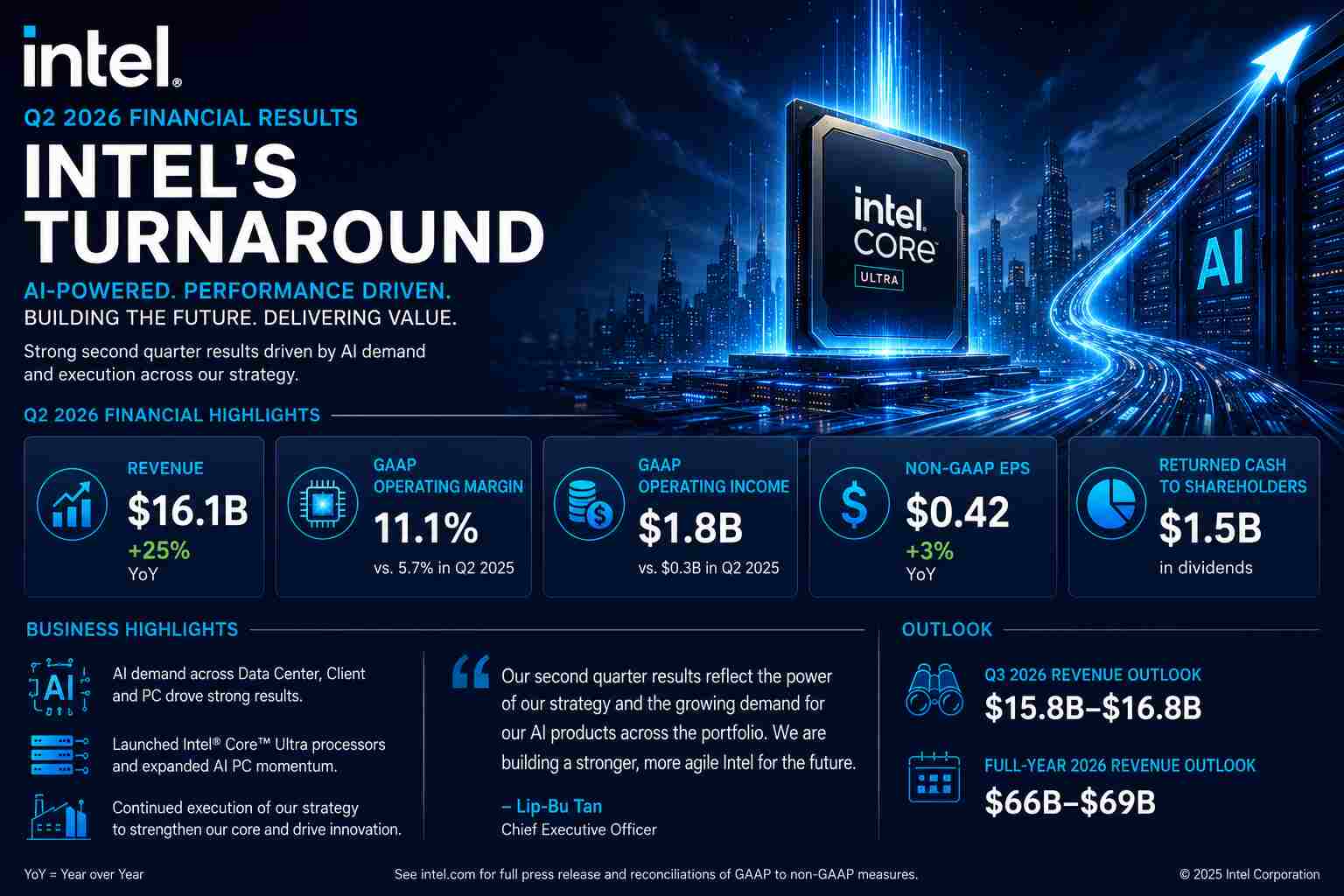
Intel reported second-quarter 2026 revenue of $16.1 billion, representing a 25% year-over-year increase and marking one of the company’s strongest growth periods in more than a decade. The company also reported non-GAAP earnings per share of $0.42, significantly exceeding expectations.
The results were driven by stronger demand across Intel’s computing portfolio, including the processors, networking technologies, advanced packaging capabilities, and manufacturing infrastructure that increasingly serve AI and HPC workloads.
Intel CEO Lip-Bu Tan emphasized that AI demand is creating unprecedented requirements for compute capacity, positioning Intel to capture growth across CPUs, ASICs, advanced packaging, and its semiconductor foundry network.
For the supercomputing community, that message carries important implications.
The AI revolution is not replacing traditional high-performance computing architectures; it is expanding them.
Modern AI supercomputers require enormous amounts of heterogeneous computing power. GPUs and specialized accelerators deliver massive parallel processing, but CPUs remain essential for:
- System orchestration
- Data preparation pipelines
- Simulation workloads
- Memory management
- Scheduling and resource coordination
- Scientific workflows combining AI and traditional HPC
The future of supercomputing is not a single processor architecture. It is a carefully balanced ecosystem.
The return of the CPU in AI supercomputing
Earlier this year, SC Online News examined Intel and Google’s expanded AI collaboration and questioned whether the partnership represented a meaningful advancement for HPC or primarily a strategic repositioning of Intel’s market narrative. The financial results provide new context.
Intel’s renewed momentum suggests that the company’s strategy is built around a broader vision: AI infrastructure will require multiple forms of computing, not just accelerator-heavy architectures.
The industry’s largest AI systems increasingly resemble supercomputers more than traditional data centers. They combine:
- Massive accelerator clusters
- High-performance CPUs
- Advanced networking
- Specialized memory architectures
- Large-scale storage systems
- Intelligent software orchestration
In this environment, Intel’s long-standing expertise in general-purpose computing becomes an advantage rather than a legacy limitation. The CPU is not disappearing. It is becoming the coordinator of increasingly complex computational ecosystems.
AI infrastructure becomes a financial growth engine
Intel’s Q2 financial performance underscores a historic shift in the economics of computing. For decades, high-performance computing was predominantly confined to government laboratories, academic institutions, and specialized scientific research. Today, however, the rise of artificial intelligence has propelled supercomputing principles into the core of mainstream business strategy.
Organizations are now allocating billions of dollars toward AI training clusters, inference infrastructure, digital twins, scientific AI platforms, autonomous systems, and industrial simulation environments. This transition has redefined computing capacity as a critical strategic asset. As SC Online has documented throughout 2026, highlighting the surging importance of AI infrastructure investment and the commercialization of HPC technologies, Intel’s financial recovery reflects this broader industry trend. The company is uniquely positioned to capitalize on a market where the global demand for computation is accelerating at a rate that significantly outpaces traditional technology cycles.
Foundry ambitions and the next supercomputing supply chain
One of the most important aspects of Intel’s strategy is its continued investment in semiconductor manufacturing. The AI era has exposed a fundamental challenge: the world needs dramatically more advanced chips, but manufacturing capacity has become a strategic bottleneck. Intel’s foundry ambitions position the company as more than a processor supplier. The company is attempting to become a critical manufacturing partner for future computing platforms. For supercomputing, this matters because next-generation systems will depend on:
- More advanced process technologies
- Improved power efficiency
- Faster chip-to-chip communication
- Advanced packaging
- Specialized compute architectures
The race for AI leadership is increasingly becoming a race for semiconductor manufacturing capability.
Optimism returns, but execution remains critical
Intel’s Q2 results represent a significant milestone, but the company’s long-term success will depend on continued execution. The semiconductor industry remains intensely competitive, with companies investing unprecedented amounts into AI infrastructure.
Intel must continue delivering:
- Competitive processor roadmaps
- Reliable manufacturing execution
- Strong developer ecosystems
- Efficient AI solutions
- Customer adoption of its foundry capabilities
However, the direction is encouraging. The company’s financial improvement demonstrates that demand for computing infrastructure is broad enough to support multiple technology approaches. The AI supercomputing revolution does not belong exclusively to one type of chip. It belongs to complete systems.
The supercomputing opportunity ahead
Intel’s Q2 financial results signal a promising shift for the future of high-performance computing (HPC). This recovery reflects a broader transformation: supercomputing is no longer merely a niche scientific pursuit, but the bedrock of artificial intelligence, scientific discovery, and industrial innovation. The primary takeaway from Intel’s performance is that the future of computing will be defined by architectural collaboration rather than competition. While accelerators remain vital for driving AI performance, it is the synergy of CPUs, advanced manufacturing, networking, and memory that will ultimately determine system scalability. As AI demands unprecedented computational power, Intel’s resurgence confirms that the next generation of supercomputing will require a holistic approach to innovation. The era of AI-driven supercomputing has only just begun, and the firms that provide the foundational infrastructure will be the ones to define the future of technology.