 How to resolve AdBlock issue?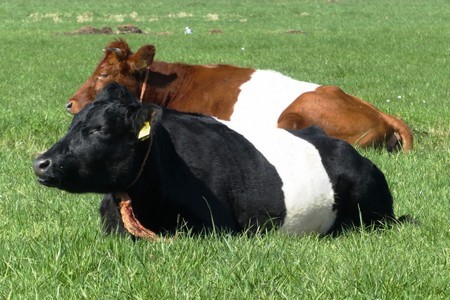
A small percentage of cows will experience problems when calving and breeders would like to know which cows are at risk. Using the vast dataset of the Dutch cattle breeding company CRV, computer scientists at the University of Groningen used artificial intelligence to develop a predictive model that in theory could halve the number of calving problems. 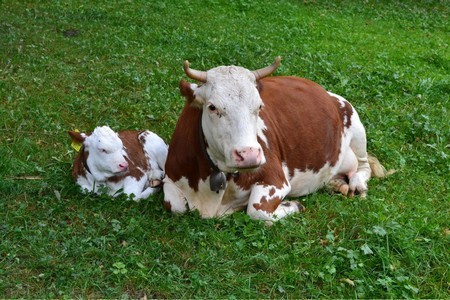
Cattle breeding is data science. Breeding firms provide semen from bulls and register the success of their offspring. Data on the milk yield of the cows and many other characteristics are collected and stored in a vast database, together with the genetic data from all the animals. This allows the companies to attribute an ‘estimated breeding value’ to the animals and find matches for optimal breeding.
Risk
One aspect of breeding is the birthing of calves. In about 3.3 percent of all cases, some kind of complication occurs during calving, which is referred to as dystocia. "This could range from the calf needing to be pulled to needing veterinary intervention," explains Ahmad Alsahaf. "There are models to predict the risk of dystocia, but these work with data only available after insemination. We wanted to produce a model that could predict the risk before insemination."
Alsahaf now works as a postdoctoral researcher at the Department of Biomedical Sciences of Cells & Systems of the University Medical Center Groningen. Still, he has worked on a predictive model for dystocia during his Ph.D. project at the Intelligent Systems research group at the Bernoulli Institute for Mathematics, Computer Science, and Artificial Intelligence at the University of Groningen in The Netherlands.
Challenges
"We were asked to create this model for the cattle breeding company CRV and they gave us a large dataset comprising information on cows and bulls," says Alsahaf. ‘We first used a machine-learning system to analyze the data and create a provisional model. Then, we checked if the most important risk factors made sense. They did and, therefore, we proceeded to build a full model."
There were two main challenges: the first was to clean up and compile the available data. The second was that only 3.3 percent of pregnant cows experience dystocia. "This meant that there was a huge imbalance in our dataset," explains Alsahaf. To solve this, he created a large number of subsets with balanced data and aggregated those to train the predictive model. "Subsequently, we tested this model on a subset of the data that was not used for training and studied the results." It turned out that the model performed significantly better than the chance.
"A colleague of ours calculated that, under ideal circumstances, our model could roughly halve the risk of dystocia. But this requires an ideal combination of bull and cow, which is not always possible." Nevertheless, the model can help farmers and the breeding company to assess the risk of a particular mating before insemination. "This is important since, so far, all other models require information gathered after insemination, which means you are not really preventing complications."