SUPERCOMPUTING NEWS SUPERCOMPUTING NEWS
    • MEDIA KIT
    • MOST READ
    • RSS FEED
    • ACADEMIA
    • AEROSPACE
    • APPLICATIONS
    • ASTRONOMY
    • AUTOMOTIVE
    • BIG DATA
    • BIOLOGY
    • CHEMISTRY
    • CLIENTS
    • CLOUD
    • DEFENSE
    • DEVELOPER TOOLS
    • EARTH SCIENCES
    • ECONOMICS
    • ENGINEERING
    • ENTERTAINMENT
    • GAMING
    • GOVERNMENT
    • HEALTH
    • OIL & GAS
    • INDUSTRY
    • INTERCONNECTS
    • MANUFACTURING
    • MIDDLEWARE
    • MOVIES
    • NETWORKS
    • PHYSICS
    • PROCESSORS
    • RETAIL
    • SCIENCE
    • STORAGE
    • SYSTEMS
    • VISUALIZATION
    • AcyMailing subscription form

    • ADD YOUR VIDEOS
    • MANAGE VIDEOS
    • CONVERSATION INBOX
    • SOCIAL ADVERTISER
    • SOCIAL NETWORK VIDEOS
    • SURVEYS
    • GROUPS
    • PAGES
    • MARKETPLACE LISTINGS
    • APPLICATIONS BROWSER
    • PRIVACY CONFIRM REQUEST
    • PRIVACY CREATE REQUEST
    • LEADERBOARD
    • POINTS LISTING
      • BADGES
    • TRADE SHOWS
Sign In
Milky Way’s own gravity can mimic dark matter clues, supercomputer simulations suggest
Featured
Tyler O'Neal, Staff Editor LATEST August 27, 2026, 8:00 am

Milky Way’s own gravity can mimic dark matter clues, supercomputer simulations suggest

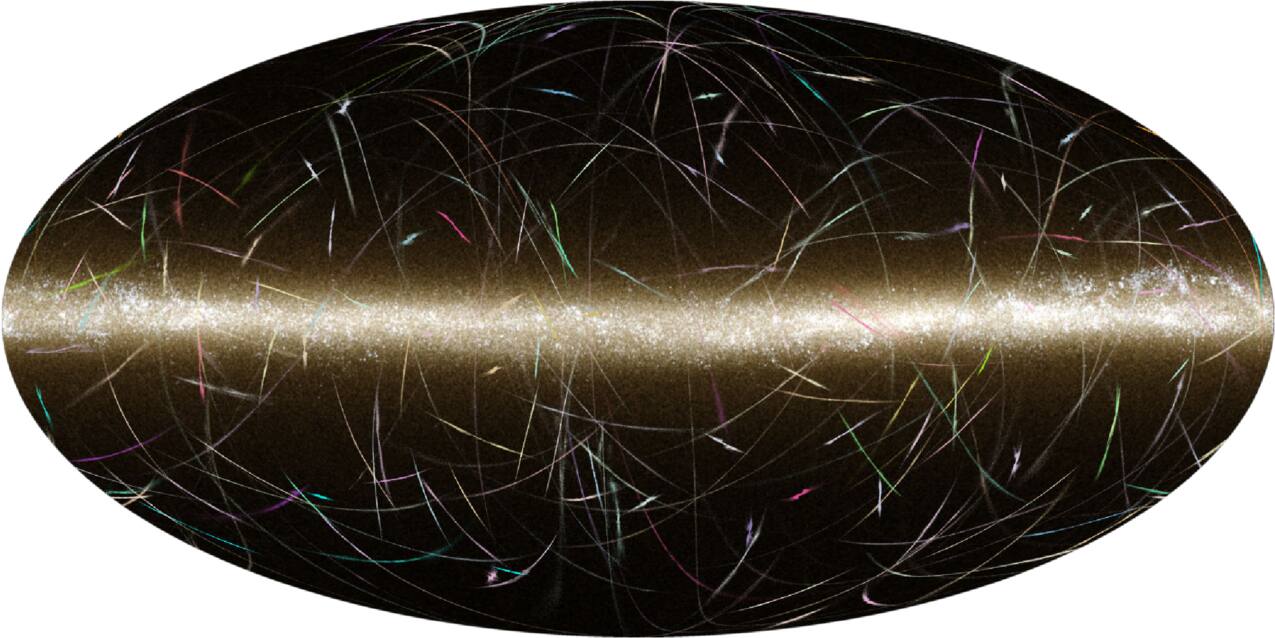
A massive computational experiment involving nearly 15,000 simulated stellar streams finds that the Milky Way’s evolving disk, halo, mergers and gravitational structure can generate spurs, kinks, gaps and other features often treated as evidence for invisible dark-matter subhalos.

For years, astronomers have identified the thin stellar streams surrounding the Milky Way as some of the most promising detectors for dark matter. The logic is compelling: as the Milky Way’s gravitational influence gradually disrupts a globular cluster, its stars form a long, coherent, and dynamically cold structure. Consequently, even minor gravitational disturbances, such as a passing dark-matter subhalo, can leave distinct signatures, including gaps, spurs, or positional displacements.

However, a recent computational study challenges the assumption that dark matter is the sole cause of these disruptions, suggesting that the Milky Way itself produces far more substructure than previously recognized. In a sophisticated numerical experiment, researchers simulated approximately 15,000 stellar streams across four galaxies modeled after the Milky Way, utilizing evolving gravitational potentials derived from FIRE-2 cosmological simulations. Notably, these simulations excluded small-scale perturbers, such as dark-matter subhalos and giant molecular clouds. 

Despite these exclusions, approximately 75% of the streams exhibited complex morphological features, including kinks, spurs, and cocoon-like envelopes. Furthermore, streams classified as relatively smooth showed significant variations in width, with gaps and overdensities appearing at the same two-degree angular scale typically associated with dark-matter subhalo encounters. These findings do not invalidate dark matter as a phenomenon, but they do impose a rigorous requirement for future research: astronomers must now demonstrate that observed stream irregularities cannot be attributed to the Milky Way’s intrinsic gravitational dynamics before concluding that they provide evidence of invisible objects. This underscores the essential role of advanced supercomputing in disentangling these complex galactic influences.

The Dark-Matter Detector With a Built-In Confounder

Stellar streams have become increasingly important in the search for low-mass dark-matter structures.

A cold stream is essentially a gravitational test particle stretched across thousands of light-years. If a dark-matter subhalo passes nearby, its gravity can disturb the stream, potentially producing gaps, density fluctuations, and off-track features.

That makes streams attractive because dark-matter subhalos are expected to exist at masses too small to contain stars.

But the traditional picture contains an assumption:

the undisturbed stream should be relatively smooth.

The new study challenges that assumption.

The Milky Way is not a static, spherical gravitational potential.

It has a massive rotating disk, spiral structure, a central bar, an asymmetric dark-matter halo, and satellite galaxies. The Large Magellanic Cloud is currently interacting with the Milky Way, while previous mergers and accretion events have left the galaxy dynamically disturbed.

The paper emphasizes that the Milky Way is a dynamically evolving system, with its disk, halo, and satellite interactions changing the gravitational environment on timescales comparable to stellar-stream orbital periods.

That creates a fundamental problem for dark-matter inference.

If the background gravitational field itself produces gaps and kinks, then a stream feature isn’t automatically a dark-matter detection.

The Computational Experiment: Remove the Dark Matter Subhalos

The researchers approached the problem in an unusually useful way.

Instead of asking:

“What does a dark-matter subhalo do to a stream?”

they first asked:

“What does the Milky Way do to a stream when we deliberately remove the small-scale perturbers?”

That creates a computational control experiment.

The researchers selected four Milky Way-mass galaxies, designated m12i, m12f, m12m and m12b, from the LATTE suite of zoomed-in cosmological baryonic simulations within the FIRE-2 project.

These galaxies span different assembly histories and structural properties.

Their total masses range from approximately 1.1 to 1.5 trillion solar masses. The simulations resolve dark matter with initial particle masses of approximately 35,000 solar masses and baryonic matter with approximately 7,100-solar-mass particles.

The four galaxies were deliberately chosen because they were not identical.

One is relatively isolated.

Another has a massive disk.

Two experienced significant mergers.

The researchers could therefore investigate whether stellar-stream morphology depends on the particular history of the host galaxy.

It does.

15,000 Streams Instead of One

This is where the computational scale becomes particularly important.

Rather than simulate one or two representative streams, the team generated a statistical population of globular-cluster streams.

Each stream was represented by 10,000 test particles, evolved for 5 billion years in a time-dependent gravitational potential.

The final catalog contained 14,787 streams:

  • 3,909 in m12i;
  • 4,093 in m12m;
  • 3,493 in m12b; and
  • 3,292 in m12f.

The merger hosts retain fewer streams because their stronger tidal environments produce greater disruption and shorter-lived coherent debris.

That scale changes the scientific question.

The researchers are no longer asking whether one carefully selected simulation can reproduce an observed feature.

They are asking:

How common are these structures in a realistic population of galaxies and stellar streams?

Turning Cosmological Simulations Into a Stellar-Stream Laboratory

There is a computational trick behind the experiment.

The underlying FIRE-2 cosmological simulations contain enormous numbers of particles representing the evolving galaxy.

But directly calculating gravitational forces from every particle for every stream particle throughout thousands of simulated systems would be extraordinarily expensive.

The researchers therefore construct basis-function expansion (BFE) representations of the evolving gravitational potential.

The method decomposes the gravitational field into mathematical basis functions capable of representing the dominant structures of the galaxy.

The spherical components capture the large-scale halo, while Fourier-harmonic components represent structures such as the disk, spiral arms, and other non-axisymmetric features.

The resulting coefficients are interpolated in time to produce a continuously evolving gravitational potential for orbit integration.

This is an important HPC lesson.

The computational challenge is not merely generating a galaxy.

It is compressing a complicated gravitational field into a representation that can be repeatedly interrogated by thousands of synthetic stellar systems without throwing away the physics that matters.

The Galaxy Becomes a Time-Dependent Computational Object

Many simplified galaxy models assume that the gravitational potential is static.

That is computationally convenient.

It is also potentially misleading.

The FIRE-2-based models used in this work evolve with time.

Snapshots are separated by approximately 25 million years, and the researchers focus on the final five billion years when integrating their stream populations.

The gravitational potential therefore changes as the galaxy evolves.

Satellite galaxies interact with it.

The disk changes.

The halo responds.

Large-scale structures generate non-axisymmetric gravitational forces.

A stellar stream moving through this environment does not experience the same gravitational field at every point in its orbit, or necessarily on every orbital passage.

That history accumulates.

The Simulation Does Not Need a Dark-Matter Subhalo to Make a Mess

The headline result is difficult to ignore.

Approximately three-quarters of the simulated streams developed complex features generated by the host potential alone.

Those features include:

  • spurs;
  • kinks;
  • off-track extensions;
  • broad envelopes;
  • density variations;
  • gaps; and
  • width fluctuations.

No small dark-matter subhalos were required.

That does not eliminate dark matter.

It establishes a complexity floor, the amount of structure the host galaxy can generate before adding the specific small-scale perturbers researchers want to detect.

That baseline could become critically important for future dark-matter studies.

Only 26% Were Completely Smooth

The distribution is even more striking when the streams are classified quantitatively.

The researchers define several morphological categories.

A stream is considered smooth when its global disturbance metric is at or below one.

A stream with an isolated strong feature can be classified as smooth + feature.

More strongly disturbed systems enter intermediate or messy categories.

Across the complete simulated population:

  • 26% were classified as smooth;
  • 13% were smooth but contained a significant localized feature;
  • 27% were intermediate; and
  • 34% were messy.

In other words, only about one-quarter of the simulated streams were truly free of detectable off-track structure under the study’s criteria.

That is a surprisingly high background level.

And remember:

These simulations intentionally excluded dark-matter subhalos and giant molecular clouds.

The Inner Milky Way Is Particularly Hostile

The simulations reveal a strong relationship between stream morphology and pericentric distance—the closest approach of the stream’s progenitor to the galactic center.

Streams that plunge deeper into the Milky Way encounter a much more complicated gravitational environment.

The disk contributes.

The bar contributes.

Spiral structure contributes.

The stream also experiences more frequent orbital passages through the inner galaxy during the five-billion-year integration.

The simulations show a clear trend: smaller pericenters correspond to systematically greater morphological disturbance.

A rough transition occurs around 15 kiloparsecs.

Streams with larger pericenters tend to be cleaner.

Those venturing deeper into the galaxy are more likely to become morphologically complicated.

The Galaxy’s History Is Written Into Its Streams

The four simulated galaxies do not produce identical results.

That is precisely what the researchers wanted to see.

The relatively isolated m12i galaxy reaches the smooth regime at around 15 kpc and has approximately 80% smooth streams beyond 20 kpc.

The massive-disk m12m galaxy reaches the comparable threshold closer to 20 kpc.

The merger hosts M12B and M12F remain more disturbed at intermediate distances and show greater scatter.

The implication is important.

Two streams with apparently similar orbital parameters might not have equivalent backgrounds if their host galaxies have different assembly histories.

The gravitational environment is not merely a function of where the stream is now.

It also reflects how the galaxy got there.

A Dark-Matter-Like Gap Without Dark Matter

Perhaps the most uncomfortable result concerns angular scale.

Dark-matter subhalo searches often focus on stream gaps and density variations because a passing subhalo can create characteristic disturbances.

But the simulations produce host-generated density structures at approximately two-degree scales.

Those scales fall directly inside the 1°–5° range expected for some subhalo-induced gaps.

That creates a serious degeneracy.

If an astronomer observes a two-degree-scale gap, the feature’s size alone may not identify its origin.

It could be caused by an invisible subhalo.

Or it could be the accumulated result of the visible and large-scale gravitational structure of the Milky Way.

Or both.

The GD-1 Problem Gets More Interesting

The famous GD-1 stellar stream has often been described as a particularly promising target for dark-matter substructure searches.

Its morphology includes a prominent spur and a gap.

Those features have been interpreted in previous work as possible evidence for an encounter with a dark-matter subhalo in the approximate mass range of (10^6)–(10^8) solar masses.

The new simulations complicate that interpretation.

The researchers find a simulated stream whose morphology is qualitatively similar to the observed GD-1 spur, even though the simulation contains no small-scale dark-matter subhalo encounter.

The simulated stream has a pericenter of approximately 10 kpc and apocenter near 24 kpc, compared with GD-1’s observed values of approximately 14 kpc and 22 kpc.

That does not prove that GD-1’s spur was produced by the Milky Way.

It demonstrates something more cautious:

A GD-1-like spur is not, by itself, proof of a dark-matter subhalo.

ATLAS–Aliqa Uma Offers Another Warning

The same computational experiment produced a stream with a kink qualitatively resembling the feature observed in the ATLAS–Aliqa Uma stream.

The observed stream contains a prominent kink and larger-scale asymmetries that have previously been connected to the Large Magellanic Cloud.

Again, the simulation can produce a similar morphological feature without invoking a small dark-matter subhalo.

The point is not that every observed feature has now been explained.

It is that morphological similarity is not equivalent to causal identification.

The Supercomputing Challenge: Numerical Artifacts Can Look Like Physics

This is where the study becomes particularly valuable for computational scientists.

If the entire conclusion rests on simulated gravitational structure, the researchers must demonstrate that the structures aren’t numerical artifacts.

They therefore subjected the computational framework to extensive validation.

The BFE gravitational representation was compared with direct gravitational-force calculations from the FIRE-2 particle distribution.

Using a GPU-based Barnes–Hut tree algorithm, the researchers evaluated accelerations at 12 fixed locations spanning approximately 5–35 kpc from the galactic center.

The BFE representation reproduced the tree-based acceleration to better than approximately 2% outside 7 kpc, with the largest discrepancies confined to the innermost region.

That is significant.

The researchers weren’t simply trusting their compressed gravitational representation.

They checked it against a more direct calculation.

Even the Force-Field Noise Was Tested

The finite number of particles in the underlying cosmological simulations introduces statistical noise.

If that noise were strong enough, it could potentially create artificial stream structure.

The team tested this too.

They generated 50 bootstrap realizations of the BFE coefficients and evaluated the resulting force fields over a spatial grid containing 50,000 directions across 15 logarithmically spaced radial shells between 10 and 30 kpc.

The measured fractional force noise was only around (10^{-3}) at full decorrelation, approximately three orders of magnitude below the mean force.

The authors conclude that this shot noise contributes negligibly to the stream morphology.

In other words, the complexity is not simply the computer making things noisy.

The gravitational environment itself is doing the work.

Five Billion Years Requires Numerical Discipline

Orbit integration over billions of years is another potential source of trouble.

Small numerical errors can accumulate.

The researchers therefore compared several integration schemes, including adaptive eighth-order Runge–Kutta methods and a fixed-step leapfrog integrator.

Across 16 test orbits integrated backward for five billion years, the maximum position residual had a median of approximately 0.002 kpc, with a worst case of 0.03 kpc, well below the typical stream width of roughly 0.1 kpc.

The median maximum velocity residual was approximately 0.014 km/s, with a worst case of 0.23 km/s.

The tests found no evidence that the time-interpolation boundaries were generating artificial kinks in the trajectories.

That matters enormously when the scientific conclusion itself concerns tiny kinks.

The 10,000-Particle Stream Shortcut

There is another computational compromise worth understanding.

The cosmological simulations do not directly resolve individual globular-cluster streams at the required resolution.

The FIRE-2 baryonic particle mass is approximately 7,000 solar masses, far too coarse to directly represent the stellar populations of individual globular clusters.

The researchers therefore inject the streams as test-particle populations into the simulated gravitational potential.

Their stream formation model uses a particle-spray approach.

Each synthetic stream can then be evolved efficiently without performing a full self-gravitating N-body calculation for every globular cluster.

This is a classic computational-science tradeoff: sacrifice some microscopic detail to make a massive statistical experiment possible.

But They Checked the Shortcut

The team did not simply assume that the particle-spray model was adequate.

They compared it against direct collisionless N-body simulations.

For a test progenitor with a mass of (2.7\times10^4) solar masses and scale radius of 4 pc, the direct calculation used 25,000 particles, a GPU-based collisionless N-body code, a 0.3-pc gravitational softening and a (10^{-5})-Gyr timestep.

The resulting N-body stream was compared with the particle-spray representation in the same evolving potential.

The large-scale phase-space structures agreed within the statistical uncertainty of a single realization across the tested progenitor configurations.

Again, the objective is not to eliminate approximation.

It is to quantify whether the approximation matters for the question being asked.

A Better Definition of “Dark-Matter Signal”

The implications for dark-matter searches are potentially significant.

The study argues that researchers need a baseline describing what a stream looks like before small-scale dark-matter encounters are added.

That baseline can then become part of the inference process.

Instead of:

Observed feature = dark-matter subhalo

the calculation becomes something more like:

Observed feature = host potential + known perturbers + uncertain background + possible subhalo contribution.

That is much harder.

It is also much more scientifically defensible.

The Milky Way May Be the Confounding Experiment

The ironic part is that astronomers chose stellar streams because the Milky Way provides a gravitational laboratory.

Now the laboratory itself is proving difficult to calibrate.

The disk isn’t perfectly symmetric.

The halo isn’t spherical.

The Large Magellanic Cloud is disturbing the system.

Past mergers have altered the gravitational field.

The bar and spiral structure influence stellar orbits.

And every one of those effects can leave signatures in stellar streams.

The paper notes that an ordinary Milky Way-like bar could actually make the inner-halo complexity floor even higher than measured in these simulations because the four FIRE-2 hosts lack a strong, long-lived bar.

That is a sobering caveat.

The simulations may actually be conservative.

This Does Not Make Dark Matter Go Away

It is important not to overinterpret the result.

The study does not demonstrate that observed stream gaps are caused by ordinary Milky Way gravity instead of dark matter.

It does not disprove dark matter.

It does not show that dark-matter subhalos do not exist.

And it does not establish the origin of every observed stream feature.

Instead, it demonstrates that host-galaxy dynamics create a substantial false-positive background for a particular class of dark-matter searches.

That distinction is critical.

The authors themselves describe the goal as establishing a baseline against which subhalo-induced perturbations can be measured.

The dark-matter search therefore becomes harder, but potentially more rigorous.

The Computational Work Is Far From Finished

The researchers identify several important limitations.

Their four simulated galaxies do not encompass every possible Milky Way assembly history.

None contains a strong, long-lived bar.

The particle-spray stream model is efficient but does not replace a full statistical N-body calculation.

And the analysis intentionally removes small-scale perturbers in order to isolate the host-driven component.

The authors point out that a full decomposition of the individual contributions from disk structure, halo evolution, bars, satellite interactions, and other components remains a subject for future work.

That next step could become computationally formidable.

The Next Generation of Surveys Will Make the Problem Bigger

Ironically, better telescopes could make this computational problem more urgent.

The Vera C. Rubin Observatory’s Legacy Survey of Space and Time, ESA’s Euclid mission and NASA’s Nancy Grace Roman Space Telescope are expected to dramatically expand the number of known stellar streams and improve the resolution of their structure.

The study notes that these surveys should make it possible to examine density fluctuations, width variations, and off-track features on subdegree scales across dozens or even hundreds of streams.

That will produce an enormous amount of observational data.

But better observations don’t automatically produce better dark-matter constraints.

They produce better constraints if the models are good enough to interpret them.

Otherwise, astronomers may simply become better at detecting features whose origins they cannot confidently identify.

Supercomputers Become the Necessary Skeptic

This is perhaps the most important lesson from the work.

The supercomputer isn’t being used to confirm an exciting hypothesis.

It is being used to challenge one.

That is a powerful role for computational science.

The researchers deliberately remove the phenomenon they want to detect, small-scale dark-matter perturbers, and ask whether the remaining physics can reproduce similar observational signatures.

And it can.

That is precisely the kind of computational experiment that can prevent scientists from mistaking correlation for causation.

The Stream as a Gravitational Recorder

A stellar stream records the gravitational environment through which it travels.

But the recording is not simple.

A kink may represent a satellite encounter.

A spur may indicate a subhalo.

A density variation may be caused by a perturbation.

Or the feature may have been generated by the disk.

Or the halo.

Or a merger.

Or the combined effect of several structures acting over billions of years.

The simulation suggests that these possibilities cannot always be separated simply by looking at the final shape of the stream.

The history matters.

From One Simulation to a Statistical Universe

This is where the study’s scale provides its greatest advantage.

A single simulation can demonstrate possibility.

Nearly 15,000 simulated streams can begin to quantify probability.

The researchers can ask:

How often does a spur appear?

At what pericenter?

At what angular scale?

How does eccentricity matter?

How does the host’s merger history change the result?

How frequently do apparently smooth streams contain smaller-scale structure?

And, crucially:

How unusual does a feature need to be before it becomes genuinely interesting as a dark-matter candidate?

Those are statistical questions.

They require statistical computation.

A New Standard for Dark-Matter Forensics

The study ultimately argues for a more demanding standard.

Before treating a stream feature as evidence for an invisible subhalo, researchers should first understand the distribution of structures generated naturally by a realistic, evolving host galaxy.

That means moving beyond idealized static potentials.

It means incorporating galaxy evolution.

It means modeling disk structure.

It means including satellite interactions.

It means testing numerical errors.

And it means running enough synthetic streams to understand the background population.

That is a supercomputing problem.

The Universe May Be Hiding Dark Matter Behind the Galaxy

The irony is almost perfect. Astronomers developed stellar streams as extraordinarily sensitive gravitational detectors. Now computational astrophysics is showing that the detector itself has a complicated gravitational environment. The Milky Way may be producing some of the very signatures researchers hoped would reveal dark matter. That doesn’t make the search pointless. It makes the search more interesting. Because the challenge is no longer simply to find a gap. It is to determine why the gap exists. And that requires a much more sophisticated computational model of the galaxy.

The Skeptical Bottom Line

The new simulations don’t tell us that dark matter is hiding in plain sight. They tell us something more useful: We may not yet understand how much structure a realistic Milky Way naturally creates in the first place.

Nearly 15,000 simulated streams evolved in four cosmological Milky Way analogs suggest that the host galaxy alone can generate a remarkable range of features normally considered interesting for dark-matter searches. Only about 26% of the simulated streams were completely smooth under the study’s criteria, while roughly three-quarters exhibited some off-track complexity.

Some host-generated structures even resemble features observed in famous streams such as GD-1 and ATLAS–Aliqa Uma. The skeptical interpretation is therefore straightforward: A strange stellar-stream feature is not yet a dark-matter discovery. It is a question. And increasingly, the only practical way to answer that question is computational.

The next generation of astronomical surveys will deliver hundreds of increasingly detailed stellar streams. The challenge will be to build equally sophisticated virtual galaxies against which those observations can be tested. That means more simulations, better gravitational models, more realistic galaxy evolution and vastly larger statistical samples. The supercomputer may ultimately determine whether a tiny gap in a ribbon of stars is the footprint of an invisible dark-matter subhalo, or simply another reminder that the Milky Way itself is far more gravitationally complicated than our simplified models have allowed. And perhaps that is the most encouraging result of all. The search for dark matter is not becoming easier. It is becoming more scientifically honest.

NVIDIA's $96.2 billion quarter redefines the supercomputing economy
Featured

NVIDIA's $96.2 billion quarter redefines the supercomputing economy

Deckard, Staff Editor LATEST August 26, 2026, 4:00 pm

With Data Center revenue reaching $89 billion, up 117% year over year, NVIDIA's latest results show that accelerated computing is no longer a specialized segment of the technology industry. It is becoming the economic foundation of a new generation of supercomputing infrastructure, and memory may be the component that determines how expensive that future becomes.

While the supercomputing industry historically gauged progress through performance metrics such as teraFLOPS, petaFLOPS, and exaFLOPS, NVIDIA's recent financial results indicate a shift toward a new performance indicator: revenue generation per unit of compute.

NVIDIA reported quarterly revenue of $96.2 billion, a significant 106% year-over-year increase, with Data Center revenue accounting for $89.0 billion, up 117% year-over-year and 18% sequentially. Alongside a 75% gross margin and $59.7 billion in GAAP net income, these figures underscore the rapid transition of accelerated computing from specialized HPC laboratories to the fundamental infrastructure supporting global AI production. 

With projected revenue of $108 billion for the fiscal third quarter and a consistent 74% gross margin, NVIDIA shows no signs of decelerating. This period of rapid expansion, however, presents a significant challenge: as the global demand for computational power increases, the costs of the critical components required to support that infrastructure are rising in tandem.

Compute Has Become the Infrastructure

NVIDIA CEO Jensen Huang summarized the transformation bluntly: “Now, compute is revenue.”

The company says AI infrastructure is now being built at full speed, with its Vera Rubin platform entering full production.

That statement represents a profound change for HPC.

For decades, computing was largely treated as a capital expense supporting another business.

Now computing itself is becoming an economic asset.

AI companies sell inference.

Cloud providers sell accelerated compute.

Scientific institutions consume GPU cycles.

Enterprises build private AI infrastructure.

Governments are building sovereign AI systems.

And supercomputing centers increasingly combine traditional simulation with machine learning and AI workloads.

The result is a market in which computing capacity has become productive infrastructure in its own right.

The Numbers Are Almost Difficult to Comprehend

Consider the trajectory.

NVIDIA's fiscal Q1 2027 Data Center revenue was $75.2 billion, already up 92% from a year earlier.

Three months later:

$89.0 billion.

That represents an additional $13.8 billion in quarterly Data Center revenue.

Year over year, the increase is approximately $48 billion in a single quarter.

This isn't incremental growth.

It is an infrastructure cycle.

And increasingly, that cycle encompasses the entire computing stack:

GPU → HBM → CPU → networking → storage → rack → cooling → power → data center.

The supercomputer is becoming an integrated industrial system.

Vera Rubin Moves the Industry Beyond the GPU

One of the most significant details in NVIDIA's results is that the company is no longer presenting its future simply as a succession of faster GPUs.

The Vera Rubin platform encompasses CPUs, GPUs, networking, storage, and software designed to operate as a complete AI factory.

NVIDIA says Vera Rubin is ramping into full production, with racks being deployed by customers including CoreWeave, Google Cloud, Microsoft Azure, Oracle Cloud Infrastructure and Nebius.

NVIDIA also highlighted Spectrum-6 networking, Vera CPUs, Groq 3 LPX inference accelerators, BlueField-4 infrastructure and its DSX platform for designing and operating AI factories at scale.

This is increasingly recognizable as supercomputer architecture, even when the workload is described as AI rather than traditional HPC.

The dividing line between AI infrastructure and supercomputing infrastructure is becoming increasingly difficult to draw.

And That's Why Server Prices Matter

Now to the question many SuperComputing News readers are likely asking:

Will server prices go up?

The answer appears to be yes, at least for some NVIDIA-based AI systems, and particularly those with large memory configurations.

Before NVIDIA released its results, Reuters reported that some major customers had been told that prices for servers containing NVIDIA AI chips could increase by more than 15% in many cases, with the increases expected for systems shipping in early 2027. The report attributed the increases primarily to soaring memory costs and said configurations involving Vera Rubin and Grace Blackwell would be affected differently depending on memory configuration. Reuters noted that it could not independently verify the report and that NVIDIA had not commented at the time.

That report now looks particularly significant in light of NVIDIA's earnings.

The demand isn't collapsing.

It is accelerating.

And the memory required by these systems is enormous.

The Memory Problem May Be Bigger Than the GPU Problem

This may be the most important hardware story hiding behind NVIDIA's spectacular numbers.

Modern AI accelerators don't operate alone.

They require enormous amounts of high-bandwidth memory, or HBM, to keep their computational engines fed with data.

As accelerator performance increases, memory bandwidth and capacity must increase with it.

That creates a difficult supply-chain equation.

The industry is simultaneously demanding:

  • more GPUs;
  • more HBM;
  • more server DRAM;
  • more CPUs;
  • more networking silicon;
  • more SSDs;
  • more advanced packaging;
  • more substrates;
  • more power infrastructure; and
  • more cooling capacity.

The memory industry is already warning that supply may not expand quickly enough.

Micron has specifically warned that when demand for DRAM or HBM exceeds available supply, manufacturers may have to prioritize production and allocate limited capacity among customers, potentially resulting in elevated pricing and downstream supply-chain disruption.

Will Memory Prices Rise?

This is where the answer becomes more nuanced.

Yes, memory pricing is under pressure, but not every memory product will necessarily rise by the same amount.

The strongest pressure is on AI-oriented memory, particularly HBM.

At the same time, the enormous amount of manufacturing capacity being directed toward AI memory can affect conventional DRAM availability.

Reuters reported in July that average DRAM and NAND prices had already risen substantially amid AI-driven demand, while major memory manufacturers were expanding capacity.

The result is a fascinating feedback loop:

More AI compute → more HBM → more memory capacity devoted to AI → tighter conventional memory supply → higher memory costs → more expensive servers.

And that means NVIDIA's extraordinary success could have consequences far beyond NVIDIA.

The Supercomputer Bill Is Becoming a Memory Bill

Consider a modern rack-scale AI system.

The GPU is the obvious centerpiece.

But the GPU is only one component.

A production AI supercomputer also needs:

HBM + system memory + CPU memory + networking + storage + power delivery + cooling + rack infrastructure.

As systems become more memory-intensive, the cost contribution from memory grows.

This is particularly important because AI workloads are increasingly becoming memory-bound rather than purely compute-bound.

A processor capable of enormous mathematical throughput is useless if the architecture cannot deliver data quickly enough.

That is why HBM has become one of the most strategically important components in the AI infrastructure supply chain.

NVIDIA Is Already Responding to the Memory Challenge

The company's earnings release includes another important clue.

NVIDIA announced a multiyear technology partnership with SK hynix to advance next-generation memory for the global AI factory buildout.

That is not a minor supplier relationship.

It illustrates the degree to which memory has become a strategic component of the computing architecture.

NVIDIA needs the accelerator.

But the accelerator needs memory.

And the memory has to arrive in enormous quantities, at precisely the right performance, packaging and power characteristics.

The AI supercomputer is therefore increasingly a co-designed compute-and-memory system.

The Memory Industry Is Building for the Supercomputing Boom

SK hynix announced earlier this month that it would invest approximately 54 trillion won across new DRAM and NAND facilities in Yongin and Cheongju to expand its production base for growing AI-memory demand. The company said the investments are intended to support the long-term AI memory market and improve supply stability.

That is the kind of investment required when demand is no longer measured in thousands of chips.

It is measured in gigawatts of data-center capacity and millions of accelerators.

The memory industry is effectively becoming part of the supercomputing infrastructure industry.

Could Higher Server Prices Slow Supercomputing?

Not necessarily.

This is where the story becomes optimistic.

If a new generation of AI accelerators delivers substantially more useful work per watt, per rack and per dollar, customers may willingly pay more for the complete system.

In other words:

Higher hardware prices do not automatically mean higher computing costs.

A $10 million system that delivers twice the useful scientific throughput of a $7 million system may be the better investment.

The real metric isn't the purchase price.

It is:

Cost per useful computation.

For HPC, that can mean:

  • time to solution;
  • energy per simulation;
  • cost per training run;
  • cost per inference;
  • scientific productivity per rack; and
  • useful work per megawatt.

That is where the next generation of supercomputing competition will increasingly take place.

Efficiency Could Matter More Than Price

NVIDIA says the Vera Rubin platform is designed for this new environment.

The company's strategy is increasingly focused on complete systems rather than isolated accelerators.

That means combining:

compute + memory + networking + storage + software.

NVIDIA also highlighted that Blackwell led across categories in the MLPerf Training 6.0 benchmarks and AgentPerf, an infrastructure benchmark for agentic AI.

For HPC, benchmark leadership matters, but application efficiency matters even more.

A scientific center doesn't buy an accelerator because it has impressive theoretical specifications.

It buys it because researchers can solve problems faster.

The Supercomputing Industry Is Getting Bigger

NVIDIA's results also reveal how much the potential market has expanded.

The company says 35 new NVIDIA AI HPC supercomputers are in development across Europe.

That's an extraordinary signal for traditional HPC.

AI isn't replacing supercomputing.

It is expanding the market for accelerated computing and bringing HPC-style architectures into new industries.

Scientific research.

Drug discovery.

Climate modeling.

Fusion.

Materials science.

Engineering.

Digital twins.

Robotics.

National security.

Financial modeling.

Every one of these workloads can potentially consume accelerated compute.

The New Supercomputing Economy

There is another reason NVIDIA's results matter.

Earlier this month, NVIDIA announced partnerships with Apollo, BlackRock, Blackstone, Brookfield, Goldman Sachs and KKR to establish financing platforms intended to mobilize more than $500 billion of third-party capital for AI infrastructure. NVIDIA described compute and full-stack AI infrastructure as an investable asset class.

Put that together with today's earnings.

We now have:

Demand.

Capital.

Compute.

Memory.

Infrastructure.

The pieces of a new industrial economy are coming together.

Server Makers May Have More Pricing Power

This is an important consequence for companies building AI servers.

Traditional server manufacturing is typically a competitive, relatively low-margin business.

AI servers are different.

They incorporate extremely expensive accelerators, high-bandwidth memory, advanced networking, sophisticated power delivery and liquid cooling.

When critical components become scarce, the economics of the entire rack change.

The reported 15%-plus price increases are therefore significant, not because every AI server will necessarily rise exactly 15%, but because they demonstrate that the supply chain is gaining the ability to pass rising component costs downstream.

Server makers may have little choice.

If HBM costs rise, someone has to absorb the increase.

It can be:

NVIDIA.

The server manufacturer.

The cloud provider.

The AI company.

Or ultimately:

the customer.

The early indications are that at least some of the cost is being passed along.

But Scarcity Could Also Accelerate Innovation

There is an optimistic side to this.

When a resource becomes expensive, engineers have an enormous incentive to use it more efficiently.

Memory scarcity could accelerate research into:

  • memory compression;
  • sparsity;
  • quantization;
  • better caching;
  • memory pooling;
  • near-memory computing;
  • processing-in-memory;
  • optical interconnects;
  • advanced packaging;
  • larger shared memory architectures;
  • improved software scheduling; and
  • algorithms designed around data locality.

In other words, the memory squeeze could help create better computers.

Supercomputing Is Becoming a Supply-Chain Science

There is a lesson here for HPC administrators.

Building the next supercomputer isn't simply a matter of selecting the fastest processor.

Procurement teams increasingly have to think about:

HBM availability.

DRAM allocation.

Network bandwidth.

Power delivery.

Cooling capacity.

Rack density.

Advanced packaging.

Lead times.

Total cost of ownership.

The machine room itself is becoming part of the computational architecture.

The 1-Gigawatt Supercomputer Is Coming Into View

The industry's scale is also changing the physical definition of a supercomputer.

NVIDIA and its partners are now discussing AI factories at gigawatt scale.

Its recent PORTS-Pike project in Ohio, for example, involves an initial 4.25 IT-gigawatt capacity with an option for another 3.75 IT gigawatts, while OpenAI is expected to be the customer for an 8-IT-gigawatt campus.

That is no longer simply a computer installation.

It is an industrial facility.

Power plants, substations, cooling systems, fiber networks, buildings and semiconductor supply chains all become part of the computer.

The definition of "supercomputer" is expanding accordingly.

A Remarkable Positive Signal for HPC

It would be easy to focus exclusively on the risks:

Memory shortages.

Higher server prices.

Power constraints.

Supply-chain bottlenecks.

Increasing capital requirements.

Those challenges are real.

But NVIDIA's results tell a much more encouraging story.

The world is investing extraordinary amounts of money into computing because computing is producing extraordinary amounts of economic and scientific value.

That is good news for the supercomputing industry.

Every new AI factory expands demand for:

  • accelerators;
  • networking;
  • memory;
  • storage;
  • cooling;
  • power infrastructure;
  • software;
  • system integration;
  • data-center engineering; and
  • computational expertise.

The supercomputing ecosystem is expanding with it.

The Most Important Number May Not Be $96.2 Billion

NVIDIA's $96.2 billion quarter is remarkable.

Its $89 billion Data Center business is even more remarkable.

But perhaps the most important number for SuperComputing News readers is 117%.

That is the year-over-year growth rate of Data Center revenue.

It tells us that the world's appetite for accelerated computing is not merely continuing.

It is accelerating.

And NVIDIA expects another leap, forecasting $108 billion in revenue in the coming quarter.

That means the infrastructure buildout remains in full swing.

The Great Compute Expansion

We may eventually look back at this period as the moment when computing stopped being simply a component of the economy and became one of its fundamental physical resources.

Just as electricity transformed industrial production, abundant computation is transforming scientific discovery, engineering and artificial intelligence.

The difference is that this new infrastructure requires extraordinary amounts of silicon, memory, networking, electricity and cooling.

And that means the next great supercomputing race won't be won by processors alone.

It will be won by whoever can integrate the entire system most effectively.

The Memory Challenge Could Become the Next Supercomputing Opportunity

As computing evolves into an essential economic asset, the industry is shifting from pure performance metrics to revenue-per-compute efficiency. With AI demand driving a massive infrastructure expansion, memory has become a critical bottleneck. The future of the supercomputing economy now hinges on integrating high-bandwidth memory with accelerated compute, where long-term success will be measured by cost-effectiveness and application efficiency rather than raw hardware pricing.

When physics computes: Simulations turn random skyrmion motion into directional information
Featured

When physics computes: Simulations turn random skyrmion motion into directional information

Tyler O'Neal, Staff Editor LATEST August 25, 2026, 8:00 am

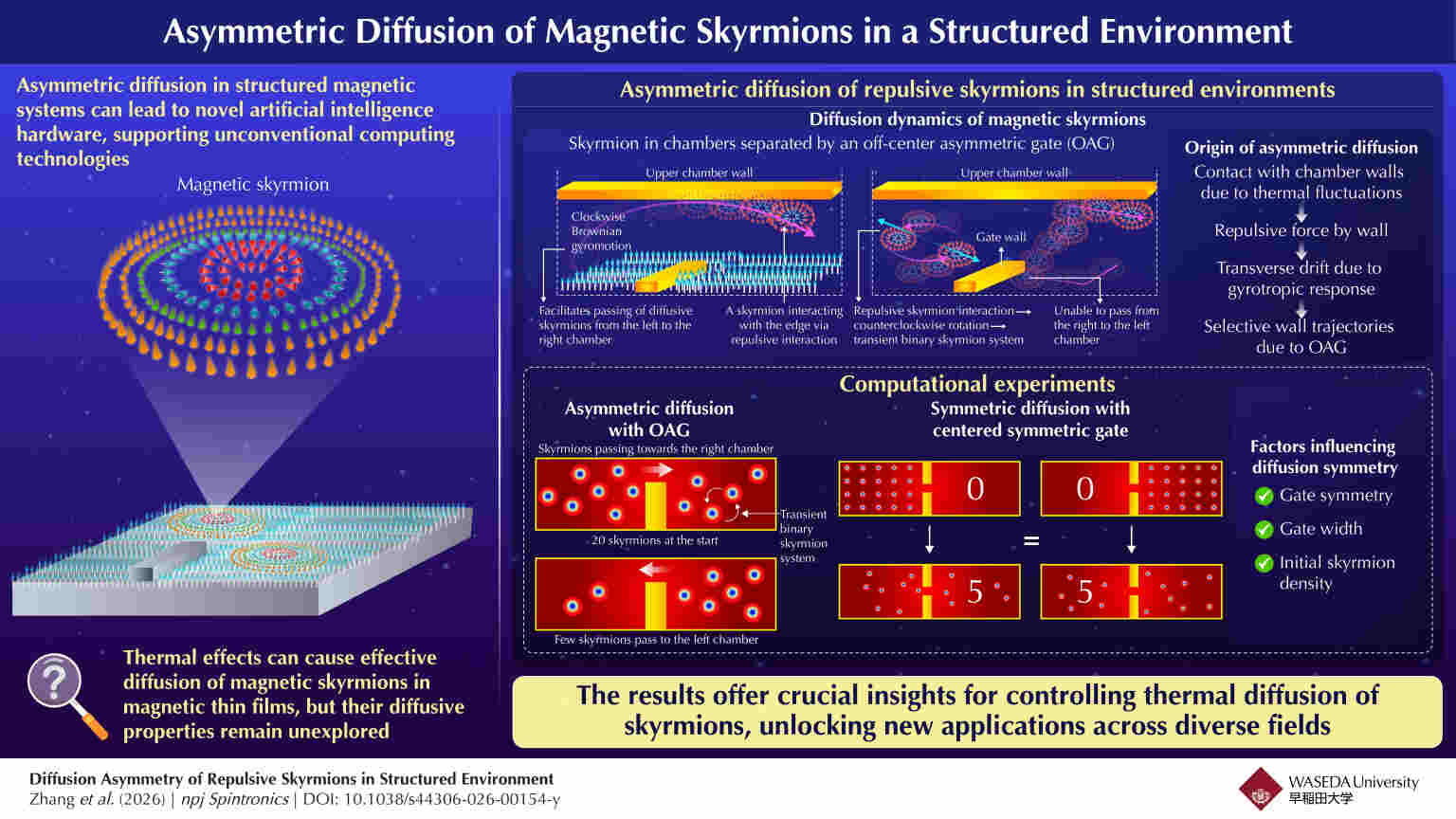
An international research team led by Waseda University in Japan has used finite-temperature spin-dynamics simulations to show how nanoscale magnetic skyrmions can leverage topology, thermal noise, particle interactions, and engineered geometry to perform computation. This research, published in *npj Spintronics* under the title "Diffusion asymmetry of repulsive skyrmions in a structured environment," challenges the traditional computational paradigm of eliminating noise. Instead, the study suggests that thermal randomness can be harnessed as a functional component of a system. By designing physical structures, specifically, asymmetric nanoscale gates, that interact with the unique dynamics of skyrmions, researchers have shown that physical systems can be engineered to process information directly through their inherent material properties. This represents a significant shift toward unconventional computing architectures, where the physics of the system itself is designed to perform complex computational operations.

The Computational Experiment

The researchers created a simulated nanoscale environment consisting of two chambers connected by an off-center asymmetric gate, or OAG.

The comparison is important.

In a conventional centered symmetric gate, a skyrmion approaching from either direction encounters essentially equivalent geometry.

In the asymmetric configuration, the gate is deliberately displaced from the center of the connecting region.

The simulations then ask a deceptively simple question:

Will thermally driven skyrmions move through the structure equally well in both directions?

The answer is no.

The computational model shows that skyrmions can preferentially diffuse from one chamber to the other. The effect emerges from the combined influence of skyrmion topology, gyrotropic motion, damping, boundary interactions and repulsive skyrmion-skyrmion forces.

This is not a simple mechanical ratchet.

The directional behavior emerges from the interaction of multiple physical effects.

Simulating Magnetic Objects as Computational Particles

Magnetic skyrmions are particularly interesting because their internal spin structure gives them unusual dynamics.

They are topological spin textures, meaning their behavior is governed in part by a topological charge rather than simply by their physical position.

The researchers model skyrmions with topological charge Q = −1.

Their motion includes a gyrotropic component that can cause a skyrmion undergoing thermal Brownian motion to follow curved rather than purely random trajectories.

That becomes critical when the skyrmion encounters a boundary.

Instead of simply bouncing away, the combination of gyrotropic motion and boundary interactions can guide the skyrmion along a wall.

With the gate positioned asymmetrically, the geometry can therefore make passage easier from one direction than the other.

The computer is effectively revealing a nanoscale transport mechanism that would be extraordinarily difficult to understand from geometry alone.

MuMax3 Turns the Physics Into a Numerical Experiment

To test their theoretical predictions, the researchers performed computational spin-dynamics experiments using MuMax3, a micromagnetic simulation package.

At finite temperature, the dynamics are governed by the stochastic Landau–Lifshitz–Gilbert equation, which describes the evolution of magnetization while incorporating thermal fluctuations.

This is a crucial part of the computational story.

The randomness is not an error term.

It is deliberately included in the model.

The simulation therefore attempts to reproduce the statistical behavior of real thermally fluctuating magnetic structures rather than calculating only an idealized deterministic trajectory.

In the primary simulation configuration, the researchers modeled:

  • 20 skyrmions;
  • topological charge Q = −1;
  • temperature of 150 K;
  • an asymmetric gate width of 36 nanometers; and
  • stochastic thermal fluctuations controlled through random seeds.

The simulations followed the system for hundreds of nanoseconds and examined how many skyrmions crossed between the two chambers.

One Direction Works Better Than the Other

The computational results provide a striking demonstration.

Starting with 20 skyrmions in the left chamber and none in the right, the simulation produced six skyrmions in the right chamber after 500 nanoseconds and nine after 1,000 nanoseconds.

When the initial population was reversed—20 skyrmions in the right chamber and none in the left—only two crossed to the left after 500 nanoseconds and three after 1,000 nanoseconds in the representative simulation.

The system therefore has a preferred diffusion direction.

That preference disappears when the gate is made symmetric.

The comparison between the asymmetric-gate and centered-symmetric-gate systems is what turns the result from an interesting trajectory into a computationally testable physical effect.

The Researchers Had to Prove It Wasn’t Just Random Luck

There is an obvious problem with a thermally driven system.

If the physics contains randomness, how can researchers be sure that an apparent directional effect isn’t simply a statistical accident?

The answer was to repeat the computational experiment.

The researchers performed 100 repetitions using different thermal random seeds while keeping the physical parameters fixed.

This is an important computational methodology.

The objective isn’t to find one simulation that produces an interesting result.

It is to determine whether the statistical behavior survives changes in the random realization of the thermal noise.

The repeated simulations support the persistence of the diffusion asymmetry.

Geometry Becomes a Computing Parameter

One of the most interesting findings is that the gate cannot simply be made arbitrarily narrow or wide.

The ratio between the gate opening and the skyrmion size is critical.

If the gate is too narrow, skyrmions cannot pass.

If it is too wide, the skyrmions pass through without sufficiently interacting with the surrounding geometry.

The simulations identify intermediate regimes where the asymmetric behavior emerges.

In particular, asymmetric diffusion was observed for gate widths of approximately 30–32 nm and 36–38 nm in the modeled system.

This is a fascinating computational result because it means geometry itself becomes a control parameter.

The shape of the device determines how thermal motion is transformed into directional information.

Twenty Skyrmions Are Different From One

The simulations also reveal something that would be absent from a single-particle model.

The skyrmions interact with one another.

Their interactions are predominantly repulsive, but those forces can produce surprisingly complex collective behavior.

Two diffusing skyrmions can temporarily form a kind of rotating bound configuration, producing emergent rotational dynamics even though their mutual interaction is repulsive.

This is important computationally.

The system cannot simply be modeled as 20 independent random walkers.

The motion of one skyrmion affects the environment experienced by another.

The resulting dynamics are therefore many-body and nonlinear.

Density Changes the Computation

The number of skyrmions inside the chambers also matters.

The simulations show that diffusion rates increase with the initial number of skyrmions for both asymmetric and symmetric geometries, although the geometry determines whether the resulting diffusion remains directionally asymmetric.

At very low density, there may be insufficient interaction to produce the effect.

At very high density, however, strong skyrmion-skyrmion repulsion can become so significant that skyrmions may be expelled from a chamber without interacting effectively with the gate.

The researchers found that 20 skyrmions provided a moderate density that maintained the desired asymmetric diffusion behavior in their modeled system.

This means the computational device has another parameter that could potentially be controlled:

information density.

The Simulation Is Time-Dependent

There is another subtle computational complication.

Skyrmions can be thermally annihilated.

Consequently, the total number of skyrmions decreases over time.

As the density changes, so do the skyrmion-skyrmion and skyrmion-wall interactions.

That means the effective diffusion rates are not necessarily constant.

The researchers therefore emphasize that their simulations should be interpreted as a dynamic, evolving system rather than a simple two-state process with fixed transition rates.

The simulations focus particularly on the early 0–500 ns interval, where changes in the effective diffusion rates are smaller and the directional effect can be analyzed more clearly.

This is an important example of why computational physics can become complicated very quickly.

The system is not just random.

It is evolving randomness.

The Thiele Model Helps Explain the Motion

The full spin-dynamics simulations reveal what happens.

The researchers then use the Thiele model to help explain why it happens.

Consider a skyrmion approaching the asymmetric gate from the left.

Its interaction with the gate and upper chamber wall produces a velocity field influenced by gyrotropic and dissipative responses.

In the simulation, the skyrmion can accelerate along the upper wall and eventually enter the opposite chamber.

The reverse trajectory behaves differently.

A skyrmion approaching from the right can be redirected away from the gate and remain trapped in its original chamber.

The numerical experiment and reduced theoretical model therefore complement each other.

The detailed simulation establishes the behavior.

The analytical model helps explain the mechanism.

Damping Turns Out to Matter

The researchers also investigate what happens if the dissipative contribution is removed.

Their Thiele-model analysis shows that when the damping-related term is effectively set to zero, asymmetric diffusion becomes much harder to produce.

The skyrmions can pass through the gate more symmetrically from either side.

This indicates that nonzero damping is an important component of the directional effect.

The result highlights another characteristic of computational physics.

A phenomenon that appears to be caused by geometry alone actually depends on the interaction of:

geometry + topology + thermal noise + gyrotropic motion + damping + boundary forces.

Remove one component and the behavior can change dramatically.

Randomness Becomes a Resource

This is where the work becomes particularly interesting for computing.

Traditional computer engineering generally attempts to suppress randomness.

Digital logic depends on reproducible states.

Noise is usually treated as something that must be minimized.

The skyrmion system suggests another possibility.

A carefully engineered physical structure can transform thermal fluctuations into a statistically useful directional process.

The researchers point out that asymmetric diffusion in physical systems could provide a route toward nonlinear, noise-assisted and geometry-controlled information processing.

That connects directly to the broader field of unconventional computing.

From Spintronics to Neuromorphic Computing

Neuromorphic computing attempts to emulate some characteristics of biological information processing using physical systems that can naturally represent complex, dynamic states.

Skyrmions are attractive candidates because they can move, interact, fluctuate and respond to their environment.

The new work suggests that their behavior could potentially be manipulated statistically rather than forcing every skyrmion into a perfectly deterministic trajectory.

That is conceptually important.

A future computational device might not ask:

Did the skyrmion move left or right?

It might ask:

What information is encoded in the probability distribution of where the skyrmions move?

That is a very different computational paradigm.

Reservoir Computing Without Conventional Digital Logic

The paper’s references point to previous demonstrations of Brownian reservoir computing using geometrically confined skyrmion dynamics, as well as gesture-recognition experiments using skyrmion-based Brownian reservoir computing.

Reservoir computing is particularly interesting because the physical system itself performs a nonlinear transformation of input signals.

Instead of explicitly programming every internal operation, the dynamics of the physical reservoir provide a complex computational state space.

The new asymmetric-diffusion mechanism could potentially add another useful ingredient:

controlled directional transport generated by stochastic physical dynamics.

The researchers are not claiming that this study has produced a complete computer.

Rather, it identifies a physical mechanism that could contribute to future unconventional architectures.

That distinction is important.

A Computational Device Built From Probability

The deeper idea is almost philosophical.

Conventional computing asks engineers to create predictable operations from predictable states.

This research explores whether engineers can instead create predictable statistics from unpredictable microscopic events.

That distinction could be valuable for specialized computing workloads.

Thermal fluctuations are unavoidable at nanoscale dimensions.

Instead of treating them entirely as a liability, future devices might exploit them.

The geometry acts as the algorithm.

The skyrmion dynamics provide the nonlinear transformation.

Thermal noise supplies stochasticity.

And the resulting probability distribution becomes the computational output.

Why This Matters for Future AI Hardware

Artificial intelligence increasingly requires computing systems that can perform enormous numbers of operations under tight energy constraints.

Conventional transistor scaling alone may not provide the efficiency improvements required indefinitely.

That has driven research into alternative approaches including analog computing, in-memory computing, neuromorphic architectures, photonic processors and spintronic systems.

Skyrmion-based computing belongs to this broader search for architectures that use physical processes more directly.

The Waseda-led study is particularly interesting because it demonstrates that device geometry can shape stochastic information flow.

Instead of designing a circuit entirely from deterministic gates, one could potentially design physical landscapes in which particles naturally perform useful transformations.

The Supercomputing Connection

There is an important nuance for the HPC community.

The paper does not present a conventional “supercomputer achieved X petaflops” breakthrough.

The significance is different.

Computational modeling is being used to discover and engineer new computing physics.

The researchers use numerical spin dynamics to explore a parameter space involving temperature, skyrmion density, gate geometry, interactions and stochastic fluctuations.

They then use statistical repetition and reduced theoretical modeling to identify robust physical behavior.

This is exactly the kind of computational workflow increasingly important across modern science:

simulate → observe → vary parameters → repeat statistically → identify mechanism → design new experiment or technology.

When the Algorithm Is the Physics

The most exciting possibility is that the eventual computational device may look very different from today’s processors.

Instead of billions of transistors executing precisely defined Boolean operations, a future unconventional processor could contain physical structures whose collective dynamics naturally transform information.

The software could encode an input into the physical system.

The skyrmions could evolve.

Thermal fluctuations could provide controlled stochasticity.

Geometry could bias the resulting trajectories.

Sensors could measure the distribution of final states.

And machine-learning algorithms could interpret those states.

In such a system, the physics becomes part of the algorithm.

A Tiny Magnetic System With a Big Computational Idea

The physical structures in this study are nanoscale.

The gate widths producing the strongest asymmetric diffusion are measured in tens of nanometers.

Yet the computational implications are much larger.

The research demonstrates that carefully engineered nanoscale environments can convert a fundamental physical process—Brownian diffusion—into a directional and potentially information-bearing phenomenon.

It is a reminder that the future of computing may not necessarily be found by making conventional processors ever larger.

It may be found by making computation increasingly physical, parallel, stochastic and specialized.

The Road to Practical Hardware Is Still Long

The researchers themselves identify important limitations and areas for future work.

The diffusion rate depends on skyrmion density and can change as skyrmions are thermally annihilated.

The gate geometry cannot easily be changed after fabrication.

Skyrmion size and density, however, can respond to thermal conditions and external magnetic fields.

The study also suggests future investigations of other skyrmion types and interaction regimes.

Therefore, this is not a finished computing technology.

It is a computationally demonstrated physical mechanism.

And that may be precisely why it is interesting.

The Future May Compute With Noise

For decades, computing has been a story about controlling physics.

Control the electron.

Control the transistor.

Control the voltage.

Control the bit.

But as computing moves into the nanoscale and researchers search for new architectures beyond conventional CMOS, another philosophy is emerging:

Don’t necessarily control every microscopic event. Control the statistical behavior of the system.

The skyrmion simulations from Waseda and its collaborators provide a compelling example.

Twenty nanoscale magnetic structures are allowed to move under thermal fluctuations.

Their topology bends their trajectories.

Their mutual interactions alter their motion.

A carefully positioned gate biases their diffusion.

And a computational experiment reveals that the resulting randomness can become directional information.

From Random Motion to Useful Computation

The broader significance of this research can be encapsulated in a single principle: geometry serves as a mechanism to transform noise into computation. The study demonstrates that asymmetric diffusion emerges only when specific conditions regarding skyrmion size, gate dimensions, boundary geometry, damping, thermal fluctuations, and particle density are met. Because this effect is negated by restrictive, overly open, or symmetric configurations, the physical environment itself functions as a critical computational design parameter, a development with promising implications for the future of spintronics and unconventional AI hardware. While the researchers have not developed a direct replacement for current GPUs, they have established a fundamental insight through detailed computational modeling: nanoscale physical systems can effectively harness randomness to generate structured information. As the demand for computational power rises alongside the need for greater energy efficiency, this approach may redefine the architecture of future processors, shifting from traditional logic gate operations to systems that leverage fundamental physical processes for computation.

  1. Supercomputing reveals why some black hole flares fade away
  2. The next supercomputing breakthrough may come from memory, not compute
  3. Supercomputing rewrites the timeline of planet formation at cosmic dawn
  4. Supercomputers reveal four regimes of radiation damage in tungsten
  5. Computational radiative transfer reveals a gas-ensheathed black hole at cosmic dawn
  6. Supercomputers scan 165 years of weather data to find the ‘Snow-Eater’ heat waves behind Western US snowmelt
  7. The stars that remember: Supercomputing reveals the hidden histories of massive binary systems

Page 1 of 60

  • 1
  • 2
  • 3
  • 4
  • 5
  • 6
  • 7
  • 8
  • 9
  • 10
POPULAR RIGHT NOW
  • IBM's Historic stock collapse raises questions for the future of enterprise supercomputing
    IBM's Historic stock collapse raises questions for the future of enterprise supercomputing
  • Could a novel dark matter theory simultaneously resolve multiple cosmic enigmas? Supercomputer simulations provide a compelling, albeit currently unverified, potential solution
    Could a novel dark matter theory simultaneously resolve multiple cosmic enigmas? Supercomputer simulations provide a compelling, albeit currently unverified, potential solution
  • Melting icebergs may be reshaping Earth’s greatest ocean current
    Melting icebergs may be reshaping Earth’s greatest ocean current
  • Supercomputers replace ‘bathtub’ flood maps with physics-based digital twins of Britain’s coastline
    Supercomputers replace ‘bathtub’ flood maps with physics-based digital twins of Britain’s coastline
  • Supercomputers push neural quantum simulation beyond previous limits
    Supercomputers push neural quantum simulation beyond previous limits
  • Intel’s AI supercomputing revival: Q2 financial surge signals new era for CPU-powered HPC infrastructure
    Intel’s AI supercomputing revival: Q2 financial surge signals new era for CPU-powered HPC infrastructure
  • AI infrastructure financing fears shake semiconductor sector
    AI infrastructure financing fears shake semiconductor sector
  • AWS supercomputing investment reaches historic scale as Amazon’s AI strategy powers record financial results
    AWS supercomputing investment reaches historic scale as Amazon’s AI strategy powers record financial results
  • Catching the wave of the future: Supercomputers unlock the hidden dynamics of Venus
    Catching the wave of the future: Supercomputers unlock the hidden dynamics of Venus
  • NCAR supercomputers run planet scale climate experiments impossible in the real world
    NCAR supercomputers run planet scale climate experiments impossible in the real world
THIS YEAR'S MOST READ
  • Wall Street wants to trade supercomputing power like oil
    Wall Street wants to trade supercomputing power like oil
  • Beamforming the future: BeammWave's 6G push signals the rise of orbital-terrestrial wireless networks
    Joakim Axmon
    Joakim Axmon
  • Cosmic ambition at scale: UK’s supercomputer unlocks a 2.5 petabytes universe
    Cosmic ambition at scale: UK’s supercomputer unlocks a 2.5 petabytes universe
  • Hidden order, revealed at scale: Supercomputing, electron ptychography uncover the inner workings of relaxor ferroelectrics
    Hidden order, revealed at scale: Supercomputing, electron ptychography uncover the inner workings of relaxor ferroelectrics
  • Intel's Q1 results signal supercomputing surge driving Xeon momentum
    Intel's Q1 results signal supercomputing surge driving Xeon momentum
  • When stars fall apart: Supercomputing reveals the hidden physics of black holes
    When stars fall apart: Supercomputing reveals the hidden physics of black holes
  • MIT develops computational framework to probe dark matter via gravitational waves
    MIT develops computational framework to probe dark matter via gravitational waves
  • Explainable AI moves into the watershed: FAMU-FSU engineers build predictive framework for real-time E. coli forecasting
    FAMU-FSU College of Engineering Assistant Professor Nasrin Alamdari. (Scott Holstein/FAMU-FSU College of Engineering)
    FAMU-FSU College of Engineering Assistant Professor Nasrin Alamdari. (Scott Holstein/FAMU-FSU College of Engineering)
  • Multi-layer simulations reveal the hidden supply chain of solar prominences
    Multi-layer simulations reveal the hidden supply chain of solar prominences
  • Japanese scientists decode dolphin speed with supercomputing: Turbulence, vortices, and the hidden physics of propulsion
    Japanese scientists decode dolphin speed with supercomputing: Turbulence, vortices, and the hidden physics of propulsion
  • FRONTPAGE
  • LATEST
  • POPULAR
  • REGISTER
  • SOCIAL
  • VIDEO
  • SUBSCRIPTION
  • RSS
  • GUIDELINES
  • PRIVACY
  • TOS
  • ABOUT
  • +1 (816) 799-4488
  • editorial@supercomputingonline.com
© 2001 - 2026 SuperComputingOnline.com, LLC. All rights reserved. This material may not be published, broadcast, rewritten or redistributed without permission.
Sign In
  • FRONT PAGE
  • LATEST
    • MEDIA KIT
    • MOST READ
    • RSS FEED
    • ACADEMIA
    • AEROSPACE
    • APPLICATIONS
    • ASTRONOMY
    • AUTOMOTIVE
    • BIG DATA
    • BIOLOGY
    • CHEMISTRY
    • CLIENTS
    • CLOUD
    • DEFENSE
    • DEVELOPER TOOLS
    • EARTH SCIENCES
    • ECONOMICS
    • ENGINEERING
    • ENTERTAINMENT
    • HEALTH
    • INDUSTRY
    • INTERCONNECTS
    • GAMING
    • GOVERNMENT
    • MANUFACTURING
    • MIDDLEWARE
    • MOVIES
    • NETWORKS
    • OIL & GAS
    • PHYSICS
    • PROCESSORS
    • RETAIL
    • SCIENCE
    • STORAGE
    • SYSTEMS
    • VISUALIZATION
  • VIDEOS
    • ADD YOUR VIDEOS
    • MANAGE VIDEOS
  • COMMUNITY
    • TRADE SHOWS
    • SOCIAL NETWORK VIDEOS
    • SURVEYS
    • APPLICATIONS BROWSER
    • CONVERSATION INBOX
    • SOCIAL ADVERTISER
    • GROUPS
    • MARKETPLACE LISTINGS
    • PAGES
    • LEADERBOARD
    • POINTS LISTING
      • BADGES
    • PRIVACY CONFIRM REQUEST
    • PRIVACY CREATE REQUEST

Hey there! We noticed you’re using an ad blocker.