

SUPERCOMPUTING NEWS SUPERCOMPUTING NEWS
    • MEDIA KIT
    • MOST READ
    • RSS FEED
    • ACADEMIA
    • AEROSPACE
    • APPLICATIONS
    • ASTRONOMY
    • AUTOMOTIVE
    • BIG DATA
    • BIOLOGY
    • CHEMISTRY
    • CLIENTS
    • CLOUD
    • DEFENSE
    • DEVELOPER TOOLS
    • EARTH SCIENCES
    • ECONOMICS
    • ENGINEERING
    • ENTERTAINMENT
    • GAMING
    • GOVERNMENT
    • HEALTH
    • OIL & GAS
    • INDUSTRY
    • INTERCONNECTS
    • MANUFACTURING
    • MIDDLEWARE
    • MOVIES
    • NETWORKS
    • PHYSICS
    • PROCESSORS
    • RETAIL
    • SCIENCE
    • STORAGE
    • SYSTEMS
    • VISUALIZATION
    • AcyMailing subscription form

    • ADD YOUR VIDEOS
    • MANAGE VIDEOS
    • CONVERSATION INBOX
    • SOCIAL ADVERTISER
    • SOCIAL NETWORK VIDEOS
    • SURVEYS
    • GROUPS
    • PAGES
    • MARKETPLACE LISTINGS
    • APPLICATIONS BROWSER
    • PRIVACY CONFIRM REQUEST
    • PRIVACY CREATE REQUEST
    • LEADERBOARD
    • POINTS LISTING
      • BADGES
    • TRADE SHOWS
Sign In
Tyler O'Neal, Staff Editor ACADEMIA January 10, 2022, 6:00 am

University of Tokyo researchers find public trust in AI varies greatly depending on the app

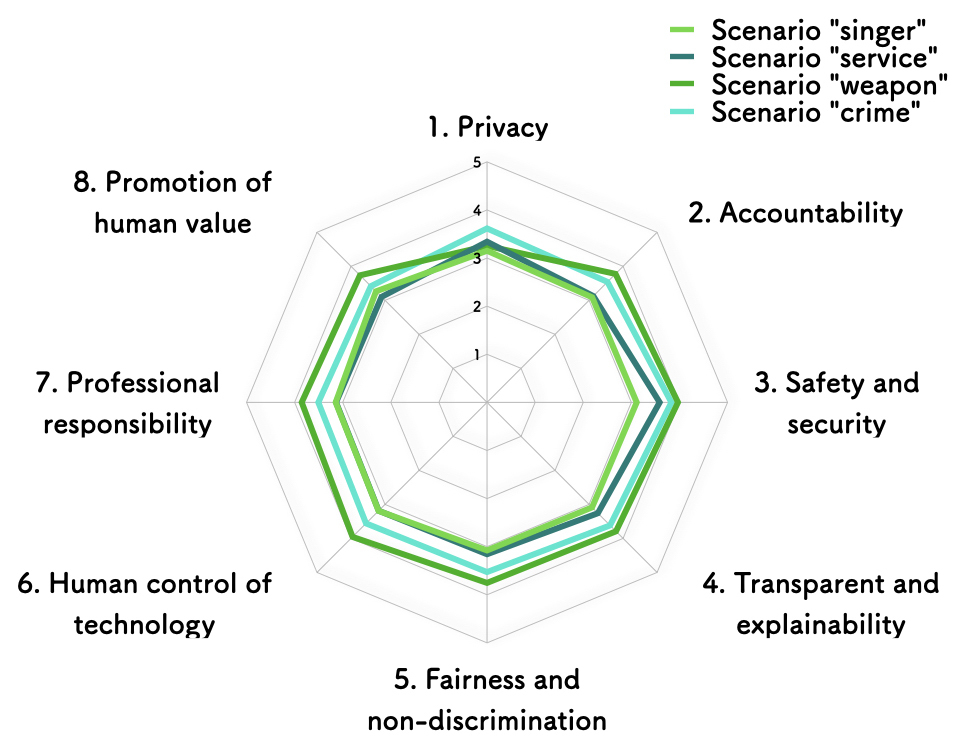
Prompted by the increasing prominence of artificial intelligence (AI) in society, University of Tokyo researchers investigated public attitudes toward the ethics of AI. Their findings quantify how different demographics and ethical scenarios affect these attitudes. As part of this study, the team developed an octagonal visual metric, analogous to a rating system, which could be useful to AI researchers who wish to know how their work may be perceived by the public. Octagon chart. An example chart showing a respondent’s ratings of the eight themes for each of the four ethical scenarios on a different application of AI. © 2021 Yokoyama et al.
Many people feel the rapid development of technology often outpaces that of the social structures that implicitly guide and regulate it, such as law or ethics. AI in particular exemplifies this as it has become so pervasive in everyday life for so many, seemingly overnight. This proliferation, coupled with the relative complexity of AI compared to more familiar technology, can breed fear and mistrust of this key component of modern living. Who distrusts AI and in what ways are matters that would be useful to know for developers and regulators of AI technology, but these kinds of questions are not easy to quantify.

Researchers at the University of Tokyo, led by Professor Hiromi Yokoyama from the Kavli Institute for the Physics and Mathematics of the Universe, set out to quantify public attitudes toward ethical issues around AI. There were two questions, in particular, the team, through analysis of surveys, sought to answer: how attitudes change depending on the scenario presented to a respondent, and how the demographic of the respondent changed attitudes.

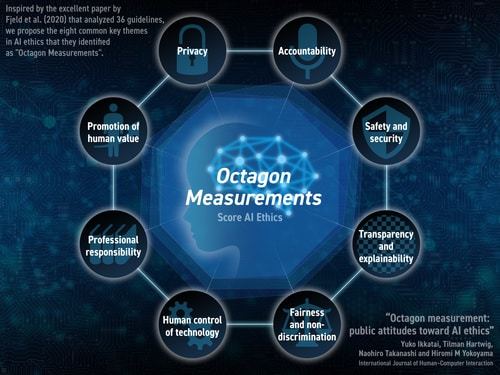
Ethics cannot be quantified, so to measure attitudes toward the ethics of AI, the team employed eight themes common to many AI applications that raised ethical questions: privacy, accountability, safety and security, transparency and explainability, fairness and non-discrimination, human control of technology, professional responsibility, and promotion of human values. These, which the group has termed “octagon measurements,” were inspired by a 2020 paper by Harvard University researcher Jessica Fjeld and her team.

Survey respondents were given a series of four scenarios to judge according to these eight criteria. Each scenario looked at a different application of AI. They were: AI-generated art, customer service AI, autonomous weapons, and crime prediction.

The survey respondents also gave the researchers information about themselves such as age, gender, occupation, and level of education, as well as a measure of their level of interest in science and technology by way of an additional set of questions. This information was essential for the researchers to see what characteristics of people would correspond to certain attitudes.

“Prior studies have shown that risk is perceived more negatively by women, older people, and those with more subject knowledge. I was expecting to see something different in this survey given how commonplace AI has become, but surprisingly we saw similar trends here,” said Yokoyama. “Something we saw that was expected, however, was how the different scenarios were perceived, with the idea of AI weapons being met with far more skepticism than the other three scenarios.” Octagon measurements. The eight themes common to a wide range of AI scenarios for which the public have pressing ethical concerns. © 2021 Yokoyama et al.
The team hopes the results could lead to the creation of a sort of universal scale to measure and compare ethical issues around AI. This survey was limited to Japan, but the team has already begun gathering data in several other countries.

“With a universal scale, researchers, developers, and regulators could better measure the acceptance of specific AI applications or impacts and act accordingly,” said Assistant Professor Tilman Hartwig. “One thing I discovered while developing the scenarios and questionnaire is that many topics within AI require significant explanation, more so than we realized. This goes to show there is a huge gap between perception and reality when it comes to AI.”
Seeking a way of preventing audio models for AI machine learning from being fooled

Tyler O'Neal, Staff Editor ACADEMIA January 7, 2022, 6:00 am

Warnings have emerged about the unreliability of the metrics used to detect whether an audio perturbation designed to fool AI models can be perceived by humans

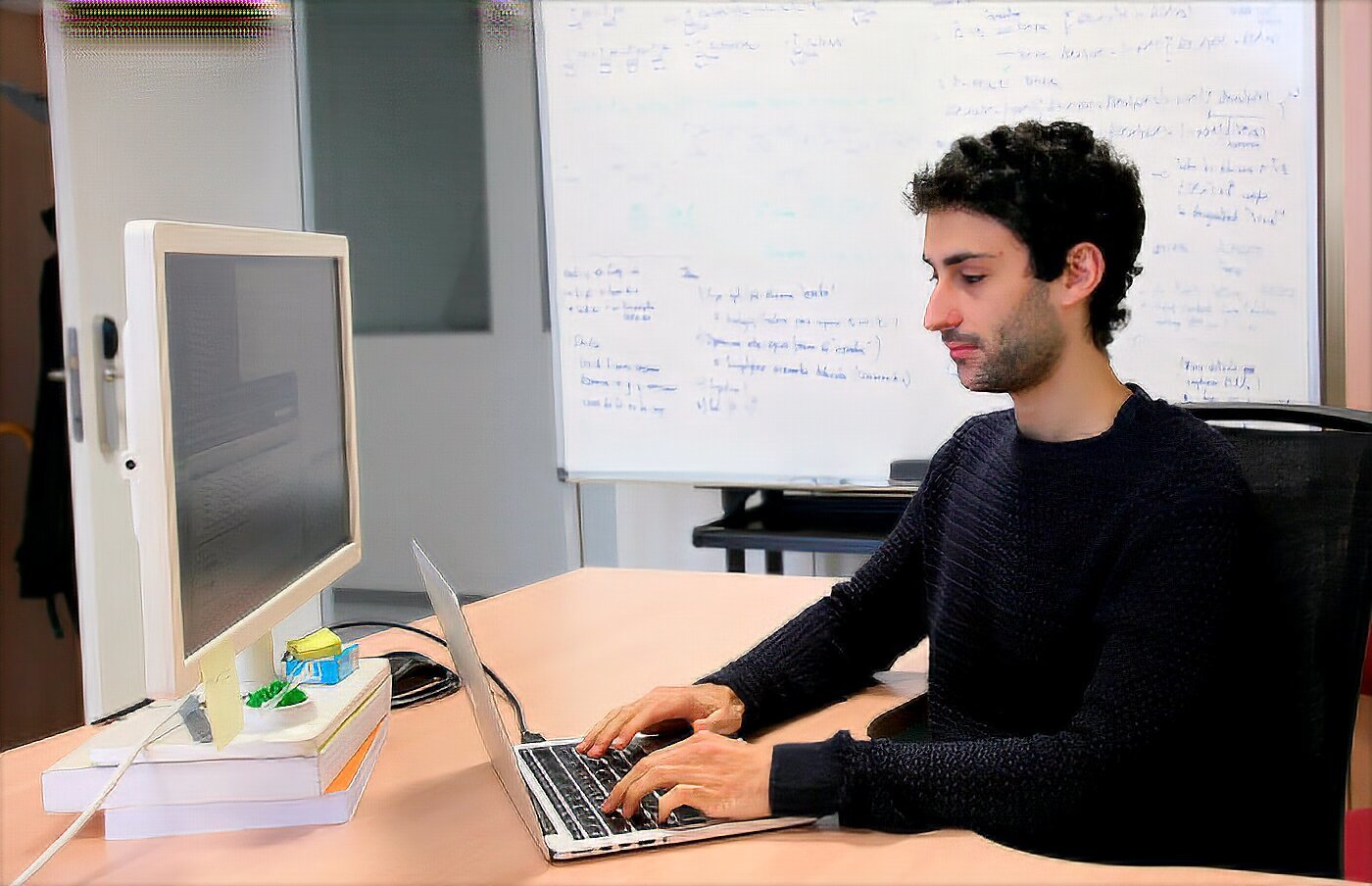
Artificial intelligence (AI) is increasingly based on machine learning models, trained using large datasets. Likewise, human-computer interaction is increasingly dependent on speech communication, mainly due to the remarkable performance of machine learning models in speech recognition tasks. CAPTION Jon Vadillo, in his office at the University of The Basque Country.  CREDIT Nagore Iraola. UPV/EHU

However, these models can be fooled by "adversarial" examples, in other words, inputs intentionally perturbed to produce a wrong prediction without the changes being noticed by humans. "Suppose we have a model that classifies audio (e.g. voice command recognition) and we want to deceive it, in other words, generate a perturbation that maliciously prevents the model from working properly. If a signal is heard properly, a person can notice whether a signal says 'yes', for example. When we add an adversarial perturbation we will still hear 'yes', but the model will start to hear 'no', or 'turn right' instead of left or any other command we don't want to execute," explained Jon Vadillo, a researcher in the UPV/EHU’s Department of Computer Science and Artificial Intelligence.

This could have "very serious implications at the level of applying these technologies to real-world or highly sensitive problems", added Vadillo. It remains unclear why this happens. Why would a model that behaves so intelligently suddenly stop working properly when it receives even slightly altered signals?

Deceiving the model by using an undetectable perturbation

“It is important to know whether a model or a program has vulnerabilities," added the researcher from the Faculty of Informatics. “Firstly, we investigate these vulnerabilities, to check that they exist and because that is the first step in eventually fixing them.” While much research has focused on the development of new techniques for generating adversarial perturbations, less attention has been paid to the aspects that determine whether these perturbations can be perceived by humans and what these aspects are like. This issue is important, as the adversarial perturbation strategies proposed only pose a threat if the perturbations cannot be detected by humans.

This study has investigated the extent to which the distortion metrics proposed in the literature for audio adversarial examples can reliably measure the human perception of perturbations. In an experiment in which 36 people evaluated adversarial examples or audio perturbations according to various factors, the researchers showed that "the metrics that are being used by convention in the literature are not completely robust or reliable. In other words, they do not adequately represent the auditory perception of humans; they may tell you that a perturbation cannot be detected, but then when we evaluate it with humans, it turns out to be detectable. So we want to issue a warning that due to the lack of reliability of these metrics, the study of these audio attacks is not being conducted very well," said the researcher.

In addition, the researchers have proposed a more robust evaluation method that is the outcome of the "analysis of certain properties or factors in the audio that are relevant when assessing detectability, for example, the parts of the audio in which a perturbation is most detectable". Even so, "this problem remains open because it is very difficult to come up with a mathematical metric that is capable of modeling auditory perception. Depending on the type of audio signal, different metrics will probably be required or different factors will need to be considered. Achieving general audio metrics that are representative is a complex task," concluded Vadillo.

Anomalo, Snowflake partner to help enterprises trust their data

Tyler O'Neal, Staff Editor ACADEMIA January 6, 2022, 6:00 am

Anomalo has announced a partnership with Snowflake to help customers trust the data they use to make decisions and build products. The combination provides customers with a way to monitor the quality of the data in any table in Snowflake’s platform without writing code, configuring rules, or setting thresholds.

Today’s modern data-powered organizations are using Snowflake’s platform to centralize all of their data and make it easily available for everything from business decision-making to predictive analytics and machine learning.

However, dashboards and data-powered products are only as good as the quality of the data that powers them. Many data-powered companies quickly encounter one unfortunate fact: much of their data is missing, stale, corrupt, or prone to unexpected and unwelcome changes. As a result, companies spend more time dealing with issues in their data rather than unlocking that data’s value.

Anomalo thus addresses the data quality problem by monitoring enterprise data and automatically detecting and root-causing data issues, allowing teams to resolve any hiccups with their data before making decisions, running operations, or powering models. Anomalo leverages machine learning to rapidly assess a wide range of data sets with minimal human input. If desired, enterprises can fine-tune Anomalo’s monitoring through the low-code configuration of metrics and validation rules. This is in contrast to legacy approaches to monitoring data quality that require extensive work writing data validation rules or setting limits and thresholds.

As a result, Snowflake customers can now begin monitoring the quality of their data with Anomalo in under five minutes. They simply connect Anomalo’s data quality platform to their Snowflake account and select the tables they wish to monitor. No further configuration or code is required.

Anomalo and Snowflake are used by customers globally:

  • Discover Financial Services is leveraging Anomalo to quickly gain trust in their most critical data. Discover’s Chief Data and Analytics Officer Keith Toney said: “Discover is transforming and expanding how we use data as an enterprise asset to serve our customers better through advanced data analytics. We were looking for a product that would help us maintain a scalable foundation of trusted data in a fast-paced digital environment. We selected Anomalo to fully automate the basis of our data quality monitoring because their machine learning and root cause detection technology identify late, missing, or anomalous data across our petabyte-scale cloud warehouse. Our data stewards use Anomalo’s intuitive UI to tailor monitoring to their business needs. Compared to legacy solutions, Anomalo will help us detect more quality issues with just a fraction of the time invested by our team.”
  • Faire uses Anomalo to monitor the most important tables in their Snowflake account. Daniele Perito, Chief Data Officer and co-founder at Faire, said: “We monitor hundreds of key tables in Snowflake’s platform with Anomalo. I sleep better at night knowing our data is more reliable, and my team loves how easy it is to use and how insightful the notifications are.”
  • Substack uses Anomalo to empower their small team to keep up with an ever-growing collection of data. Mike Cohen, Substack’s Data Manager, said: “With a small data team at Substack, the automated checks that Anomalo provides are like having another data engineer on the team whose primary focus is to ensure data quality and integrity. With these checks, we've caught internal data and production bugs and detected the presence of bad actors internal to our system that might have otherwise gone unnoticed for long periods.”

“Snowflake provides an ideal environment for tools like Anomalo. With its ability to centralize the full set of enterprise data and its unique ability to automatically size query workloads based on their priority and urgency, Snowflake is a perfect partner in helping enterprises trust all of their important data,” said Elliot Shmukler, co-founder and CEO of Anomalo.

“Anomalo offers an easy-to-use way to monitor every table in a customer’s Snowflake account for data quality issues," said Tarik Dwiek, Head of Technology Alliances at Snowflake. "We're excited to offer Snowflake customers the ability to leverage Anomalo to further build trust in the data they are using to develop products and make decisions.”

As part of today’s announcement, Anomalo is a Select Partner within the Snowflake Partner Program.

  1. CfA astronomer Karen Collins uses ML to discover mysterious dusty object orbiting TIC 400799224
  2. German researchers investigate the isotopic composition of rocky planets in the inner Solar System

Page 77 of 123

  • 72
  • 73
  • 74
  • 75
  • 76
  • 77
  • 78
  • 79
  • 80
  • 81
POPULAR RIGHT NOW
  • Supercomputers uncover a new class of cosmic explosions hidden in plain sight
    Supercomputers uncover a new class of cosmic explosions hidden in plain sight
  • AI supercharges the hunt for stronger magnets: Iowa State researchers launch a new era of intelligent materials discovery
    AI supercharges the hunt for stronger magnets: Iowa State researchers launch a new era of intelligent materials discovery
  • IBM's Historic stock collapse raises questions for the future of enterprise supercomputing
    IBM's Historic stock collapse raises questions for the future of enterprise supercomputing
  • Could a novel dark matter theory simultaneously resolve multiple cosmic enigmas? Supercomputer simulations provide a compelling, albeit currently unverified, potential solution
    Could a novel dark matter theory simultaneously resolve multiple cosmic enigmas? Supercomputer simulations provide a compelling, albeit currently unverified, potential solution
  • Melting icebergs may be reshaping Earth’s greatest ocean current
    Melting icebergs may be reshaping Earth’s greatest ocean current
  • Supercomputers replace ‘bathtub’ flood maps with physics-based digital twins of Britain’s coastline
    Supercomputers replace ‘bathtub’ flood maps with physics-based digital twins of Britain’s coastline
  • Supercomputers push neural quantum simulation beyond previous limits
    Supercomputers push neural quantum simulation beyond previous limits
  • Intel’s AI supercomputing revival: Q2 financial surge signals new era for CPU-powered HPC infrastructure
    Intel’s AI supercomputing revival: Q2 financial surge signals new era for CPU-powered HPC infrastructure
  • AI infrastructure financing fears shake semiconductor sector
    AI infrastructure financing fears shake semiconductor sector
  • AWS supercomputing investment reaches historic scale as Amazon’s AI strategy powers record financial results
    AWS supercomputing investment reaches historic scale as Amazon’s AI strategy powers record financial results
THIS YEAR'S MOST READ
  • Wall Street wants to trade supercomputing power like oil
    Wall Street wants to trade supercomputing power like oil
  • Cosmic ambition at scale: UK’s supercomputer unlocks a 2.5 petabytes universe
    Cosmic ambition at scale: UK’s supercomputer unlocks a 2.5 petabytes universe
  • Hidden order, revealed at scale: Supercomputing, electron ptychography uncover the inner workings of relaxor ferroelectrics
    Hidden order, revealed at scale: Supercomputing, electron ptychography uncover the inner workings of relaxor ferroelectrics
  • Beamforming the future: BeammWave's 6G push signals the rise of orbital-terrestrial wireless networks
    Joakim Axmon
    Joakim Axmon
  • Intel's Q1 results signal supercomputing surge driving Xeon momentum
    Intel's Q1 results signal supercomputing surge driving Xeon momentum
  • When stars fall apart: Supercomputing reveals the hidden physics of black holes
    When stars fall apart: Supercomputing reveals the hidden physics of black holes
  • Multi-layer simulations reveal the hidden supply chain of solar prominences
    Multi-layer simulations reveal the hidden supply chain of solar prominences
  • Japanese scientists decode dolphin speed with supercomputing: Turbulence, vortices, and the hidden physics of propulsion
    Japanese scientists decode dolphin speed with supercomputing: Turbulence, vortices, and the hidden physics of propulsion
  • Cosmic feedback at scale: Supercomputing reveals how quasars regulate the early Universe
    Cosmic feedback at scale: Supercomputing reveals how quasars regulate the early Universe
  • Modeling life at the microscopic scale: A computational breakthrough in oxygen transport
    Modeling life at the microscopic scale: A computational breakthrough in oxygen transport
MOST READ OF ALL-TIME
  • Largest Computational Biology Simulation Mimics The Ribosome
    Details
    112108
    The amino acid (green) slithers into the chemical reaction center, moving through an evolutionarily ancient corridor of the ribosome (purple). The amino acid is delivered to the reaction core by the transfer RNA molecule (yellow).
    The amino acid (green) slithers into the chemical reaction center, moving through an evolutionarily ancient corridor of the ribosome (purple). The amino acid is delivered to the reaction core by the transfer RNA molecule (yellow).
  • Silicon 'neurons' may add a new dimension to chips
    Details
    80995
    Silicon 'neurons' may add a new dimension to chips
  • Linux Networx Accelerators Expected to Drive up to 4x Price/Performance
    Details
    75539
  • Complex Concepts That Really Add Up
    Details
    73640
    Complex Concepts That Really Add Up
  • Blue Sky Studios Donates Animation SuperComputer to Wesleyan
    Details
    68141
    Each rack holds 52 Angstrom Microsystem-brand “blades,” with a memory footprint of 12 or 24 gigabytes each. (Photos by Olivia Bartlett Drake)
    Each rack holds 52 Angstrom Microsystem-brand “blades,” with a memory footprint of 12 or 24 gigabytes each. (Photos by Olivia Bartlett Drake)
  • Humanities, HPC connect at NERSC
    Details
    57948
  • TeraGrid ’09 'Call for Participation'
    Details
    54952
  • Turbulence responsible for black holes' balancing act
    Details
    52313
  • Cray Wins $52 Million SuperComputer Contract
    Details
    50141
  • SDSC Researchers Accurately Predict Protein Docking
    Details
    46082
  • FRONTPAGE
  • LATEST
  • POPULAR
  • REGISTER
  • SOCIAL
  • VIDEO
  • SUBSCRIPTION
  • RSS
  • GUIDELINES
  • PRIVACY
  • TOS
  • ABOUT
  • +1 (816) 799-4488
  • editorial@supercomputingonline.com
© 2001 - 2026 SuperComputingOnline.com, LLC. All rights reserved. This material may not be published, broadcast, rewritten or redistributed without permission.
Sign In
  • FRONT PAGE
  • LATEST
    • MEDIA KIT
    • MOST READ
    • RSS FEED
    • ACADEMIA
    • AEROSPACE
    • APPLICATIONS
    • ASTRONOMY
    • AUTOMOTIVE
    • BIG DATA
    • BIOLOGY
    • CHEMISTRY
    • CLIENTS
    • CLOUD
    • DEFENSE
    • DEVELOPER TOOLS
    • EARTH SCIENCES
    • ECONOMICS
    • ENGINEERING
    • ENTERTAINMENT
    • HEALTH
    • INDUSTRY
    • INTERCONNECTS
    • GAMING
    • GOVERNMENT
    • MANUFACTURING
    • MIDDLEWARE
    • MOVIES
    • NETWORKS
    • OIL & GAS
    • PHYSICS
    • PROCESSORS
    • RETAIL
    • SCIENCE
    • STORAGE
    • SYSTEMS
    • VISUALIZATION
  • VIDEOS
    • ADD YOUR VIDEOS
    • MANAGE VIDEOS
  • COMMUNITY
    • TRADE SHOWS
    • SOCIAL NETWORK VIDEOS
    • SURVEYS
    • APPLICATIONS BROWSER
    • CONVERSATION INBOX
    • SOCIAL ADVERTISER
    • GROUPS
    • MARKETPLACE LISTINGS
    • PAGES
    • LEADERBOARD
    • POINTS LISTING
      • BADGES
    • PRIVACY CONFIRM REQUEST
    • PRIVACY CREATE REQUEST

Hey there! We noticed you’re using an ad blocker.