Exotic quantum particles research paves the way for future quantum apps with less magnetic field required

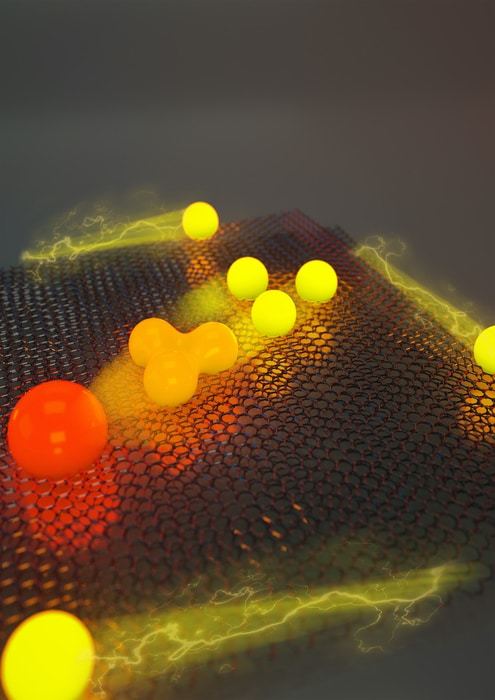
Exotic quantum particles and phenomena are like the world’s most daring elite athletes. Like the free solo climbers who scale impossibly cliff faces without a rope or harness, only the most extreme conditions will entice them to show up. For exotic phenomena like superconductivity or particles that carry a fraction of the charge of an electron, that means extremely low temperatures or extremely high magnetic fields. Electron fractionalization in magic-angle twisted bilayer graphene  CREDIT Second Bay Studios/Harvard SEAS
But what if you could get these particles and phenomena to show up under less extreme conditions? Much has been made of the potential of room-temperature superconductivity, but generating exotic fractionally charged particles at the low-to-zero magnetic field is equally important to the future of quantum materials and applications, including new types of quantum supercomputing.  

Now, a team of researchers from Harvard University led by Amir Yacoby, Professor of Physics and Applied Physics at the Harvard John A. Paulson School of Engineering and Applied Sciences (SEAS), and Ashvin Vishwanath, Professor of Physics in the Department of Physics, in collaboration with Pablo Jarillo-Herrero at the Massachusetts Institute of Technology, have observed exotic fractional states at a low magnetic field in twisted bilayer graphene for the first time.

“One of the holy grails in the field of condensed matter physics is getting exotic particles with low to zero magnetic fields,” said Yacoby, senior writer of the study.  “There have been theoretical predictions that we should be able to see these bizarre particles with low to zero magnetic fields, but no one has been able to observe it until now.”

The researchers were interested in a specific exotic quantum state known as fractional Chern insulators. Chern insulators are topological insulators, meaning they conduct electricity on their surface or edge, but not in the middle. 

In a fractional Chern insulator, electron interactions form what’s known as quasiparticles, a particle that emerges from complex interactions between large numbers of other particles. Sound, for example, can be described as a quasiparticle because it emerges from the complex interactions of particles in a material. Like fundamental particles, quasiparticles have well-defined properties like mass and charge.

In fractional Chern insulators, electron interactions are so strong within the material that quasiparticles are forced to carry a fraction of the charge of normal electrons. These fractional particles have bizarre quantum properties that could be used to create robust quantum bits that are extremely resilient to outside interference.

To build their insulator, the researchers used two sheets of graphene twisted together at the so-called magic angle. Twisting unlocks new and different properties in graphene, including superconductivity, as first discovered by Jarillo-Herrero’s group at MIT, and states known as Chern bands, which hold great potential to generate fractional quantum states, as shown theoretically by Vishwanath’s group at Harvard. 

Think of these Chern bands like buckets that fill up with electrons. 

“In previous studies, you needed a large magnetic field to generate these buckets, which are the topological building blocks you need to get these exotic fractional particles,” said Andrew T. Pierce, a graduate student in Yacoby’s group and co-first author of the paper. “But magic-angle twist bilayer graphene already has these useful topological units built-in at zero magnetic fields.”

To generate fractional states, the researchers need to fill the buckets a fraction of the way with electrons. But here’s the hitch: for this to work, all the electrons in a bucket must have nearly the same properties. In twisted bilayer graphene, they don’t. In this system, electrons have different levels of a property known as the Berry curvature, which causes each electron to experience a magnetic field tied to its particular momentum. (It’s more complicated than that, but what isn’t in quantum physics?) 

When filling up the buckets, the electrons’ Berry curvature needs to be evened out for the fractional Chern insulator state to appear. 

That’s where a small applied magnetic field comes in. 

“We showed that we can apply a very small magnetic field to evenly distribute Berry curvature among electrons in the system, allowing us to observe a fractional Chern insulator in the twisted bilayer graphene,” said Yonglong Xie, a postdoctoral fellow at SEAS and co-first author of the paper.  “This research sheds light on the importance of the Berry curvature to realize fractionalized exotic states and could point to alternative platforms where Berry curvature isn’t as heterogeneous as it is in twisted graphene.”

"Twisted bilayer graphene is the gift that keeps on giving and this discovery of fractional Chern insulators is arguably one of the most significant advances in the field,” said Vishwanath, senior author of the study. “It is astonishing to think that this wonder material is ultimately made of the same stuff as your pencil tip. "

"The discovery of low magnetic field fractional Chern insulators in magic-angle twisted bilayer graphene opens a new chapter in the field of topological quantum matter,” said Jarillo-Herrero, the Cecil and Ida Green Professor of Physics at MIT and senior author of the study. “It offers the realistic prospect of coupling these exotic states with superconductivity, possibly enabling the creation and control of even more exotic topological quasiparticles known as anyons.”


Animated sequence of the VLTI images of stars around the Milky Way’s central black hole

This animation shows the orbits of the stars S29 and S55 as they move close to Sgr A* (centre), the supermassive black hole at the heart of the Milky Way.As we follow the stars along in their orbits, we see real images of the region obtained with the GRAVITY instrument on ESO’s Very Large Telescope Interferometer (VLTI) in March, May, June and July 2021.In addition to S29 and S55, the images als...
...

Read more

NYU researcher wins $200K to bring AI tool to support under-resourced newsrooms

Mona Sloane, faculty at NYU Tandon and Senior Research Scientist at the NYU Center for Responsible AI (R/AI), and Hilke Schellmann, professor of journalism at NYU’s Graduate School of Arts and Science, has been awarded a $200,000 grant from the Patrick J. McGovern Foundation to bring an innovative AI tool to under-resourced newsrooms to significantly scale up their investigative capacity and democratize access to FOIA records.

The project will integrate the NYU-developed Gumshoe prototype — a Natural Language Processing Tool that identifies relevant and irrelevant sections in large text corpora — to help journalists effectively comb through thousands of Freedom of Information Request (FOIA) releases and other document sets. NYU will collaborate with MuckRock, an open-source journalism platform used by tens of thousands of journalists across 4,000 newsrooms to help request, analyze, and publish public documents. The effort will unlock decades of valuable information, data, and history contained in federal government records released under the Freedom of Information Act.

“Effective use of the Freedom of Information Act is a key public tool to encourage transparent, accountable government activity,” said Vilas Dhar, president of the Patrick J. McGovern Foundation. “This innovative application of AI by New York University and MuckRock makes important records accessible to under-resourced newsrooms that are shining a light on our country’s most important social justice stories.”

Gumshoe is an innovative NLP-based text analyzing tool that was developed in a collaboration between Schellmann and Sloane and a team of graduate students at the NYU Center for Data Science, under the supervision of Julia Stoyanovich, professor of computer science at NYU Tandon and director of R/AI. Gumshoe sorts and ranks content in FOIA requests for journalists. Because it is based on NLP technology, Gumshoe understands the meaning of words in context and “learns” about the individual investigation of the journalist over time - like a shoe that fits better with every walk.

“We built this tool because as a freelance journalist I was frustrated with combing through large Freedom of Information requests. I knew other journalists had the same problem and I am so delighted the Patrick J. McGovern Foundation is making it possible for us to bring this AI tool to small newsrooms across America that really need this,” said Schellmann. “Journalists in underserved newsrooms need this AI tool and the training MuckRock will provide to hold the powerful accountable and help strengthen democracy.” 

Through integration with MuckRock’s open-source DocumentCloud platform used by tens of thousands of journalists around the world, Gumshoe will help journalists on a wide variety of critical stories.

“Combining AI innovation, social research, and investigative journalism is extremely important for advancing the public interest in technology”, said Sloane. “We must work together to advance innovation in the right direction and level the playing field of journalistic practice across the U.S. and beyond.”

“We’ve seen a widening disparity between the newsrooms that get access to the advanced tools and support needed to tackle the complex analysis and those that struggle to fund basic resources and training,” said Michael Morisy, MuckRock’s co-founder and chief executive. “I’m grateful for the McGovern Foundation’s support of this collaboration with Hilke and Mona, which will help us start to address that gap while supporting local accountability reporting.”

Over the past year, MuckRock has been expanding the way that it collaborates with local organizations, particularly those serving communities of color and innovative new outlets helping fill the voids left through news deserts where legacy media no longer exist. This includes extensive editorial partnerships helping dig into the impact of the COVID-19 pandemic as well as a revamped FOIA training and coaching program. These expanded collaborations, which have resulted in tens of thousands of newly released documents, provide the perfect opportunity to rapidly scale the impact of Gumshoe by integrating with MuckRock’s platform while further expanding editorial and investigative support to newsrooms around the country. 

Along with access to the tool, the collaboration will offer select newsrooms additional training, editorial guidance, and financial support in the form of microgrants and training stipends to ensure that key stories in communities around the country can be told while journalists from a wide variety of backgrounds have an opportunity to put advanced technology to work in their reporting. These close collaborations will be leveraged to iteratively improve both Gumshoe and MuckRock’s approach to building intuitive and impactful transparency tools.

ThePatrick J. McGovern Foundation is global 21st-century philanthropy bridging the frontiers of artificial intelligence, data science, and social impact to create a thriving, equitable, and sustainable future for all. The Foundation’s work focuses on bringing together academia, practitioners, and civil society to pursue the potential of AI and data science to address some of the world’s most urgent challenges.