

SUPERCOMPUTING NEWS SUPERCOMPUTING NEWS
    • MEDIA KIT
    • MOST READ
    • RSS FEED
    • ACADEMIA
    • AEROSPACE
    • APPLICATIONS
    • ASTRONOMY
    • AUTOMOTIVE
    • BIG DATA
    • BIOLOGY
    • CHEMISTRY
    • CLIENTS
    • CLOUD
    • DEFENSE
    • DEVELOPER TOOLS
    • EARTH SCIENCES
    • ECONOMICS
    • ENGINEERING
    • ENTERTAINMENT
    • GAMING
    • GOVERNMENT
    • HEALTH
    • OIL & GAS
    • INDUSTRY
    • INTERCONNECTS
    • MANUFACTURING
    • MIDDLEWARE
    • MOVIES
    • NETWORKS
    • PHYSICS
    • PROCESSORS
    • RETAIL
    • SCIENCE
    • STORAGE
    • SYSTEMS
    • VISUALIZATION
    • AcyMailing subscription form

    • ADD YOUR VIDEOS
    • MANAGE VIDEOS
    • CONVERSATION INBOX
    • SOCIAL ADVERTISER
    • SOCIAL NETWORK VIDEOS
    • SURVEYS
    • GROUPS
    • PAGES
    • MARKETPLACE LISTINGS
    • APPLICATIONS BROWSER
    • PRIVACY CONFIRM REQUEST
    • PRIVACY CREATE REQUEST
    • LEADERBOARD
    • POINTS LISTING
      • BADGES
    • TRADE SHOWS
Sign In
Tyler O'Neal, Staff Editor ACADEMIA December 14, 2021, 2:00 pm

Salk Stites lab's computational methods could contribute to improving treatment options for cancer patients

Patients with colorectal cancer were among the first to receive targeted therapies. These drugs aim to block the cancer-causing proteins that trigger out-of-control cell growth while sparing healthy tissues. But some patients are not eligible for these treatments because they have cancer-promoting mutations that are believed to cause resistance to these drugs. From left: Edward Stites and Thomas McFall
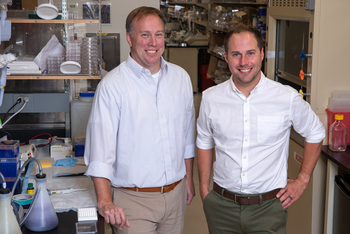
Now, Salk Assistant Professor and physician-scientist Edward Stites have used supercomputer modeling and cell studies to discover that more patients may be helped by a common class of targeted therapies than previously thought. The findings were published December 14, 2021, in Cell Reports.

“Colorectal cancer patients who have tried all of the standard treatment options but still seen their cancer progress need new options. Our study suggests that one already available targeted therapy could benefit up to 12,000 additional colon cancer patients every year,” says Stites, the paper’s senior author. “Our findings are pre-clinical, and we hope this research will motivate clinicians to develop clinical trials that further examine our results.”

Stites was interested in examining drugs that target a protein called EGFR (epidermal growth factor receptor). EGFR is known to drive a subset of many different cancer types, including lung cancer and colorectal cancer.

In 2004, the US Food and Drug Administration (FDA) approved cetuximab, the first drug to block EGFR activity in colorectal cancer. Since then, other drugs that target EGFR also have received approval. But from the early development of these drugs, doctors believed that patients with a mutation in any one of the families of proteins known as RAS would not respond to EGFR drugs. Therefore, whenever molecular testing of a patient’s tumor revealed a RAS mutation, the patient was not offered these targeted therapies.

Earlier research by the Stites lab suggested that not all RAS mutations act in the same manner, and was able to explain one well-known, but poorly understood, the exception to the rule. In the new study, the team combined computational and experimental approaches to using this new explanation to find more RAS mutations that should not cause resistance to the EGFR drugs.

The researchers used cells from cancers that were identical except for specific RAS mutations. This allowed them to compare how each specific mutation influenced the response to EGFR-inhibiting drugs. They found that some RAS mutations did not prevent the drugs from working. These experiments also allowed them to validate their computational studies, which helps establish how new computational methods could contribute to improving treatment options for cancer patients.

The investigators also examined how well different RAS mutants bound to another protein, called NF1. Stites’ previous mathematical models hinted that NF1 could play a key role in the cells’ response to targeted drugs. In their new studies, they revealed that the RAS mutants that do not bind NF1 well retain sensitivity to EGFR drugs, while the RAS mutants that bind NF1 well are resistant to EGFR drugs. This relationship to EGFR drugs was not originally apparent, but the computational modeling was able to uncover it from within the available and varied data.

Ultimately, the investigators identified 10 distinct RAS mutations that do not preclude the use of EGFR inhibitors. Many of the drugs that would work for these mutations are already approved by the FDA for other uses, which means that doctors could start prescribing them for their patients “off label” even before clinical trials are conducted.

Stites, who holds the Hearst Foundation Developmental Chair, stresses that this study also helps to validate the mathematical and computational methods developed by his team. “Models can solve scientific problems that traditional methods cannot,” he says. “We hope that future clinical trials will help identify the magnitude of benefit as well as whether all the RAS mutations we identified are equally sensitive to the EGFR-inhibiting drugs and how other mutations in addition to RAS may influence the strength of the response.”

The first author of the paper is Thomas McFall, a former postdoctoral fellow at Salk who is now at the Medical College of Wisconsin.

VLTI uses machine learning to help find stars moving around the Milky Way’s supermassive black hole

Tyler O'Neal, Staff Editor ACADEMIA December 14, 2021, 1:00 pm

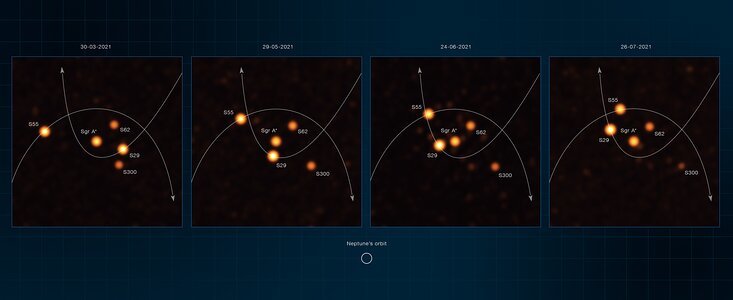
The European Southern Observatory’s Very Large Telescope Interferometer (ESO’s VLTI) has obtained the deepest and sharpest images to date of the region around the supermassive black hole at the center of our galaxy. The new images zoom in 20 times more than what was possible before the VLTI and have helped astronomers find a never-before-seen star close to the black hole. By tracking the orbits of stars at the center of our Milky Way, the team has made the most precise measurement yet of the black hole’s mass. These annotated images, obtained with the GRAVITY instrument on ESO’s Very Large Telescope Interferometer (VLTI) between March and July 2021, show stars orbiting very close to Sgr A*, the supermassive black hole at the heart of the Milky Way. One of these stars, named S29, was observed as it was making its closest approach to the black hole at 13 billion kilometres, just 90 times the distance between the Sun and Earth. Another star, named S300, was detected for the first time in the new VLTI observations. To obtain the new images, the astronomers used a machine-learning technique, called Information Field Theory. They made a model of how the real sources may look, simulated how GRAVITY would see them, and compared this simulation with GRAVITY observations. This allowed them to find and track stars around Sagittarius A* with unparalleled depth and accuracy. Credit: ESO/GRAVITY collaboration

“We want to learn more about the black hole at the center of the Milky Way, Sagittarius A*: How massive is it exactly? Does it rotate? Do stars around it behave exactly as we expect from Einstein’s general theory of relativity? The best way to answer these questions is to follow stars on orbits close to the supermassive black hole. And here we demonstrate that we can do that to a higher precision than ever before,” explains Reinhard Genzel, a director at the Max Planck Institute for Extraterrestrial Physics (MPE) in Garching, Germany who was awarded a Nobel Prize in 2020 for Sagittarius A* research. Genzel and his team’s latest results, which expand on their three-decade-long study of stars orbiting the Milky Way's supermassive black hole, are published today in two papers in Astronomy & Astrophysics.

On a quest to find even more stars close to the black hole, the team, known as the GRAVITY collaboration, developed a new analysis technique that has allowed them to obtain the deepest and sharpest images yet of our Galactic Centre. “The VLTI gives us this incredible spatial resolution and with the new images, we reach deeper than ever before. We are stunned by their amount of detail, and by the action and number of stars they reveal around the black hole,” explains Julia Stadler, a researcher at the Max Planck Institute for Astrophysics in Garching who led the team’s imaging efforts during her time at MPE. Remarkably, they found a star, called S300, which had not been seen previously, showing how powerful this method is when it comes to spotting very faint objects close to Sagittarius A*.

With their latest observations, conducted between March and July 2021, the team focused on making precise measurements of stars as they approached the black hole. This includes the record-holder star S29, which made its nearest approach to the black hole in late May 2021. It passed it at a distance of just 13 billion kilometers, about 90 times the Sun-Earth distance, at the stunning speed of 8740 kilometers per second. No other star has ever been observed to pass that close to, or travel that fast around, the black hole. 

{media id=266,layout=solo}

The team’s measurements and images were made possible thanks to GRAVITY, a unique instrument that the collaboration developed for ESO’s VLTI, located in Chile. GRAVITY combines the light of all four 8.2-meter telescopes of ESO’s Very Large Telescope (VLT) using a technique called interferometry. This technique is complex, “but in the end you arrive at images 20 times sharper than those from the individual VLT telescopes alone, revealing the secrets of the Galactic Centre,” says Frank Eisenhauer from MPE, principal investigator of GRAVITY.

“Following stars on close orbits around Sagittarius A* allows us to precisely probe the gravitational field around the closest massive black hole to Earth, to test General Relativity, and to determine the properties of the black hole,” explains Genzel. The new observations, combined with the team’s previous data, confirm that the stars follow paths exactly as predicted by General Relativity for objects moving around a black hole of mass 4.30 million times that of the Sun. This is the most precise estimate of the mass of the Milky Way’s central black hole to date. The researchers also managed to fine-tune the distance to Sagittarius A*, finding it to be 27 000 light-years away.

To obtain the new images, the astronomers used a machine-learning technique, called Information Field Theory. They made a model of how the real sources may look, simulated how GRAVITY would see them, and compared this simulation with GRAVITY observations. This allowed them to find and track stars around Sagittarius A* with unparalleled depth and accuracy. In addition to the GRAVITY observations, the team also used data from NACO and SINFONI, two former VLT instruments, as well as measurements from the Keck Observatory and NOIRLab’s Gemini Observatory in the US.

GRAVITY will be updated later this decade to GRAVITY+, which will also be installed on ESO’s VLTI and will push the sensitivity further to reveal fainter stars even closer to the black hole. The team aims to eventually find stars so close that their orbits would feel the gravitational effects caused by the black hole’s rotation. ESO’s upcoming Extremely Large Telescope (ELT), under construction in the Chilean Atacama Desert, will further allow the team to measure the velocity of these stars with very high precision. “With GRAVITY+’s and the ELT’s powers combined, we will be able to find out how fast the black hole spins,” says Eisenhauer. “Nobody has been able to do that so far.”

Stanford researchers show why heat may make weather less predictable

Tyler O'Neal, Staff Editor ACADEMIA December 14, 2021, 12:00 pm

A Stanford University study shows chaos reigns earlier in midlatitude weather models as temperatures rise. The result? Climate change could be shifting the limits of weather predictability and pushing reliable 10-day forecasts out of reach. Climate change could be shifting the limits of weather predictability and pushing reliable 10-day forecasts out of reach. (Image credit: Pexels and Getty Images Signature via Canva)

A new Stanford University study shows rising temperatures may intensify the unpredictability of the weather in Earth’s mid-latitudes. The limit of reliable temperature, wind, and rainfall forecasts falls by about a day when the atmosphere warms by even a few degrees Celsius.

“Our results show the state of the climate, in general, has implications for how many days out you can say something that’s accurate about the weather,” said atmospheric scientist Aditi Sheshadri, lead author of the study published Nov. 29 in Geophysical Research Letters. “Cooler climates seem to be inherently more predictable.”

Widespread changes in weather patterns and increased frequency and severity of extreme weather events are well-documented consequences of global climate change. These departures from old norms can bring storms, droughts, heatwaves, and wildfire conditions beyond what infrastructure has been designed to withstand or what people have come to expect.

Yet numerical weather models are still generally able to predict day-to-day weather 3 to 10 days out more reliably than they could in decades past, thanks to faster computers, better models of physical atmospheric processes, and more precise measurements.

The new research, based on computer simulations of a simplified Earth system and a comprehensive global climate model, suggests the window for accurate forecasts in the midlatitudes is several hours shorter with every degree (Celsius) of warming. This could translate to less time to prepare and mobilize for big storms in balmy winters than in frigid ones.

For precipitation, predictability falls by about a day with every 3 C rise in temperature. The effect is more muted for wind and temperature, with one day of predictability lost with each 5 C increase in temperature.

While global average temperatures have increased by 1.1 C (2 F) since the late 1800s, not all places are warming at the same rate. Some U.S. cities have seen average annual temperatures rise by well over 2 C since 1970. Seasonal variations can be even more extreme.

Further analysis will be needed to assess whether winter weather is inherently more predictable than summer weather, Sheshadri said, but the new results strongly indicate a shorter time horizon for reliable weather predictions in places that warm beyond their historical norms.

Butterfly effect

The research comes as the U.S. government prepares to spend $80 million on supercomputing equipment for developing weather and climate models as part of the bipartisan infrastructure law enacted in November.

But the problem of predicting specific weather beyond 10 or possibly 15 days in the future with perfect accuracy isn’t one that can be solved with more computing power or better models. The chaotic nature of Earth’s atmosphere imposes insurmountable limits on forecasting.

This is the crux of meteorologist Edward Lorenz’s discoveries related to the “butterfly effect” in the 1960s. Lorenz found that minuscule differences in initial conditions – like the wind perturbations from a butterfly flapping its wings – produce dramatically different results in models of Earth’s weather system.

For each measure of barometric pressure, temperature, wind speed, and the like that might be included in numerical weather models, uncertainty is impossible to avoid. These imperfections propagate through the model over time, so as you look further into the future, the gap between predictions made from seemingly identical initial conditions grows. At a point, the results lose all resemblance to one another and are indistinguishable from predictions based on realistic but random starting conditions. The supercomputer model at this juncture is said to “lose memory” of its initial conditions.

There is value in unpacking the effects of atmospheric chaos. Meteorologists have long sought to identify the intrinsic limit of weather predictability, in part to find ways to improve models of Earth’s climate and atmosphere. The United Nations’ World Meteorological Organization has estimated the socioeconomic benefits of weather prediction amount to at least $160 billion per year.

“We’re working to understand what sets this finite limit of predictability, and also how it might change in different climates, so people can be prepared for these changes,” said Sheshadri, who is an assistant professor of Earth system science at Stanford’s School of Earth, Energy & Environmental Sciences (Stanford Earth).

For Earth’s middle latitudes, where most Americans live, the new research suggests errors propagate through weather models faster as temperatures rise, and there don’t appear to be any temperature thresholds where the trend shifts. According to the authors, this appears to be linked to the growth of storms known as eddies in the troposphere, the layer of atmosphere closest to Earth. Past research has shown that when air at the planet’s surface is warmer, changes in the vertical arrangement of heat and cold in the atmosphere fuel faster eddy growth.

“When the eddies grow quicker, the models seem to lose track of initial conditions very quickly. And that means that the window of prediction narrows,” Sheshadri said.

  1. Japanese team uses ATERUI II to show stellar 'ashfall' could help distant planets grow
  2. Washington researchers build Artificial intelligence that can create better lightning forecasts

Page 83 of 123

  • 78
  • 79
  • 80
  • 81
  • 82
  • 83
  • 84
  • 85
  • 86
  • 87
POPULAR RIGHT NOW
  • Supercomputers uncover a new class of cosmic explosions hidden in plain sight
    Supercomputers uncover a new class of cosmic explosions hidden in plain sight
  • AI supercharges the hunt for stronger magnets: Iowa State researchers launch a new era of intelligent materials discovery
    AI supercharges the hunt for stronger magnets: Iowa State researchers launch a new era of intelligent materials discovery
  • IBM's Historic stock collapse raises questions for the future of enterprise supercomputing
    IBM's Historic stock collapse raises questions for the future of enterprise supercomputing
  • Could a novel dark matter theory simultaneously resolve multiple cosmic enigmas? Supercomputer simulations provide a compelling, albeit currently unverified, potential solution
    Could a novel dark matter theory simultaneously resolve multiple cosmic enigmas? Supercomputer simulations provide a compelling, albeit currently unverified, potential solution
  • Melting icebergs may be reshaping Earth’s greatest ocean current
    Melting icebergs may be reshaping Earth’s greatest ocean current
  • Supercomputers replace ‘bathtub’ flood maps with physics-based digital twins of Britain’s coastline
    Supercomputers replace ‘bathtub’ flood maps with physics-based digital twins of Britain’s coastline
  • Supercomputers push neural quantum simulation beyond previous limits
    Supercomputers push neural quantum simulation beyond previous limits
  • Intel’s AI supercomputing revival: Q2 financial surge signals new era for CPU-powered HPC infrastructure
    Intel’s AI supercomputing revival: Q2 financial surge signals new era for CPU-powered HPC infrastructure
  • AI infrastructure financing fears shake semiconductor sector
    AI infrastructure financing fears shake semiconductor sector
  • AWS supercomputing investment reaches historic scale as Amazon’s AI strategy powers record financial results
    AWS supercomputing investment reaches historic scale as Amazon’s AI strategy powers record financial results
THIS YEAR'S MOST READ
  • Wall Street wants to trade supercomputing power like oil
    Wall Street wants to trade supercomputing power like oil
  • Cosmic ambition at scale: UK’s supercomputer unlocks a 2.5 petabytes universe
    Cosmic ambition at scale: UK’s supercomputer unlocks a 2.5 petabytes universe
  • Hidden order, revealed at scale: Supercomputing, electron ptychography uncover the inner workings of relaxor ferroelectrics
    Hidden order, revealed at scale: Supercomputing, electron ptychography uncover the inner workings of relaxor ferroelectrics
  • Beamforming the future: BeammWave's 6G push signals the rise of orbital-terrestrial wireless networks
    Joakim Axmon
    Joakim Axmon
  • Intel's Q1 results signal supercomputing surge driving Xeon momentum
    Intel's Q1 results signal supercomputing surge driving Xeon momentum
  • When stars fall apart: Supercomputing reveals the hidden physics of black holes
    When stars fall apart: Supercomputing reveals the hidden physics of black holes
  • Multi-layer simulations reveal the hidden supply chain of solar prominences
    Multi-layer simulations reveal the hidden supply chain of solar prominences
  • Japanese scientists decode dolphin speed with supercomputing: Turbulence, vortices, and the hidden physics of propulsion
    Japanese scientists decode dolphin speed with supercomputing: Turbulence, vortices, and the hidden physics of propulsion
  • Cosmic feedback at scale: Supercomputing reveals how quasars regulate the early Universe
    Cosmic feedback at scale: Supercomputing reveals how quasars regulate the early Universe
  • Modeling life at the microscopic scale: A computational breakthrough in oxygen transport
    Modeling life at the microscopic scale: A computational breakthrough in oxygen transport
MOST READ OF ALL-TIME
  • Largest Computational Biology Simulation Mimics The Ribosome
    Details
    112108
    The amino acid (green) slithers into the chemical reaction center, moving through an evolutionarily ancient corridor of the ribosome (purple). The amino acid is delivered to the reaction core by the transfer RNA molecule (yellow).
    The amino acid (green) slithers into the chemical reaction center, moving through an evolutionarily ancient corridor of the ribosome (purple). The amino acid is delivered to the reaction core by the transfer RNA molecule (yellow).
  • Silicon 'neurons' may add a new dimension to chips
    Details
    80995
    Silicon 'neurons' may add a new dimension to chips
  • Linux Networx Accelerators Expected to Drive up to 4x Price/Performance
    Details
    75538
  • Complex Concepts That Really Add Up
    Details
    73639
    Complex Concepts That Really Add Up
  • Blue Sky Studios Donates Animation SuperComputer to Wesleyan
    Details
    68141
    Each rack holds 52 Angstrom Microsystem-brand “blades,” with a memory footprint of 12 or 24 gigabytes each. (Photos by Olivia Bartlett Drake)
    Each rack holds 52 Angstrom Microsystem-brand “blades,” with a memory footprint of 12 or 24 gigabytes each. (Photos by Olivia Bartlett Drake)
  • Humanities, HPC connect at NERSC
    Details
    57948
  • TeraGrid ’09 'Call for Participation'
    Details
    54952
  • Turbulence responsible for black holes' balancing act
    Details
    52313
  • Cray Wins $52 Million SuperComputer Contract
    Details
    50140
  • SDSC Researchers Accurately Predict Protein Docking
    Details
    46082
  • FRONTPAGE
  • LATEST
  • POPULAR
  • REGISTER
  • SOCIAL
  • VIDEO
  • SUBSCRIPTION
  • RSS
  • GUIDELINES
  • PRIVACY
  • TOS
  • ABOUT
  • +1 (816) 799-4488
  • editorial@supercomputingonline.com
© 2001 - 2026 SuperComputingOnline.com, LLC. All rights reserved. This material may not be published, broadcast, rewritten or redistributed without permission.
Sign In
  • FRONT PAGE
  • LATEST
    • MEDIA KIT
    • MOST READ
    • RSS FEED
    • ACADEMIA
    • AEROSPACE
    • APPLICATIONS
    • ASTRONOMY
    • AUTOMOTIVE
    • BIG DATA
    • BIOLOGY
    • CHEMISTRY
    • CLIENTS
    • CLOUD
    • DEFENSE
    • DEVELOPER TOOLS
    • EARTH SCIENCES
    • ECONOMICS
    • ENGINEERING
    • ENTERTAINMENT
    • HEALTH
    • INDUSTRY
    • INTERCONNECTS
    • GAMING
    • GOVERNMENT
    • MANUFACTURING
    • MIDDLEWARE
    • MOVIES
    • NETWORKS
    • OIL & GAS
    • PHYSICS
    • PROCESSORS
    • RETAIL
    • SCIENCE
    • STORAGE
    • SYSTEMS
    • VISUALIZATION
  • VIDEOS
    • ADD YOUR VIDEOS
    • MANAGE VIDEOS
  • COMMUNITY
    • TRADE SHOWS
    • SOCIAL NETWORK VIDEOS
    • SURVEYS
    • APPLICATIONS BROWSER
    • CONVERSATION INBOX
    • SOCIAL ADVERTISER
    • GROUPS
    • MARKETPLACE LISTINGS
    • PAGES
    • LEADERBOARD
    • POINTS LISTING
      • BADGES
    • PRIVACY CONFIRM REQUEST
    • PRIVACY CREATE REQUEST

Hey there! We noticed you’re using an ad blocker.