

SUPERCOMPUTING NEWS SUPERCOMPUTING NEWS
    • MEDIA KIT
    • MOST READ
    • RSS FEED
    • ACADEMIA
    • AEROSPACE
    • APPLICATIONS
    • ASTRONOMY
    • AUTOMOTIVE
    • BIG DATA
    • BIOLOGY
    • CHEMISTRY
    • CLIENTS
    • CLOUD
    • DEFENSE
    • DEVELOPER TOOLS
    • EARTH SCIENCES
    • ECONOMICS
    • ENGINEERING
    • ENTERTAINMENT
    • GAMING
    • GOVERNMENT
    • HEALTH
    • OIL & GAS
    • INDUSTRY
    • INTERCONNECTS
    • MANUFACTURING
    • MIDDLEWARE
    • MOVIES
    • NETWORKS
    • PHYSICS
    • PROCESSORS
    • RETAIL
    • SCIENCE
    • STORAGE
    • SYSTEMS
    • VISUALIZATION
    • AcyMailing subscription form

    • ADD YOUR VIDEOS
    • MANAGE VIDEOS
    • CONVERSATION INBOX
    • SOCIAL ADVERTISER
    • SOCIAL NETWORK VIDEOS
    • SURVEYS
    • GROUPS
    • PAGES
    • MARKETPLACE LISTINGS
    • APPLICATIONS BROWSER
    • PRIVACY CONFIRM REQUEST
    • PRIVACY CREATE REQUEST
    • LEADERBOARD
    • POINTS LISTING
      • BADGES
    • TRADE SHOWS
Sign In
Tyler O'Neal, Staff Editor ACADEMIA December 9, 2021, 9:00 am

Washington scientists show what types of environments astronomers can expect to find on exoplanets

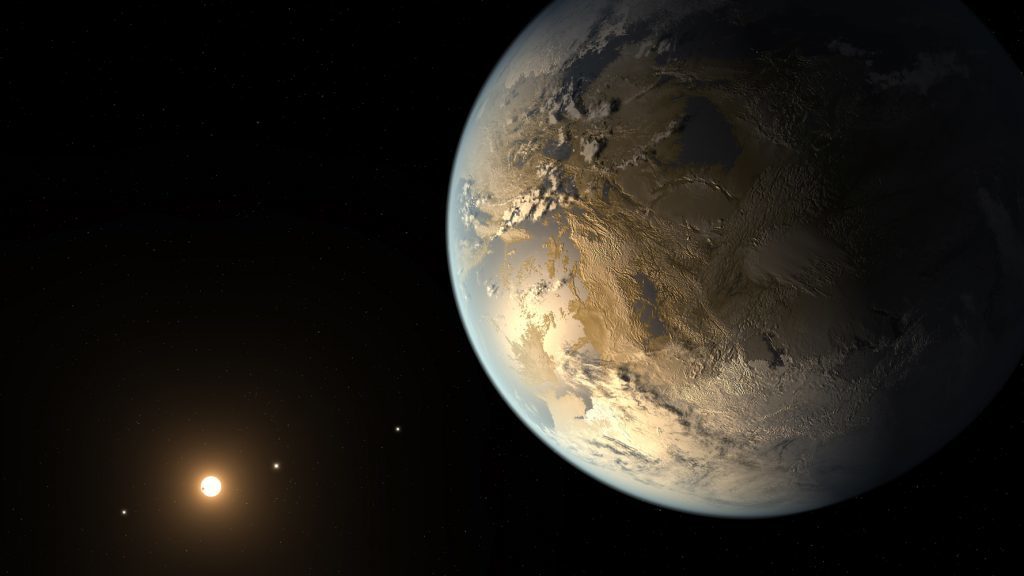
Exoplanets are experiencing a stratospheric rise. In the three decades since the first confirmed planet orbiting another star, scientists have cataloged more than 4,000 of them. As the list grows, so too does the desire to find Earth-like exoplanets — and to determine whether they could be life-sustaining oases like our own globe. An artist’s depiction of Kepler-186f, an Earth-sized exoplanet, showing a hypothetical surface that includes partial ice coverage at the poles.NASA Ames/SETI Institute/JPL-Caltech
The coming decades should see the launch of new missions that can gather ever-larger amounts of data about exoplanets. Anticipating these future endeavors, a team at the University of Washington and the University of Bern has computationally simulated more than 200,000 hypothetical Earth-like worlds — planets that have the same size, mass, atmospheric composition, and geography as modern Earth — all in orbit of stars like our sun. Their goal was to model what types of environments astronomers can expect to find on real Earth-like exoplanets.

As they report in a paper accepted to the Planetary Science Journal and submitted Dec. 6 to the preprint site arXiv, on these simulated exoplanets, one common feature of present-day Earth was often lacking: partial ice coverage.

“We essentially simulated Earth’s climate on worlds around different types of stars, and we find that in 90% of cases with liquid water on the surface, there are no ice sheets, like polar caps,” said co-author Rory Barnes, a UW professor of astronomy and scientist with the UW’s Virtual Planetary Laboratory. “When ice is present, we see that ice belts — permanent ice along the equator — are actually more likely than ice caps.”

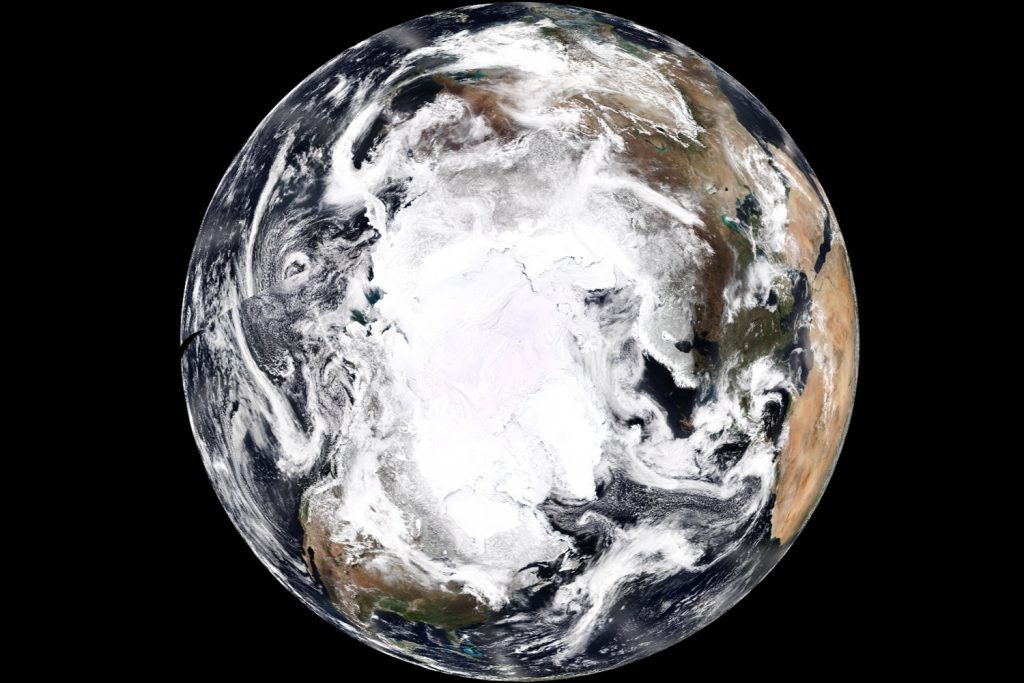
The findings shed light on the complex interplay between liquid water and ice on Earth-like worlds, according to lead author Caitlyn Wilhelm, who led the study as an undergraduate student in the UW Department of Astronomy. A composite image of the ice cap covering Earth’s Arctic region — including the North Pole — taken 512 miles above our planet on April 12, 2018 by the NOAA-20 polar-orbiting satellite.NOAA
“Looking at ice coverage on an Earth-like planet can tell you a lot about whether it’s habitable,” said Wilhelm, who is now a research scientist with the Virtual Planetary Laboratory. “We wanted to understand all the parameters — the shape of the orbit, the axial tilt, the type of star — that affect whether you have ice on the surface, and if so, where.”

The team used a 1-D energy balance model, which computationally imitates the energy flow between a planet’s equator and poles, to simulate the climates on thousands of hypothetical exoplanets in various orbital configurations around F-, G- or K-type stars. These classes of stars, which include our G-type sun, are promising candidates for hosting life-friendly worlds in their habitable zones, also known as the “Goldilocks” zone. F-type stars are a bit hotter and larger than our sun; K-type stars are slightly cooler and smaller.

In their simulations, the orbits of the exoplanets ranged from circular to pronounced oval. The team also considered axial tilts ranging from 0 to 90 degrees. Earth’s axial tilt is a moderate 23.5 degrees. A planet with a 90-degree tilt would “sit on its side” and experience extreme seasonal variations in climate, much like the planet Uranus.

According to the simulations, which encompassed a 1-million-year timespan on each world, Earth-like worlds showed climates ranging from planet-wide “snowball” climates — with ice present at all latitudes — to a steaming “moist greenhouse,” which is probably similar to Venus’ climate before a runaway greenhouse effect made its surface hot enough to melt lead. But even though most environments in the simulations fell somewhere between those extremes, partial surface ice was present on only about 10% of hypothetical, habitable exoplanets.

The model included natural variations over time in each world’s axial tilt and orbit, which in part explains the general lack of ice on habitable exoplanets, according to co-author Russell Deitrick, a postdoctoral scientist at the University of Bern and researcher with the Virtual Planetary Laboratory. An artist’s depiction of ancient Earth in a snowball state.NASA

“Orbits and axial tilts are always changing,” said Deitrick. “On Earth, these variations are called Milankovitch cycles and are very small in amplitude. But for exoplanets, these changes can be quite large, which can eliminate ice or trigger ‘snowball’ states.”

When partial ice was present, its distribution varied by a star. Around F-type stars, polar ice caps — like what Earth sports currently — were found about three times more often than ice belts, whereas ice belts occurred twice as often as caps for planets around G- and K-type stars. Ice belts were also more common on worlds with extreme axial tilts, likely because seasonal extremes keep the polar climates more volatile than equatorial regions, according to Wilhelm.

The team’s findings of ice on these simulated Earth-like worlds should help in the search for potentially habitable worlds by showing astronomers what they can expect to find, especially regarding ice distribution and the types of climates.

“Surface ice is very reflective, and can shape how an exoplanet ‘looks’ through our instruments,” said Wilhelm. “Whether or not ice is present can also shape how a climate will change over the long term, whether it goes to an extreme — like a ‘snowball Earth’ or a runaway greenhouse — or something more moderate.”

Ice alone, or its absence, does not determine habitability, though.

“Habitability encompasses a lot of moving parts, not just the presence or absence of ice,” said Wilhelm.

Life on Earth has survived snowball periods, as well as hundreds of millions of ice-free years, according to Barnes.

“Our own planet has seen some of these extremes in its own history,” said Barnes. “We hope this study lays the groundwork for upcoming missions to look for habitable signatures in exoplanet atmospheres — and to even image exoplanets directly — by showing what’s possible, what’s common, and what’s rare.”

Rachel Mellman, a recent UW graduate in astronomy, is a co-author of the paper. The research was funded by NASA through grants to the Virtual Planetary Laboratory.
Japanese built AI can discover hidden physical laws in various data

Tyler O'Neal, Staff Editor ACADEMIA December 9, 2021, 8:00 am

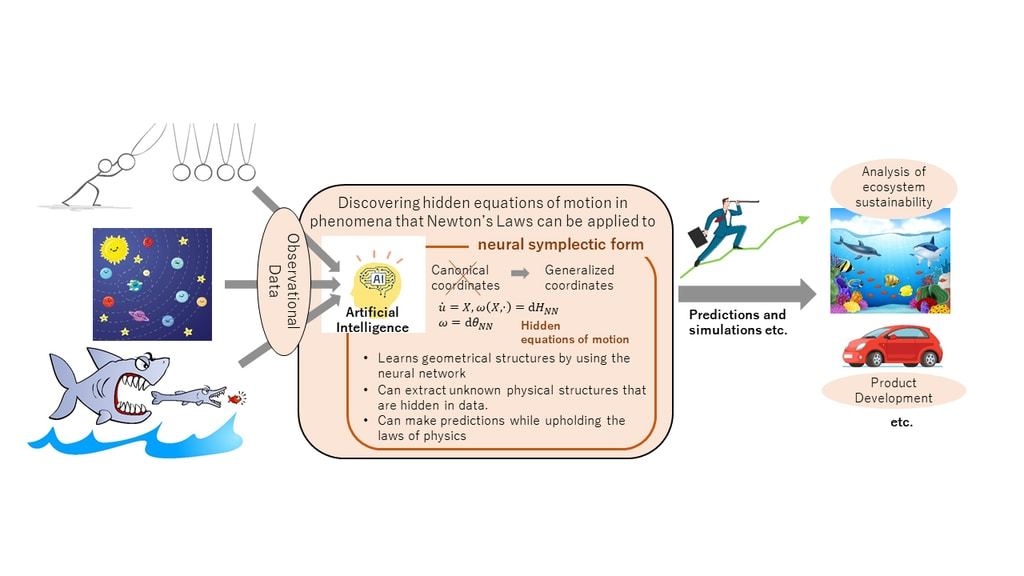
Researchers at Kobe University and Osaka University in Japan have successfully developed artificial intelligence technology that can extract hidden equations of motion from regular observational data and create a model that is faithful to the laws of physics. Diagram explaining the developed artificial intelligence technology

This technology could enable us to discover the hidden equations of motion behind phenomena for which the laws were considered unexplainable. For example, it may be possible to use physics-based knowledge and simulations to examine ecosystem sustainability.

The research group consisted of Associate Professor YAGUCHI Takaharu and Ph.D. student CHEN Yuhan (Graduate School of System Informatics, Kobe University), and Associate Professor MATSUBARA Takashi (Graduate School of Engineering Science, Osaka University).

These research achievements were made public on December 6, 2021, and were presented at the Thirty-fifth Conference on Neural Information Processing Systems (NeurIPS2021), a prestigious meeting on artificial intelligence technologies. This research was among the top 3% selected for the spotlight category.

Main Points

  • Being able to model (formularize) physical phenomena using artificial intelligence could result in extremely precise, high-speed simulations.
  • In current methods using artificial intelligence, it is necessary to use transformed data that fits the equation of motion. Therefore it is difficult to apply artificial intelligence to actual observational data for which the equations of motion are unknown.
  • The research group used geometry to develop artificial intelligence that can find the hidden equation of motion in the supplied observational data (regardless of its format) and model it accordingly.
  • In the future, it may be possible to discover the hidden physical laws behind phenomena that had previously been considered to be incompatible with Newton’s Laws, such as ecosystem changes.
  • This will enable us to carry out investigations and simulations related to these phenomena using the laws of physics, which could reveal previously unknown properties.

Research Background
Ordinarily, predictions of physical phenomena are carried out via simulations using supercomputers. These simulations use mathematical models based on the laws of physics, however, if the model is not highly reliable then the results will also lack reliability. Therefore, it is essential to develop a method of producing highly reliable models from the observational data of phenomena. Furthermore, in recent years the range of physics applications has expanded beyond our predictions, and it has been demonstrated that it is possible to apply Newton’s Laws to other aspects, such as part of a model to show ecosystem changes. However, a concrete equation of motion has not yet been revealed in many cases.

Research Methodology
This research study developed a method of discovering novel equations of motion in observational data for phenomena that Newton’s Laws can be applied to. Previously, research has been conducted into discovering equations of motion from data, however, the prior method required the data to be in the appropriate format to fit its assumed special form of the equation of motion. However, there are many cases in a reality where it is not clear what data format is best to use, therefore it is difficult to apply realistic data.

In response to this, the researchers considered that the appropriate transformation of observational data is akin to coordinate transformation in geometry, thus resolving the issue by applying the geometric idea of coordinate transformation invariance found in physics. For this, it is necessary to illuminate the unknown geometric properties behind phenomena. The research team subsequently succeeded in developing AI that can find these geometric properties in data. If equations of motion can be extracted from data, then it will be possible to use these equations to create models and simulations that are faithful to physical laws.

Physics simulations are carried out in a wide range of fields, including weather forecasting, drug discovery, building analyses, and car design, but they usually require extensive calculations. However, if AI can learn from the data of specific phenomena and construct small-scale models using the proposed method, then this will simplify and speed up calculations that are faithful to the laws of physics. This will contribute to the development of the aforementioned fields. Furthermore, we can apply this method to aspects that at first glance appear to be unrelated to physics. If equations of motion can be extracted in such cases, this will make it possible to do physics knowledge-based investigations and simulations even for phenomena that have been considered impossible to explain using physics. For example, it may be possible to find a hidden equation of motion in animal population data that shows the change in the number of individuals. This could be used to investigate ecosystem sustainability by applying the appropriate physical laws (eg. the law of conservation of energy, etc.).

New supercomputer simulations identify widespread changes in climate variability under sustained anthropogenic forcing

Tyler O'Neal, Staff Editor ACADEMIA December 9, 2021, 7:00 am

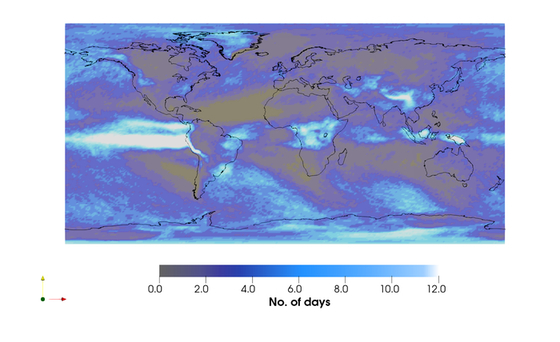
There is growing public awareness that climate change will impact society not only through changes in mean temperatures and precipitation over the 21st century, but also in the occurrence of more pronounced extreme events, and more generally in natural variability in the Earth system. Extreme precipitation days per decade due to greenhouse warming over the 21st century. The first step in deriving the pattern shown is identifying the once-in-ten-year events of maximum precipitation over 2000-2009 for the 100 simulations. Here, this threshold is chosen as the lowest of the top 100 values of precipitation. For the second step, the number of days over 2090-2099 that exceed the threshold value is counted, and thereby while a value of 1 on the scale (units of days) means that there is no change in future, a value of 6 indicates 5 additional days of extreme precipitation in future. Note that the color scale saturates at 12 days to emphasize the response over land, given the very large amplitude over the eastern equatorial Pacific domain.

Such changes could also have large impacts on vulnerable ecosystems in both terrestrial and marine habitats. A scientific exploration of projected future changes in climate and ecosystem variability is described in a new study published in the journal Earth System Dynamics, representing the result of a broad collaborative partnership between the IBS Center for Climate Physics (ICCP) at Pusan National University in South Korea and the Community Earth System Model (CESM) project at the National Center for Atmospheric Research (NCAR) in the US.

The team conducted a set of 100 global Earth system model simulations over 1850-2100, working with a “business-as-usual” scenario for relatively strong emissions of greenhouse gases over the 21st century. The runs were given different initial conditions, and by virtue of the butterfly effect, they were able to represent a broad envelope of possible climate states over 1850-2100, enabling sophisticated analyses of changes in the variability of the Earth system over time. The nominally one-degree (~100km) resolution of the model, in conjunction with the 100-member set of runs, represented an unprecedented set of technical challenges that needed to be met before advancing to the goal of assessing how climate variability is impacted by sustained anthropogenic changes to the climate system. “We met these challenges by using the IBS/ICCP supercomputer Aleph, one of Korea’s fastest supercomputers,” says Dr. Sun-Seon Lee from the ICCP, a co-author of the study who ran the simulations together with her NCAR colleague Dr. Nan Rosenbloom. For the project, approximately 80 million hours of supercomputer time were used, and approximately 5 Petabytes of disc space (approximately 5000 normal hard discs) were required for storage of the model output.

The main finding of the study is that the impact of climate change is apparent in nearly all aspects of climate variability, ranging from temperature and precipitation extremes over land to increased number of fires in California, to changes in bloom amplitude for phytoplankton in the North Atlantic Ocean. Each of these changes has an important impact on sustainable resource management. As an example, occurrences of extreme precipitation events over the 21st century (between 2000-2009 and 2090-2099, see Fig. 1) indicate that extremes are expected to become more commonplace over many regions. These projected changes in precipitation extremes are in fact representative of the omnipresence of changes in extremes in the future across a broad range of climate and ecosystem variables, which has important implications for future adaptation strategies.

“In addition to large-scale changes in extreme events, our study also identified large-scale changes in the structure of the seasonal cycle over the 21st century, showing an enhanced growing season length over the continental regions north of 50°N”, says Dr. Keith Rodgers from the ICCP, first author of the study and a co-lead of the CESM2 Large Ensemble Project. Largely due to mean state warming and ensuing changes in the timing of the retreat and advance of winter snow cover, by the end of the 21st century growing season length is projected to increase by three weeks.

Taken together, the supercomputer simulations reveal that across our planet we can expect widespread changes in climate variability, ranging in timescales from synoptic storms to seasons to that of El Niño to decades. Dr. Gokhan Danabasoglu, a co-author of the study and a co-lead of the project, says “an important step moving forward will be to identify more fully the potential societal impacts and to communicate the implications for adaptation strategies.” This broader study has already motivated a number of more specialized scientific investigations using the tremendous volume of output from the simulations, spanning topics from marine ecosystem impacts to hydrological changes that affect water supply.

  1. Virginia Tech research makes waves tackling the future of tsunami modeling
  2. Pandemic protection investment must be maintained against the next COVID

Page 88 of 123

  • 83
  • 84
  • 85
  • 86
  • 87
  • 88
  • 89
  • 90
  • 91
  • 92
POPULAR RIGHT NOW
  • Supercomputers uncover a new class of cosmic explosions hidden in plain sight
    Supercomputers uncover a new class of cosmic explosions hidden in plain sight
  • AI supercharges the hunt for stronger magnets: Iowa State researchers launch a new era of intelligent materials discovery
    AI supercharges the hunt for stronger magnets: Iowa State researchers launch a new era of intelligent materials discovery
  • IBM's Historic stock collapse raises questions for the future of enterprise supercomputing
    IBM's Historic stock collapse raises questions for the future of enterprise supercomputing
  • Could a novel dark matter theory simultaneously resolve multiple cosmic enigmas? Supercomputer simulations provide a compelling, albeit currently unverified, potential solution
    Could a novel dark matter theory simultaneously resolve multiple cosmic enigmas? Supercomputer simulations provide a compelling, albeit currently unverified, potential solution
  • Melting icebergs may be reshaping Earth’s greatest ocean current
    Melting icebergs may be reshaping Earth’s greatest ocean current
  • Supercomputers replace ‘bathtub’ flood maps with physics-based digital twins of Britain’s coastline
    Supercomputers replace ‘bathtub’ flood maps with physics-based digital twins of Britain’s coastline
  • Supercomputers push neural quantum simulation beyond previous limits
    Supercomputers push neural quantum simulation beyond previous limits
  • Intel’s AI supercomputing revival: Q2 financial surge signals new era for CPU-powered HPC infrastructure
    Intel’s AI supercomputing revival: Q2 financial surge signals new era for CPU-powered HPC infrastructure
  • AI infrastructure financing fears shake semiconductor sector
    AI infrastructure financing fears shake semiconductor sector
  • AWS supercomputing investment reaches historic scale as Amazon’s AI strategy powers record financial results
    AWS supercomputing investment reaches historic scale as Amazon’s AI strategy powers record financial results
THIS YEAR'S MOST READ
  • Wall Street wants to trade supercomputing power like oil
    Wall Street wants to trade supercomputing power like oil
  • Cosmic ambition at scale: UK’s supercomputer unlocks a 2.5 petabytes universe
    Cosmic ambition at scale: UK’s supercomputer unlocks a 2.5 petabytes universe
  • Hidden order, revealed at scale: Supercomputing, electron ptychography uncover the inner workings of relaxor ferroelectrics
    Hidden order, revealed at scale: Supercomputing, electron ptychography uncover the inner workings of relaxor ferroelectrics
  • Beamforming the future: BeammWave's 6G push signals the rise of orbital-terrestrial wireless networks
    Joakim Axmon
    Joakim Axmon
  • Intel's Q1 results signal supercomputing surge driving Xeon momentum
    Intel's Q1 results signal supercomputing surge driving Xeon momentum
  • When stars fall apart: Supercomputing reveals the hidden physics of black holes
    When stars fall apart: Supercomputing reveals the hidden physics of black holes
  • Multi-layer simulations reveal the hidden supply chain of solar prominences
    Multi-layer simulations reveal the hidden supply chain of solar prominences
  • Japanese scientists decode dolphin speed with supercomputing: Turbulence, vortices, and the hidden physics of propulsion
    Japanese scientists decode dolphin speed with supercomputing: Turbulence, vortices, and the hidden physics of propulsion
  • Cosmic feedback at scale: Supercomputing reveals how quasars regulate the early Universe
    Cosmic feedback at scale: Supercomputing reveals how quasars regulate the early Universe
  • Modeling life at the microscopic scale: A computational breakthrough in oxygen transport
    Modeling life at the microscopic scale: A computational breakthrough in oxygen transport
MOST READ OF ALL-TIME
  • Largest Computational Biology Simulation Mimics The Ribosome
    Details
    112108
    The amino acid (green) slithers into the chemical reaction center, moving through an evolutionarily ancient corridor of the ribosome (purple). The amino acid is delivered to the reaction core by the transfer RNA molecule (yellow).
    The amino acid (green) slithers into the chemical reaction center, moving through an evolutionarily ancient corridor of the ribosome (purple). The amino acid is delivered to the reaction core by the transfer RNA molecule (yellow).
  • Silicon 'neurons' may add a new dimension to chips
    Details
    80995
    Silicon 'neurons' may add a new dimension to chips
  • Linux Networx Accelerators Expected to Drive up to 4x Price/Performance
    Details
    75538
  • Complex Concepts That Really Add Up
    Details
    73639
    Complex Concepts That Really Add Up
  • Blue Sky Studios Donates Animation SuperComputer to Wesleyan
    Details
    68141
    Each rack holds 52 Angstrom Microsystem-brand “blades,” with a memory footprint of 12 or 24 gigabytes each. (Photos by Olivia Bartlett Drake)
    Each rack holds 52 Angstrom Microsystem-brand “blades,” with a memory footprint of 12 or 24 gigabytes each. (Photos by Olivia Bartlett Drake)
  • Humanities, HPC connect at NERSC
    Details
    57948
  • TeraGrid ’09 'Call for Participation'
    Details
    54952
  • Turbulence responsible for black holes' balancing act
    Details
    52313
  • Cray Wins $52 Million SuperComputer Contract
    Details
    50140
  • SDSC Researchers Accurately Predict Protein Docking
    Details
    46082
  • FRONTPAGE
  • LATEST
  • POPULAR
  • REGISTER
  • SOCIAL
  • VIDEO
  • SUBSCRIPTION
  • RSS
  • GUIDELINES
  • PRIVACY
  • TOS
  • ABOUT
  • +1 (816) 799-4488
  • editorial@supercomputingonline.com
© 2001 - 2026 SuperComputingOnline.com, LLC. All rights reserved. This material may not be published, broadcast, rewritten or redistributed without permission.
Sign In
  • FRONT PAGE
  • LATEST
    • MEDIA KIT
    • MOST READ
    • RSS FEED
    • ACADEMIA
    • AEROSPACE
    • APPLICATIONS
    • ASTRONOMY
    • AUTOMOTIVE
    • BIG DATA
    • BIOLOGY
    • CHEMISTRY
    • CLIENTS
    • CLOUD
    • DEFENSE
    • DEVELOPER TOOLS
    • EARTH SCIENCES
    • ECONOMICS
    • ENGINEERING
    • ENTERTAINMENT
    • HEALTH
    • INDUSTRY
    • INTERCONNECTS
    • GAMING
    • GOVERNMENT
    • MANUFACTURING
    • MIDDLEWARE
    • MOVIES
    • NETWORKS
    • OIL & GAS
    • PHYSICS
    • PROCESSORS
    • RETAIL
    • SCIENCE
    • STORAGE
    • SYSTEMS
    • VISUALIZATION
  • VIDEOS
    • ADD YOUR VIDEOS
    • MANAGE VIDEOS
  • COMMUNITY
    • TRADE SHOWS
    • SOCIAL NETWORK VIDEOS
    • SURVEYS
    • APPLICATIONS BROWSER
    • CONVERSATION INBOX
    • SOCIAL ADVERTISER
    • GROUPS
    • MARKETPLACE LISTINGS
    • PAGES
    • LEADERBOARD
    • POINTS LISTING
      • BADGES
    • PRIVACY CONFIRM REQUEST
    • PRIVACY CREATE REQUEST

Hey there! We noticed you’re using an ad blocker.