Scientists use ASU built supercomputer models to solve a part of the mystery of ultra-rare blood clots linked to adenovirus-based COVID-19 vaccines

An international team of scientists believes they may have found a molecular mechanism behind the extremely rare blood clots linked to adenovirus COVID-19 vaccines.

Scientists led by a team from Arizona State University, Cardiff University, and others worked with AstraZeneca to investigate vaccine-induced immune thrombotic thrombocytopenia (VITT), also known as thrombosis with thrombocytopenia syndrome (TTS), a life-threatening condition seen in a very small number of people after receiving the Oxford-AstraZeneca or Johnson & Johnson vaccines. 

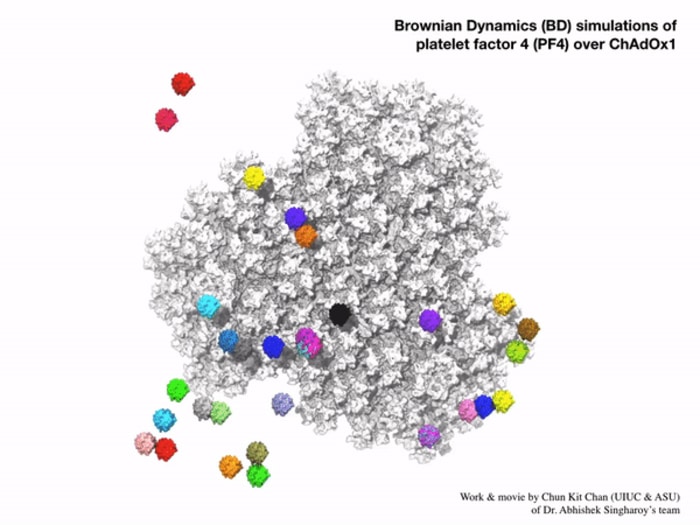
“The mechanism which results in this condition, termed vaccine-induced immune thrombotic thrombocytopenia (VITT), was unknown,” said Abhishek Singharoy, an Arizona State University scientist and corresponding author of the study who teamed up to lead an international effort to tease out the details. So, a team quickly assembled to try to understand the problem more clearly. This supercomputer simulation shows a cloud of platelet factor 4 proteins interacting with the electrostatic surface of the Oxford vaccine.  CREDIT Chun Kit Chan, Arizona State University
Together, they worked to solve the structural biology of the vaccine and see the molecular details that may be at play, utilizing ASU’s new cryo-EM facilities, and a state-of-the-art Titan Krios machine at ASU’s Eyring Materials Center at Arizona State University.

ASU scientists included several from the School of Molecular Sciences and Biodesign Institute: Ryan J. Boyd, Daipayan Sarkar, John Vant, Eric Wilson, Chloe D. Truong, Petra Fromme, Po-Lin Chiu, Dewight Williams, and Josh Vermaas (ASU alumnus now at Michigan State University). Mitesh Borad, Bolni M. Nagalo, and Alexander T. Baker were also part of the Arizona-based team.

The global team used state-of-the-art cryo-EM technology to analyze the AstraZeneca vaccine in minute detail to understand whether the ultra-rare side effect could be linked to the viral vector which is used in many vaccines, including those from Oxford/AstraZeneca and Johnson & Johnson.

Their findings suggest it is the viral vector – in this case, an adenovirus used to shuttle the coronavirus’ genetic material into cells – and the way it binds to platelet factor 4 (PF4) once injected that could be the potential mechanism.

In very rare cases, the scientists suggest, the viral vector may enter the bloodstream and bind to PF4, where the immune system then views this complex as foreign. They believe this misplaced immunity could result in the release of antibodies against PF4, which bind to and activate platelets, causing them to cluster together and triggering blood clots in a very small number of people after the vaccine is administered.

“It’s really critical to fully investigate the vector-host interactions of the vaccine at a mechanistic level,” said Singharoy. “This will assist in understanding both how the vaccine generates immunity, and how it may lead to any rare adverse events, such as VITT.”

Their findings are published today in the international journal Science Advances.

Professor Alan Parker, an expert in the use of adenoviruses for medical applications from Cardiff University’s School of Medicine, said: “VITT only happens in extremely rare cases because a chain of complex events needs to take place to trigger this ultra-rare side effect. Our data confirms PF4 can bind to adenoviruses, an important step in unraveling the mechanism underlying VITT. Establishing a mechanism could help to prevent and treat this disorder.”

“We hope our findings can be used to better understand the rare side effects of these new vaccines – and potentially to design new and improved vaccines to turn the tide on this global pandemic.”

Both the AstraZeneca and Johnson & Johnson vaccines use an adenovirus to carry spike proteins from the coronavirus into people to trigger a protective immune response.

When both vaccines showed the ultra-rare side effect of VITT, scientists wondered whether the viral vector had some part to play. Another important clue was that neither the Moderna nor Pfizer vaccines, made from an entirely different technology called mRNA vaccines, showed this effect.

The team used cryo-EM technology to flash-freeze preparations of ChAdOx1, the adenovirus used in the AstraZeneca vaccine, and bombard them with electrons to produce microscopic images of the vaccine components.

They were then able to look at the atomic level at the structure of the outer protein cage of the virus – the viral capsid – and other critical proteins that allow entry of the virus into the cell.

In particular, the team outlined the details for the structure and receptor of ChAdOx1, which is adapted from chimpanzee adenovirus Y25 – and how it interacts with PF4. They believe it is this specific interaction – and how it is then presented to the immune system – that could prompt the body’s defenses to view it as foreign and release antibodies against this self-protein.

The research team also used the computational models of Singharoy to show that one of the ways the two molecules tightly bind is via electrostatic interactions. The group showed that ChAdOx1 is mostly electronegative. This makes the protein act like the negative end of a battery terminal and could attract other positively charged molecules to its surface.

The first author of the study Dr. Alexander Baker, said: “We found that ChAdOx1 has a strong negative charge. This means the viral vector can act as a magnet and attract proteins with the opposite, positive charge, like PF4.” Baker is a member of ASU’s Biodesign Center for Applied Structural Discovery and an Honorary Research Fellow at Cardiff University School of Medicine.

“We then found that PF4 is just the right size and shape that when it gets close to ChAdOx1 it could bind in between the negatively charged parts of ChAdOx1’s surface, called hexons.”

The research team is hopeful that armed with a better understanding of what may be causing rare VITT they can provide further insights into how vaccines and other therapies, which rely on the same technology, might be altered in the development of the next-generation vaccines and therapies.

“With a better understanding of the mechanism by which PF4 and adenoviruses interact there is an opportunity to engineer the shell of the vaccine, the capsid, to prevent this interaction with PF4. Modifying ChAdOx1 to reduce the negative charge may reduce the chance of causing thrombosis with thrombocytopenia syndrome,” said Baker.

The team likens it to the two birds, one stone effect. The key contacts of individual amino acids that are essential to the capsid protein’s proteins interaction with PF4 can be removed or substituted.

“The modification of the ChAdOx1 hexons to reduce their electronegativity may solve two problems simultaneously: reduce the propensity to cause VITT to even lower levels, and reduce the levels of pre-existing immunity, thus helping to maximize the opportunity to induce robust immune responses, said Singharoy.”

Both the UK-based Medicines and Healthcare products Regulatory Agency (MHRA) and Centers for Disease Control and Prevention (CDC) in the U.S. continue to advise that vaccination is the best way to protect people from COVID-19 and the benefits far outweigh the risk of any known side effects.


Michigan Tech students build a machine learning model that reduces uncertainty in breast cancer diagnoses

Breast cancer is the most common cancer with the highest mortality rate. Swift detection and diagnosis diminish the impact of the disease. However, classifying breast cancer using histopathology images — tissues and cells examined under a microscope — is a challenging task because of bias in the data and the unavailability of annotated data in large quantities. Automatic detection of breast cancer using convolutional neural network (CNN), a machine learning technique, has shown promise — but it is associated with a high risk of false positives and false negatives.

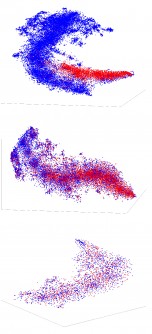
Without any measure of confidence, such false predictions of CNN could lead to catastrophic outcomes. But a new machine learning model developed by Michigan Technological University researchers can evaluate the uncertainty in its predictions as it classifies benign and malignant tumors, helping reduce this risk. The test images are divided into three subsets. Images with: 11 a) low uncertainty 11 b) medium uncertainty and 11 c) high uncertainty. A dimensionality reduction of the images reveals that the images with low uncertainty (11 a) show clear distinction between the benign and malignant images. These are the images with low uncertainty are easily separable in low dimensions and the machine learning model is confident in classifying these images. Whereas the images with high uncertainty are randomly distributed in three dimensions (11 c). For medium uncertainty images, the images are clustered without a clear distinction of classes. Thus explaining the uncertainty quantified by the machine learning model.

In their study, mechanical engineering graduate students Ponkrshnan Thiagarajan and Pushkar Kharinar and Susanta Ghosh, assistant professor of mechanical engineering and machine learning expert, outline their novel probabilistic machine learning model, which outperforms similar models.

“Any machine learning algorithm that has been developed so far will have some uncertainty in its prediction,” Thiagarajan said. “There is little way to quantify those uncertainties. Even if an algorithm tells us a person has cancer, we do not know the level of confidence in that prediction.”

From Experience Comes Confidence

In the medical context, not knowing how confident an algorithm is has made it difficult to rely on computer-generated predictions. The present model is an extension of the Bayesian neural network — a machine learning model that can evaluate an image and produce an output. The parameters for this model are treated as random variables that facilitate uncertainty quantification. 

The Michigan Tech model differentiates between negative and positive classes by analyzing the images, which at their most basic level are collections of pixels. In addition to this classification, the model can measure the uncertainty in its predictions.

In a medical laboratory, such a model promises time savings by classifying images faster than a lab tech. And, because the model can evaluate its level of certainty, it can refer the images to a human expert when it is less confident.

But why is a mechanical engineer creating algorithms for the medical community? Thiagarajan’s idea kindled when he started using machine learning to reduce the computational time needed for mechanical engineering problems. Whether a computation evaluates the deformation of building materials or determines whether someone has breast cancer, it’s important to know the uncertainty of that computation — the key ideas remain the same.

“Breast cancer is one of the cancers that have the highest mortality and highest incidence,” Thiagarajan said. “We believe that this is an exciting problem wherein better algorithms can make an impact on people’s lives directly.”

Next Steps

Now that their study has been published, the researchers will extend the model for multiclass classification of breast cancer. They will aim to detect cancer subtypes in addition to classifying benign and malignant tissues. And the model, though developed using breast cancer histopathology images, can also be extended for other medical diagnoses.

“Despite the promise of machine learning-based classification models, their predictions suffer from uncertainties due to the inherent randomness and the bias in the data and the scarcity of large datasets,” Ghosh said. “Our work attempts to address these issues and quantifies, uses, and explains the uncertainty.”

Ultimately, Thiagarajan, Khairnar, and Ghosh’s model itself — which can evaluate whether images have high or low measures of uncertainty and identify when images need the eyes of a medical expert — represents the next steps in the endeavor of machine learning.

Washington, Rosetta@home's deep learning supercomputer dreams up new protein structures

Researchers show that a neural network trained exclusively to predict protein shapes can also generate new ones

Just as convincing images of cats can be created using artificial intelligence, new proteins can now be made using similar tools. In a study, a team including researchers at the University of Washington in Seattle, Washington, Rensselaer Polytechnic Institute, and Harvard University describe the development of a neural network that “hallucinates” proteins with new, stable structures. A neural network "hallucinated" proteins that were synthesized to confirm their structure.

“The potential to hallucinate brand-new proteins that bind particular biomolecules or form desired enzymatic active sites is very exciting,” said Gaetano Montelione, a professor of chemistry and chemical biology at Rensselaer, where synthesized versions of “hallucinated” proteins invented by a neural network were analyzed. 

Proteins are string-like molecules found in every cell that spontaneously fold into intricate three-dimensional shapes. These folded shapes are key to nearly every process in biology, including cellular development, DNA repair, and metabolism. But the complexity of protein shapes makes them difficult to study. Biochemists often use supercomputers to predict how protein strings, or sequences, might fold. In recent years, artificial intelligence techniques like neural networks and deep learning have revolutionized the accuracy of this work.

“For this project, we made up completely random protein sequences and introduced mutations into them until our neural network predicted that they would fold into stable structures,” said co-lead author Ivan Anishchenko, a postdoctoral scholar in the Baker lab in the Institute for Protein Design at the University of Washington School of Medicine. “At no point did we guide the software toward a particular outcome — these new proteins are just what a computer dreams up.”

In the future, the team believes it should be possible to steer artificial intelligence so that it generates new proteins with useful features. “We’d like to use deep learning to design proteins with function, including protein-based drugs, enzymes, you name it,” said co-lead author Sam Pellock, a postdoctoral scholar in the Baker lab.

The research team generated 2,000 new protein sequences that were predicted to fold. Over 100 of these were produced in the laboratory and studied. Detailed analysis on three such proteins confirmed that the shapes predicted by the supercomputer were indeed realized in the lab.

“Our solution NMR studies, along with X-ray crystal structures determined by the University of Washington team, demonstrate the remarkable accuracy of protein designs created by the hallucination approach,” said co-author Theresa Ramelot, a senior research scientist in the Montelione lab within the Rensselaer Center for Biotechnology and Interdisciplinary Studies.  

Montelione notes, “The hallucination approach builds on earlier observations we made together with the Baker lab revealing that protein structure prediction with deep learning can be quite accurate even for a single protein sequence, without recourse to contact predictions usually obtained by analysis of many evolutionary-related protein sequences.”  

“This approach greatly simplifies protein design,” said senior author David Baker, recipient of the 2021 Breakthrough Prize in Life Sciences. “Before, to create a new protein with a particular shape, people first carefully studied related structures in nature to come up with a set of rules that were then applied in the design process. New sets of rules were needed for each new type of fold. Here, by using a deep-learning network that already captures general principles of protein structure, we eliminate the need for fold-specific rules and open up the possibility of focusing on just the functional parts of a protein directly.” 

“Exploring how to best use this strategy for specific applications is now an active area of research, and this is where I expect the next breakthroughs,” said Baker.