

SUPERCOMPUTING NEWS SUPERCOMPUTING NEWS
    • MEDIA KIT
    • MOST READ
    • RSS FEED
    • ACADEMIA
    • AEROSPACE
    • APPLICATIONS
    • ASTRONOMY
    • AUTOMOTIVE
    • BIG DATA
    • BIOLOGY
    • CHEMISTRY
    • CLIENTS
    • CLOUD
    • DEFENSE
    • DEVELOPER TOOLS
    • EARTH SCIENCES
    • ECONOMICS
    • ENGINEERING
    • ENTERTAINMENT
    • GAMING
    • GOVERNMENT
    • HEALTH
    • OIL & GAS
    • INDUSTRY
    • INTERCONNECTS
    • MANUFACTURING
    • MIDDLEWARE
    • MOVIES
    • NETWORKS
    • PHYSICS
    • PROCESSORS
    • RETAIL
    • SCIENCE
    • STORAGE
    • SYSTEMS
    • VISUALIZATION
    • AcyMailing subscription form

    • ADD YOUR VIDEOS
    • MANAGE VIDEOS
    • CONVERSATION INBOX
    • SOCIAL ADVERTISER
    • SOCIAL NETWORK VIDEOS
    • SURVEYS
    • GROUPS
    • PAGES
    • MARKETPLACE LISTINGS
    • APPLICATIONS BROWSER
    • PRIVACY CONFIRM REQUEST
    • PRIVACY CREATE REQUEST
    • LEADERBOARD
    • POINTS LISTING
      • BADGES
    • TRADE SHOWS
Sign In
Tyler O'Neal, Staff Editor ACADEMIA June 24, 2021, 8:00 am

COVID-19 origins still a mystery

Study finds virus was 'highly human adapted'

Scientists using supercomputer modeling to study SARS-CoV-2, the virus that caused the COVID-19 pandemic, have discovered the virus is most ideally adapted to infect human cells - rather than bat or pangolin cells, again raising questions of its origin.

Australian scientists have described how they used high-performance computer modeling of the form of the SARS-CoV-2 virus at the beginning of the pandemic to predict its ability to infect humans and a range of 12 domestic and exotic animals.

Their work aimed to help identify any intermediate animal vector that may have played a role in transmitting a bat virus to humans, and to understand any risk posed by the susceptibilities of companion animals such as cats and dogs, and commercial animals like cows, sheep, pigs, and horses. Professor Nikolai Petrovsky, Flinders University.

From Flinders University and La Trobe University, the scientists used genomic data from the 12 animal species to painstakingly build computer models of the key ACE2 protein receptors for each species. These models were then used to calculate the strength of binding of the SARS-CoV-2 spike protein to each species' ACE2 receptor.

Surprisingly, the results showed that SARS-CoV-2 bound to ACE2 on human cells more tightly than any of the tested animal species, including bats and pangolins. If one of the animal species tested was the origin, it would normally be expected to show the highest binding to the virus.

"Humans showed the strongest spike binding, consistent with the high susceptibility to the virus, but very surprised if an animal was the initial source of the infection in humans," says La Trobe University Professor David Winkler.

"The computer modeling found the virus's ability to bind to the bat ACE2 protein was poor relative to its ability to bind human cells. This argues against the virus being transmitted directly from bats to humans. Hence, if the virus has a natural source, it could only have come to humans via an intermediary species which has yet to be found," says Flinders affiliated Professor Nikolai Petrovsky.

The team's supercomputer modeling shows the SARS-CoV-2 virus also bound relatively strongly to ACE2 from pangolins, a rare exotic ant-eater found in some parts of South-East Asia with occasional instances of use as food or traditional medicines. Professor Winkler says pangolins showed the highest spike binding energy of all the animals the study looked at - significantly higher than bats, monkeys and snakes.

"While it was incorrectly suggested early in the pandemic by some scientists that they had found SARS-CoV-2 in pangolins, this was due to a misunderstanding and this claim was rapidly retracted as the pangolin coronavirus they described had less than 90% genetic similarity to SARS-CoV-2 and hence could not be its ancestor," Professor Petrovsky says.

However, this study and others have shown that the specific part of the pangolin coronavirus spike protein that binds ACE2 was almost identical to that of the SARS-CoV-2 spike protein.

"This sharing of the almost identical spike protein almost certainly explains why SARS-CoV-2 binds so well to pangolin ACE2. Pangolin and SARS-CoV-2 spike proteins may have evolved similarities through a process of convergent evolution, genetic recombination between viruses, or through genetic engineering, with no current way to distinguish between these possibilities," Professor Petrovsky says.

"Overall, putting aside the intriguing pangolin ACE2 results, our study showed that the COVID-19 virus was very well adapted to infect humans."

"We also deduced that some domesticated animals like cats, dogs, and cows are likely to be susceptible to SARS-CoV-2 infection too," Professor Winkler adds. Professor David Winkler, La Trobe University, Australia.

The extremely important and open question of how the virus came to infect humans has two main explanations currently. The virus may have passed to humans from bats through an intermediary animal yet to be found (zoonotic origin), but it cannot yet be excluded that it was released accidentally from a virology lab. A thorough scientific, evidence-based investigation is needed to determine which of these explanations is correct.

How and where the SARS-CoV-2 virus adapted to become such an effective human pathogen remains a mystery. The researchers conclude, adding that finding the origins of the disease will help protect humanity against future coronavirus pandemics.

Michigan physicist suggests a fix to the cosmological cornerstone Hubble constant

Tyler O'Neal, Staff Editor ACADEMIA May 21, 2021, 12:00 pm

More than 90 years ago, astronomer Edwin Hubble observed the first hint of the rate at which the universe expands, called the Hubble constant.

Almost immediately, astronomers began arguing about the actual value of this constant, and over time, realized that there was a discrepancy in this number between early universe observations and late universe observations.

Early in the universe's existence, the light moved through plasma--there were no stars yet--and from oscillations similar to sound waves created by this, scientists deduced that the Hubble constant was about 67. This means the universe expands about 67 kilometers per second faster every 3.26 million light-years. Pictured is the supernova of the type Ia star 1994D, in galaxy NGC 4526. The supernova is the bright spot in the lower left corner of the image.

But this observation differs when scientists look at the universe's later life after stars were born and galaxies formed. The gravity of these objects causes what's called gravitational lensing, which distorts light between a distant source and its observer.

Other phenomena in this late universe include extreme explosions and events related to the end of a star's life. Based on these later life observations, scientists calculated a different value, around 74. This discrepancy is called the Hubble tension.

Now, an international team including a University of Michigan physicist has analyzed a database of more than 1,000 supernovae explosions, supporting the idea that the Hubble constant might not actually be constant.

Instead, it may change based on the expansion of the universe, growing as the universe expands. This explanation likely requires new physics to explain the increasing rate of expansion, such as a modified version of Einstein's gravity.

The team's results are published in the Astrophysical Journal.

"The point is that there seems to be a tension between the larger values for late universe observations and lower values for early universe observation," said Enrico Rinaldi, a research fellow in the U-M Department of Physics. "The question we asked in this paper is: What if the Hubble constant is not constant? What if it actually changes?"

The researchers used a dataset of supernovae--spectacular explosions that mark the final stage of a star's life. When they shine, they emit a specific type of light. Specifically, the researchers were looking at Type Ia supernovae.

These types of supernovae stars were used to discover that the universe was expanding and accelerating, Rinaldi said, and they are known as "standard candles," like a series of lighthouses with the same lightbulb. If scientists know their luminosity, they can calculate their distance by observing their intensity in the sky.

Next, the astronomers use what's called the "redshift" to calculate how the universe's rate of expansion might have increased over time. Redshift is the name of the phenomenon that occurs when light stretches as the universe expands.

The essence of Hubble's original observation is that the further away from the observer, the more wavelength becomes lengthened--like you tacked a Slinky to a wall and walked away from it, holding one end in your hands. Redshift and distance are related.

In Rinaldi's team's study, each bin of stars has a fixed reference value of redshift. By comparing the redshift of each bin of stars, the researchers can extract the Hubble constant for each of the different bins.

In their analysis, the researchers separated these stars based on intervals of redshift. They placed the stars at one interval of distance in one "bin," than an equal number of stars at the next interval of distance in another bin, and so on. The closer the bin to Earth, the younger the stars are.

"If it's a constant, then it should not be different when we extract it from bins of different distances. But our main result is that it actually changes with distance," Rinaldi said. "The tension of the Hubble constant can be explained by some intrinsic dependence of this constant on the distance of the objects that you use."

Additionally, the researchers found that their analysis of the Hubble constant changing with redshift allows them to smoothly "connect" the value of constant from the early universe probes and the value from the late universe probes, Rinaldi said.

"The extracted parameters are still compatible with the standard cosmological understanding that we have," he said. "But this time they just shift a little bit as we change the distance, and this small shift is enough to explain why we have this tension."

The researchers say there are several possible explanations for this apparent change in the Hubble constant--one being the possibility of observational biases in the data sample. To help correct for potential biases, astronomers are using Hyper Suprime-Cam on the Subaru Telescope to observe fainter supernovae over a wide area. Data from this instrument will increase the sample of observed supernovae from remote regions and reduce the uncertainty in the data.

ALMA discovers the most ancient galaxy with spiral morphology

Tyler O'Neal, Staff Editor ACADEMIA May 20, 2021, 5:00 pm

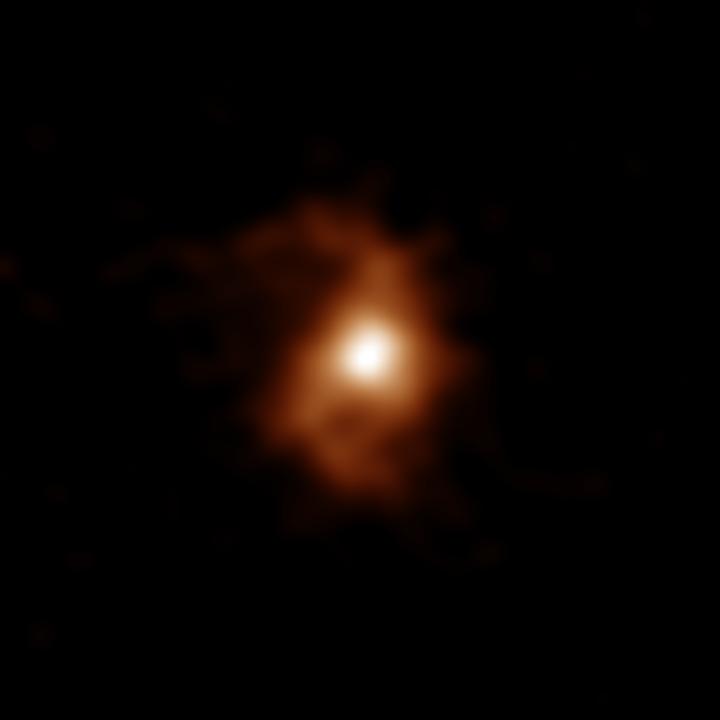
Analyzing data obtained with the Atacama Large Millimeter/submillimeter Array (ALMA), researchers found a galaxy with a spiral morphology by only 1.4 billion years after the Big Bang. This is the most ancient galaxy of its kind ever observed. The discovery of a galaxy with a spiral structure at such an early stage is an important clue to solving the classic questions of astronomy: "How and when did spiral galaxies form?"

"I was excited because I had never seen such clear evidence of a rotating disk, spiral structure, and centralized mass structure in a distant galaxy in any previous literature," says Takafumi Tsukui, a graduate student at SOKENDAI and the lead author of the research paper published in the journal Science. "The quality of the ALMA data was so good that I was able to see so much detail that I thought it was a nearby galaxy."

The Milky Way Galaxy, where we live, is a spiral galaxy. Spiral galaxies are fundamental objects in the Universe, accounting for as much as 70% of the total number of galaxies. However, other studies have shown that the proportion of spiral galaxies declines rapidly as we look back through the history of the Universe. So, when were the spiral galaxies formed? ALMA detected emissions from carbon ions in the galaxy. Spiral arms are visible on both sides of the compact, bright area in the center of the galaxy.  CREDIT ALMA (ESO/NAOJ/NRAO), T. Tsukui & S. Iguchi

Tsukui and his supervisor Satoru Iguchi, a professor at SOKENDAI and the National Astronomical Observatory of Japan, noticed a galaxy called BRI 1335-0417 in the ALMA Science Archive. The galaxy existed 12.4 billion years ago and contained a large amount of dust, which obscures the starlight. This makes it difficult to study this galaxy in detail with visible light. On the other hand, ALMA can detect radio emissions from carbon ions in the galaxy, which enables us to investigate what is going on in the galaxy.

The researchers found a spiral structure extending 15,000 light-years from the center of the galaxy. This is one-third of the size of the Milky Way Galaxy. The estimated total mass of the stars and interstellar matter in BRI 1335-0417 is roughly equal to that of the Milky Way.

"As BRI 1335-0417 is a very distant object, we might not be able to see the true edge of the galaxy in this observation," comments Tsukui. "For a galaxy that existed in the early Universe, BRI 1335-0417 was a giant."

Then the question becomes, how was this distinct spiral structure formed in only 1.4 billion years after the Big Bang? The researchers considered multiple possible causes and suggested that it could be due to an interaction with a small galaxy. BRI 1335-0417 is actively forming stars and the researchers found that the gas in the outer part of the galaxy is gravitationally unstable, which is conducive to star formation. This situation is likely to occur when a large amount of gas is supplied from outside, possibly due to collisions with smaller galaxies.

The fate of BRI 1335-0417 is also shrouded in mystery. Galaxies that contain large amounts of dust and actively produce stars in the ancient Universe are thought to be the ancestors of the giant elliptical galaxies in the present Universe. In that case, BRI 1335-0417 changes its shape from a disk galaxy to an elliptical one in the future. Or, contrary to the conventional view, the galaxy may remain a spiral galaxy for a long time. BRI 1335-0417 will play an important role in the study of galaxy shape evolution over the long history of the Universe.

"Our Solar System is located in one of the spiral arms of the Milky Way," explains Iguchi. "Tracing the roots of spiral structure will provide us with clues to the environment in which the Solar System was born. I hope that this research will further advance our understanding of the formation history of galaxies."

These research results are presented in T. Tsukui & S. Iguchi "Spiral morphology in an intensely star-forming disk galaxy more than 12 billion years ago" published online by the journal Science on Thursday, 20 May 2021.

  1. Tohoku researchers develop a numerical method that paves the way for simulating landslide tsunamis
  2. Australian scientists rewrite the genesis of mosquito-borne viruses

Page 100 of 123

  • 95
  • 96
  • 97
  • 98
  • 99
  • 100
  • 101
  • 102
  • 103
  • 104
POPULAR RIGHT NOW
  • Supercomputers uncover a new class of cosmic explosions hidden in plain sight
    Supercomputers uncover a new class of cosmic explosions hidden in plain sight
  • AI supercharges the hunt for stronger magnets: Iowa State researchers launch a new era of intelligent materials discovery
    AI supercharges the hunt for stronger magnets: Iowa State researchers launch a new era of intelligent materials discovery
  • IBM's Historic stock collapse raises questions for the future of enterprise supercomputing
    IBM's Historic stock collapse raises questions for the future of enterprise supercomputing
  • Could a novel dark matter theory simultaneously resolve multiple cosmic enigmas? Supercomputer simulations provide a compelling, albeit currently unverified, potential solution
    Could a novel dark matter theory simultaneously resolve multiple cosmic enigmas? Supercomputer simulations provide a compelling, albeit currently unverified, potential solution
  • Melting icebergs may be reshaping Earth’s greatest ocean current
    Melting icebergs may be reshaping Earth’s greatest ocean current
  • Supercomputers replace ‘bathtub’ flood maps with physics-based digital twins of Britain’s coastline
    Supercomputers replace ‘bathtub’ flood maps with physics-based digital twins of Britain’s coastline
  • Supercomputers push neural quantum simulation beyond previous limits
    Supercomputers push neural quantum simulation beyond previous limits
  • Intel’s AI supercomputing revival: Q2 financial surge signals new era for CPU-powered HPC infrastructure
    Intel’s AI supercomputing revival: Q2 financial surge signals new era for CPU-powered HPC infrastructure
  • AI infrastructure financing fears shake semiconductor sector
    AI infrastructure financing fears shake semiconductor sector
  • AWS supercomputing investment reaches historic scale as Amazon’s AI strategy powers record financial results
    AWS supercomputing investment reaches historic scale as Amazon’s AI strategy powers record financial results
THIS YEAR'S MOST READ
  • Wall Street wants to trade supercomputing power like oil
    Wall Street wants to trade supercomputing power like oil
  • Cosmic ambition at scale: UK’s supercomputer unlocks a 2.5 petabytes universe
    Cosmic ambition at scale: UK’s supercomputer unlocks a 2.5 petabytes universe
  • Hidden order, revealed at scale: Supercomputing, electron ptychography uncover the inner workings of relaxor ferroelectrics
    Hidden order, revealed at scale: Supercomputing, electron ptychography uncover the inner workings of relaxor ferroelectrics
  • Beamforming the future: BeammWave's 6G push signals the rise of orbital-terrestrial wireless networks
    Joakim Axmon
    Joakim Axmon
  • Intel's Q1 results signal supercomputing surge driving Xeon momentum
    Intel's Q1 results signal supercomputing surge driving Xeon momentum
  • When stars fall apart: Supercomputing reveals the hidden physics of black holes
    When stars fall apart: Supercomputing reveals the hidden physics of black holes
  • Multi-layer simulations reveal the hidden supply chain of solar prominences
    Multi-layer simulations reveal the hidden supply chain of solar prominences
  • Japanese scientists decode dolphin speed with supercomputing: Turbulence, vortices, and the hidden physics of propulsion
    Japanese scientists decode dolphin speed with supercomputing: Turbulence, vortices, and the hidden physics of propulsion
  • Cosmic feedback at scale: Supercomputing reveals how quasars regulate the early Universe
    Cosmic feedback at scale: Supercomputing reveals how quasars regulate the early Universe
  • Modeling life at the microscopic scale: A computational breakthrough in oxygen transport
    Modeling life at the microscopic scale: A computational breakthrough in oxygen transport
MOST READ OF ALL-TIME
  • Largest Computational Biology Simulation Mimics The Ribosome
    Details
    112108
    The amino acid (green) slithers into the chemical reaction center, moving through an evolutionarily ancient corridor of the ribosome (purple). The amino acid is delivered to the reaction core by the transfer RNA molecule (yellow).
    The amino acid (green) slithers into the chemical reaction center, moving through an evolutionarily ancient corridor of the ribosome (purple). The amino acid is delivered to the reaction core by the transfer RNA molecule (yellow).
  • Silicon 'neurons' may add a new dimension to chips
    Details
    80994
    Silicon 'neurons' may add a new dimension to chips
  • Linux Networx Accelerators Expected to Drive up to 4x Price/Performance
    Details
    75538
  • Complex Concepts That Really Add Up
    Details
    73637
    Complex Concepts That Really Add Up
  • Blue Sky Studios Donates Animation SuperComputer to Wesleyan
    Details
    68141
    Each rack holds 52 Angstrom Microsystem-brand “blades,” with a memory footprint of 12 or 24 gigabytes each. (Photos by Olivia Bartlett Drake)
    Each rack holds 52 Angstrom Microsystem-brand “blades,” with a memory footprint of 12 or 24 gigabytes each. (Photos by Olivia Bartlett Drake)
  • Humanities, HPC connect at NERSC
    Details
    57947
  • TeraGrid ’09 'Call for Participation'
    Details
    54952
  • Turbulence responsible for black holes' balancing act
    Details
    52311
  • Cray Wins $52 Million SuperComputer Contract
    Details
    50140
  • SDSC Researchers Accurately Predict Protein Docking
    Details
    46079
  • FRONTPAGE
  • LATEST
  • POPULAR
  • REGISTER
  • SOCIAL
  • VIDEO
  • SUBSCRIPTION
  • RSS
  • GUIDELINES
  • PRIVACY
  • TOS
  • ABOUT
  • +1 (816) 799-4488
  • editorial@supercomputingonline.com
© 2001 - 2026 SuperComputingOnline.com, LLC. All rights reserved. This material may not be published, broadcast, rewritten or redistributed without permission.
Sign In
  • FRONT PAGE
  • LATEST
    • MEDIA KIT
    • MOST READ
    • RSS FEED
    • ACADEMIA
    • AEROSPACE
    • APPLICATIONS
    • ASTRONOMY
    • AUTOMOTIVE
    • BIG DATA
    • BIOLOGY
    • CHEMISTRY
    • CLIENTS
    • CLOUD
    • DEFENSE
    • DEVELOPER TOOLS
    • EARTH SCIENCES
    • ECONOMICS
    • ENGINEERING
    • ENTERTAINMENT
    • HEALTH
    • INDUSTRY
    • INTERCONNECTS
    • GAMING
    • GOVERNMENT
    • MANUFACTURING
    • MIDDLEWARE
    • MOVIES
    • NETWORKS
    • OIL & GAS
    • PHYSICS
    • PROCESSORS
    • RETAIL
    • SCIENCE
    • STORAGE
    • SYSTEMS
    • VISUALIZATION
  • VIDEOS
    • ADD YOUR VIDEOS
    • MANAGE VIDEOS
  • COMMUNITY
    • TRADE SHOWS
    • SOCIAL NETWORK VIDEOS
    • SURVEYS
    • APPLICATIONS BROWSER
    • CONVERSATION INBOX
    • SOCIAL ADVERTISER
    • GROUPS
    • MARKETPLACE LISTINGS
    • PAGES
    • LEADERBOARD
    • POINTS LISTING
      • BADGES
    • PRIVACY CONFIRM REQUEST
    • PRIVACY CREATE REQUEST

Hey there! We noticed you’re using an ad blocker.