Australian scientists rewrite the genesis of mosquito-borne viruses

Better designed vaccines for insect-spread viruses like dengue and Zika are likely after researchers discovered models of immature flavivirus particles were originally misinterpreted.

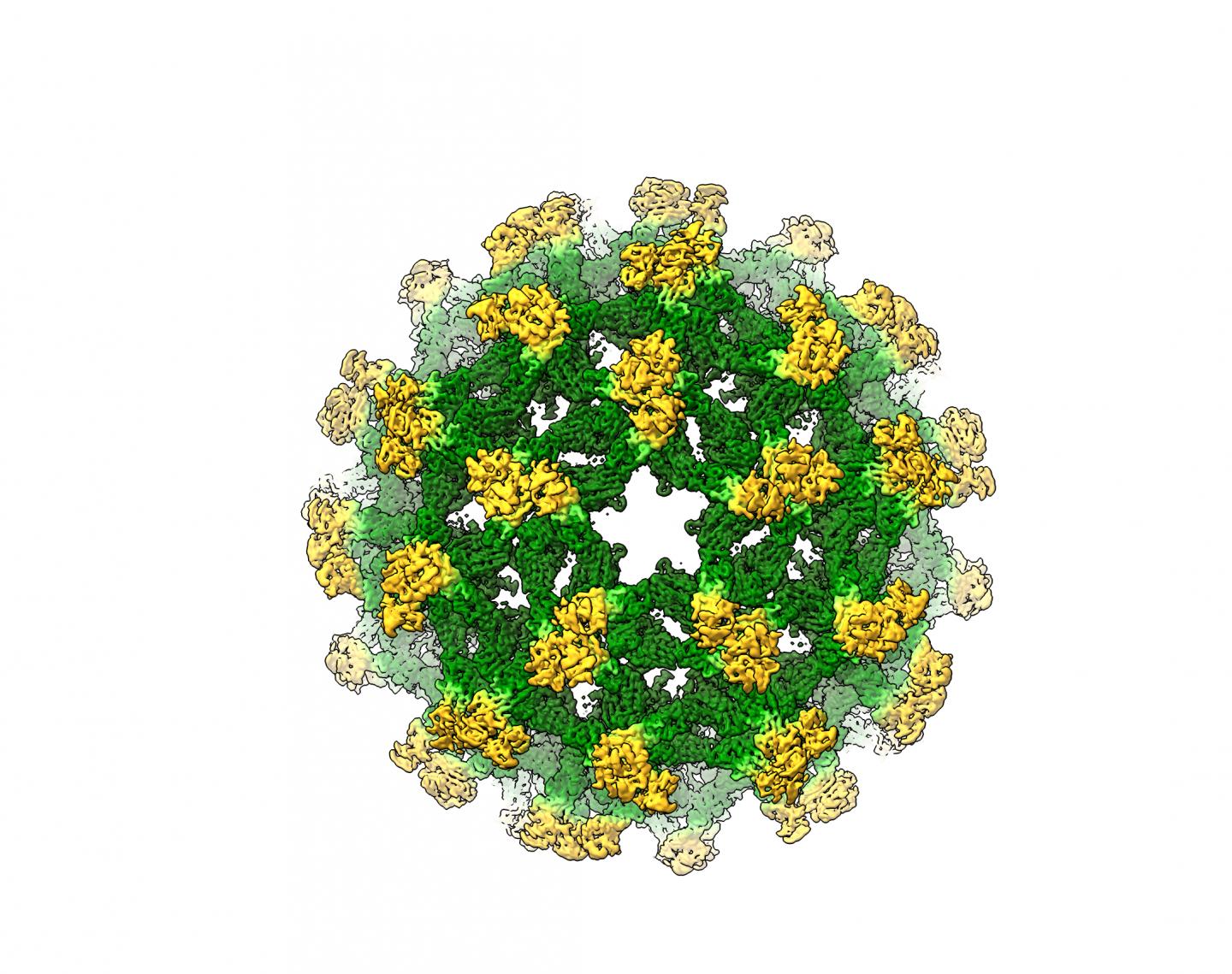
Researchers from The University of Queensland and Monash University have now determined the first complete 3D molecular structure of the immature flavivirus, revealing an unexpected organization.

UQ researcher Associate Professor Daniel Watterson said the team was studying the insect-specific Binjari virus when they made the discovery.

"We were using Australia's safe-to-handle Binjari virus, which we combine with more dangerous viral genes to make safer and more effective vaccines," Dr. Watterson said. Cryo-electron microscopy reconstruction of Binjari virus. The projecting spikes are a typical feature of immature flaviviruses such as dengue virus but reveal an unexpected organization.  CREDIT Associate Professor Fasseli Coulibaly

"But when analyzing Binjari we could clearly see that the molecular structure we've all been working from since 2008 wasn't quite correct.

"Imagine trying to build a house when your blueprints are wrong - that's exactly what it's like when you're attempting to build effective vaccines and treatments and your molecular 'map' is not quite right."

The team used a technique known as cryogenic electron microscopy to image the virus, generating high-resolution data from Monash's Ramaciotti Centre for Cryo-Electron Microscopy facility.

With thousands of collected two-dimensional images of the virus, the researchers then combined them using a high-performance computing platform called 'MASSIVE' to construct a high-resolution 3D structure.

Monash's Associate Professor Fasséli Coulibaly, a co-leader of the study, said the revelation could lead to new and better vaccines for flaviviruses, which have a huge disease burden globally.

"Flaviviruses are globally distributed and the dengue virus alone infects around 400 million people annually," Dr. Coulibaly said.

"They cause a spectrum of potentially severe diseases including hepatitis, vascular shock syndrome, encephalitis, acute flaccid paralysis, congenital abnormalities, and fetal death.

"This structure defines the exact wiring of the immature virus before it becomes infectious, and we now have a better understanding of the levers and pulleys involved in viral assembly.

"This is a continuation of fundamental research by us and others and, without this hard-won basic knowledge, we wouldn't have the solid foundation needed to design tomorrow's treatments."

Peking University Professor Zhang Pingwen honored as SIAM Fellow

On March 31, Society for Industrial and Applied Mathematics (SIAM) announced the 2020 Class of SIAM Fellows. These distinguished members were nominated for their exemplary research as well as outstanding service to the community. Through their contributions, SIAM Fellows help advance the fields of applied mathematics and computational science. Professor Zhang Pingwen from the School of Mathematical Sciences, Peking University is inducted for his contributions in complex fluids modeling, multiscale analysis, and adaptive grid supercomputation. Professor Zhang is the only member to be elected this year among all faculty members from universities on the Chinese mainland.

Zhang Pingwen, vice president of Peking University and professor of the School of Mathematical Sciences, has published more than 100 papers in journals like JAMS, SINUM and PRL. His research interests include modeling and simulation of soft matter (complex fluids), applied analysis and numerical analysis, moving mesh methods and applications. Professor Zhang Pingwen from Peking University{module INSIDE STORY}

SIAM was incorporated in 1952 as a nonprofit organization to convey useful mathematical knowledge to other professionals who could implement mathematical theory for practical, industrial, or scientific use.

Swiss university deploys virtual screening for active substances against the coronavirus

The University of Basel is part of the global search for a drug to fight the rampant coronavirus. Researchers in the Computational Pharmacy group have so far virtually tested almost 700 million substances, targeting a specific site on the virus – with the aim of inhibiting its multiplication. Due to the current emergency, the first results of the tests will be made available to other research groups immediately.

Over the past few weeks, the research group in the Department of Pharmaceutical Sciences, led by Professor Markus Lill, has been working with supercomputer-aided methods to identify possible new drugs to combat the current coronavirus outbreak and similar epidemics in the future. In the process, the researchers have tested, albeit virtually, more than 680 substances on one of the virus’s key proteins: its central protease. Researchers have tested more than 680 million substances on the computer to virtually test one of the virus’ important proteins, the central protease. {module INSIDE STORY}

This “virtual screening” has already identified several interesting substances that have the potential to inhibit the virus’s critical enzyme – and thus its further multiplication. “Even if the complete development of a drug to fight this particular coronavirus is likely to exceed the duration of the current epidemic, it is important to develop drugs for future coronaviruses. This will make it possible to nip health crises like this one in the bud in the future,” says Lill.

Test results made public

In light of the current crisis, the group took an unusual decision by immediately making the test results publicly available in the form of an open-source preprint. The publication was consulted more than 3,000 times during the first 48 hours alone.

The Basel researchers hope that a larger number of research groups worldwide will test their proposals on the virus and initiate further trials. Normally, when it comes to drug design, the molecules of interest would be experimentally tested with other groups before the results were patented and published. The main focus of other ongoing coronavirus trials is currently on the usability of existing antiviral drugs or the realignment of other drugs.