University of Southampton study analyzes potential global spread of new coronavirus

Experts in population mapping at the University of Southampton have identified cities and provinces within mainland China, and cities and countries worldwide, which are at high-risk from the spread of the 2019 Novel Coronavirus (2019-nCoV).

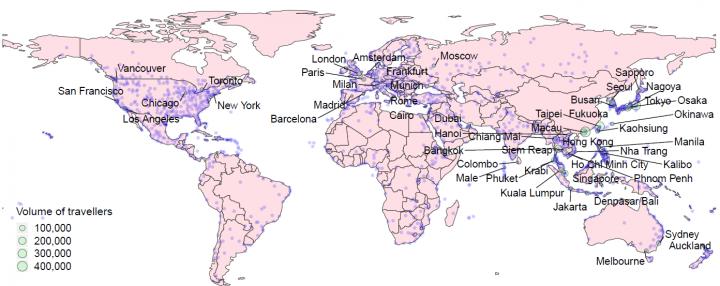
A report by the University's WorldPop team has found Bangkok (Thailand) is currently the city most at risk from a global spread of the virus - based on the number of air travelers predicted to arrive there from the worst affected cities in mainland China. Hong Kong (China) is second on the list, followed by Taipei (Taiwan, the Republic of China). Singapore (6), Sydney (12), New York (16) and London (19) are among 30 other major international cities ranked in the research.

The most 'at-risk' countries or regions worldwide are Thailand (1), Japan (2) and Hong Kong (3). USA is placed 6th on the list, Singapore 8th, Australia 10th, and the UK 17th.

Within mainland China, the cities of Beijing, Guangzhou, Shanghai, and Chongqing are all identified as high-risk by the researchers, along with the Chinese provinces of Guangdong, Zhejiang, Sichuan, and Henan. Global cities receiving airline travellers from 18 high-risk cities in mainland China over three month period.{module INSIDE STORY}

Full data can be found in the report on the WorldPop website at https://www.worldpop.org/events/china.

Andrew Tatem, Director of WorldPop and professor within Geography and Environmental Science at the University of Southampton, says: "It's vital that we understand patterns of population movement, both within China and globally, in order to assess how this new virus might spread - domestically and internationally. By mapping these trends and identifying high-risk areas, we can help inform public health interventions, such as screenings and healthcare preparedness."

The team at WorldPop used anonymized mobile phone and IP address data (2013-15)1, along with international air travel data (2018)2 to understand typical patterns of movement of people within China, and worldwide, during the annual 40-day Lunar New Year celebrations (including the seven-day public holiday from 24 to 30 January).

From this, they identified 18 Chinese cities (including Wuhan) at high-risk from the new coronavirus and established the volume of air passengers likely to be traveling from these cities to global destinations (over a three month period). The team was then able to rank the top 30 most at-risk countries and cities around the world.

The researchers acknowledge that their analysis is based on 'non-outbreak' travel patterns, but highlight that a high proportion of people traveled with symptoms at an early stage of the outbreak, before restrictions were put in place. In fact, travel cordons are likely to have only coincided with the latter stages of peak population numbers leaving Wuhan for the holiday period. According to Wuhan authorities, it is likely more than five million people had already left the city.

Lead report author Dr. Shengjie Lai of the University of Southampton comments: "The spread of the new coronavirus is a fast-moving situation and we are closely monitoring the epidemic in order to provide further up-to-date analysis on the likely spread, including the effectiveness of the transport lockdown in Chinese cities and transmission by people returning from the Lunar New Year holiday, which has been extended to 2 February."

WorldPop at the University of Southampton conducted this research in collaboration with the University of Toronto, St Michael's Hospital Toronto, disease surveillance organization Bluedot in Toronto and the China Centre for Disease Control and Prevention.

New cancer center established at Johns Hopkins University

With $5 million awards, The Mark Foundation for Cancer Research partners with the multi-investigator team at Johns Hopkins University developing next-generation genomics and imaging platforms for cancer immunotherapy

The Mark Foundation for Cancer Research announced today the creation of The Mark Foundation Center for Advanced Genomics and Imaging at the Johns Hopkins University (JHU), which will receive initial funding of $5 million over 2 years.

Bringing together the tools of astronomy image analysis, pathology, computer science, cancer genomics, and immunogenomics to solve problems in oncology, the new center will find innovative solutions that can expand the number of cancer patients who benefit from immunotherapy. 

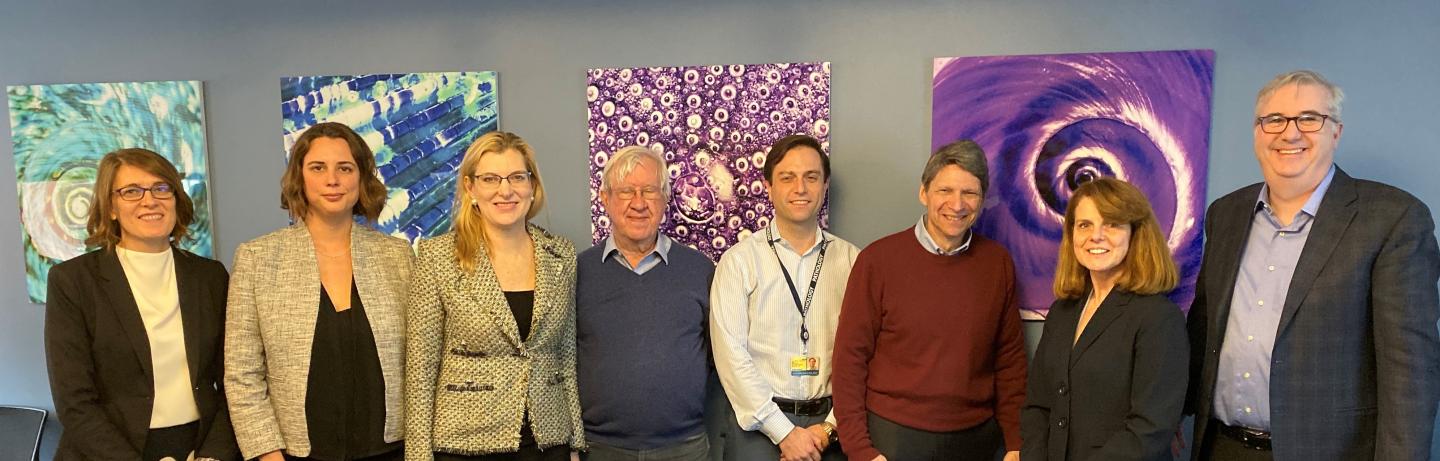
Scientists from The Mark Foundation will collaborate with JHU researchers as part of a joint steering committee that will review scientific progress and facilitate the success of the center. CAPTION The Mark Foundation and Johns Hopkins University scientists  CREDIT Clinton Petty{module INSIDE STORY}

"It takes a village of diverse disciplines and areas of expertise to confront the vast challenges presented by cancer, and the work of this center is the perfect embodiment of this reality," said Michele Cleary, Ph.D., CEO of The Mark Foundation. "One focus of the center is especially imaginative, as it involves developing a new platform that takes a model used in astronomical nighttime sky analysis and turns it into one that can be used to analyze cancer tumors."

The Mark Foundation Center for Advanced Genomics and Imaging will be led by Drew Pardoll, MD, Ph.D., Director of the Bloomberg-Kimmel Institute for Cancer Immunotherapy and co-director of the Cancer Immunology Program at the Sidney Kimmel Comprehensive Cancer Center at Johns Hopkins, together with Janis Taube, MD, MSc, Professor of Dermatology and Pathology and Director of the Division of Dermatopathology and co-Director of the Tumor Microenvironment Laboratory of the Bloomberg-Kimmel Institute for Cancer Immunotherapy.

Northern Arizona University researcher looks for clues in the mystery of the Grand Canyon's water supply

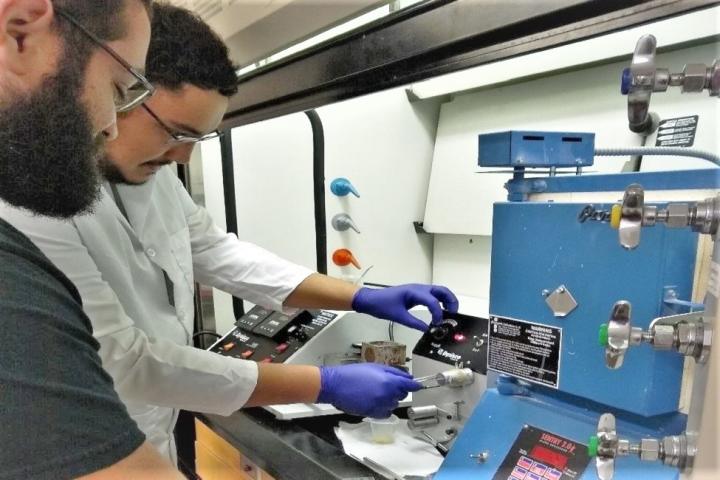
Northern Arizona University research technician Natalie Jones developed a new model that can give land and water managers more information so they can better protect the water system.

Where does the water in the Grand Canyon come from?

We all know the Colorado River, but it's not the most mysterious water resource in the Grand Canyon; we know it moves through at a rate of about 12,000 cubic feet per second as it travels from the Rocky Mountains to the Gulf of California. But Roaring Springs, Grand Canyon National Park's only water source, is a bigger mystery--one NAU researcher Natalie Jones hopes to have a hand in solving.

Jones, an NAU research technician and graduate student contracted by the Grand Canyon Physical Sciences program, asked where the water in Roaring Springs comes from in research she did with School of Earth and Sustainability professor Abe Springer. It's building on previous research for both of them. They published their findings in November in Hydrogeology Journal, with Jones as the lead author and in collaboration with researchers at the Grand Canyon National Park, Nez Perce-Clearwater National Forests and the Kentucky Geological Survey at the University of Kentucky. Northern Arizona University research technician Natalie Jones studies water in the Grand Canyon.{module INSIDE STORY}

So, where does the water come from? It's complicated. But this research helps to pinpoint the region feeding the springs and, importantly, the risk of contamination in that region. It takes researchers one step closer to understanding how to protect this vital resource.

Jones and her co-authors set out to investigate how to create a better way to model karst-aquifer vulnerability in the Grand Canyon. Having a model that more accurately predicts different variables in the geology and water behavior in the park will benefit future researchers and water managers as they consider individual recharge areas and how best to protect them.

What is karst and why does it matter?

Did you know water can sometimes dissolve rock? Karst is a type of rocky feature such as a cave or sinkhole that forms in dissolvable rocks. Karst creates pathways that can carry water quickly from the land surface directly to underground aquifers. Karst landscapes cover about 16 percent of the Earth's land surface, including most of the Colorado Plateau around Flagstaff and the Grand Canyon. It's an important geologic feature that most of us have never heard of.

Karst aquifers, which have a pipe-like flow network of caves and conduits, directly supply up to 25 percent of the world population with water for drinking, agriculture, and other needs and they are uniquely vulnerable to contamination. Two such aquifers, the Redwall and Coconino aquifers, supply water to Roaring Springs and many other Grand Canyon springs. The two aquifers are stacked on top of each other. While there are many types of vulnerability models, most ignore the complication of layered karst aquifer systems; this results in oversimplified, less accurate modeling.

"Vulnerability models identify regions of high, moderate and low vulnerability on the land surface, which directly relates to how quickly and efficiently water or contaminants would sink and enter the aquifer," Jones said. "However, existing well-regarded vulnerability modeling methods for karst aquifers did not produce realistic results for our region."

How does the modeling work?

Jones modified the well-known concentration-overburden-precipitation method (COP). This method is effective, the researchers say, but it oversimplifies some details, which limits the model. She presented two new models that better address the factors that help scientists predict vulnerability.

The modifications more accurately account for recharge patterns in the Grand Canyon region, which has many karst features and a deep, complex aquifer system. Jones and the research team automated a process to identify sinkholes from high-resolution topography data, converted those data into sinkhole densities, and combined those data with a map of fault locations in the region. Jones then incorporated these features into the existing model using a geographic information system to produce the final vulnerability model.

It meant significant data processing, but the result was a model that produced greater resolution of vulnerability regions and fit well with previous groundwater flow path analyses. In addition to creating a better supercomputer model on which future research can build, Jones found similar patterns in vulnerability between the two karst aquifers in the Grand Canyon region, despite them being separated by more than 600 meters of impermeable rock.

Jones also learned that about a fifth of the Kaibab Plateau has a high vulnerability to contamination of the Redwall-Muav aquifer, which is about 1,000 meters deep, and almost half of the plateau surface (45.6 percent) has high to very high vulnerability for the Coconino aquifer, which is much closer to the surface.

What does this mean for me?

If you've stopped to fill your water bottle while you're hiking the Grand Canyon or admiring the views on the canyon rim, this matters to you. Since the Roaring Springs is the only source of water in the park, its quality has significant value. This research provides better information to water managers to protect the Grand Canyon's water resources, including creeks on the north side, which researchers think are recharged by the Kaibab Plateau.

"These springs and streams support diverse ecosystems, and many hikers and wildlife rely on them for survival," Jones said. "This research helps narrow down where these water sources are coming from and could help us better protect them in the future."