

Northern Arizona University research technician Natalie Jones developed a new model that can give land and water managers more information so they can better protect the water system.
Where does the water in the Grand Canyon come from?
We all know the Colorado River, but it's not the most mysterious water resource in the Grand Canyon; we know it moves through at a rate of about 12,000 cubic feet per second as it travels from the Rocky Mountains to the Gulf of California. But Roaring Springs, Grand Canyon National Park's only water source, is a bigger mystery--one NAU researcher Natalie Jones hopes to have a hand in solving.
Jones, an NAU research technician and graduate student contracted by the Grand Canyon Physical Sciences program, asked where the water in Roaring Springs comes from in research she did with School of Earth and Sustainability professor Abe Springer. It's building on previous research for both of them. They published their findings in November in Hydrogeology Journal, with Jones as the lead author and in collaboration with researchers at the Grand Canyon National Park, Nez Perce-Clearwater National Forests and the Kentucky Geological Survey at the University of Kentucky. 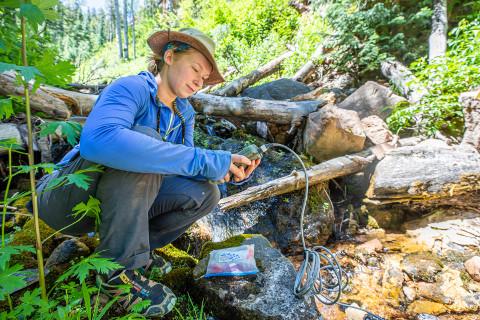 {module INSIDE STORY}
So, where does the water come from? It's complicated. But this research helps to pinpoint the region feeding the springs and, importantly, the risk of contamination in that region. It takes researchers one step closer to understanding how to protect this vital resource.
Jones and her co-authors set out to investigate how to create a better way to model karst-aquifer vulnerability in the Grand Canyon. Having a model that more accurately predicts different variables in the geology and water behavior in the park will benefit future researchers and water managers as they consider individual recharge areas and how best to protect them.
What is karst and why does it matter?
Did you know water can sometimes dissolve rock? Karst is a type of rocky feature such as a cave or sinkhole that forms in dissolvable rocks. Karst creates pathways that can carry water quickly from the land surface directly to underground aquifers. Karst landscapes cover about 16 percent of the Earth's land surface, including most of the Colorado Plateau around Flagstaff and the Grand Canyon. It's an important geologic feature that most of us have never heard of.
Karst aquifers, which have a pipe-like flow network of caves and conduits, directly supply up to 25 percent of the world population with water for drinking, agriculture, and other needs and they are uniquely vulnerable to contamination. Two such aquifers, the Redwall and Coconino aquifers, supply water to Roaring Springs and many other Grand Canyon springs. The two aquifers are stacked on top of each other. While there are many types of vulnerability models, most ignore the complication of layered karst aquifer systems; this results in oversimplified, less accurate modeling.
"Vulnerability models identify regions of high, moderate and low vulnerability on the land surface, which directly relates to how quickly and efficiently water or contaminants would sink and enter the aquifer," Jones said. "However, existing well-regarded vulnerability modeling methods for karst aquifers did not produce realistic results for our region."
How does the modeling work?
Jones modified the well-known concentration-overburden-precipitation method (COP). This method is effective, the researchers say, but it oversimplifies some details, which limits the model. She presented two new models that better address the factors that help scientists predict vulnerability.
The modifications more accurately account for recharge patterns in the Grand Canyon region, which has many karst features and a deep, complex aquifer system. Jones and the research team automated a process to identify sinkholes from high-resolution topography data, converted those data into sinkhole densities, and combined those data with a map of fault locations in the region. Jones then incorporated these features into the existing model using a geographic information system to produce the final vulnerability model.
It meant significant data processing, but the result was a model that produced greater resolution of vulnerability regions and fit well with previous groundwater flow path analyses. In addition to creating a better supercomputer model on which future research can build, Jones found similar patterns in vulnerability between the two karst aquifers in the Grand Canyon region, despite them being separated by more than 600 meters of impermeable rock.
Jones also learned that about a fifth of the Kaibab Plateau has a high vulnerability to contamination of the Redwall-Muav aquifer, which is about 1,000 meters deep, and almost half of the plateau surface (45.6 percent) has high to very high vulnerability for the Coconino aquifer, which is much closer to the surface.
What does this mean for me?
If you've stopped to fill your water bottle while you're hiking the Grand Canyon or admiring the views on the canyon rim, this matters to you. Since the Roaring Springs is the only source of water in the park, its quality has significant value. This research provides better information to water managers to protect the Grand Canyon's water resources, including creeks on the north side, which researchers think are recharged by the Kaibab Plateau.
"These springs and streams support diverse ecosystems, and many hikers and wildlife rely on them for survival," Jones said. "This research helps narrow down where these water sources are coming from and could help us better protect them in the future."
 {module INSIDE STORY}